64| Part 2 of –30 Shin Shin-To : Bakumatsu sword (新々刀)

This Chapter is a detailed Chapter of the 30|Bakumatsu Period, Shin Shin-to.  Please read Chapter 30 before reading this chapter.
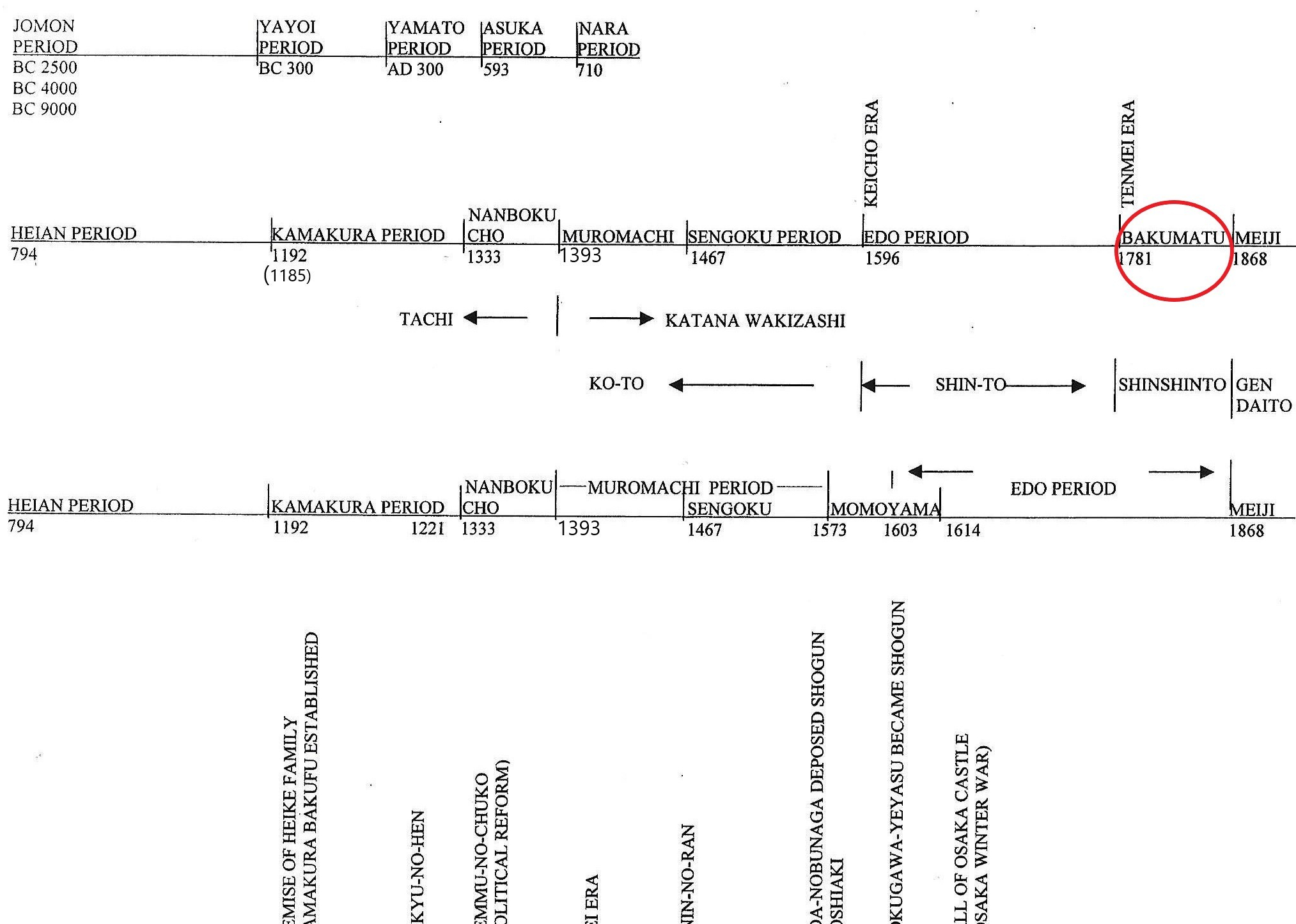
0-timeline - size 24 Bakumatsu

                  The circle Above indicates the time we discuss in this chapter.

Swords made between the Tennmei era (天明 1781) and the end of the Keio era (慶應) are called shin shin-to.  Please refer to the timeline above.  This period was when Japan was moving toward the Meiji Restoration, known as the Bakumatsu era.  During this time, sword-making became active again.  Below are the well-known swordsmiths from the main areas.

Musashi no Kuni  (武蔵の国: Tokyo today)                                                       

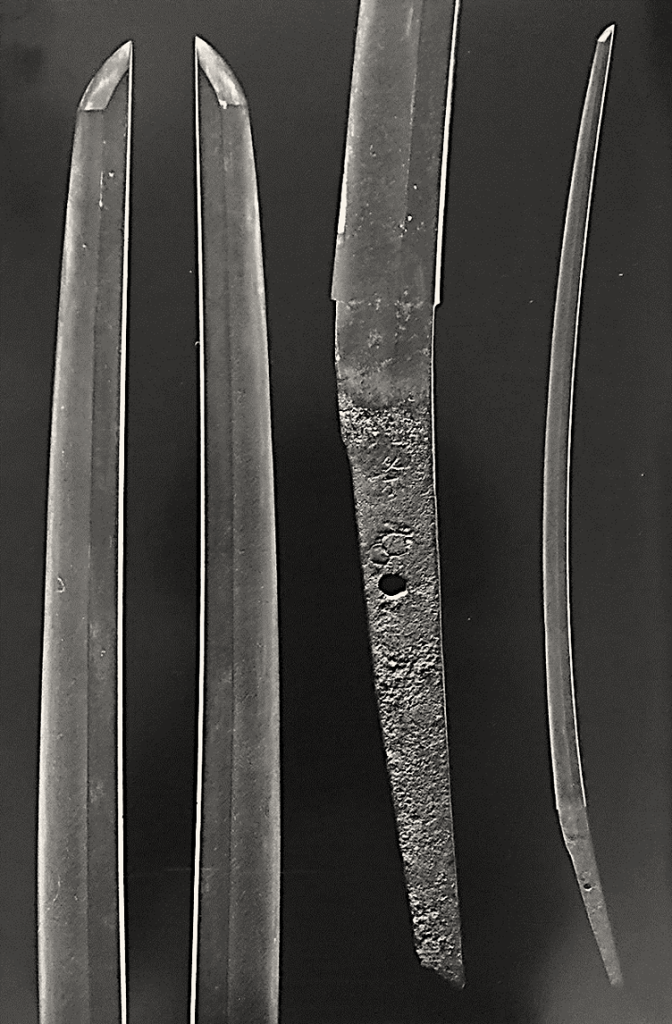
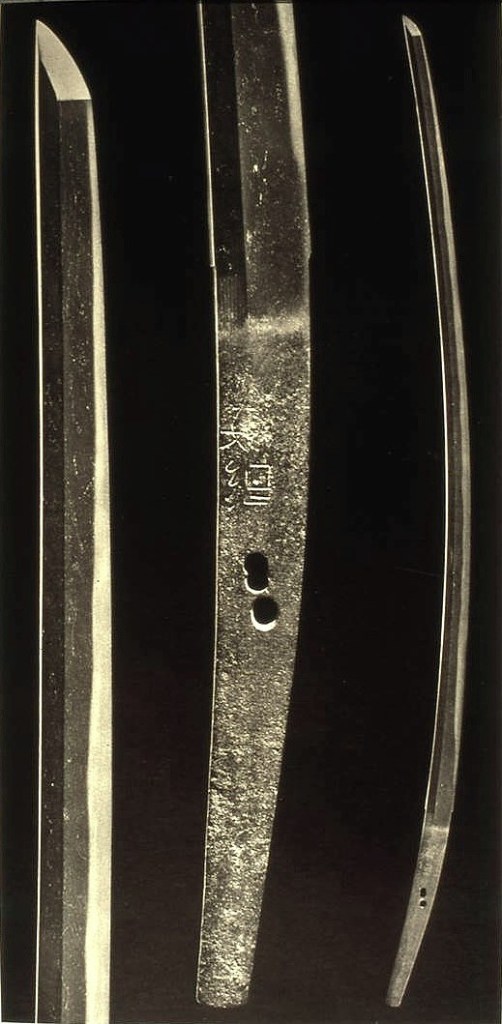
Suishinshi Masahide (水心子正秀) ——— When Suishinshi Masahide made Yamashiro-den style swords, their shapes resembled those of ko-to period swords; funbari, an elegant shape; chu-suguha (medium straight); komaru-boshi, with fine wood grain. When he forged in the Bizen style, he made a Koshi-zori shape, similar to a ko-to made by Bizen Osafune.  Nioi with ko-choji, and katai-ha (refer to  30| Bakumatsu Period Sword 新々刀).  In my old sword textbook, I noted that  I saw Suishinshi in November 1970 and October 1971.

Taikei Naotane (大慶直胤) ————————–Although Taikei Naotane was part of the Suishinshi group, he was one of the top swordsmiths.  He had an exceptional ability to forge a wide range of sword styles beautifully.  When he made a Bizen-den style, it resembled Nagamitsu from the Ko-to era, with nioi.  Also, he did sakasa-choji as Katayama Ichimonji had done.  Katai-ha appearsThe notes in my old textbook indicate I saw Naotane in August 1971.

Minamoto no Kiyomaro (源清麿) ————————– Kiyomaro wanted to join the Meiji Restoration movement as a samurai; however, his guardian recognized Kiyomaro’s talent as a master swordsmith and helped him become one.  It is said that because Kiyomaro had a drinking problem, he was not very eager to make swords.  At age 42, he committed seppukuKiyomaro, who lived in Yotsuya (now part of Shinjuku, Tokyo), was called Yotsuya Masamune because he was as good as Masamune.  His swords featured wide-width, shallow sori, stretched kissaki, and fukura-kereru.  The boshi is komaru-boshi.  Fine wood grain ji-gane.

Settsu no Kuni   ( 摂津の国:  Osaka today)

Gassan Sadakazu (月山貞一) ———- Gassan excelled in the Soshu-den and Bizen-den styles, but he was capable of making in any style.  He was as much a genius as Taikei Naotane.  You must pay close attention to notice a sword made by Gassan from genuine ko-to.  He also had remarkable carving skills.  His hirazukuri-kowakizashi, forged in the Soshu-den style, looks just like a Masamune or a Yukimitsu.  He forged in the Yamashiro-den style, with Takenoko-zori, hoso-suguha, or chu-suguha in nie.  Additionally, he forged the Yamato-den style with masame-hada.


49| Part 2 of — 15 The Revival of Yamato Den (大和伝復活)

This chapter is a detailed part of Chapter 15, Revival of Yamato Den.  Please read Chapter 15 before reading this section.

0-timeline - size 24 Late Kamakura                          The red circle above indicates the time we discuss in this section

At the end of the Kamakura period, powerful temples expanded their territories in the Yamato region.  Refer to the map below for the location of the Yamato region.  Several prominent temples, especially those with large territories, held political and military power to control the area at the end of the Kamakura period.  These large territories were called shoen (荘園).  They employed many monk soldiers known as so-hei.  The demand for swords increased because of the rising number of Sohei (僧兵).  This increased demand revived the Yamatoden.  

Some prominent temples had their own swordsmiths within their territories. Todaiji Temple (東大寺) supported the Tegai (手掻) sword group.  The Senjuin (千手院) sword group lived near Senju-do (千手堂), where Senju Kannon (千手観音) is enshrined.  The Taima sword group originated from the Taima-ji Temple (当麻寺).  The Shikkake group (尻懸) and the Hosho group (保昌) were also part of the Yamato-den sword groups.  These five groups are known as Yamato Goha (the Yamato five groups).

51 Japan map Yamato

General Characteristic of Yamato Den

The Yamato-den (大和伝) sword always shows masame (柾目: straight grain-like pattern) somewhere on the ji-hada, ji-gane, or hamon.  Refer to Chapter 15, Revival of Yamato Den.   Masame is sometimes mixed with mokume (burl-like pattern) or itame (wood-grain-like pattern).  Either way, Yamato-den always shows masame somewhere.  Some swords display masame across the entire blade, while others show less.  Because of the masame, the hamon often shows sunagashi (a brush stroke-like pattern) or a double line called niju-ha.

Taima (or Taema) group (当麻)

  • Shape ———————– Middle Kamakura period style and Ikubi-kissaki style    
  • Hamon ———–Mainly medium Suguha.  Double HamonSuguha mixed with Choji.  Often shows Inazuma and Kinsuji, especially Inazuma appear under the Yokote line.
  • Boshi ————————- Often Yakizume.  Refer Yakizume on 15| The Revival of Yamato Den(大和伝復活)
  • Ji-hada ——————– Small wood grain pattern and well-kneaded surface.  At the top part of the sword, the wood grain pattern becomes Masame.

Shikkake Group (尻懸 

  • Shape —————- Late Kamakura period shape. Refer 14| Late Kamakura Period: Sword (鎌倉末太刀) 
  • Hamon ————————- Mainly Nie (we say Nie-hon’i).  Medium frayed Suguha, mixed with small irregular and Gunome (half-circle pattern).  A double-lined, brush-stroke-like Pattern may appear.  Small Inazuma and Kinsuji may also be shown.      
  • Boshi ———————— Yakizume, Hakikake (bloom trace like pattern) and Ko-maru (small round)     
  • Ji-hada ———- Small burl mixed with Masame.  The Shikkake group sometimes shows Shikkake-hada (the Ha side shows Masame, and the mune side shows burl.)

Tegai Group ( 手掻 )

  • Shape —— Early Kamakura style with thick Kasane (body).  High ShinogiKoshizori.
  • Hamon ————- Narrow tempered line with medium Suguha hotsure (frayed Suguha).   Mainly Nie.   Double tempered line.  Inazuma and Kinsuji may show.                                                                 
  • Boshi ————————————— Yakizume (no turn back), Kaen (flame-like).   
  • Ji-Hada ————————————————— Fine burl mixed with Masame. 

51 Kanenaga photo Yamato51 Kanenaga ilustration Yamato

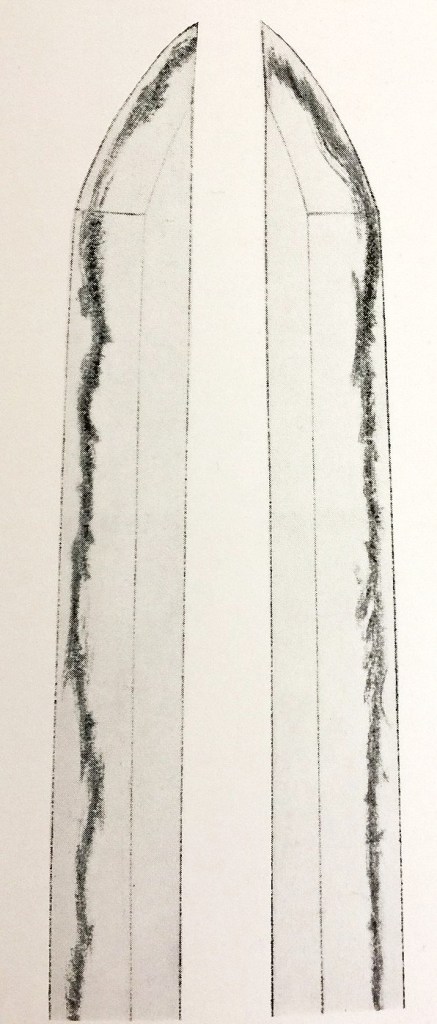
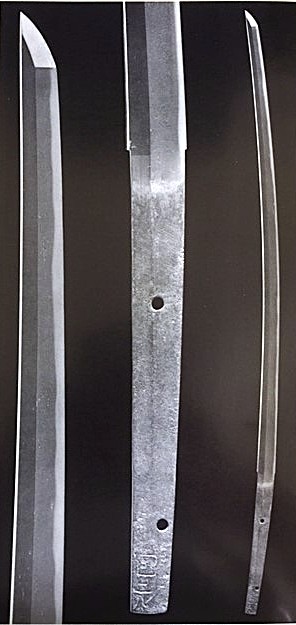
Tegai Kanenaga of Yamato.  From the Sano Museum Catalogue (permission granted).   The illustration (called Oshigata) shows notare (wave-like hamon) and suguha-hotsure (frayed suguha pattern) with kinsuji.

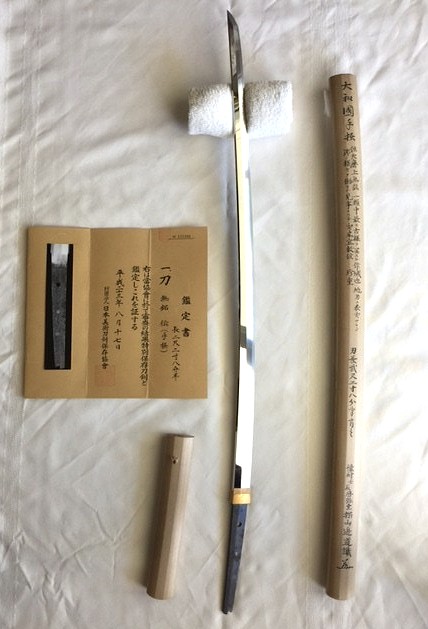
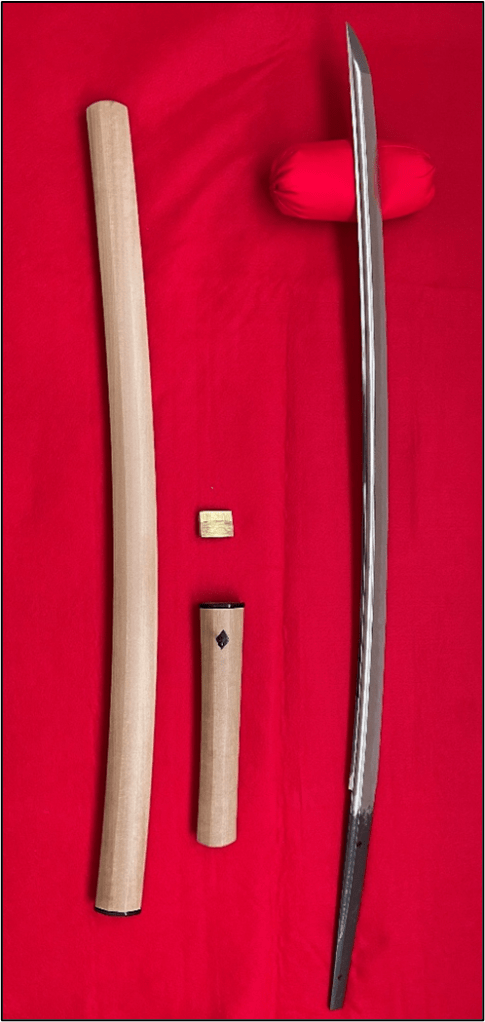
My Yamato sword Acquired at the Annual San Francisco Swords Show.

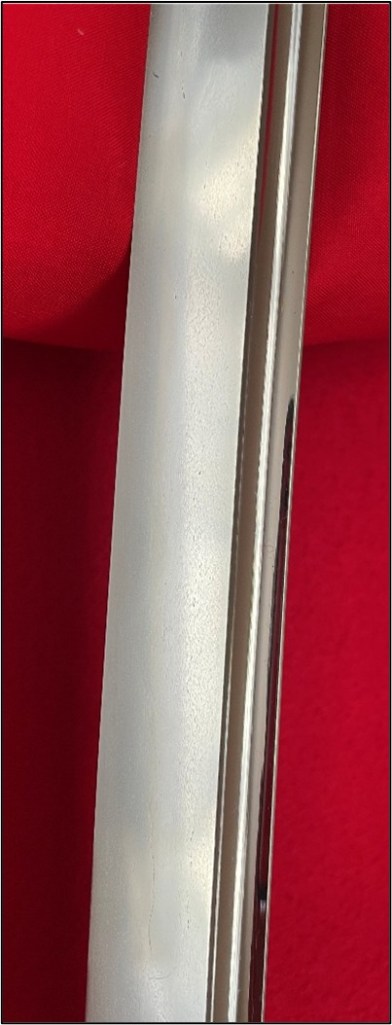
Characteristics: Munei (shortened and without signature).  Yamato-den, Tegai-ha (Yamato school Tegai group).  Length is two shaku, two sun, eight &1/2 bu (27 1/4 inches), small kissaki and funbari. HamonNiju-ba, Sunagashi.  Boshi: Yakizume.  Ji-hada: Itame with masame, Nie-hon’i .                                                                                                                                     

My Yamato sword

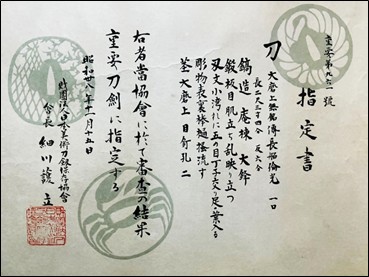
The full view of the sword and Kantei-sho (NBTHK Certification). “Tokubetsu Hozon Token”.

My Yamato sword 5

My Yamato sword 4

My Yamato sword.jpg 2

My sword: acquired at Dai Token Ichi (大刀剣市)Bizen Osafune Tomomitsu (備前長船倫光) Length: 2 feet 4 inches,  Shape: Shinogi zukuri,  Hada:itame midare-utsuri, Hamon: konotare gunome choji

38|Part 2 of — 5 Heian Period Sword 794-1192 (平安太刀)

This chapter is a detailed part of  Chapter 5, Heian Period Sword.  Please read Chapter 5 before this section.  More sword terminology will be used in the upcoming chapters.  These terms were explained in Chapters 1-31.  If you encounter unfamiliar sword terms, please refer to Chapters 1 through 31.

0-timeline - size 24 Heian                   The red circle above indicates the time we discuss in this sect         

During the Heian period, several swordsmith schools were active.  We use the word “den” to refer to these schools.  These include Yamashiro-den (山城伝), Yamato-den (大和伝), and Bizen-den (備前伝).  Additionally, the following regions had other active groups during the Heian period: Hoki-no-kuni (伯耆の国) and Oo-u (奥羽).   Oo-u is pronounced “Oh,” and “U” as in uber.

 Yamashiro Den (山城伝 )

During the Heian period, among Yamashiro-den swords, the most famous sword was the “Mikazuki Munechika“ (三日月宗近) by Sanjo Munechika (三条宗近).  Mikazuki means crescent.  It was named Mikazuki Munechika because the crescent-shaped uchinoke (collection of Nie) pattern appears in the hamon.  It has a graceful shape, a narrow body, koshi-zori, funbari, and a small kissaki.  The sword shows a wood grain pattern on its surface, with suguha with nie mixed with small irregular lines, and sometimes a nijyu-ha (double hamon: 二重刃) appears.  Sanjo Munechika lived in the Sanjo area of Kyoto.  His sword style was passed down through his sons and grandsons: Sanjo Yoshiie (三条吉家), Gojo Kanenaga (五条兼永), and Gojo Kuninaga (五条国永).  Gojo is also a district in Kyoto

    三日月宗近    Mikazuki Munechika  東京国立博物館蔵 Tokyo National Museum           Photo from “Showa Dai Mei-to Zufu 昭和大名刀図譜” published by NBTHK

Houki -no-Kuni (伯耆の国)

Houki-no-kuni is the area now called Tottori Prefecture.  It is known for producing high-quality iron.  The sword, “Doujigiri Yasutsuna” (童子切安綱), made by Hoki-no-yasutsuna (伯耆の安綱), was one of the most famous swords of its time.                                                                                                 

The characteristics of Yasutsuna’s sword ——- It has a graceful shape with a small kissaki, a narrow hamon (often suguha with ko-choji), coarse nie in the hamon area, and a large wood grain pattern mixed with masame on the ji-hada.  The hamon area often shows inazuma and kinsuji.  The boshi area is yakizume, and the kaen (pronounced ka as in calf, en as in engineer) has a slight turn back. 

   伯耆の安綱 (Hoki no Yasutsuna) 佐野美術館図録 (Sano Musem Catalogue)                     Permission to use granted 

Bizen Den (備前伝 )

Bizen is in Okayama Prefecture today.  It is known for producing high-quality iron.  From the Heian period to the present, Bizen has been famous for its sword-making tradition.  The sword-making group in this area during the Heian period was called the Ko-bizen group.  The most famous swordsmiths in the Ko-bizen group included Bizen Tomonari (備前友成), Bizen Masatsune (備前正恒), and Bizen Kanehira (備前包平).                                                                   

Ko-bizen group’s characteristics ———- A graceful, narrow body, a small kissaki, and a narrow-tempered line with ko-choji (small irregular) with inazuma and kin-suji.  The ji-hada displays a small wood-grain pattern.

   Bizen Kanehira (備前包平) Sano Museum Catalogue (佐野美術館図録)                          (Permission to use granted)

I saw Ko-bizen Sanetsune (真恒) at Mori Sensei’s house.  That was one of the kantei-to of that day.  I received a dozen*ᴵ.  The book written by Hon’ami Koson was used as our textbook.  Each time I saw a sword at Mori Sensei’s house, I recorded the date next to the swordsmith’s name in the book we used.  It was Nov. 22, 1970.  It had a narrow body line, a small kissaki (Ko-bizen komaru), kamasu*2 (no fukura), and suguha.  Kamasu is a condition in which the fukura (arc) is much less than usual.  Looking back, it is amazing that we had the opportunity to study such famous swords as our study materials.

Kantei-Kai

Kantei-kai is a study meeting.  Usually, several swords are displayed, with the nakago area covered.  Attendees try to guess the sword maker’s name and submit their answer sheets to the judge.  Below are the grades.

Atari —– If your answer is the exact correct name, you get Atari. That is the best answer.

Dozen —— The second best is a dozen.  It means nearly a correct answer. The subject sword was made by the family or clan of the right den.   A dozen is considered very good.  It indicates that the student has solid knowledge of the particular group.

Kaido Yoshi —– This means it is correct regarding the line, but not about the family.

Jidai Yoshi — it means the time or period is correct.  Each Kantei-kai has its own grading system.  Some may not have a “Jidai Yoshi” grade.

Hazure——– the wrong answer. 

Once all answer sheets are submitted, they are graded and returned. The judge reveals the correct answer and explains why.

*1 Dozen:  Almost the same as the correct answer. *2 Kamasu:  A name of a fish that has a narrow, pointed head.


21| Muromachi Period Sword (室町時代刀)

0-timeline - size 24 Muromach

       The red circle above indicates the time we discuss in this section

The Muromachi period was a relatively peaceful and prosperous time until shortly before the “Onin-no-ran,” which occurred at the end of the Muromachi periodRefer to Chapter 20, Muromachi Period History (室町時代歴史).   The Nanboku-cho style long swords became outdated; as a result, they were shortened.  The shortened blade is called suriage.  Overall, the Muromachi period was a declining time for sword-making.

Tachi and Katana 

Until the end of the Nanboku-cho period or the beginning of the Muromachi period, samurai wore swords suspended from their waists with the blade facing down.  When a sword was worn this way, the swordsmith inscribed his name on the side facing outward, meaning the blade is on your right when you see the inscription.  In this case, the sword is called a tachi.

During the Muromachi period, a sword was worn between the belt, with the blade facing up.   The swordsmith inscribed his name so that it faced outward when it was worn. Therefore, when you see the inscription, the cutting edge is to your left.  This is classified as a katana. 

Around the beginning of the Muromachi period, samurai started to wear a pair of swords called dai-sho (大小), meaning large and small.  The longer sword is a katana, and the shorter one is a wakizashi.  In general, a tachi is longer than a katana.  A katana is longer than a wakizashi, and a wakizashi is longer than a tanto.  Here is the order of their lengths. 

                                       Tachi   >   Katana   >   Wakizashi   >  Tanto                                  Tachi and katana differ in how they are worn, not in length.   

O-suriage ( 大磨上: Katana shortened by great length) 

How much the sword should be shortened depends on its original length and how much the owner wants it shortened.  O-suriage is a type of sword that is significantly shortened.  Once the blade is shortened by that length, the inscription of the maker’s name is cut off.  When the Hon’ami family (本阿弥家, a family of sword connoisseurs who have appraised Japanese swords for generations from the Muromachi period to today) appraises such a suriage sword, they write the make of the sword and the swordsmith’s name on the front side of the hilt, and the connoisseur’s name with his kaou (similar to a signature) on the back.  There are several levels of writing.  The level at which it should be done depends on the sword’s quality and the owner’s preference.  Below is the order of levels (high to low).

Shu-Mei (朱明 )————————————————————-name written in Vermilion  Kinpun-Mei (金粉名 )———————————————–name lacquered in gold powder  Gin-Zougan (銀象嵌 )————————————————————name inlaid in silver  Kin-Zougan (金象嵌 )————————————————————-name inlaid in gold

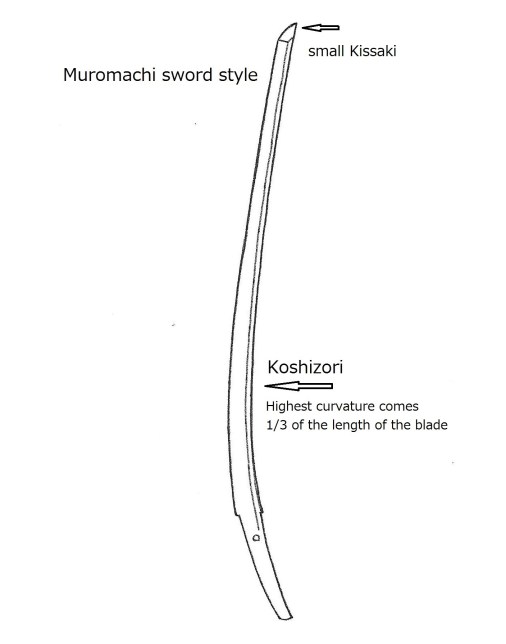
Sugata (姿: Shape) ——— The average length is typically two feet three to four inches (68~71cm).  The shape of the Muromachi period katana is somewhat similar to that of the Heian period tachi.  However, Muromachi katana are less grand or graceful than those from the Heian period swords.  The curvature is usually of the koshizori style.  Koshizori refers to the highest curvature being near the lower part of the blade.  The length and shape are suitable for wearing between the body and the belt.  The width and thickness are well-balanced with the size of the sword.  Small kissaki.

22 Muromachi sword shape

Hirazukuri-Wakizashi ———– Hirazukuri refers to a flat surface without a shinogi or yokote line.  Usually, it is 1 foot and 1 to 2 inches long.  No curvature.  Hirazukuri-wakizashi appeared during the Muromachi period.

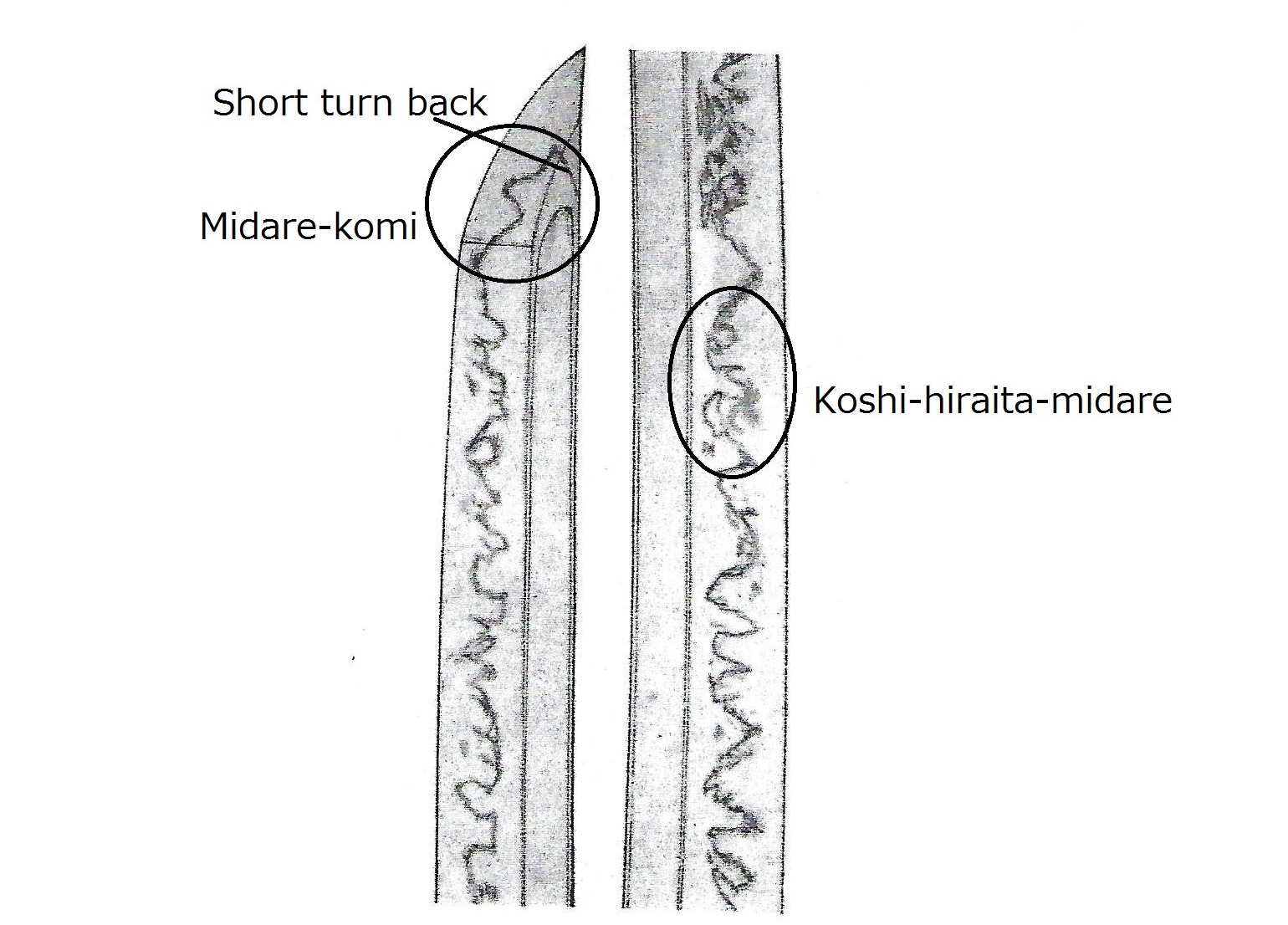
Hamon (刃文: tempered line) ———————- Nioi base.  The tempered area is well balanced with the blade’s width.  Koshi-hiraita-midare is mixed with choji-midare.

22Hamon (Koshi Hiraita midare)
from Sano Museum Catalogue (permission granted)
  • Boshi (Tempered line at Kissaki area) ————– Midare-komi, a short turn back.  See the above illustration.  Midare is an irregular wave-like pattern.
  • Ji-hada (地肌: An area between the tempered line and Shinogi)- Soft look, a large wood grain pattern, Ji-utsuri (faint smoke or cloud-like effect) shows.
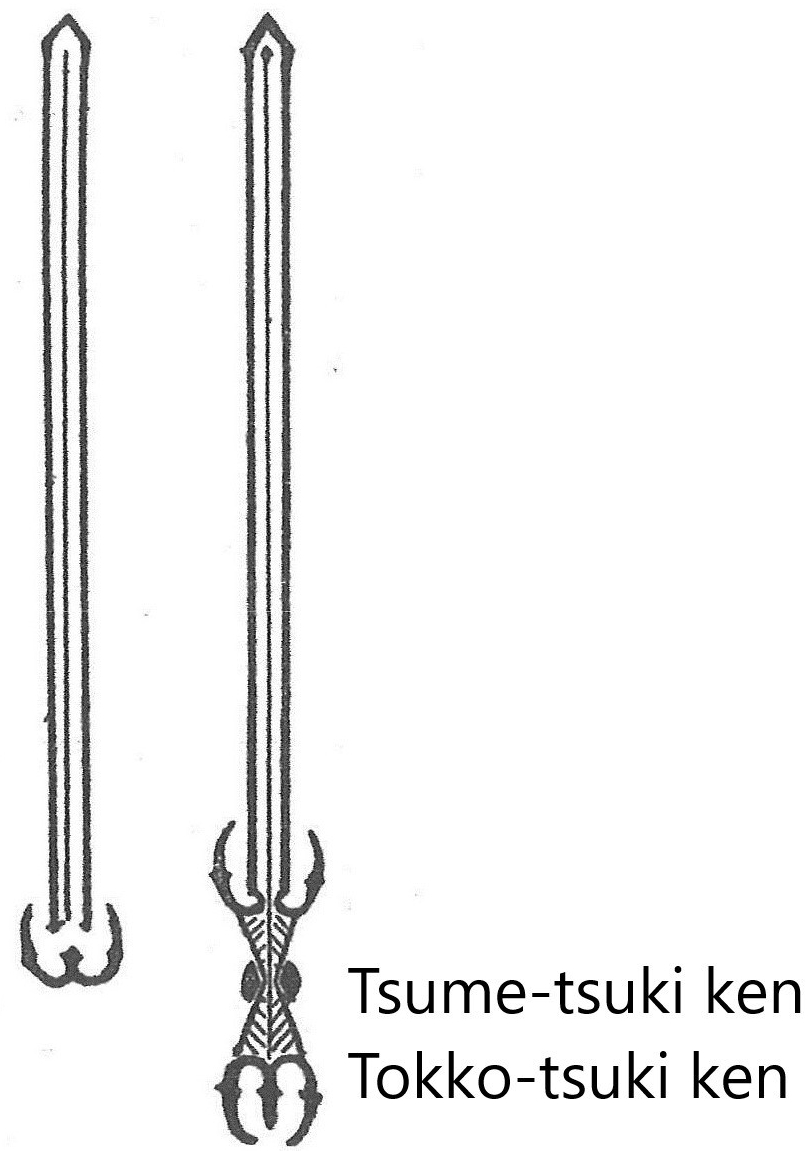
  • Horimono (彫物Engravings) ———- Bo-hi (single groove), Soe-hi (a thin groove alongside the main hi), Futasuji-hi (double narrow groove), Sanskrit, Tokko-tsuki ken, Tsume-tsuki Ken, name of God, and dragon.  Carvings became elaborate.

8 Hi, Suken, Bonji                  21 Tsume-tuki-ken tokko with caption

Sword Smiths during Muromachi Period

  • Bizen Den ——–Osafune Morimitsu (長船盛光), Yasumitsu (康光), Moromitsu (師光)
  • Yamashiro Den————————————————-Yamashiro Nobukuni (山城信国)

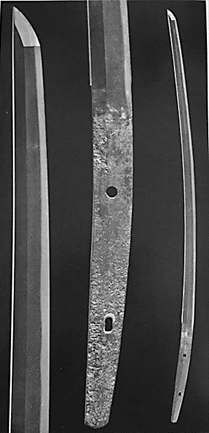
21 Muromachi sword from Sano

Ise Masashige (伊勢正重),                     Bizen Osafune Naomitsu (備前長船尚光)         Juyo Token(重要刀剣)                           Sano Museum Catalogue (permission granted)    once my family sword