41| Part 2 of — 8 Middle Kamakura Period: Yamashiro Den 鎌倉中期山城伝

This chapter is a detailed part of Chapter 8| Middle Kamakura Period –Yamashiro Den(鎌倉中期山城伝).   Please read Chapter 8 before reading this chapter.

0-timeline - size 24 Middle Kamakura

      The red circle indicates the time we discuss in this section

During the middle Kamakura period, the Yamashiroden consisted of 3 main groups: the Ayano-koji (綾小路) group, the Awataguchi (粟田口) group, and the Rai (来) group.

When referring to a specific group, we use terms like “xxx ha,” “xxx ippa,” or “xxx ichimon.”   We use these three terms interchangeably.  They all mean “group.”   For example, when we say “Ayano-koji ippa,” we refer to the Ayano-koji group.

Ayano-koji Ippa (綾小路)

Sugata (shape) —————–Generally, a gentle or graceful kyo-zori shape.  The difference in width between the yokote line and the machi is minimal.  The sword is slender, yet thick, with a small kissaki.                                                                                                                         

Hi and Engraving ———————– Bo-hi (single groove) or futasuji-hi (double grooves) 

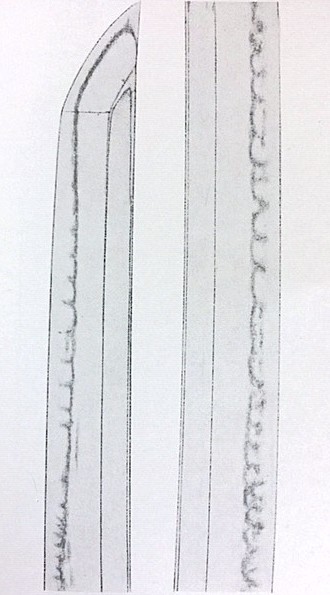
Hamon ——————— Nie base with ko-choji (small clove shape) and ko-midare (small irregular).  Small inazuma (lightning-like lines) and kinsuji (golden streaks) may be present.   Double ko-choji (two ko-choji side by side) may appear.   

Boshi (tempered line at the kissaki area) ———————– Ko-maru (small round), yakizume (see the illustration below ), and kaen (flame-like pattern)   

Ji-hada —————– Small wood grain with a little masame (straight grain).  Ji-nie shows. 

Nakago (hilt) ———————— Long, slightly thick feel  

Ayano-koji Ippa swordsmiths ———-Ayano-koji Sadatoshi (綾小路定利)  Sadanori (定則)        

Awataguchi Ichimon (粟田口)

Many swordsmiths from the Awataguchi Ichimon (or Awataguchi group) were honored as the Goban Kaji (the top swordsmith) by Gotoba Joko, Emperor Gotoba (後鳥羽上皇).  Their general characteristics are as follows.

Sugata (Shape) ————————- Elegant torii-zori (or kyo-zori) shape.     

Hi and Engraving ————– The tip of the hi extends all the way up and fills in the ko-shinogi.   The end of the hi can be maru-dome (the end is round), kaku-dome (the end is square), or kakinagashi.
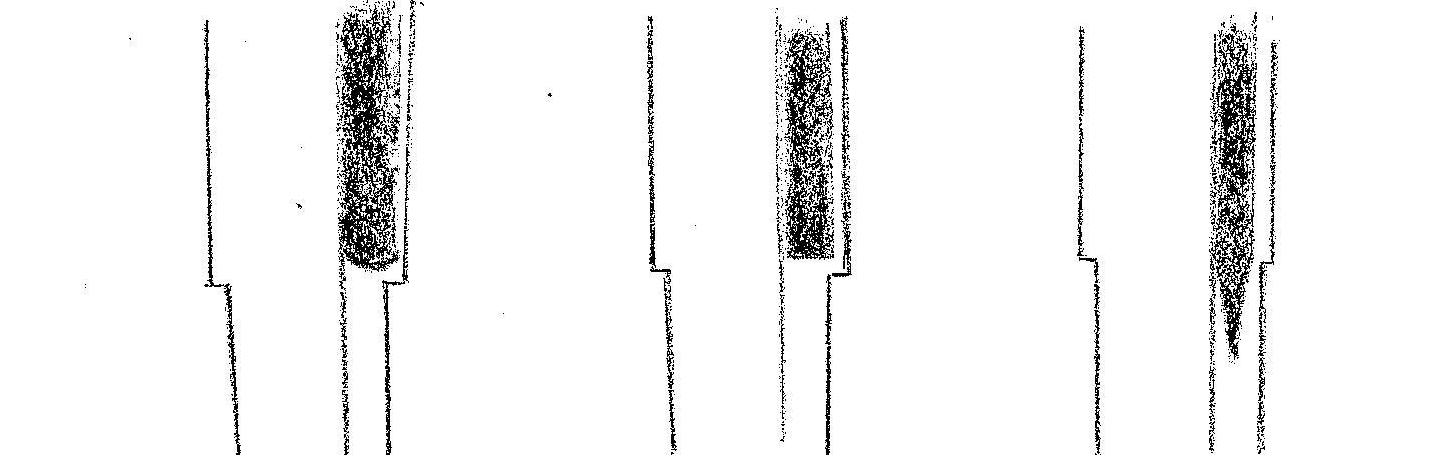
 

9 «part 2» 大小丸,焼詰,丸角止, 掻流     

              Maru-dome (rounded end)             Kaku-dome (square)          Kakinagashi

  • Hamon ———— The slightly wider tempered line at the bottom, then it becomes narrower at the top.  Nie base (called Nie-hon’i).  A straight tempered line mixed with ko-choji (small cloves) or a wide straight line combined with choji.  Awataguchi-nie appears.  Awataguchi-nie, which refers to a fine, deep, sharp, shiny nie that appears around the tempered line area. Fine inazuma (lightning-like lines) and kinsuji (golden streaks) emerge.

  • Boshi (tempered line at the tip area) —————— Ko-maru (small round)  and/or O-maru (large round).   The return is sharrow.  Yakizume, Nie Kuzure, and Kaen (flame)9-«part-2»-大小丸焼詰丸角止-掻流-1-e1547925390685.jpg

       Yakizume      O-maru     Ko-maru         Yakikuzure

  • Ji-hada ————– Fine ko-mokume (wood swirls) with ji-nie.  Ji-nie is nie on ji-hada. Yubashiri and/or chikei appear.                                                                               
  • Nakago ——————————– Often featuresa two-letter inscription
  • Names of Awataguchi swordsmiths —– Awataguchi Kunitomo (粟田口国友 ),  Hisakuni (久国), Kuniyasu (国安),  Kuniyasu (国安), Kunikiyo (国清)

 Rai Ha ()

The general characteristics of the Rai group are as follows.  However, each swordsmith has their own unique traits.

Sugata (shape) ——– Graceful and dignified.  Thick body.  Rai forged Ikubi Kissaki.         Hi and Engravings ————————- Wide and shallow hi.                                      Hamon ————————- Nie base.  Suguha (straight).  Wide suguha with ko-midare (small irregular) and choji (cloves).  Sometimes, there is a large choji at the lower part and a narrow suguha at the top.  Inazuma and Kinsuji appear around the yokote area.      Boshi ————————————- Komaru, yakizume (see the illustration above)            Ji-hada ——————— Finely forged itame (small wood grain).  Sometimes mixed with masame (parallel grain).  Fine nie.  Rai group’s swords occasionally show yowai tetsu (weak surface), which may be the core iron.    

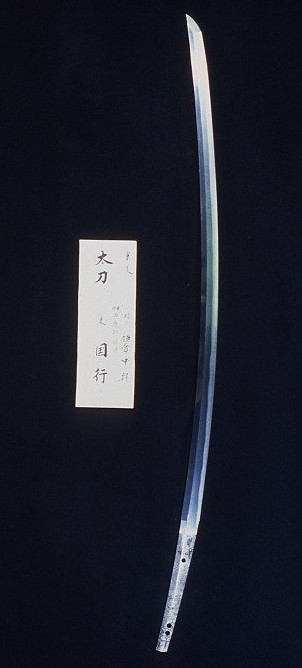
Rai Ha swordsmiths———————- Rai Kuniyuki (来国行),  Rai Kunitoshi (来国俊) or Niji Kunitoshi (二字国俊),  Ryokai (了戒 ).  Rai Kunitoshi is said to be the son of Rai Kuniyuki. Ryokai is said to be the son of Rai Kunitoshi.
img017

    Rai Kuniyuki (来国行)Once my family sword, photo taken by my father with his  writing.    
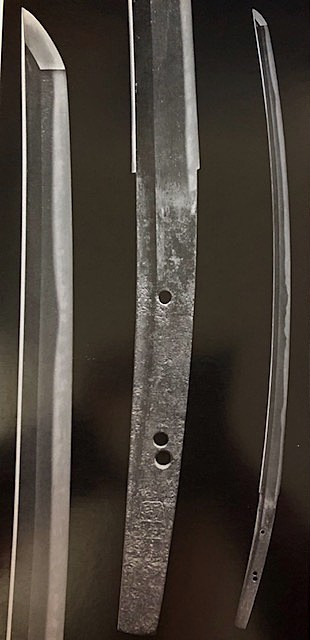
9 «part 2» Rai Kuniyuki photo.jpg       Rai Kuniyuki hamon
 
Rai Kuniyuki (来国行)Sano Museum Catalogue (佐野美術館)  (permission granted)

18| Nanboku-Cho Period Sword (南北朝太刀)

0-timeline - size 24 Nanboku-cho

                           The circle indicates the time we discuss in this section

During the Nanboku-cho period, samurai sought large, elaborate, impressive, yet practical swords.  The Soshu-den style sword from Nanboku-cho time was just that.    This was the most popular style at the time.  The Nanboku-cho period marked the peak and height of the Soshu-den sword.  Many swordsmiths moved from other provinces to the Kamakura area and forged Soshu-den style swords.  Other schools and provinces outside the Kamakura area also produced Soshu-den-style swords in their own areas.


19 Nanboku-cho Sword style

Sugata (姿: Shape) —————–The original length of a sword ranged from three to five feet, but it was later shortened to about two and a half feet.  A significantly shortened blade is called o-suriage. 

The Nanboku-cho style sword features shallow kyo-zori (also called torii-zori).  Refer to Chapter 5, Heian Period Sword.  The highest curvature occurs around the middle of the body. It has a wide body, high shinogi, narrow shinogi-ji  (Chapter 3, Names of parts),  and thin kasane (blade thickness), which are distinctive features of the Nanboku-cho style.  High gyo-no-mune or shin-no-mune, and sometimes a maru-mune (round back).

19 Nanboku-cho 3 kinds Mune

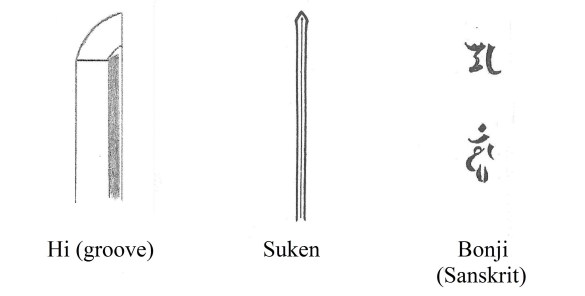
Hi (: groove) and Horimono (彫刻: engraving) ——– Often, a single hi (bo-hi), double hi, suken (dagger), Bonji (Sanskrit), and/or dragon are engraved on the shinogi-ji area.  Refer to Chapter 3, Names of Parts.

9 Hi, Suken, Bonji

Hamon (: Tempered line) —- The lower part of the body exhibits a narrow-tempered line; gradually, this line becomes wider and showier.  Course nie. O-midare (large, irregular, wavy hamon), Notare-midare (wavy, irregular hamon), and Gunome-midare (a combination of repeated half-circular and irregular hamon). Inazuma and kinsuji (see Chapter 14, Late Kamakura Period Sword) sometimes appear.

19 Hamon Notare 319 Mamon choji gunome19 Hitatsura Hamon Hiromitsu

                                  *From Sano Museum Catalogue ( Permission granted).

Ji-hada (地肌: the area between the shinogi and the tempered line) ———————-Wood-grain pattern (itame 板目). Sometimes tobiyaki (patchy tempered spots) appear on ji-hada.  For ji-hada, refer to Chapter 3, Names of Parts.

Kissaki (切っ先) and Boshi (tempered line at the kissaki area) ———- O-kissaki (long and large kissaki). Fukura kareru (less arc kissaki).  Midare-komi (the body and boshi have a similar tempered pattern), with kaeri-fukashi (hamon deeply turns back), and sometimes hitatsura (entirely tempered).  See the illustration above.

Sword-smiths during Nanboku-Cho Period Soshu Den (school)

  • From Soshu—————————————————Hiromitsu (広光)  Akihiro (秋広)  
  • From Yamashiro ———————————————Hasebe Kunishige (長谷部国重) 
  • From Bizen (called So-den Bizen)——-Chogi (長儀 )group  Kanemitsu (兼光 ) group 
  • From Chikuzen ———————————————————-Samoji (左文字 ) group

Chogi (長義)from The Sano Museum catalog. Permission to use is granted

The distinctive characteristics of the Nanboku-Cho period sword in the photo above      

  • The trace of an engraving of suken on the inside of the nakago indicates that this area was once a part of the main body.
  • Large and long kissaki

5 |Heian Period Swords  (平安時代太刀)

0-timeline - size 24 Heian

                       
                                      The circle indicates the time we discuss in this section

The Heian period is when the sword shape changed to the current curved form.  Before that, swords were straight.  It is widely accepted that the study of Japanese swords begins in the Heian period.   Swords made before the Heian period are considered archaeological artifacts.  The main reason is that sword-making techniques improved significantly after the start of the Heian period.

The elegant and graceful lifestyle of Heian culture is reflected in the style of swords.  A group of swordsmiths in the Kyoto region developed a specific sword style called Yamashiro-den (Yamashiro School).  The shape of their swords exhibits a graceful line.  The most famous sword of this period is Sanjo-Munechika (三条宗近 page 20), a national treasure today.  The Yamashiro-den represents the swords of the Heian period.                                                                                                                                 


                                                                                                      6a Heian period sword style

General Heian period sword style

The shape —————The length of a sword is about 30 inches ± a few inches.  It has an elegant, graceful shape, with a narrow blade and a small kissaki (小切先).  The curvature is deep.  This style is called Kyo-zori (京反り) or Torii-zori (鳥居ぞり).  In the Kyo-zori style, the deepest part of the curvature is near the middle of the blade.  The lower part of the sword flares out, creating an A-line shape similar to the lower part of the Eiffel Tower.  This flared shape is called funbari (踏ん張り).                                                                      

6b A line bottom

Hamon(刃文)———- Hamon is the line formed during the process of tempering.  The hamon on Heian period swords is narrow and usually suguha (直刃).  Suguha means a straight line.  The hamon is also Nie-based.  Nie(沸) are tiny particles in the hamon.   As shown below, if you look closely, you can see fine sand-like particles within the hamon line.

6 Straigh tempered line(Suguha)

10 Nie & Nioi

Ji-hada (地肌) ——–Fine wood-grained pattern.  The location of ji-hada (or ji-tetsu) is between the hamon and shinogi (see Chapter 3 |Names of Parts).

Nakago (中心)——– The nakago is the hilt area.  Sword makers inscribed their names there. During the Heian period, the nakago was often shaped like a kijimomo (雉腿), meaning a pheasant’s thigh.

6 Kijimomo-nakago

Hi and engrave ———- Hi (樋) means an engraved straight line.  Hi and other engraved designs were rare during the Heian period.  These became more common later on.

Kissaki (切先) ———– The shape of kissaki on a Heian sword is ko-gissaki, meaning small kissaki. The hamon line at the kissaki is called boshi.  During this period, the type of boshi design is called komaru, meaning small, round, and wrapping around the tip.

Names of the Heian period swordsmiths

  • Yamashiro School——–  Sanjo Munechika(三条宗近) Sanjo Yoshiie(三条吉家)                                                 Gojo Kanenaga(五条兼長) Gojo Kuninaga (五条国永)
  • Yamato School ————-Senju-in (千手院)
  • Bizen School ————— Bizen Tomonari(備前友成) Bizen Masatsune(備前正恒)                                                  Bizen Kanehira (備前包平)
  • Hoki (伯耆) —————–  Yasutsuna (安綱) Sanemori (真守)
  • Buzen (豊前) ————–   Cho-en (長円) Sinsoku (神息)
  • Satsuma (薩摩) ———— Naminohira (波平)