64| Part 2 of –30 Shin Shin-To : Bakumatsu sword (新々刀)

This Chapter is a detailed Chapter of the 30|Bakumatsu Period, Shin Shin-to.  Please read Chapter 30 before reading this chapter.
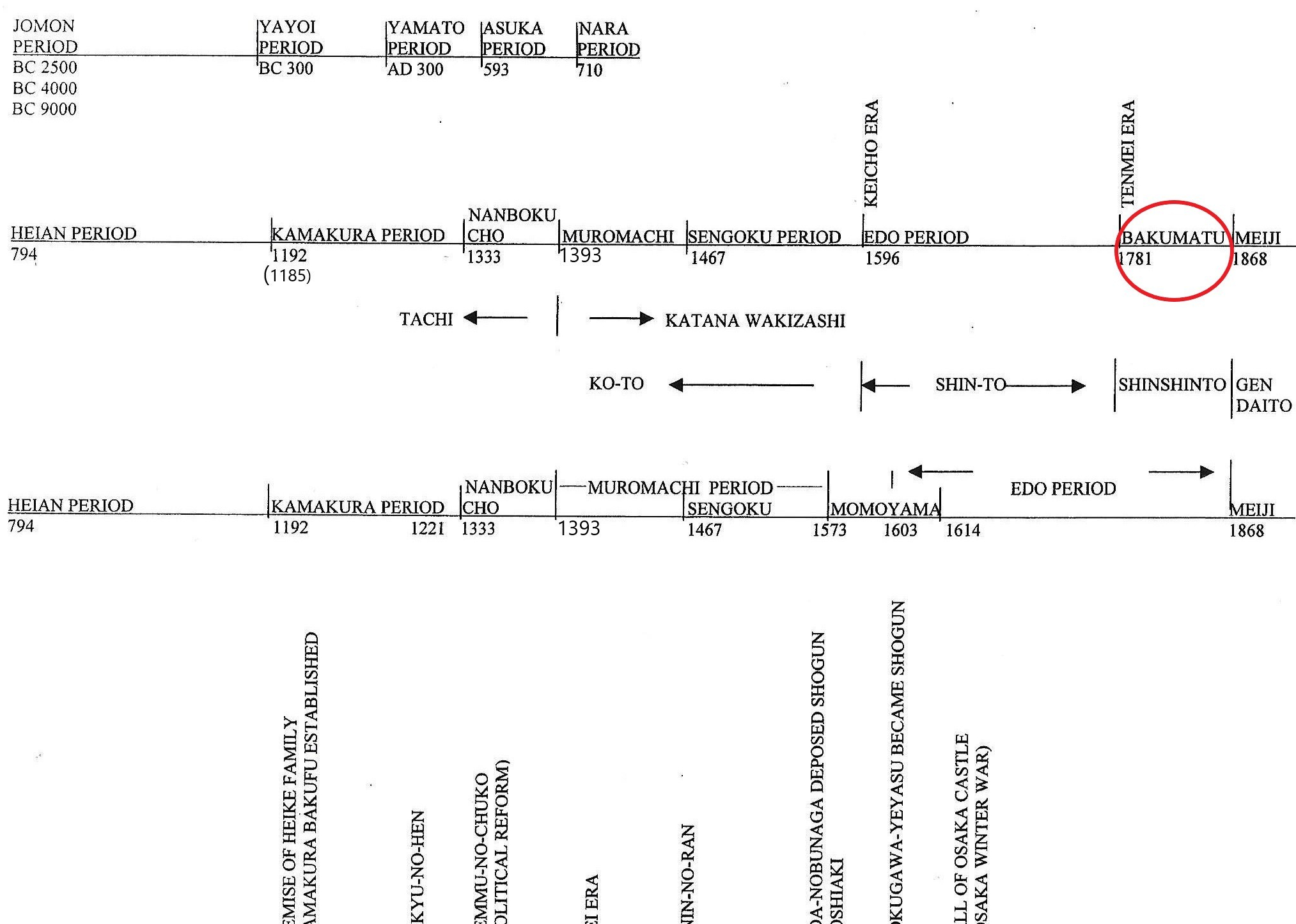
0-timeline - size 24 Bakumatsu

                  The circle Above indicates the time we discuss in this chapter.

Swords made between the Tennmei era (天明 1781) and the end of the Keio era (慶應) are called shin shin-to.  Please refer to the timeline above.  This period was when Japan was moving toward the Meiji Restoration, known as the Bakumatsu era.  During this time, sword-making became active again.  Below are the well-known swordsmiths from the main areas.

Musashi no Kuni  (武蔵の国: Tokyo today)                                                       

Suishinshi Masahide (水心子正秀) ——— When Suishinshi Masahide made Yamashiro-den style swords, their shapes resembled those of ko-to period swords; funbari, an elegant shape; chu-suguha (medium straight); komaru-boshi, with fine wood grain. When he forged in the Bizen style, he made a Koshi-zori shape, similar to a ko-to made by Bizen Osafune.  Nioi with ko-choji, and katai-ha (refer to  30| Bakumatsu Period Sword 新々刀).  In my old sword textbook, I noted that  I saw Suishinshi in November 1970 and October 1971.

Taikei Naotane (大慶直胤) ————————–Although Taikei Naotane was part of the Suishinshi group, he was one of the top swordsmiths.  He had an exceptional ability to forge a wide range of sword styles beautifully.  When he made a Bizen-den style, it resembled Nagamitsu from the Ko-to era, with nioi.  Also, he did sakasa-choji as Katayama Ichimonji had done.  Katai-ha appearsThe notes in my old textbook indicate I saw Naotane in August 1971.

Minamoto no Kiyomaro (源清麿) ————————– Kiyomaro wanted to join the Meiji Restoration movement as a samurai; however, his guardian recognized Kiyomaro’s talent as a master swordsmith and helped him become one.  It is said that because Kiyomaro had a drinking problem, he was not very eager to make swords.  At age 42, he committed seppukuKiyomaro, who lived in Yotsuya (now part of Shinjuku, Tokyo), was called Yotsuya Masamune because he was as good as Masamune.  His swords featured wide-width, shallow sori, stretched kissaki, and fukura-kereru.  The boshi is komaru-boshi.  Fine wood grain ji-gane.

Settsu no Kuni   ( 摂津の国:  Osaka today)

Gassan Sadakazu (月山貞一) ———- Gassan excelled in the Soshu-den and Bizen-den styles, but he was capable of making in any style.  He was as much a genius as Taikei Naotane.  You must pay close attention to notice a sword made by Gassan from genuine ko-to.  He also had remarkable carving skills.  His hirazukuri-kowakizashi, forged in the Soshu-den style, looks just like a Masamune or a Yukimitsu.  He forged in the Yamashiro-den style, with Takenoko-zori, hoso-suguha, or chu-suguha in nie.  Additionally, he forged the Yamato-den style with masame-hada.


27|Shinto Sword — Main Seven Regions (Part A :主要7刀匠地)

0-timeline - size 24 Shin-to

                            The red circle indicates the subject we discuss in this section

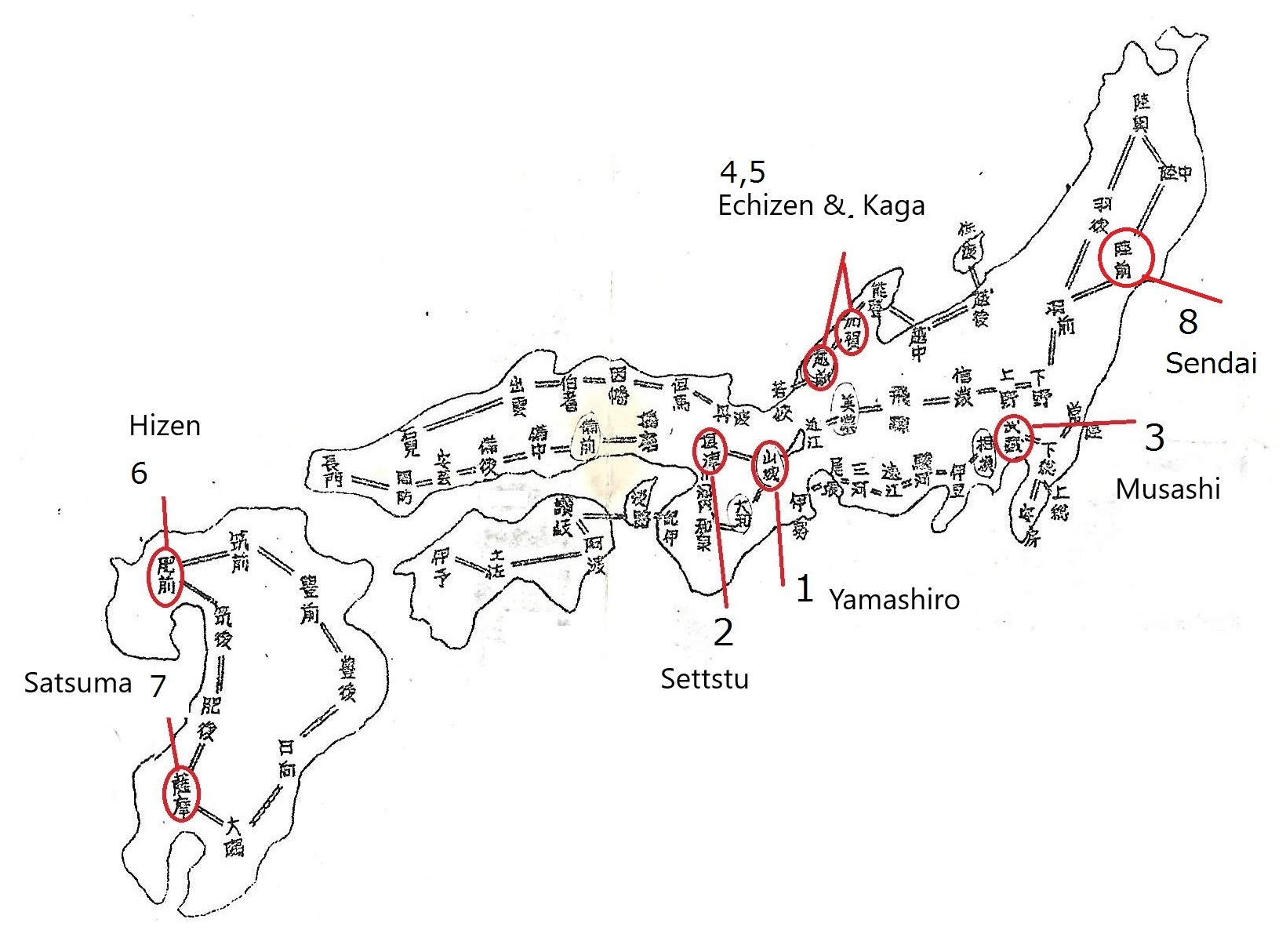
During the Shinto era, there were seven main prosperous regions where many swordsmiths gathered and actively forged swords.  These are Yamashiro (山城) in Kyoto, Settsu (摂津) in Osaka, Musashi (武蔵 ) in Edo, Hizen (肥前) in Saga, Satsuma (薩摩) in Kagoshima, Echizen (越前) in Fukui,  and Kaga (加賀) in Kanazawa.  Swordsmiths from each area shared common regional characteristics of their places.  Knowing each of these characteristics is the easiest way to understand Shin-to.  However, it is important to remember that each swordsmith within a group had their own unique way of sword-making.  The following are only general descriptions of these characteristics.

Below is a map of Japan.  Hokkaido is not shown on the map because swords were not made there during that time.

64Map with number with 8

1.  Yamashiro (山城) Kyoto

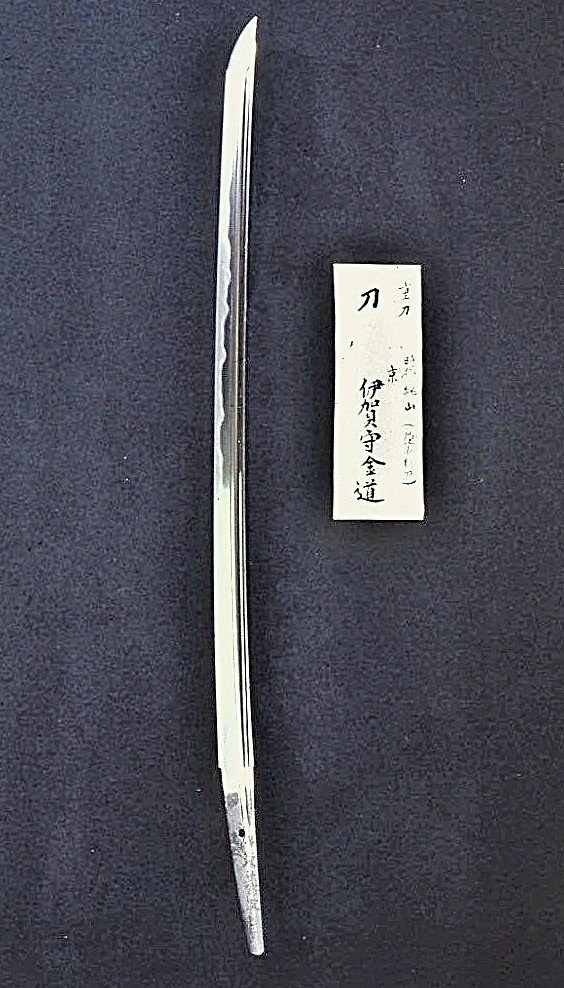
The Yamashiro shin-to sword has a solid and strong look.  The hamon near the lower part of the blade, just above the machi (区) area, shows suguha (straight hamon).  This is called kyo-yakidashi (京焼出し, meaning it starts with a straight hamon.  Then, it shows a sudden shift to a design of o-midare (大乱).  The o-midare (large irregular waviness) becomes less wavy about one or two inches below the yokote line, then continues into the boshi as a wavy hamon.  The design in the boshi is komaru-boshi.   See the illustration below. 

Ji-hada ———— Somewhat rough, (depending on the swordsmith).  Masame-hada (straight grain pattern) may show on shinogi-ji (between the ridgeline and back). 

Among the Yamashiro shin-to group, there was a group called the Mishina group (三品).  They were related to Mino-den (美濃).  Therefore, their boshi was often jizo-boshi (地蔵鋩子).  This is called Mishina-boshi (三品鋩子).  Jizo-boshi is an image of a man’s head.

The Well-known swordsmiths in Yamashiro area: Umetada Myoju (梅忠明寿)                                                                                                   Horikawa Kunihiro (堀川国広)                                                                                               Dewadaijyo Kunimichi (出羽大掾国路)

28 Mishina-Boshi Komaru-boshi, Kyo-Yakidashi

                                                        Iganokami Kinnmichi (伊賀守金道) Yamashiro Den, once my family sword

2.Settu (摂津) Osaka (大阪)

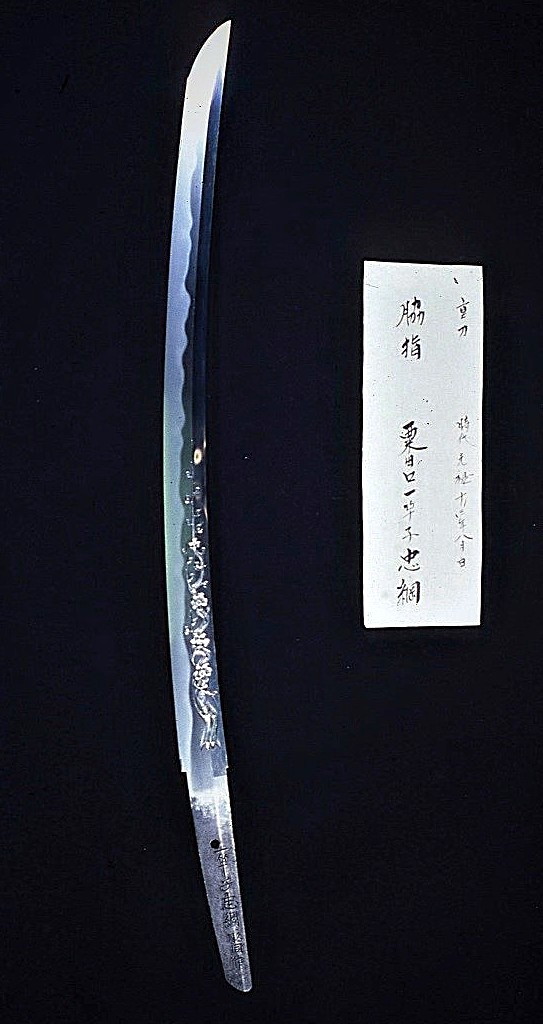
Settsu (Osaka) produced more wakizashi than katana.  They tend to make it slightly sakizori (the top half curving outward) with a slightly stretched boshi. A Settsu sword also shows yakidashi, similar to the previous Yamashiro sword.  However, unlike Yamashiro’s sword, the transition is not abrupt but relatively smooth, where suguha changes into notare (wavy pattern).  This is called Osaka Yakidashi.

Osaka Boshi ——-Hamon continues up to the yokote line, then komaru with a turn back.   Ji-hada————-Very fine,  almost no pattern, a solid surface like, especially, shinogi-ji (between the ridgeline and the back).  This is called Osaka-tetsu (iron).

29 Osaka Yakidashi Komaru Boshi

Well-known swordsmiths in Settsu area— Osaka Tsuda Sukehiro (大阪津田助広)                                                                                 Tsuda Sukenao (津田助直)                                                                                                   Ikkanshi Tadatsuna (一竿子 忠綱)

                                                                 Ikkanshi Tadatsuna (一竿子忠綱), once my family sword