34| Part 2 — 1 Timeline

Chapter 34 is a continued part of Chapter 1 Time line.   Please read Chapter 1 before reading this section.

   0 timeline - Gendai-to                             The red circle indicates the time we discuss here

In the “Chapter 1 Timeline,” the gendai-to (現代刀) are swords made from the Meiji Restoration (明治維新1868) up to the present day.  It has been about 150 years since the Meiji Restoration.  Although all swords made after the Meiji Restoration are grouped under the gendai-to, there are many differences in quality and style.  One notably different type is the gun-to (軍刀).  These are military swords forged during World War I and World War II.  Some of them have a saber-like handle.  With a few exceptions, these were made without using traditional sword-making techniques of heating and folding.  Among the gendai-to, gun-to are usually considered less valuable.  The guns-to-swords made around and during World War II are called Showa-to.  It often has a brown leather scabbard.  Gun-to is not a part of the study of the Japanese sword.

*Refer to” https://en.wikipedia.org/wiki/Gunt%C5%8D”  for the Japanese military sword.
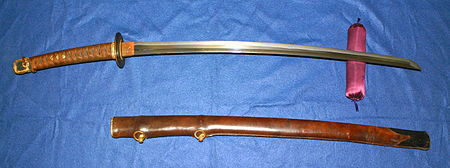
                                Gun-to    From Wikimedia Commons, the free media repository

At the time of the Meiji Restoration (明治維新), swords called Meiji-ishin-to (明治維新刀) or Kin’no-to (勤王刀) were made.  These swords were owned by famous historical figures such as Saigo Takamori (西郷隆盛) and Sakamoto Ryoma (坂本龍馬).  They are important historical figures who advanced the Meiji Restoration.  These swords are long, with some almost 3 feet long, and have no curvature.

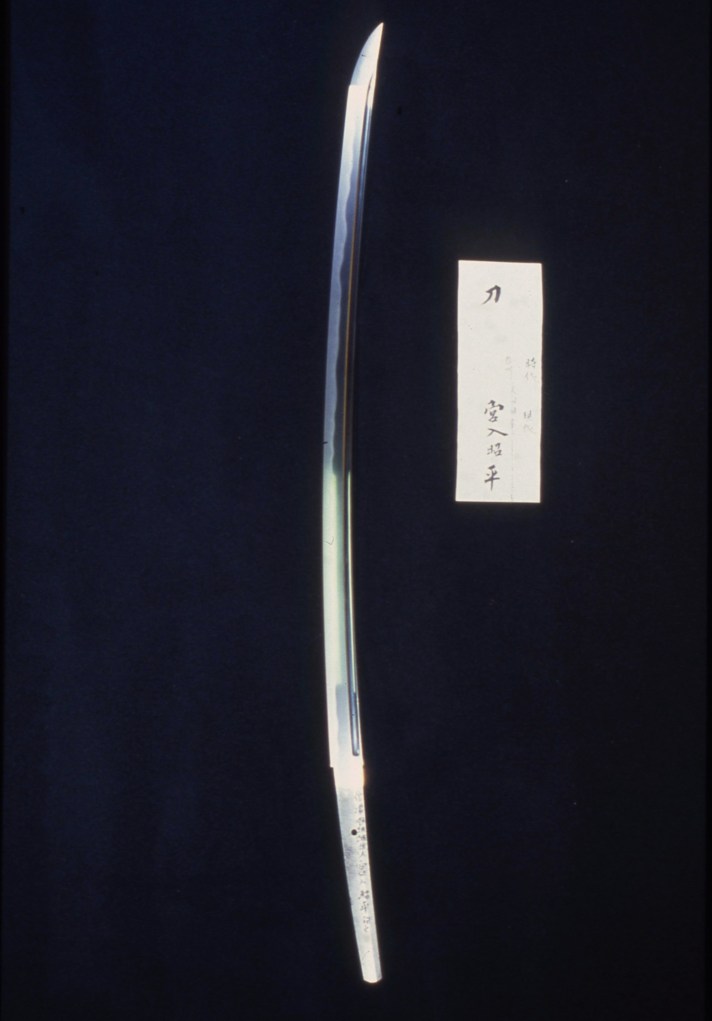
Today, many famous swordsmiths are making excellent swords.  Some are recognized as living national treasures.  Gendai-to refers to swords made after the Meiji Restoration to the present, but keep in mind that there is a wide range of differences in quality, type, and purpose among them.
36img077

                       Sword forged by a Living National Treasure, Mr. Miyairi Shohei (宮入昭平)                         owned by my brother

30| Shin-Shin-To 1781-1867 (Bakumatsu Period Sword 新々刀)

0-timeline - size 24 BakumatsuThe red circle indicates the time we discuss in this section

The later part of the Edo period is called Bakumatsu.  See the circled area on the timeline above.  Swords made during this time are called shin shin-to.   They are also called Fukko-to (復古刀: revived sword).  Fukko-to replicates the shape, hamon, boshi, and other features of the Ko-to and Shin-to swords.  The characteristics of the Shin Shin-to (新々刀) and well-known swordsmiths are listed below.

The Characteristics of Shin Shin-to

  • Katana, wakizashi, and tanto all tend to resemble or imitate the ko-to and shin-to in shape.
  • Many swords often have a Hi or detailed engravings.
  • One swordsmith would create multiple sword styles, such as Soshu-den, Bizen-den, and Shin-to style.
  • Often shows Katai-ha.

30 katai-ha

                                                                  Katai-ha

  • Weak (not tight) Nioi.
  • Yakidashi (2 to 3 inches above machi) is often suguha(straight line hamon), even though the rest of the area has irregular    Boshi is often irregular midare.
  • Detailed engravings are more realistic than those from earlier times.

Well-known swordsmiths of Shin Shin-to

  • Settsu (Osaka area) ——————Gassan Sadayoshi (月山貞吉), Gassan Sadakazu (月山貞一). The Gassan family is known for their detailed carvings.
  • Musashi no Kuni (Tokyo area) ————-Suishinshi Masahide (水心子正秀),  Minamoto Kiyomaro (源 清麿),  Taikei Naotane (大慶直胤),  Taikei Yoshitane (大慶義胤).  Yoshitane is well-known for his carvings.                                               

Minamoto Kiyomaro(源清麿)    Once my family possession

  • Tosa (四国: Shikoku area) ———————————————- Sa Yukihide (左行秀)
  • Satsuma (鹿児島: Kagoshima) ———— Oku Moptohira (奥元平) Namino Hira (波平)

Meiji Ishin-To

Right before the Meiji Restoration, long swords (about 3 feet) without any curvature were made.  Sa Yukihide (from the Tosa area) forged this type of sword.  Saigo Takamori (西郷隆盛) and Sakamoto Ryoma (坂本龍馬) owned such swords.  Both are well-known historical figures from the Meiji Restoration.  Both were part of the Kin’no-to (勤皇党) group, which supported the emperor and reformed the political system.