64| Part 2 of –30 Shin Shin-To : Bakumatsu sword (新々刀)

This Chapter is a detailed Chapter of the 30|Bakumatsu Period, Shin Shin-to.  Please read Chapter 30 before reading this chapter.
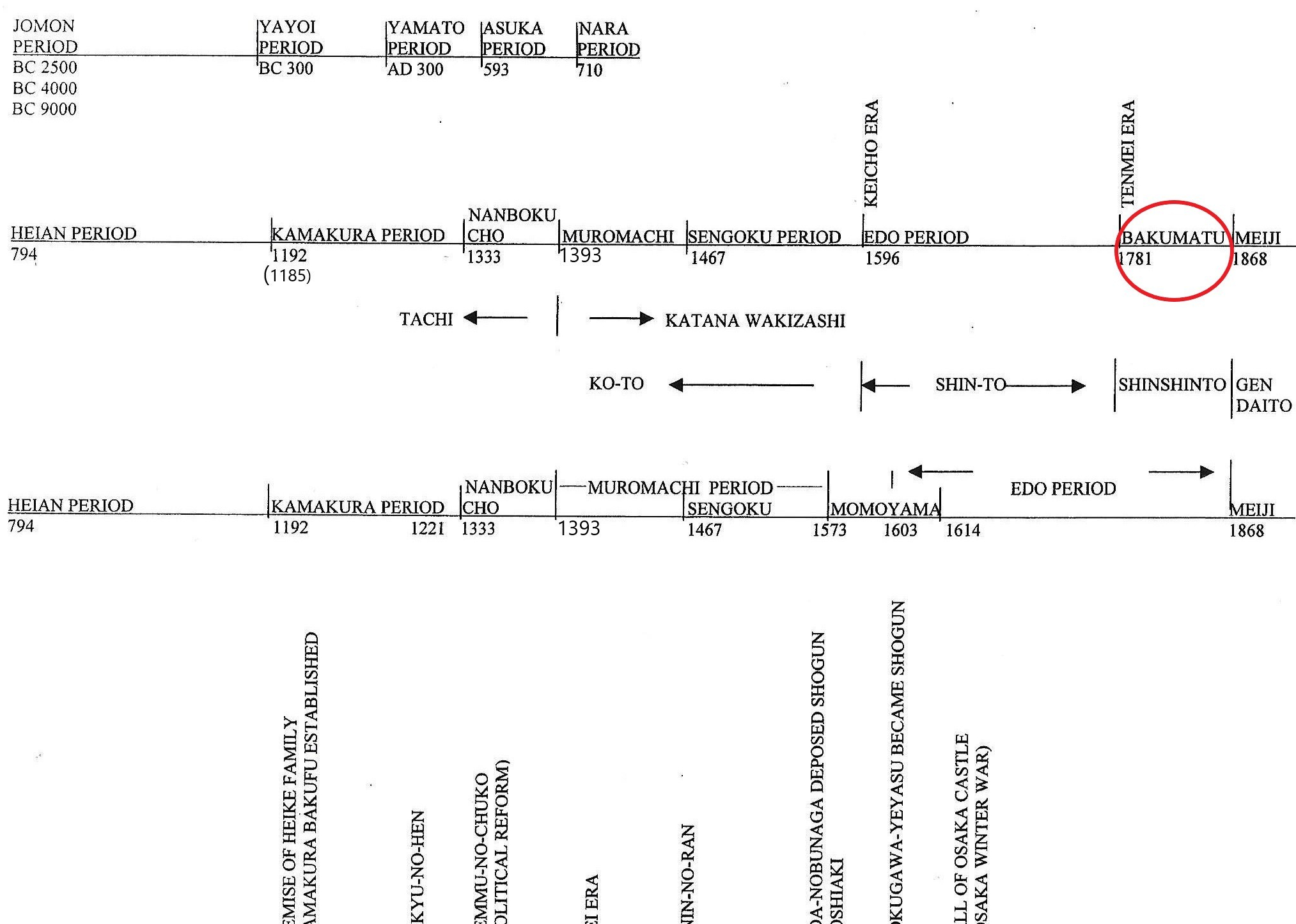
0-timeline - size 24 Bakumatsu

                  The circle Above indicates the time we discuss in this chapter.

Swords made between the Tennmei era (天明 1781) and the end of the Keio era (慶應) are called shin shin-to.  Please refer to the timeline above.  This period was when Japan was moving toward the Meiji Restoration, known as the Bakumatsu era.  During this time, sword-making became active again.  Below are the well-known swordsmiths from the main areas.

Musashi no Kuni  (武蔵の国: Tokyo today)                                                       

Suishinshi Masahide (水心子正秀) ——— When Suishinshi Masahide made Yamashiro-den style swords, their shapes resembled those of ko-to period swords; funbari, an elegant shape; chu-suguha (medium straight); komaru-boshi, with fine wood grain. When he forged in the Bizen style, he made a Koshi-zori shape, similar to a ko-to made by Bizen Osafune.  Nioi with ko-choji, and katai-ha (refer to  30| Bakumatsu Period Sword 新々刀).  In my old sword textbook, I noted that  I saw Suishinshi in November 1970 and October 1971.

Taikei Naotane (大慶直胤) ————————–Although Taikei Naotane was part of the Suishinshi group, he was one of the top swordsmiths.  He had an exceptional ability to forge a wide range of sword styles beautifully.  When he made a Bizen-den style, it resembled Nagamitsu from the Ko-to era, with nioi.  Also, he did sakasa-choji as Katayama Ichimonji had done.  Katai-ha appearsThe notes in my old textbook indicate I saw Naotane in August 1971.

Minamoto no Kiyomaro (源清麿) ————————– Kiyomaro wanted to join the Meiji Restoration movement as a samurai; however, his guardian recognized Kiyomaro’s talent as a master swordsmith and helped him become one.  It is said that because Kiyomaro had a drinking problem, he was not very eager to make swords.  At age 42, he committed seppukuKiyomaro, who lived in Yotsuya (now part of Shinjuku, Tokyo), was called Yotsuya Masamune because he was as good as Masamune.  His swords featured wide-width, shallow sori, stretched kissaki, and fukura-kereru.  The boshi is komaru-boshi.  Fine wood grain ji-gane.

Settsu no Kuni   ( 摂津の国:  Osaka today)

Gassan Sadakazu (月山貞一) ———- Gassan excelled in the Soshu-den and Bizen-den styles, but he was capable of making in any style.  He was as much a genius as Taikei Naotane.  You must pay close attention to notice a sword made by Gassan from genuine ko-to.  He also had remarkable carving skills.  His hirazukuri-kowakizashi, forged in the Soshu-den style, looks just like a Masamune or a Yukimitsu.  He forged in the Yamashiro-den style, with Takenoko-zori, hoso-suguha, or chu-suguha in nie.  Additionally, he forged the Yamato-den style with masame-hada.


58|Part 2 of — 24 Sengoku Period Tanto (戦国時代短刀)

Chapter 58 is a detailed section of Chapter 24, Sengoku Period Tanto.  Please read Chapter 24, Sengoku Period Tanto, before reading this part. 

0-timeline - size 24 Sengoku Period

           The red circle above indicates the time we discuss in this section  

Muramasa (村正)

This chapter discusses the famous Muramasa (村正).  Usually, many well-known swordsmiths come from one of the Goka-den (五家伝: the five main schools: Yamashiro-den, Bizen-den, Soshu-den, Yamato-den, and Mino-den).  However, Muramasa was not from Goka-den but from Ise Province.  The first-generation Muramasa was known as a student of He’ian-jo Nagayoshi (平安城長吉) of Yamashiro-den.  The Muramasa family existed through the mid-Muromachi period.  They spanned three generations from the mid-Muromachi to the Sengoku period

61 Ise map

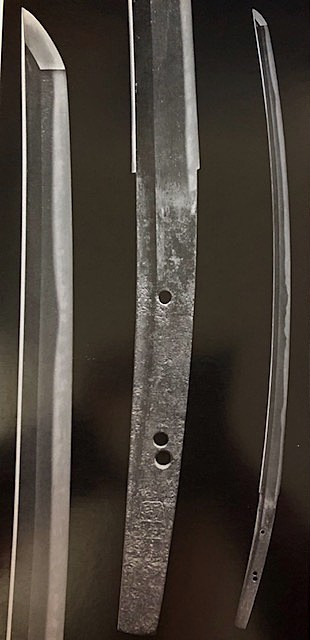
Below is one of Muramasa’s tantos, made during the Sengoku period.  Since it was made during the Sengoku era, the blade shows the style of Sengoku-period swords.  It reflects Mino-den characteristics, combined with Soshu-den traits. 


 Muramasa (村正) from Sano Museum Catalogue (permission granted)

Characteristics  on this Tanto

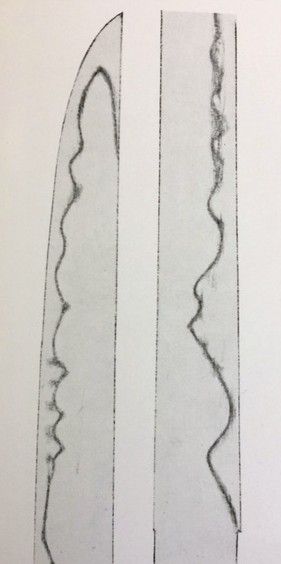
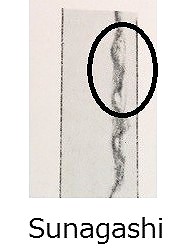
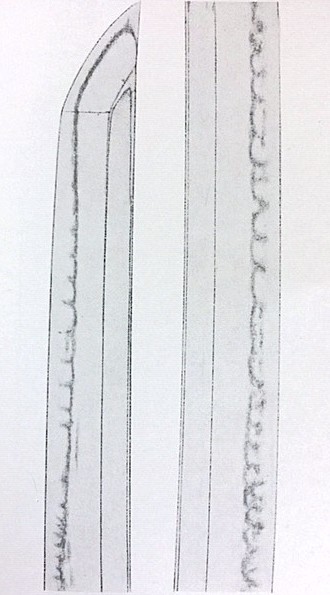
Muramasa’s tantos are typically about ten inches ± half an inch or so.  Hirazukuri (平作り). Thin blades with a sharp look.  The nioi base with small nie and sunagashi patterns (brushed sand-like patterns, as shown in the illustration below) appears.  The boshi (the top part of the hamon) is jizo (a side view of a human head).  The tempered line varies with both wide and narrow areas.  Some areas are so narrow, almost close to the edge of the blade, while others are broader.  Hako midare (box-like shape) and gunome (lined-up bead pattern) appear.  O-notare (large, gentle waviness) is a signature characteristic of Muramasa.  The pointed-tempered line is a typical characteristic of Mino-den (Sanbon-sugi).  Refer to Chapter 23, Sengoku Period Sword, and Chapter 24, Sengoku Period Tanto.


41| Part 2 of — 8 Middle Kamakura Period: Yamashiro Den 鎌倉中期山城伝

This chapter is a detailed part of Chapter 8| Middle Kamakura Period –Yamashiro Den(鎌倉中期山城伝).   Please read Chapter 8 before reading this chapter.

0-timeline - size 24 Middle Kamakura

      The red circle indicates the time we discuss in this section

During the middle Kamakura period, the Yamashiroden consisted of 3 main groups: the Ayano-koji (綾小路) group, the Awataguchi (粟田口) group, and the Rai (来) group.

When referring to a specific group, we use terms like “xxx ha,” “xxx ippa,” or “xxx ichimon.”   We use these three terms interchangeably.  They all mean “group.”   For example, when we say “Ayano-koji ippa,” we refer to the Ayano-koji group.

Ayano-koji Ippa (綾小路)

Sugata (shape) —————–Generally, a gentle or graceful kyo-zori shape.  The difference in width between the yokote line and the machi is minimal.  The sword is slender, yet thick, with a small kissaki.                                                                                                                         

Hi and Engraving ———————– Bo-hi (single groove) or futasuji-hi (double grooves) 

Hamon ——————— Nie base with ko-choji (small clove shape) and ko-midare (small irregular).  Small inazuma (lightning-like lines) and kinsuji (golden streaks) may be present.   Double ko-choji (two ko-choji side by side) may appear.   

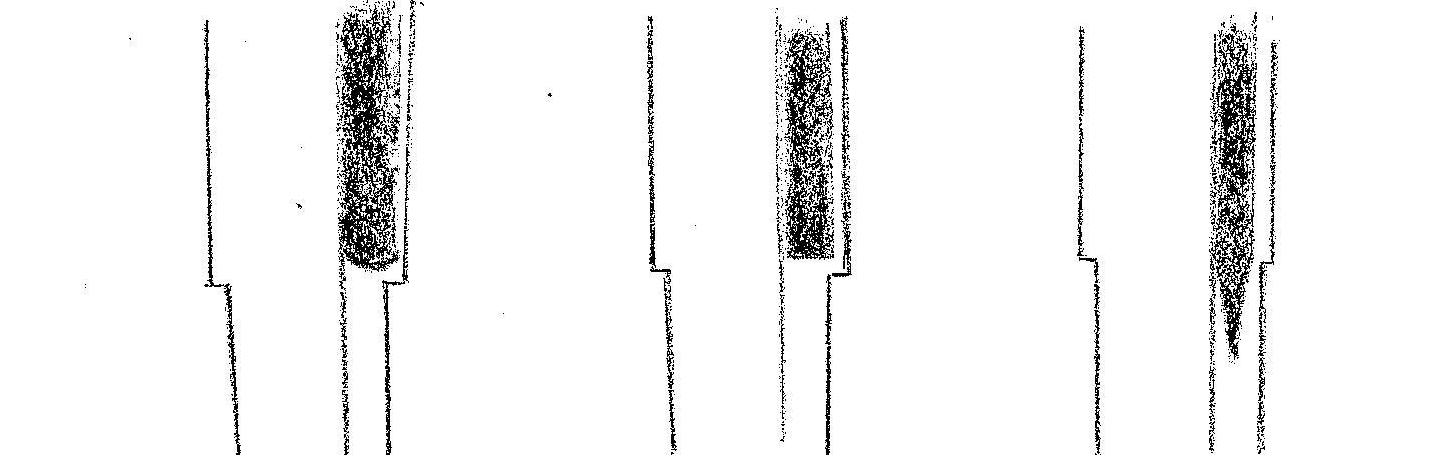
Boshi (tempered line at the kissaki area) ———————– Ko-maru (small round), yakizume (see the illustration below ), and kaen (flame-like pattern)   

Ji-hada —————– Small wood grain with a little masame (straight grain).  Ji-nie shows. 

Nakago (hilt) ———————— Long, slightly thick feel  

Ayano-koji Ippa swordsmiths ———-Ayano-koji Sadatoshi (綾小路定利)  Sadanori (定則)        

Awataguchi Ichimon (粟田口)

Many swordsmiths from the Awataguchi Ichimon (or Awataguchi group) were honored as the Goban Kaji (the top swordsmith) by Gotoba Joko, Emperor Gotoba (後鳥羽上皇).  Their general characteristics are as follows.

Sugata (Shape) ————————- Elegant torii-zori (or kyo-zori) shape.     

Hi and Engraving ————– The tip of the hi extends all the way up and fills in the ko-shinogi.   The end of the hi can be maru-dome (the end is round), kaku-dome (the end is square), or kakinagashi.


9 «part 2» 大小丸,焼詰,丸角止, 掻流     

              Maru-dome (rounded end)             Kaku-dome (square)          Kakinagashi

  • Hamon ———— The slightly wider tempered line at the bottom, then it becomes narrower at the top.  Nie base (called Nie-hon’i).  A straight tempered line mixed with ko-choji (small cloves) or a wide straight line combined with choji.  Awataguchi-nie appears.  Awataguchi-nie, which refers to a fine, deep, sharp, shiny nie that appears around the tempered line area. Fine inazuma (lightning-like lines) and kinsuji (golden streaks) emerge.

  • Boshi (tempered line at the tip area) —————— Ko-maru (small round)  and/or O-maru (large round).   The return is sharrow.  Yakizume, Nie Kuzure, and Kaen (flame)9-«part-2»-大小丸焼詰丸角止-掻流-1-e1547925390685.jpg

       Yakizume      O-maru     Ko-maru         Yakikuzure
  • Ji-hada ————– Fine ko-mokume (wood swirls) with ji-nie.  Ji-nie is nie on ji-hada. Yubashiri and/or chikei appear.                                                                               
  • Nakago ——————————– Often featuresa two-letter inscription
  • Names of Awataguchi swordsmiths —– Awataguchi Kunitomo (粟田口国友 ),  Hisakuni (久国), Kuniyasu (国安),  Kuniyasu (国安), Kunikiyo (国清)

 Rai Ha ()

The general characteristics of the Rai group are as follows.  However, each swordsmith has their own unique traits.

Sugata (shape) ——– Graceful and dignified.  Thick body.  Rai forged Ikubi Kissaki.         Hi and Engravings ————————- Wide and shallow hi.                                      Hamon ————————- Nie base.  Suguha (straight).  Wide suguha with ko-midare (small irregular) and choji (cloves).  Sometimes, there is a large choji at the lower part and a narrow suguha at the top.  Inazuma and Kinsuji appear around the yokote area.      Boshi ————————————- Komaru, yakizume (see the illustration above)            Ji-hada ——————— Finely forged itame (small wood grain).  Sometimes mixed with masame (parallel grain).  Fine nie.  Rai group’s swords occasionally show yowai tetsu (weak surface), which may be the core iron.    

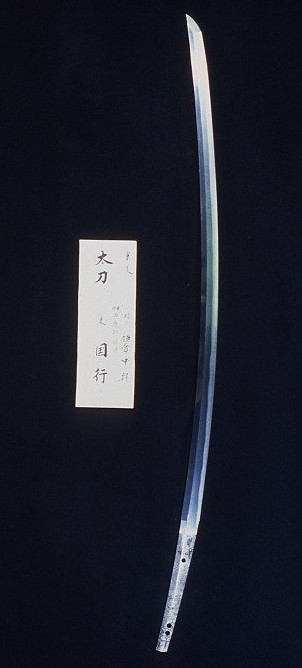
Rai Ha swordsmiths———————- Rai Kuniyuki (来国行),  Rai Kunitoshi (来国俊) or Niji Kunitoshi (二字国俊),  Ryokai (了戒 ).  Rai Kunitoshi is said to be the son of Rai Kuniyuki. Ryokai is said to be the son of Rai Kunitoshi.

img017

    Rai Kuniyuki (来国行)Once my family sword, photo taken by my father with his  writing.    
9 «part 2» Rai Kuniyuki photo.jpg       Rai Kuniyuki hamon
 
Rai Kuniyuki (来国行)Sano Museum Catalogue (佐野美術館)  (permission granted)

40|Part 2 of — 7 Overview of Kamakura Period Sword (鎌倉太刀概要)

This chapter is a detailed part of Chapter 7, an overview of the Kamakura Period Swords.  Please read  Chapter 7, Overview of the Kamakura Period Swords, before reading this section. 

0-timeline - size 24 Kamakura Period

                         The red circle above indicates the time we discuss in this section.

The Kamakura period was a golden age of sword-making.  About half of the well-known swords today were produced during this time.  This is probably because the war between the Genji and the Heishi demanded many swords, and swordsmiths improved their skills through wartime experience.  Also, Emperor Gotoba (後鳥羽) invited many talented swordsmiths to his palace, treated them favorably, and encouraged them to create excellent swords by granting them high ranks.  During the Kamakura period, sword-making techniques greatly improved.

Middle Kamakura Period —- Yamashiro-den (山城伝)

The middle Kamakura period was the height of the Yamashiro-den.  Within the Yamashiro-den, there were three main groups: the Ayanokoji group (綾小路), Awataguchi group (粟田口), and Rai group (来).                                                                                                                       Among the Awataguchi group, six swordsmiths received the honor of “Goban-kaji ” from Emperor Gotoba (後鳥羽上皇).  Awataguchi is the name of an area in Kyoto. 

The Ayanokoji ( 綾小路 ) group lived in the Ayanokoji area of Kyoto.  My sword textbook had a note indicating that I had seen Ayanokoji Sadatoshi (綾小路定利) on March 22, 1972.  My note was brief, only a few words: o-suriage, funbari, narrowbody, and ji-nie

The Rai group originated from Rai Kuniyuki (来国行 ).  Rai Kuniyuki and Ayanokoji Sadatoshi were believed to have been close friends.  Rai Kuniyuki created many well-known swords.  His famous Fudo Kuniyuki (不動国行) was once owned by Shogun Ashikaga Yoshiteru (足利義輝 ), then passed to Matsunaga Danjo (松永弾正), then to Oda Nobunaga ( 織田信長 ), then to Akechi Mitsuhide (明智光秀 ), and eventually to Toyotomi Hideyoshi (豊臣秀吉).  All of them were historically famous and influential daimyo.  It is said that Toyotomi Hideyoshi held this sword during the memorial service for Oda Nobunaga.  Rai Kuniyuki’s son was Niji Kunitoshi.  He also forged well-known swords. 

Middle Kamakura Period —– Bizen-den (備前伝)                                                              

The Bizen-den during the Heian period was called Ko-bizen.  They are similar to those in the Yamashiro-den style.  The true height of the Bizen-den was during the middle Kamakura period.  The Bizen area (today’s Okayama Prefecture) had many ideal conditions for sword-making: a good climate, abundant iron resources, plenty of wood for fuel, and a convenient location.  Naturally, many swordsmiths moved there, and it became a major center for sword production. 

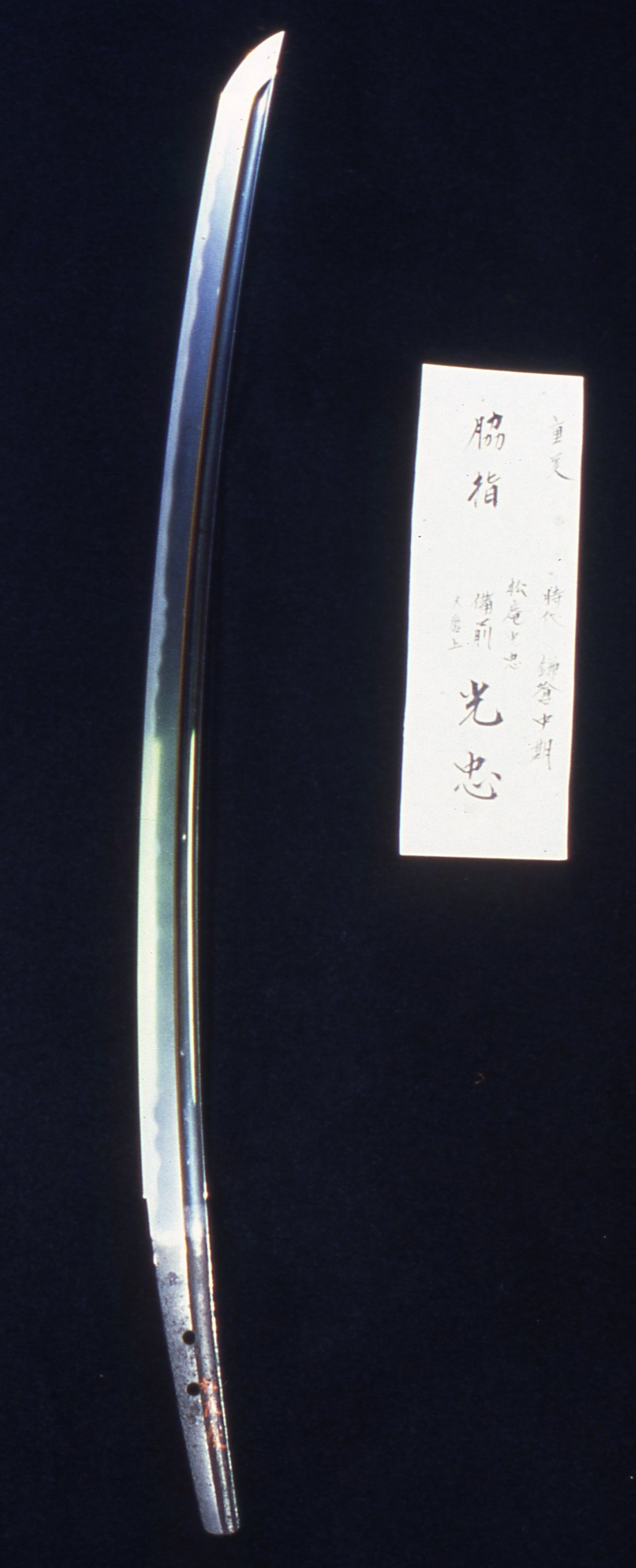
The Bizen region produced many swords of higher quality and superior to those of other sword groups and more famous swordsmiths.  Fukuoka Ichimonji Norimune (則宗) and his son Sukemune (助宗 ) received the honor of the Goban-kaji from Emperor Gotoba.   Among the Osafune group (長船), the famous Mitsutada (光忠) and Nagamitsu (長光) appeared.  My father owned four Mitsutada bladesThree tachis and one tanto.  He was so proud of owning four Mitsutada blades that he asked his tailor to monogram Mitsutada on the inside pocket of his suit jacket. 

From the Hatakeda group (畠田), Hatakeda Moriie (畠田守家), and from the Ugai (鵜飼) group, Unsho (雲生 ) and Unji (雲次) appeared.  The famous Kunimune (国宗) also emerged around this time.   Since many swordsmiths worked in the Bizen-den, many Bizen swords exist today.  Each swordsmith displayed his own characteristics in the swords.  Therefore, doing the kantei of Bizen swords can be quite complex. 

The classification of the sword ranking from the top

  1. Kokuho (国宝: National Treasure)
  2. Jyuyo Bunkazai (重要文化財: Important Cultural Property)
  3. Jyuyo Bijutsu Hin (重要美術品: Important Artwork)
  4. Juyo Token (重要刀剣: Important Sword)        more to follow

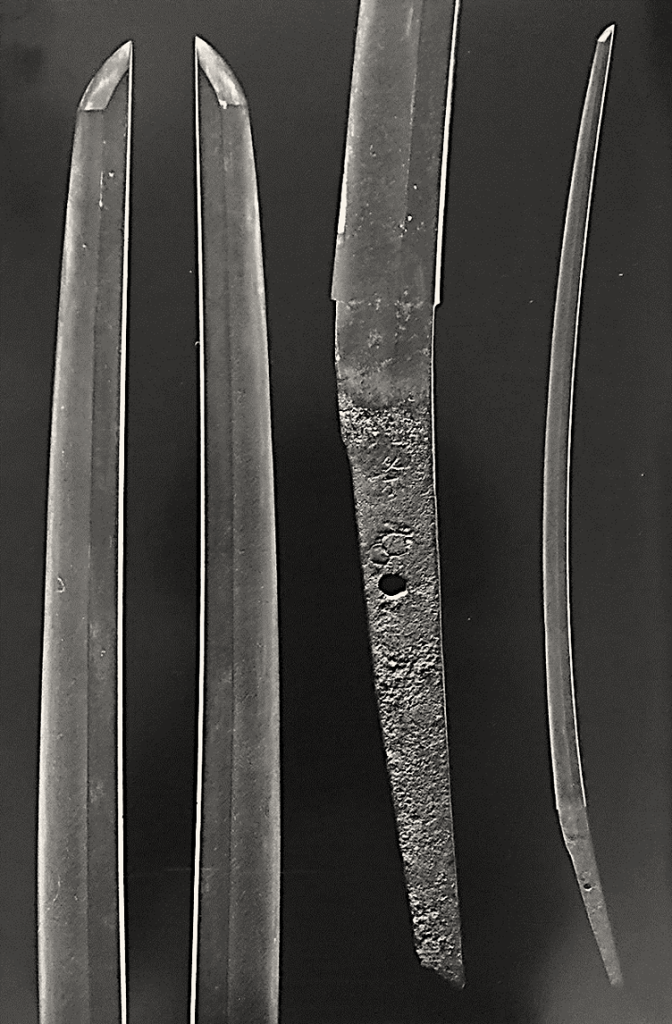
Here are my father’s four Bizen Osafune Mitsutada swords. He took these pictures many years ago at home. It is clear that he was not much of a photographer.  On a rectangular  sheet of white paper, he wrote the name of the swordsmith, the period when the sword was made, the name(s) of the daimyo who owned it in the past, and its classification.

img027               img028                Osafune Mitsutada (Juyo Bukazai)                 Osafune Mitsutada (Juyo Bunakzai)
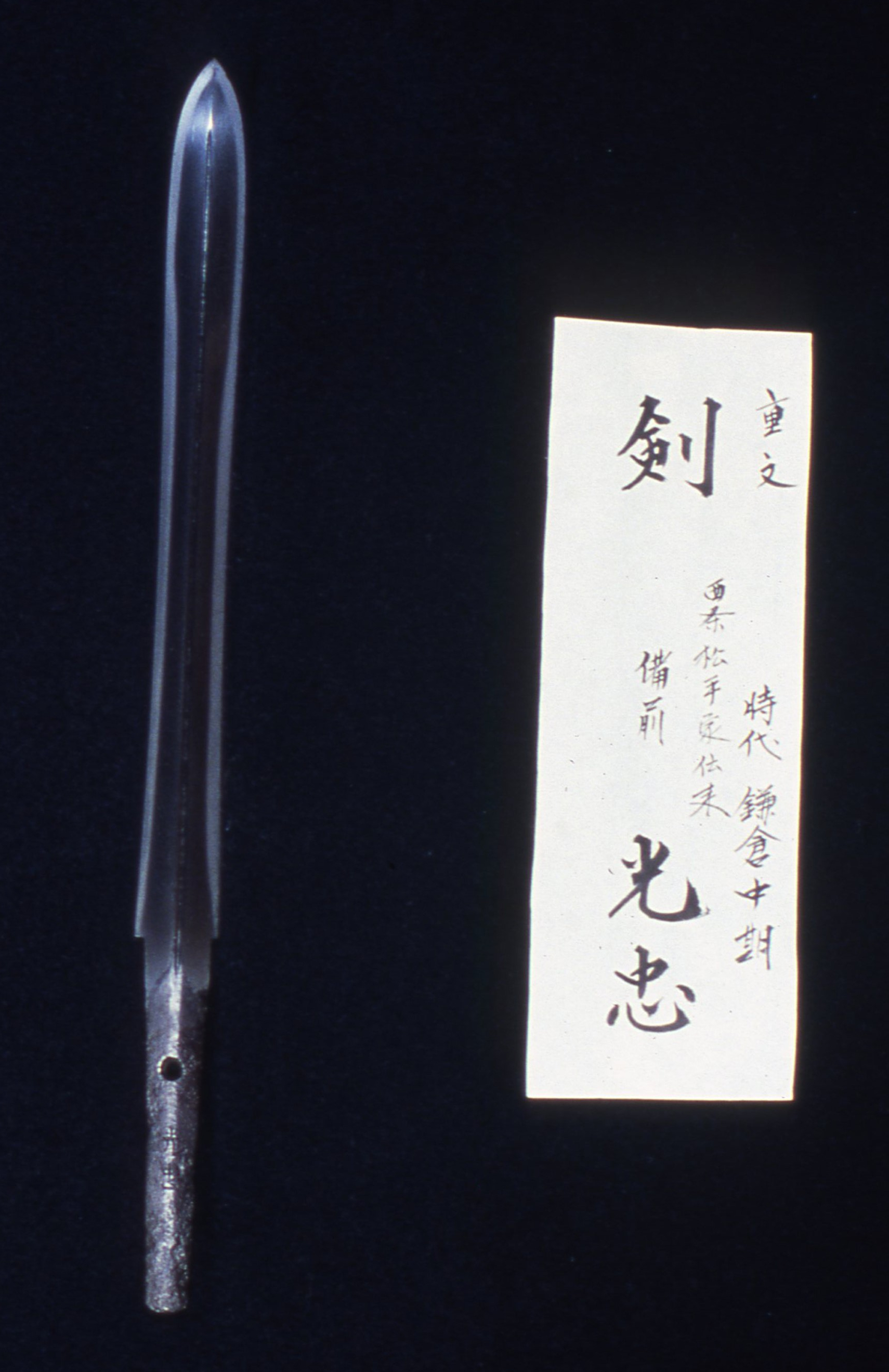
img029            img030 Osafune Mitsutada (Juyo Token)                 Osafune Mitsutada(Juyo Bunkazai)
Late Kamakura Period —– Soshu Den (相州伝 )

Yamashiro-den began to decline in the latter part of the Kamakura period.  At this time, many swordsmiths moved to the Kamakura area under the new power of the Kamakura bakufu (鎌倉幕府), led by the Hojo clan.  The new group, Soshu-den (相州伝 ), began to emerge.  Fukuoka Ichimonji Sukezane (福岡一文字助真) and Kunimune (国宗) from Bizen moved to KamakuraToroku Sakon Kunitsuna (藤六左近国綱) from the Awataguchi group of Yamashiro-den also moved to Kamakura.  These three are considered the founders of the Soshu-den in Kamakura.  Kunitsunas son was Tosaburo Yukimitsu, and his grandson was the famous Masamune (正宗)Outside Kamakura, Yamashiro Rai Kunitsugu (来国次), Go-no-Yoshihiro (郷義弘) from the Ettchu (越中) province, and Samoji  (左文字) from Chikuzen Province (筑前) were active swordsmiths.

38|Part 2 of — 5 Heian Period Sword 794-1192 (平安太刀)

This chapter is a detailed part of  Chapter 5, Heian Period Sword.  Please read Chapter 5 before this section.  More sword terminology will be used in the upcoming chapters.  These terms were explained in Chapters 1-31.  If you encounter unfamiliar sword terms, please refer to Chapters 1 through 31.

0-timeline - size 24 Heian                   The red circle above indicates the time we discuss in this sect         

During the Heian period, several swordsmith schools were active.  We use the word “den” to refer to these schools.  These include Yamashiro-den (山城伝), Yamato-den (大和伝), and Bizen-den (備前伝).  Additionally, the following regions had other active groups during the Heian period: Hoki-no-kuni (伯耆の国) and Oo-u (奥羽).   Oo-u is pronounced “Oh,” and “U” as in uber.

 Yamashiro Den (山城伝 )

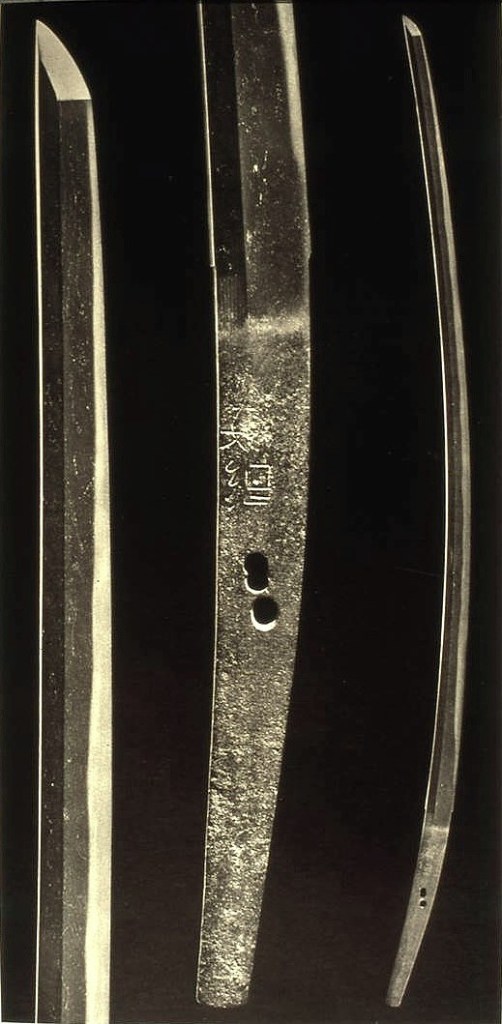
During the Heian period, among Yamashiro-den swords, the most famous sword was the “Mikazuki Munechika“ (三日月宗近) by Sanjo Munechika (三条宗近).  Mikazuki means crescent.  It was named Mikazuki Munechika because the crescent-shaped uchinoke (collection of Nie) pattern appears in the hamon.  It has a graceful shape, a narrow body, koshi-zori, funbari, and a small kissaki.  The sword shows a wood grain pattern on its surface, with suguha with nie mixed with small irregular lines, and sometimes a nijyu-ha (double hamon: 二重刃) appears.  Sanjo Munechika lived in the Sanjo area of Kyoto.  His sword style was passed down through his sons and grandsons: Sanjo Yoshiie (三条吉家), Gojo Kanenaga (五条兼永), and Gojo Kuninaga (五条国永).  Gojo is also a district in Kyoto

    三日月宗近    Mikazuki Munechika  東京国立博物館蔵 Tokyo National Museum           Photo from “Showa Dai Mei-to Zufu 昭和大名刀図譜” published by NBTHK

Houki -no-Kuni (伯耆の国)

Houki-no-kuni is the area now called Tottori Prefecture.  It is known for producing high-quality iron.  The sword, “Doujigiri Yasutsuna” (童子切安綱), made by Hoki-no-yasutsuna (伯耆の安綱), was one of the most famous swords of its time.                                                                                                 

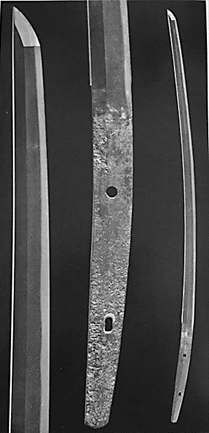
The characteristics of Yasutsuna’s sword ——- It has a graceful shape with a small kissaki, a narrow hamon (often suguha with ko-choji), coarse nie in the hamon area, and a large wood grain pattern mixed with masame on the ji-hada.  The hamon area often shows inazuma and kinsuji.  The boshi area is yakizume, and the kaen (pronounced ka as in calf, en as in engineer) has a slight turn back. 

   伯耆の安綱 (Hoki no Yasutsuna) 佐野美術館図録 (Sano Musem Catalogue)                     Permission to use granted 

Bizen Den (備前伝 )

Bizen is in Okayama Prefecture today.  It is known for producing high-quality iron.  From the Heian period to the present, Bizen has been famous for its sword-making tradition.  The sword-making group in this area during the Heian period was called the Ko-bizen group.  The most famous swordsmiths in the Ko-bizen group included Bizen Tomonari (備前友成), Bizen Masatsune (備前正恒), and Bizen Kanehira (備前包平).                                                                   

Ko-bizen group’s characteristics ———- A graceful, narrow body, a small kissaki, and a narrow-tempered line with ko-choji (small irregular) with inazuma and kin-suji.  The ji-hada displays a small wood-grain pattern.

   Bizen Kanehira (備前包平) Sano Museum Catalogue (佐野美術館図録)                          (Permission to use granted)

I saw Ko-bizen Sanetsune (真恒) at Mori Sensei’s house.  That was one of the kantei-to of that day.  I received a dozen*ᴵ.  The book written by Hon’ami Koson was used as our textbook.  Each time I saw a sword at Mori Sensei’s house, I recorded the date next to the swordsmith’s name in the book we used.  It was Nov. 22, 1970.  It had a narrow body line, a small kissaki (Ko-bizen komaru), kamasu*2 (no fukura), and suguha.  Kamasu is a condition in which the fukura (arc) is much less than usual.  Looking back, it is amazing that we had the opportunity to study such famous swords as our study materials.

Kantei-Kai

Kantei-kai is a study meeting.  Usually, several swords are displayed, with the nakago area covered.  Attendees try to guess the sword maker’s name and submit their answer sheets to the judge.  Below are the grades.

Atari —– If your answer is the exact correct name, you get Atari. That is the best answer.

Dozen —— The second best is a dozen.  It means nearly a correct answer. The subject sword was made by the family or clan of the right den.   A dozen is considered very good.  It indicates that the student has solid knowledge of the particular group.

Kaido Yoshi —– This means it is correct regarding the line, but not about the family.

Jidai Yoshi — it means the time or period is correct.  Each Kantei-kai has its own grading system.  Some may not have a “Jidai Yoshi” grade.

Hazure——– the wrong answer. 

Once all answer sheets are submitted, they are graded and returned. The judge reveals the correct answer and explains why.

*1 Dozen:  Almost the same as the correct answer. *2 Kamasu:  A name of a fish that has a narrow, pointed head.