57| Part 2 of — 23 Sengoku Period Sword (戦国時代刀)

Chapter 57 is a detailed section of Chapter 23, Sengoku Period Sword.  Please read Chapter 23, Sengoku Period Sword, before reading this part.

0-timeline - size 24 Sengoku Period

                         The red circle above indicates the time we discuss in this section

During the Sengoku period (Warring States era), the Mino-den and Bizen Osafune groups were the leading sword makers.  For nearly 100 years during the Warring States period, all daimyo needed numerous swords.  Having suppliers nearby was more advantageous.  Many Sengoku daimyo (戦国大名: warlords) could easily access the Mino region because of its central location.  Since the Heian period, Mino swordsmiths have been producing swords there.  One of the well-known swordsmiths of Mino-den at the end of the Kamakura period was Shizu Kane’uji (志津兼氏).  He was one of the Masamune juttettu (正宗十哲)*.  However, the true peak of the Mino-den came during the Sengoku periodDuring the Sengoku period, the Shizu and Tegai groups from the Yamato region, and swordsmiths from the Yamashiro area, moved to Mino.  Mino became the busiest center for sword-making, producing practical swords for feudal lords.

60-mino-map.jpg

*Masamune Juttetsu (正宗十哲) ———-The original meaning of Masamune Juttetsu was the top 10 Masamune studentsHowever, the term was later used more broadly.  Masamune Juttetsu (正宗十哲):https://www.touken-world.jp/tips/7194/

Three examples of Sengoku period swords

The three swords listed below are examples of swords from the Sengoku period.  Note that each sword is unique.  Even when the same swordsmith forged swords, each one is different.  Please refer to Chapter 23, Sengoku Period Sword, for the key characteristics of swords made during the Sengoku period.
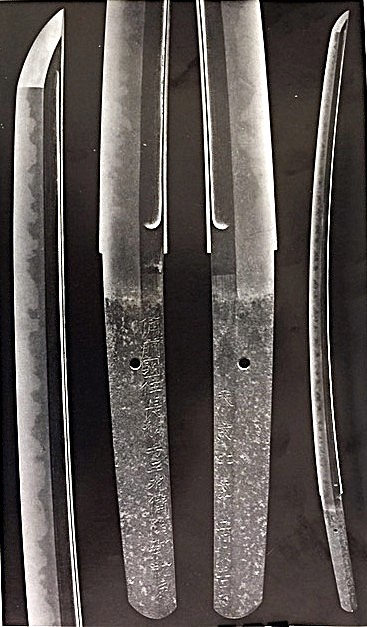
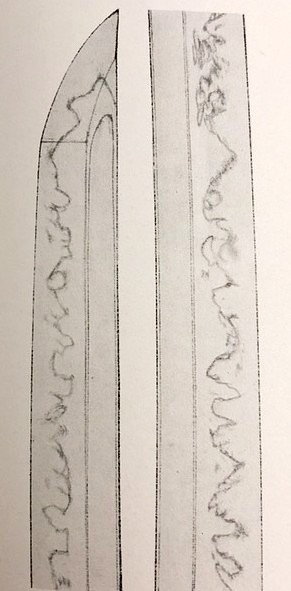
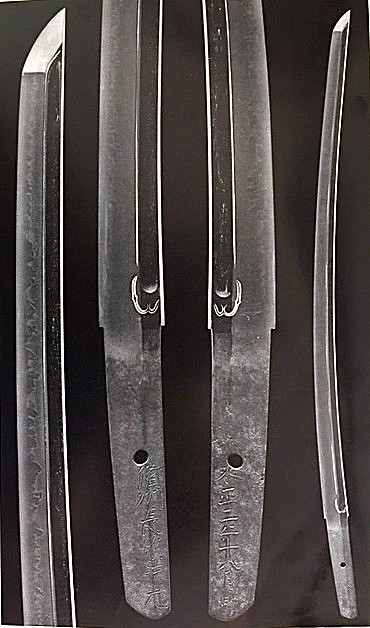
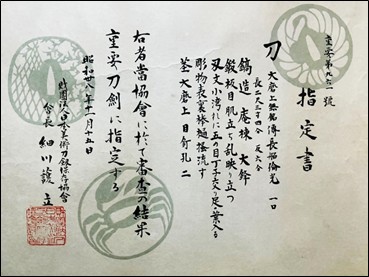
            Bizen Osafune Yosozaemon Sukesada (備前国住長船与三左衛門尉祐定) from Sano Museum Catalog (permission granted).

 Characteristis on the sword above

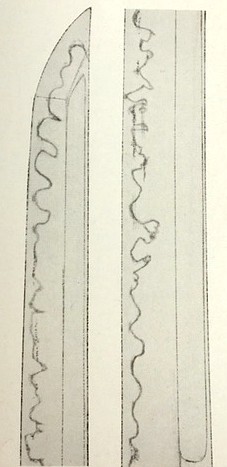
Hamon is Kani-no-tsume (crab-claw pattern; see the hamon above).  The Kani-no-tsume pattern hamon never appeared during the Heian, Kamakura, or Nanboku-cho periods.  This type of hamon is one of the key factors in determining whether a sword is from the  Sengoku Period.  Marudome-hi (the end of the groove is rounded) often appears on Bizen-den swords during the Sengoku period.  Wide tempered area.  The midare-komi boshi (where the hamon on the body and the boshi share the same pattern) has a long turn-back that stops abruptly.  The hamon has a nioi base, and most Bizen swords feature nioi, though a few exceptions exist.
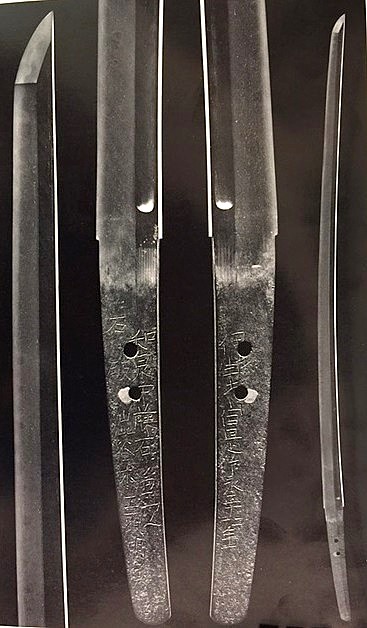
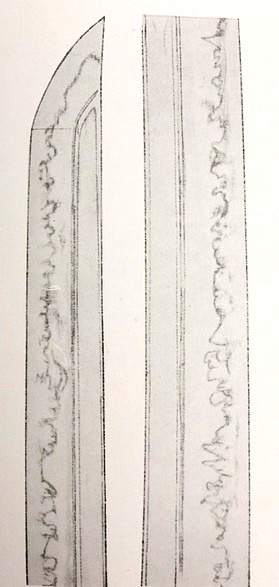
60 kanesada illustration Izuminokami Fujiwara Kanesada (和泉守藤原兼) from Sano Museum Catalog

Characteristic  on the sword above

The last character of the kanji (Chinese characters) in the swordsmith’s name above is “.”  We use this uncommon character instead of the standard “定” for him.  Because there are two Kanesada.  To distinguish him from the other Kanesada (兼定), we use the character “ “and call him Nosada “のさだ.”

Izuminokami Fujiwara Kanesada (AKA Nosada) was the leading swordsmith of Mino-den during that time.  The sword’s shape is typical of the Sengoku period: shallow curvature, a chu-gissaki (medium-sized kissaki), and a pointed gunome hamon.  The hamon width can be wide and narrow.  Nosada and other Mino-den swordsmiths often exhibit wood-grain patterns with masame on the ji-hadaNioi base, mixed with coarse nie. 

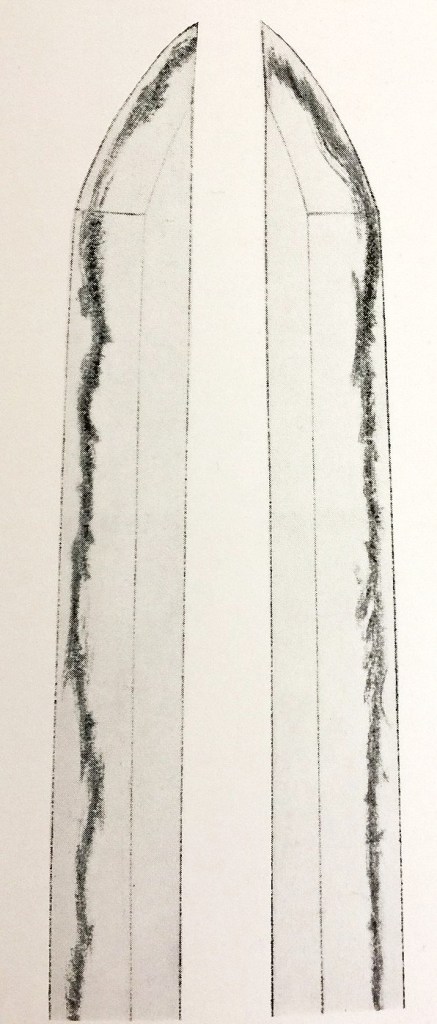
      Bizen Osafune Norimitsu (備前長船法光) from Sano Museum Catalog, permission granted.

Characteristic of the sword above

Shallow curvature.  Sturdy appearance.   Marudome-hi (the hi ends are rounded)The pointed hamon is called togari-ba (尖り刃).  Nioi base, mixed with nie.  Slight masame and wood grain patterns on Ji-hada.


49| Part 2 of — 15 The Revival of Yamato Den (大和伝復活)

This chapter is a detailed part of Chapter 15, Revival of Yamato Den.  Please read Chapter 15 before reading this section.

0-timeline - size 24 Late Kamakura                          The red circle above indicates the time we discuss in this section

At the end of the Kamakura period, powerful temples expanded their territories in the Yamato region.  Refer to the map below for the location of the Yamato region.  Several prominent temples, especially those with large territories, held political and military power to control the area at the end of the Kamakura period.  These large territories were called shoen (荘園).  They employed many monk soldiers known as so-hei.  The demand for swords increased because of the rising number of Sohei (僧兵).  This increased demand revived the Yamatoden.  

Some prominent temples had their own swordsmiths within their territories. Todaiji Temple (東大寺) supported the Tegai (手掻) sword group.  The Senjuin (千手院) sword group lived near Senju-do (千手堂), where Senju Kannon (千手観音) is enshrined.  The Taima sword group originated from the Taima-ji Temple (当麻寺).  The Shikkake group (尻懸) and the Hosho group (保昌) were also part of the Yamato-den sword groups.  These five groups are known as Yamato Goha (the Yamato five groups).

51 Japan map Yamato

General Characteristic of Yamato Den

The Yamato-den (大和伝) sword always shows masame (柾目: straight grain-like pattern) somewhere on the ji-hada, ji-gane, or hamon.  Refer to Chapter 15, Revival of Yamato Den.   Masame is sometimes mixed with mokume (burl-like pattern) or itame (wood-grain-like pattern).  Either way, Yamato-den always shows masame somewhere.  Some swords display masame across the entire blade, while others show less.  Because of the masame, the hamon often shows sunagashi (a brush stroke-like pattern) or a double line called niju-ha.

Taima (or Taema) group (当麻)

  • Shape ———————– Middle Kamakura period style and Ikubi-kissaki style    
  • Hamon ———–Mainly medium Suguha.  Double HamonSuguha mixed with Choji.  Often shows Inazuma and Kinsuji, especially Inazuma appear under the Yokote line.
  • Boshi ————————- Often Yakizume.  Refer Yakizume on 15| The Revival of Yamato Den(大和伝復活)
  • Ji-hada ——————– Small wood grain pattern and well-kneaded surface.  At the top part of the sword, the wood grain pattern becomes Masame.

Shikkake Group (尻懸 

  • Shape —————- Late Kamakura period shape. Refer 14| Late Kamakura Period: Sword (鎌倉末太刀) 
  • Hamon ————————- Mainly Nie (we say Nie-hon’i).  Medium frayed Suguha, mixed with small irregular and Gunome (half-circle pattern).  A double-lined, brush-stroke-like Pattern may appear.  Small Inazuma and Kinsuji may also be shown.      
  • Boshi ———————— Yakizume, Hakikake (bloom trace like pattern) and Ko-maru (small round)     
  • Ji-hada ———- Small burl mixed with Masame.  The Shikkake group sometimes shows Shikkake-hada (the Ha side shows Masame, and the mune side shows burl.)

Tegai Group ( 手掻 )

  • Shape —— Early Kamakura style with thick Kasane (body).  High ShinogiKoshizori.
  • Hamon ————- Narrow tempered line with medium Suguha hotsure (frayed Suguha).   Mainly Nie.   Double tempered line.  Inazuma and Kinsuji may show.                                                                 
  • Boshi ————————————— Yakizume (no turn back), Kaen (flame-like).   
  • Ji-Hada ————————————————— Fine burl mixed with Masame. 

51 Kanenaga photo Yamato51 Kanenaga ilustration Yamato

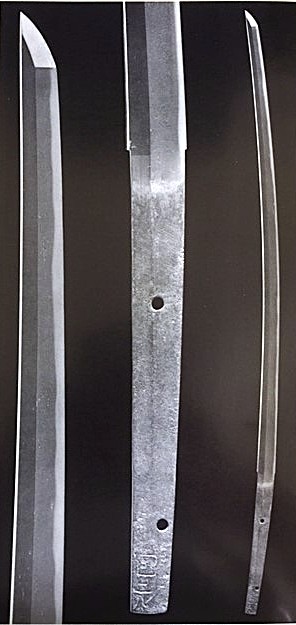
Tegai Kanenaga of Yamato.  From the Sano Museum Catalogue (permission granted).   The illustration (called Oshigata) shows notare (wave-like hamon) and suguha-hotsure (frayed suguha pattern) with kinsuji.

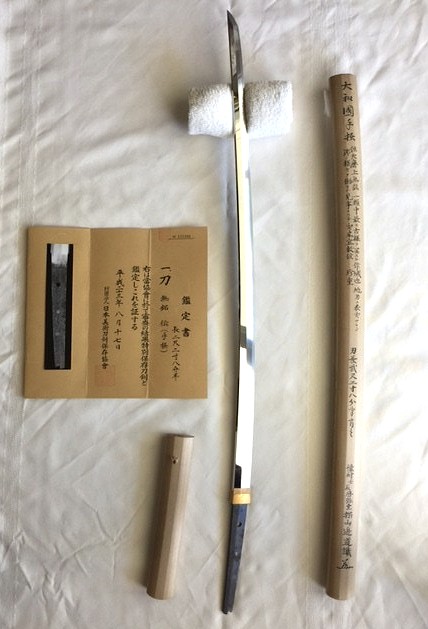
My Yamato sword Acquired at the Annual San Francisco Swords Show.

Characteristics: Munei (shortened and without signature).  Yamato-den, Tegai-ha (Yamato school Tegai group).  Length is two shaku, two sun, eight &1/2 bu (27 1/4 inches), small kissaki and funbari. HamonNiju-ba, Sunagashi.  Boshi: Yakizume.  Ji-hada: Itame with masame, Nie-hon’i .                                                                                                                                     

My Yamato sword

The full view of the sword and Kantei-sho (NBTHK Certification). “Tokubetsu Hozon Token”.

My Yamato sword 5

My Yamato sword 4

My Yamato sword.jpg 2

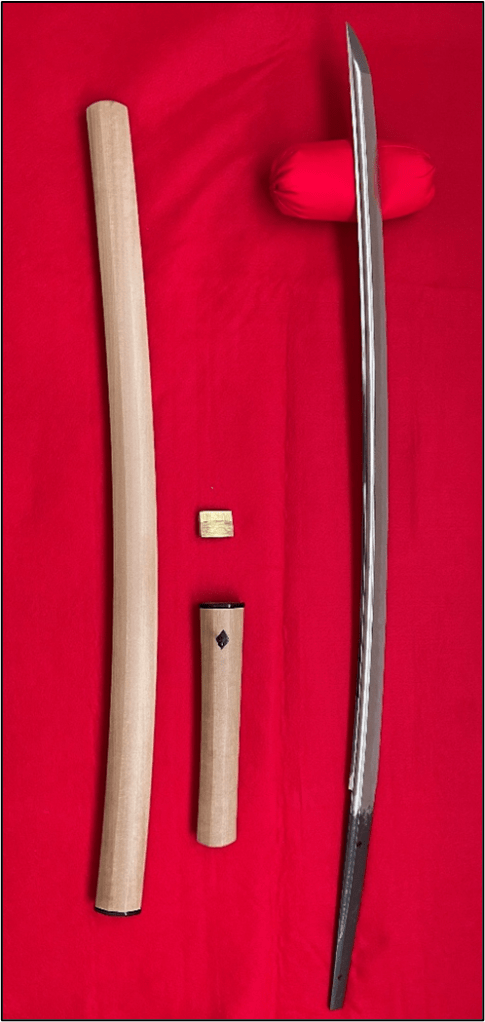
My sword: acquired at Dai Token Ichi (大刀剣市)Bizen Osafune Tomomitsu (備前長船倫光) Length: 2 feet 4 inches,  Shape: Shinogi zukuri,  Hada:itame midare-utsuri, Hamon: konotare gunome choji