61|Part 2 of — 27 Shin-to Main 7 Regions (part A)

Chapter 61 is a detailed part of Chapter 27, Shinto Main 7 Regions (part A).  Please read Chapter 27 before reading this section. 

0-timeline - size 24 Shin-to                        The red circle above indicates the time we discuss in this section

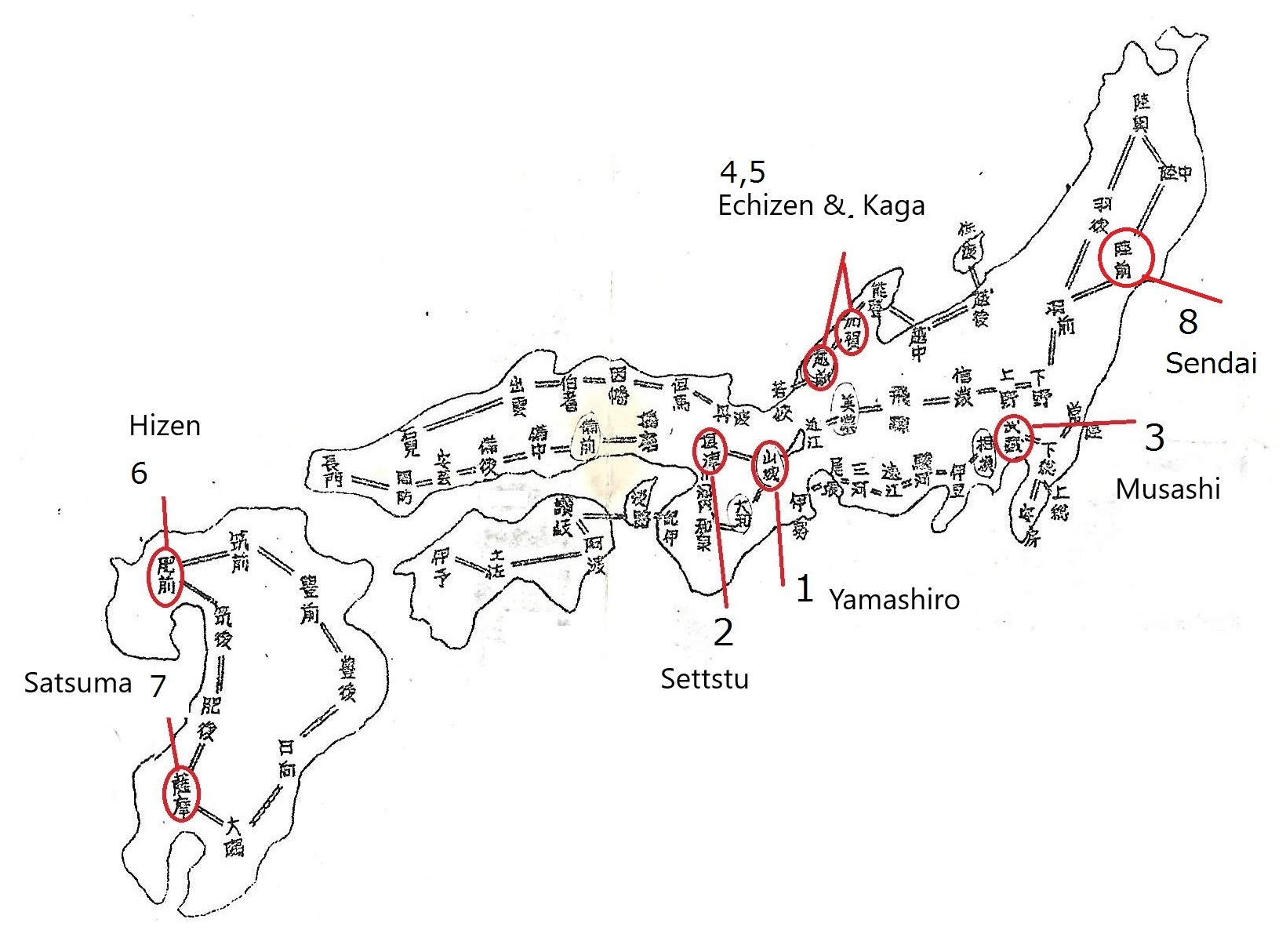
Chapter 27, Shin-to Main 7 Regions (Part A), and Chapter 28, Shin-to Main 7 Regions (Part B), describe an overview of the seven main regions.  This chapter and the next chapter show photos of representative swords from these regions.  They are Yamashiro (山城, in Kyoto), Settsu (摂津, today’s Osaka), Musashi (武蔵, Edo), and Satsuma (薩摩, Kyushu).  However, Echizen (越前), Kaga (加賀), and Hizen (肥前) are omitted.
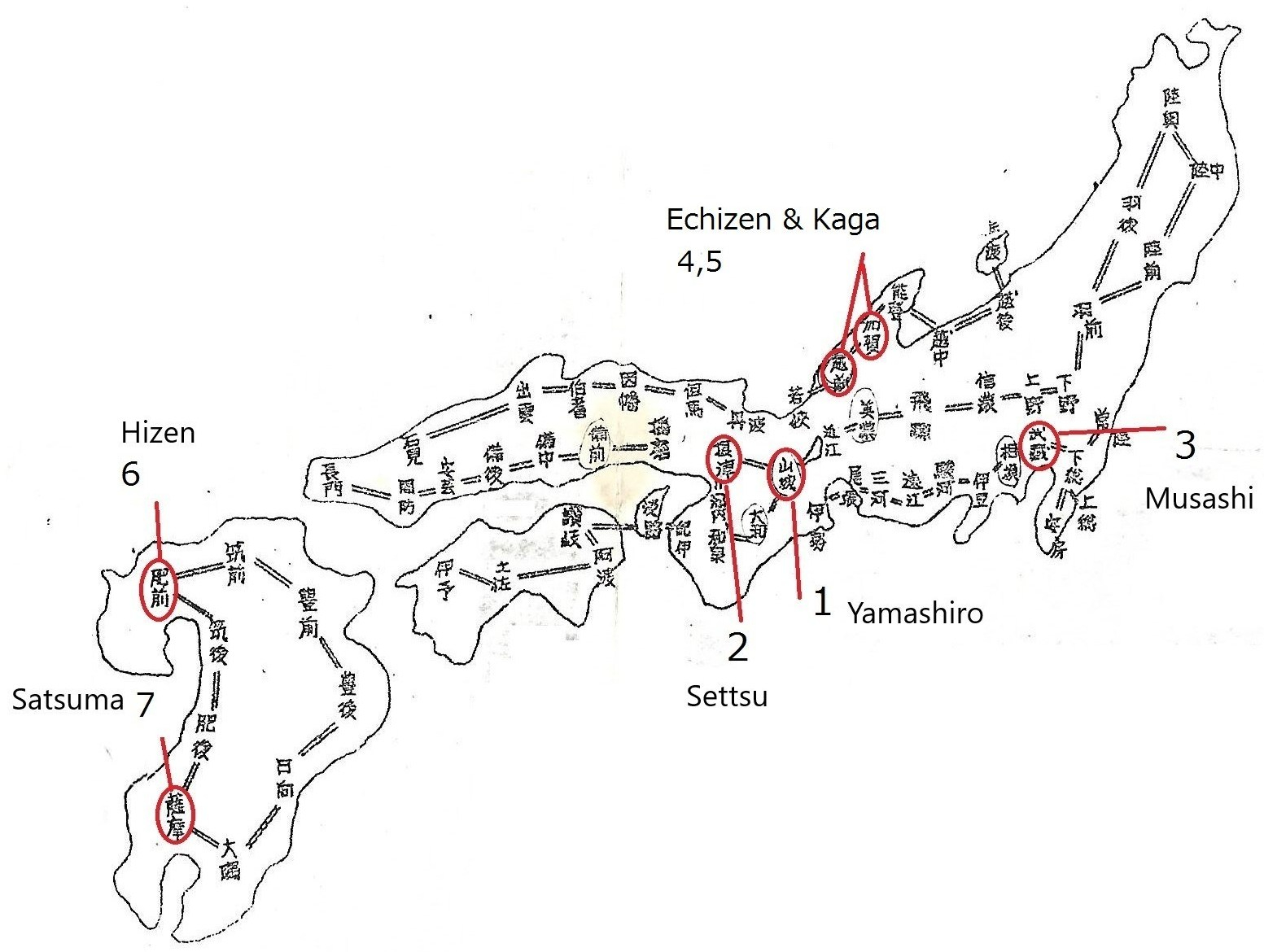
29 Map with number 7

With ko-to swords, features such as the condition of the hamon, kissaki size, length, and  shape of the nakago, etc., indicate when the sword was made.  During the ko-to period, Bizen swordsmiths produced Bizen-den swords, Yamashiro swordsmiths made Yamashiro-den swords, and Mino swordsmiths made Mino-den swords.  However, during the shin-to period, that is not the case.  The den and the swordsmith’s location often do not match.  For shin-to swords, we study the swordsmiths and swords from the seven main regions along with their characteristics.

Regarding swords made during the ko-to period, if a sword has a wide hamon line with  nie, usually, its ji-hada shows a large wood grain or a large burl grain.  Also, when you see a narrow hamon line, it typically features a fine ji-hada.

However, with shin-to swords, if a sword shows a wide hamon with nie, it often has a small wood grain or small burl grain pattern on ji-hada.  If it has a narrow hamon line, it may have a large wood grain pattern on the ji-hada.  This is a shin-to characteristic.   

Here is an exception: some early Soshu-den swords from the late Kamakura period may show a wide hamon with nie, which has small burls on the ji-hada.  Because of that, whether it is ko-to or shin-to can be confusing.  Even so, other features such as ji-hada or other parts should indicate whether it is shin-to or ko-to.

Yamashiro (山城: Kyoto)
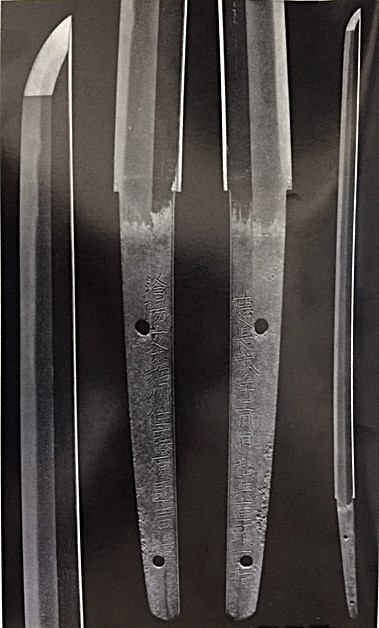
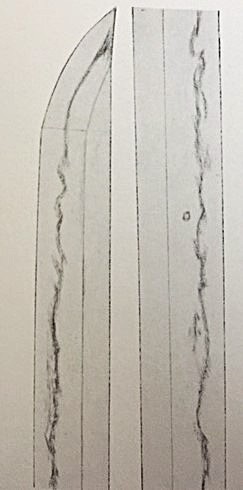
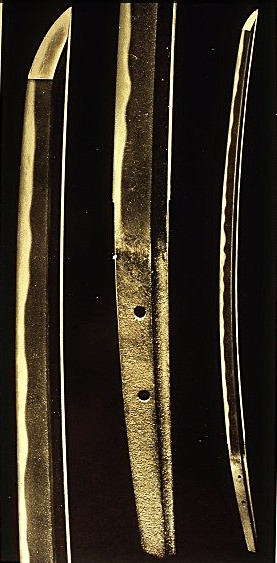
 Horikawa Kunihiro   (堀川国広)   From Sano Museum Catalogue (permission granted)

Horikawa Kunihiro (堀川国広)

Horikawa Kunihiro was regarded as a master swordsmith among shin-to swordsmiths.  He forged swords in many styles with various characteristics.  The hamon types are o-notare, o-gunome, togari-ba (pointed hamon), chu-suguha with hotsure (frayed look), hiro-suguha with a sunagashi effect, inazuma, and kinsujiKunihiro preferred to shape his swords to resemble an o-suriage (shortened Nanboku-cho style long sword).  Kunihiro‘s blades give a powerful impression.  Kunihiro‘s swords often feature beautiful carvings; designs include dragons, Sanskrit letters, and more.  Because he created swords in many different styles, there is no general characteristic that defines his work other than the hamon mainly being nie.  His ji-hada is finely forged.                                                                                                                                                                                                                                                                                                                                                     
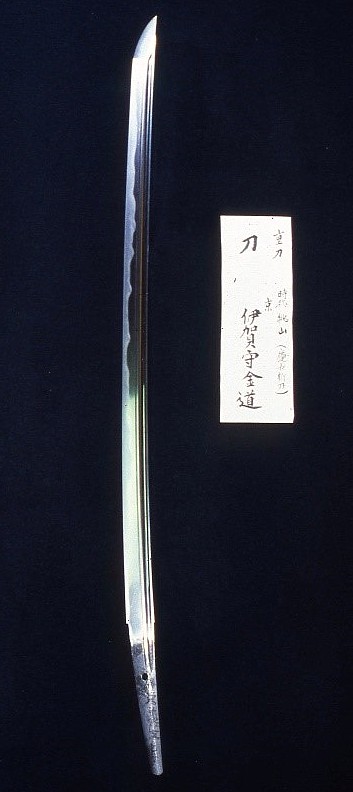
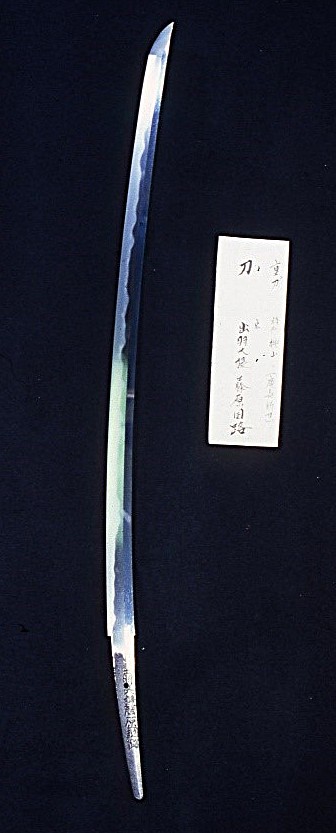
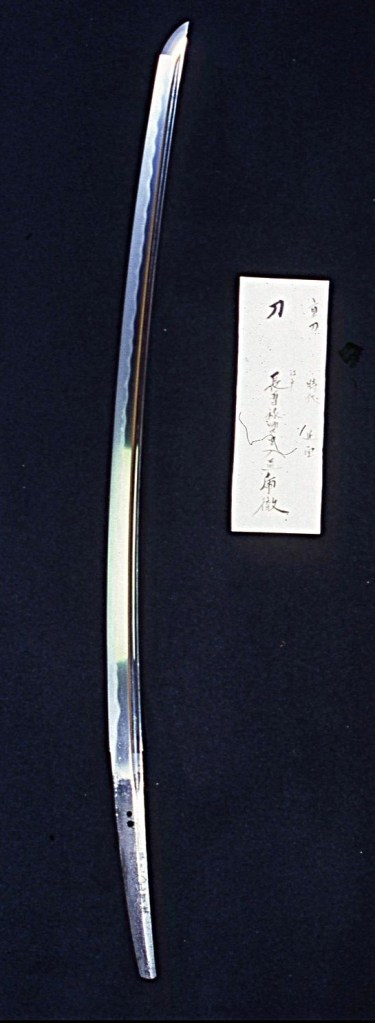
img067.jpg  img068.jpg      Iga-no-Kami Kinnmichi (伊賀守金道)           Dewa Daijyo Kunimichi (出羽大掾国路)        Both Juyo Token (重要刀剣), once my family owned, photos were taken by my father.

Iga-no-Kami Kinmichi ( 伊賀守金道)

The Kinmichi family is called the Mishina group.  Refer to 27 Shinto Main 7 Regions  Part A.   Iga-no-Kami Kinmichi was awarded the Japanese Imperial chrysanthemum crest. 

The characteristics of Kinmichi ——– Wide sword, shallow curvature, an extended kissaki, sakizori (curvature at 1/3 top),  a wide tempered line, kyo-yakidashi (see 27 Shinto Main 7 Regions  A ), hiro-suguha (wide straight hamon), o-notare (large wavy), yahazu-midare, hako-midare (refer to 24 Sengoku Period Tanto).  Mishina-boshi, refer to 27 Shin-to Main 7 Regions A.  Fine wood burl, masame appear in the shinogi-ji area.   

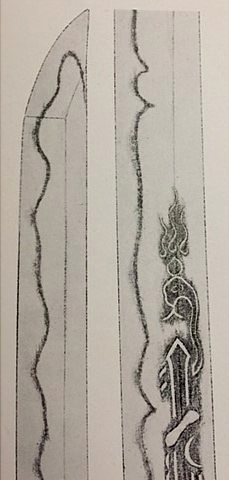
Dewa Daijo Kunimichi (出羽大掾国路)                                                                                 

Dewa Daijo Kunimichi was the top student of Horikawa Kunihiro.  The right photo above.  Like Kunihiro, the sword resembles a shortened Nanboku-cho sword.  Shallow curvature, a wide body, a somewhat elongated kissaki, and fukura-kareru (less arch in fukura).  Wide tempered lines, large gunome, nie with sunagashi, or inazuma shows.  Double gunome (two gunome side by side) appears.  Fine ji-hada.                                                                                                                                                                                                                

  1. Settu (摂津) Osaka (大阪 )

Settu (Osaka) is home to many famous swordsmiths.  They are Kawachi-no-Kami Kunisuke (河内守国助), Tsuda Echizen-no-Kami Sukehiro (津田越前守助広), Inoue Shinkai (井上真改), and Ikkanshi Tadatsuna (一竿子忠綱), among others.                          The main characteristic of the Settsu (Osaka) sword ——– The surface is beautiful and fine, almost like a solid surface with no pattern or design.  The two photos below are of the Settsu sword.
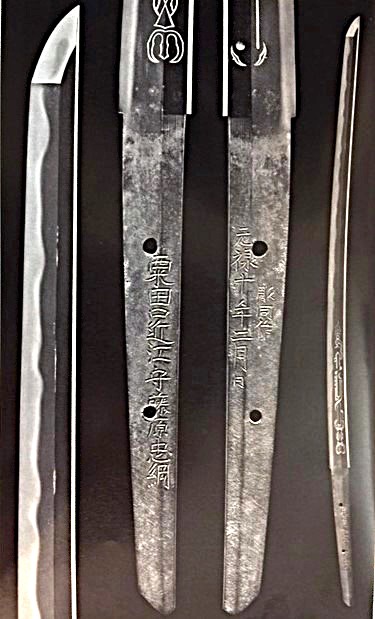
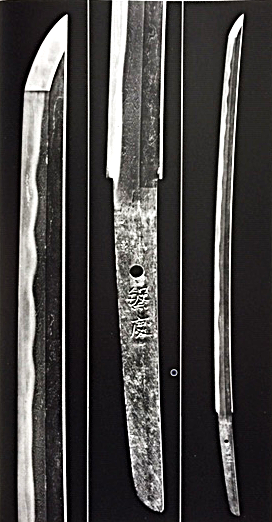
              Ikkanshi Tadatsuna from the Sano Museum Catalogue.  Permission granted to use.

Ikkanshi Tadatsuna (一竿子忠綱)

Ikkanshi Tadatsuna was famous for his carvings.  His father was also a well-known swordsmith, Omi-no-Kami Tadatsuna (近江守忠綱)Consequently, he was known as Awataguchi Omi-no-Kami Fujiwara Tadatsuna (粟田口近江守藤原忠綱), as shown in the nakago photo above.     

The characteristics of Ikkanshi Tadatsuna ——-A longer kissaki and a wide-tempered line with nie.  The Osaka yakidashi (transition between the suguha above machi and midare is smooth.  Refer to 27 Shin-to Sword – Main 7 Regions (Part A) for details on Osaka yakidashi.  O-notare with gunome, komaru-boshi with a turn back, and very fine ji-hada with almost no pattern on the surface.
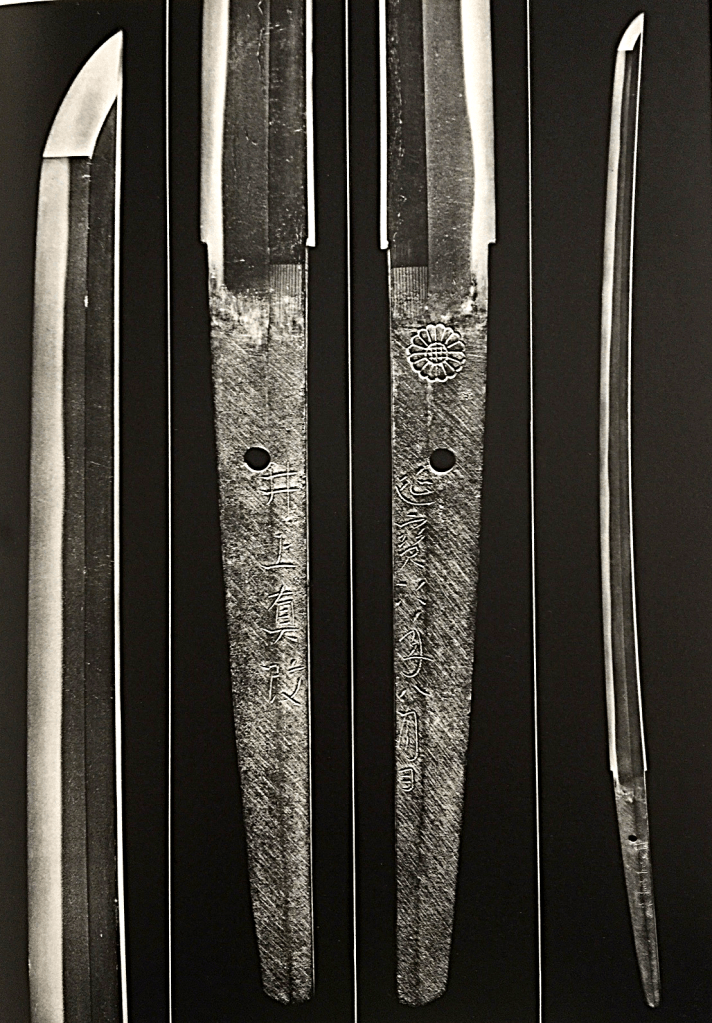
                        Inoue Shinkai (井上真改) from “Nippon-to Art Swords of Japan” The Walter A. Compton Collection

Inoue Shinkai (井上真改)

Inoue Shinkai was the second generation of Izumi-no-Kami Kunisada (和泉守国貞), who was a student of Kunihiro.                                                                                                  The characteristic of Inoue Shinkai’s swords —————- Osaka yakidashi, the tempered line gradually widens toward the top.  O-notare and deep nie.  Very fine ji-hada with almost no surface design.

60|Part 2 of – – 26 Overview of Shin-To (新刀概要)

Chapter 60 is a detailed part of Chapter 26, Overview of Shinto (新刀概要).  Please read Chapter 26 before reading this section.

0-timeline - size 24 edo Period

                   The red circle above indicates the time we discuss in this section    

The difficulty of Shin-to Kantei

Regarding swords from the ko-to period, you can estimate when they were made by analyzing their style and shape.  Several factors indicate which period and which Gokaden (五ヶ伝) created the sword by examining several points, such as the appearance of the hamon or the appearance of the ji-gane.  However, swords from the shin-to period do not follow this method.     

Although there are differences among shin-to swords made during the early Edo period, around the Keicho (慶長: 1596 ~) era, the middle Edo period, that is around the Kanbun (寛文: 1661 ~) era, and the late Edo period, that is the Genroku era (元禄: 1688 ~), these differences are not much. 

The same applies to the Gokaden (五ヶ伝) during the shin-to period.  In the ko-to time, Bizen swordsmiths forged swords with Bizen characteristics.  Swords made by Yamato swordsmiths usually showed the Yamato-den features.  However, during the shin-to period, a swordsmith from one specific den sometimes forged blades in the style of another den’s featuresAs a result, it is difficult to determine the maker of a particular sword. 

For shin-to, we will study the characteristics of the seven main locations, which will be discussed in the following chapters.

Picturesque Hamon

During and after the Genroku era (元禄1688 – 1704), some picturesque hamon style became trendy.  Several swordsmiths created picturesque hamon on wakizashi and short swords.  As it gained popularity, especially among foreigners, most of these swords were exported from Japan during the Meiji Restoration.  Today, very few remain in Japan.

The swordsmiths who made picturesque  Hamon 

Yamashiro (山城) area ———————————-Iga-no-kami Kinmichi (伊賀守金道),                                                                                       Omi-no-kami Hisamichi (近江守久道)

Settsu (摂津) area ———————————Tanba-no-Kami Yoshimichi  (丹波守吉道)                                                                                 Yamato-no-Kami Yoshimichi (大和守吉道)

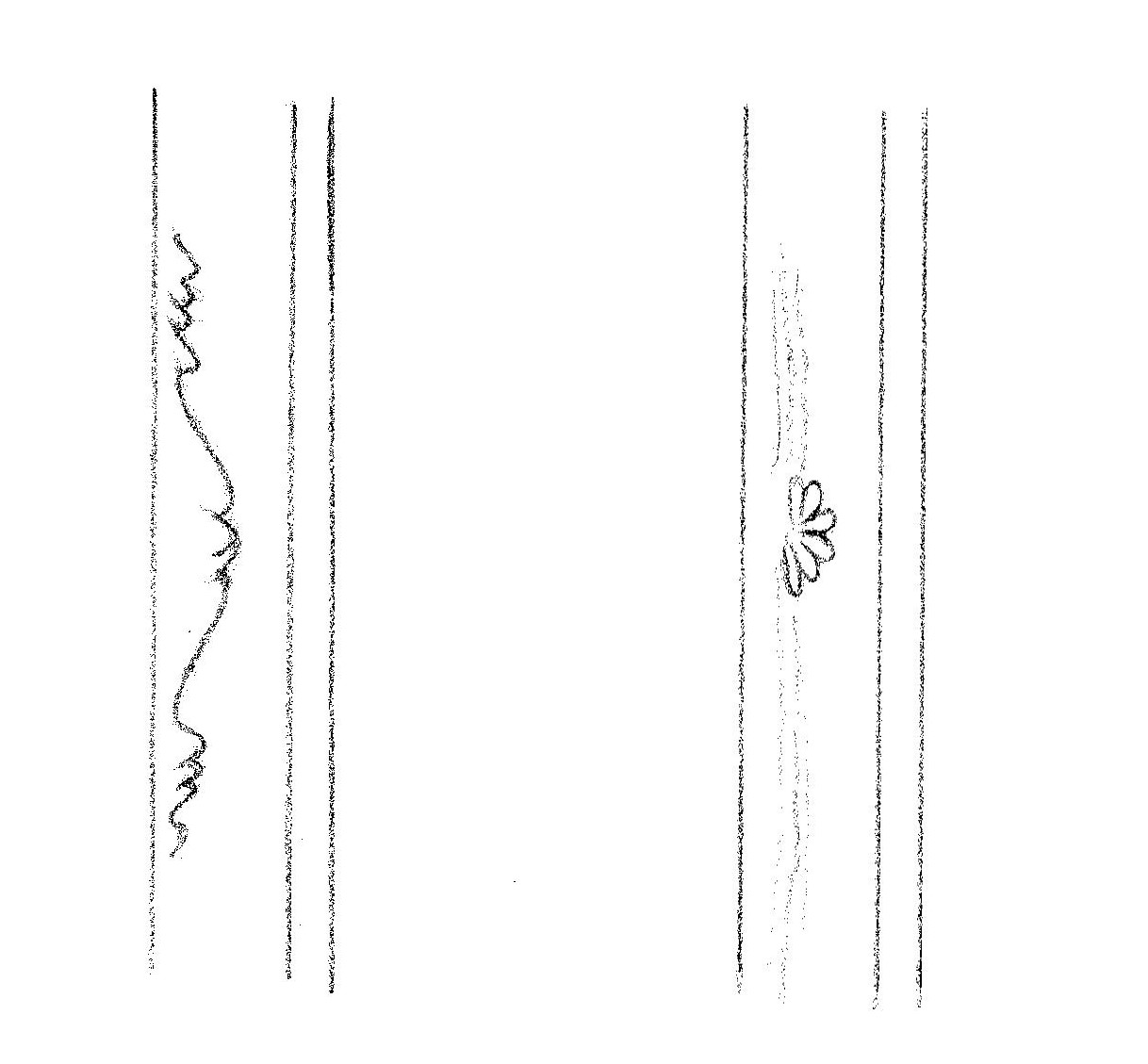
Below are examples.  Fuji is the Mount Fuji designKikusui is a chrysanthemum in the water.

63 fuji sakura hamon

        Fuji                                      Kikusui

49| Part 2 of — 15 The Revival of Yamato Den (大和伝復活)

This chapter is a detailed part of Chapter 15, Revival of Yamato Den.  Please read Chapter 15 before reading this section.

0-timeline - size 24 Late Kamakura                          The red circle above indicates the time we discuss in this section

At the end of the Kamakura period, powerful temples expanded their territories in the Yamato region.  Refer to the map below for the location of the Yamato region.  Several prominent temples, especially those with large territories, held political and military power to control the area at the end of the Kamakura period.  These large territories were called shoen (荘園).  They employed many monk soldiers known as so-hei.  The demand for swords increased because of the rising number of Sohei (僧兵).  This increased demand revived the Yamatoden.  

Some prominent temples had their own swordsmiths within their territories. Todaiji Temple (東大寺) supported the Tegai (手掻) sword group.  The Senjuin (千手院) sword group lived near Senju-do (千手堂), where Senju Kannon (千手観音) is enshrined.  The Taima sword group originated from the Taima-ji Temple (当麻寺).  The Shikkake group (尻懸) and the Hosho group (保昌) were also part of the Yamato-den sword groups.  These five groups are known as Yamato Goha (the Yamato five groups).

51 Japan map Yamato

General Characteristic of Yamato Den

The Yamato-den (大和伝) sword always shows masame (柾目: straight grain-like pattern) somewhere on the ji-hada, ji-gane, or hamon.  Refer to Chapter 15, Revival of Yamato Den.   Masame is sometimes mixed with mokume (burl-like pattern) or itame (wood-grain-like pattern).  Either way, Yamato-den always shows masame somewhere.  Some swords display masame across the entire blade, while others show less.  Because of the masame, the hamon often shows sunagashi (a brush stroke-like pattern) or a double line called niju-ha.

Taima (or Taema) group (当麻)

  • Shape ———————– Middle Kamakura period style and Ikubi-kissaki style    
  • Hamon ———–Mainly medium Suguha.  Double HamonSuguha mixed with Choji.  Often shows Inazuma and Kinsuji, especially Inazuma appear under the Yokote line.
  • Boshi ————————- Often Yakizume.  Refer Yakizume on 15| The Revival of Yamato Den(大和伝復活)
  • Ji-hada ——————– Small wood grain pattern and well-kneaded surface.  At the top part of the sword, the wood grain pattern becomes Masame.

Shikkake Group (尻懸 

  • Shape —————- Late Kamakura period shape. Refer 14| Late Kamakura Period: Sword (鎌倉末太刀) 
  • Hamon ————————- Mainly Nie (we say Nie-hon’i).  Medium frayed Suguha, mixed with small irregular and Gunome (half-circle pattern).  A double-lined, brush-stroke-like Pattern may appear.  Small Inazuma and Kinsuji may also be shown.      
  • Boshi ———————— Yakizume, Hakikake (bloom trace like pattern) and Ko-maru (small round)     
  • Ji-hada ———- Small burl mixed with Masame.  The Shikkake group sometimes shows Shikkake-hada (the Ha side shows Masame, and the mune side shows burl.)

Tegai Group ( 手掻 )

  • Shape —— Early Kamakura style with thick Kasane (body).  High ShinogiKoshizori.
  • Hamon ————- Narrow tempered line with medium Suguha hotsure (frayed Suguha).   Mainly Nie.   Double tempered line.  Inazuma and Kinsuji may show.                                                                 
  • Boshi ————————————— Yakizume (no turn back), Kaen (flame-like).   
  • Ji-Hada ————————————————— Fine burl mixed with Masame. 

51 Kanenaga photo Yamato51 Kanenaga ilustration Yamato

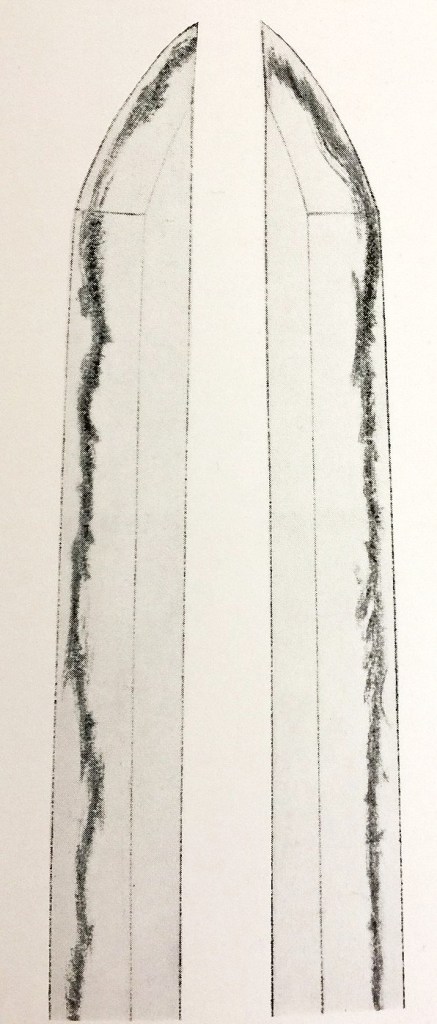
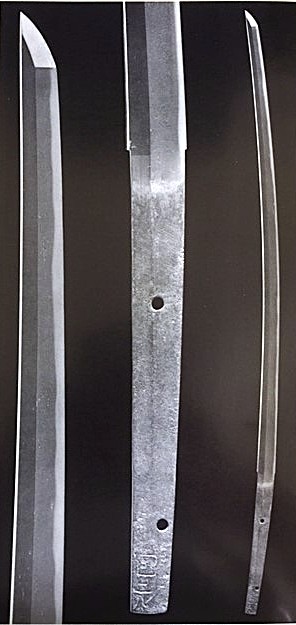
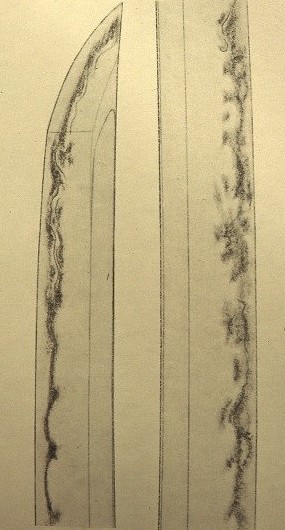
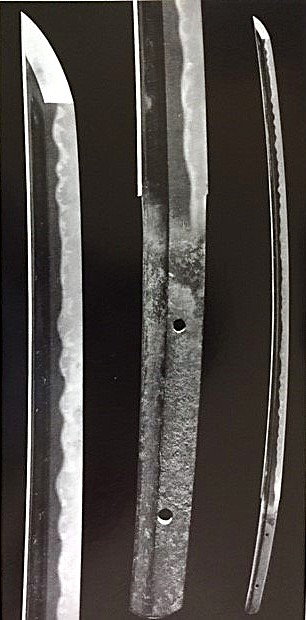
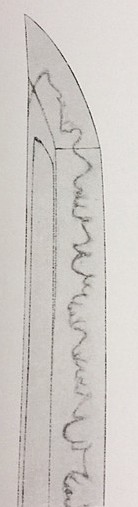
Tegai Kanenaga of Yamato.  From the Sano Museum Catalogue (permission granted).   The illustration (called Oshigata) shows notare (wave-like hamon) and suguha-hotsure (frayed suguha pattern) with kinsuji.

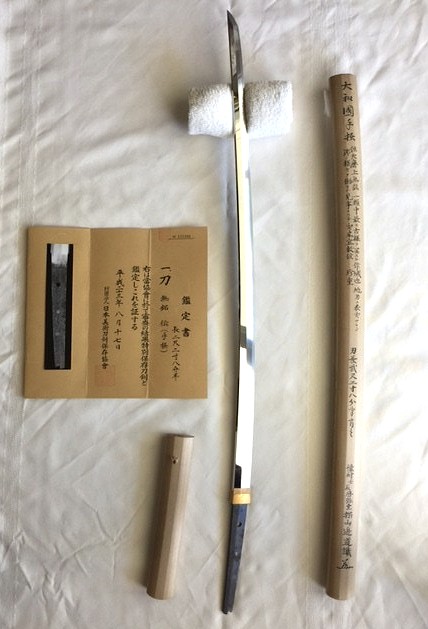
My Yamato sword Acquired at the Annual San Francisco Swords Show.

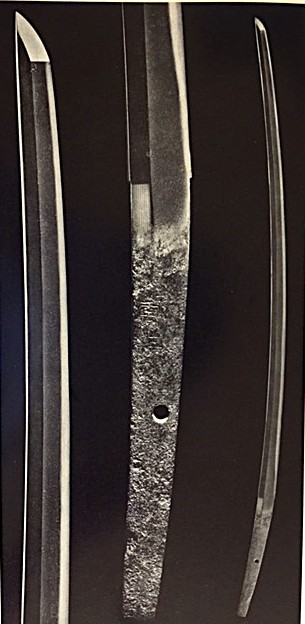
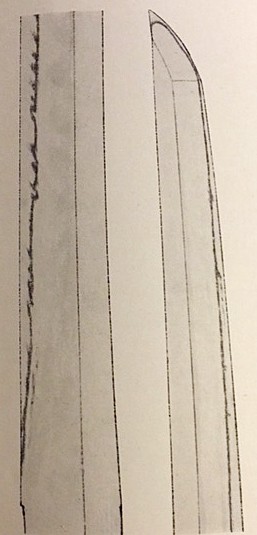
Characteristics: Munei (shortened and without signature).  Yamato-den, Tegai-ha (Yamato school Tegai group).  Length is two shaku, two sun, eight &1/2 bu (27 1/4 inches), small kissaki and funbari. HamonNiju-ba, Sunagashi.  Boshi: Yakizume.  Ji-hada: Itame with masame, Nie-hon’i .                                                                                                                                     

My Yamato sword

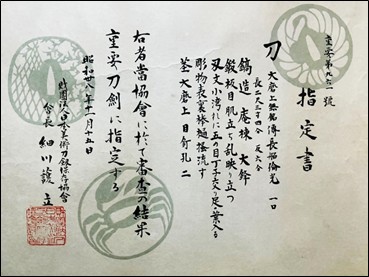
The full view of the sword and Kantei-sho (NBTHK Certification). “Tokubetsu Hozon Token”.

My Yamato sword 5

My Yamato sword 4

My Yamato sword.jpg 2

My sword: acquired at Dai Token Ichi (大刀剣市)Bizen Osafune Tomomitsu (備前長船倫光) Length: 2 feet 4 inches,  Shape: Shinogi zukuri,  Hada:itame midare-utsuri, Hamon: konotare gunome choji

48|Part 2 of — 14|Late Kamakura Period Sword : Early Soshu Den (鎌倉末刀)

This is a detailed section of Chapter 14| Late Kamakura Period Sword.  Please read Chapter 14 before this part.

0-timeline - size 24 Late Kamakura

                         The red circle above indicates the time we discuss in this section.

14 Ikubi kissaki Damadge

In Chapter 14, “Late Kamakura Period Sword (鎌倉末太刀),” the ikubi-kissaki sword is explained.  The illustration above shows a flaw caused when the damaged area was repaired.  To compensate for this flaw, swordsmiths developed a new sword style during the late Kamakura period.  They forged swords with a longer kissaki and lowered the tip of the hi below the yokote line.   This way, if the yokote line were lowered during repairs, the tip of the hi would remain below the yokote line.

15 Masamune (Sano)   15 Masamune hamon (Sano)

The above photo shows a sword by Goro Nyudo Masamune (五郎入道正宗).  Please observe the size and shape of the kissaki.  This differs from the previous ikubi-kissaki and ko-gissaki stylesThis style represents a typical late Kamakura period kissaki style.  It is o-suriage (a largely shortened form). 

Under the Kamakura Bakufu, many swordsmiths moved to KamakuraThey were Toroku Sakon Kunituna (藤六左近国綱) of the Yamashiro Awataguchi group (山城粟田口), Fukuoka Ichimonji Sukezane (福岡一文字助真), and Kunimune (国宗) from the Bizen area.  They were the origin of Soshu-den (相州伝)Eventually, Tosaburo Yukimitsu (藤三郎行光) and his famous son, Masamune (正宗), emergedIn the drawing above, kinsuji and inazuma are shown within the hamon.  The shining lines inside the hamon are inazuma and kinsuji.  Inazuma and kinsuji are collections of nie.  Masamune is well-known for his inazuma and kinsuji.  He lived in Kamakura, a seaside town, and his hamon resembles ocean waves when viewed from the side.

50 part 2 of 15 吉岡.photo 50 part 2 of 15 吉岡

The picture above shows a sword made by the swordsmith Yoshioka Ichimonji group (吉岡一文字).  The kissaki resembles one of Masamune’s swordsIt is longer than the previous ikubi-kissaki or ko-gissaki.  This is chu-gissaki.  The kissaki, like this, is one of the key points in determining the period when the sword was made.  The hamon has choji, gunome, togariba (pointed tip), and very tight nie.

50 part 2 of 15 運生 photo 50 part 2 of 15 運生 

The photo above shows a sword by Ukai Unsho (鵜飼雲生) from Bizen-den.  This sword is also from the late Kamakura period, but it has a ko-gissaki.  This sword does not have the late Kamakura period chu-gissaki style.  Narrow hoso-suguha are more characteristic of an earlier time than the late Kamakura periodThis sword indicates that swords do not always exhibit the style of their period.  To kantei*: first examine the style and shape, then give yourself an idea of the period it was made in.  However, the kissaki in this case does not indicate the late Kamakura period.  The next step is to look at the various characteristics of the sword one by one, such as the hamon, nie or nioi, ji-hada, etc., to determine the period, the den, and the province, and then come up with the name. This process is called kantei.

*Kantei – the process of identifying a swordsmith’s name by analyzing the sword’s characteristics without seeing the mei (the inscribed smith’s name).  The mei might be gone if it has been shortened.   All the photos above are from the Sano Museum Catalogue.  Permission to use them is granted.

46|Part 2 of — 12|Middle Kamakura Period: Tanto 鎌倉中期短刀

This chapter is a datiled part of chapter of 12| Middle Kamakura Period Tanto ( 短刀) .  Please read Chapter 12 before reading this section.

0-timeline - size 24 Middle Kamakura

                   The circle above indicates the time we discuss in this section


In Chapter 12, Middle Kamakura Period: Tanto, it is described that the tanto shape called takenoko-zori appeared during the middle Kamakura period.  This type of tanto  curves slightly inward at the tip.  The drawing below may be somewhat exaggerated to show the curve.  The actual curvature of the takenoko-zori is not very noticeable.  Perhaps only a few millimeters inward. 

Usually, the length of a tanto is around 12 inches.  Tantos are categorized as follows: if it is approximately ten inches, it is called a josun tanto (定寸短刀), longer than ten inches is called a sun-nobi tanto (寸延び短刀), and shorter than ten inches is called a sun-zumari tanto (寸詰短刀).

12Tanto drawing Mid Kamakur

Sun-nobi Tanto (寸延び)   >   Jyosun Tanto (定寸)   >  sun-zumari Tanto (寸詰り)  (longer than 10 inches)           (approx. 10 inches)                (less than 10 inches

13 «Part 2» Tanto photo

 46 Shintogo Kunimitsu Oshigata

Shintogo Kunimitsu (新藤五国光)  Sano Museum Catalogue, permission granted to use

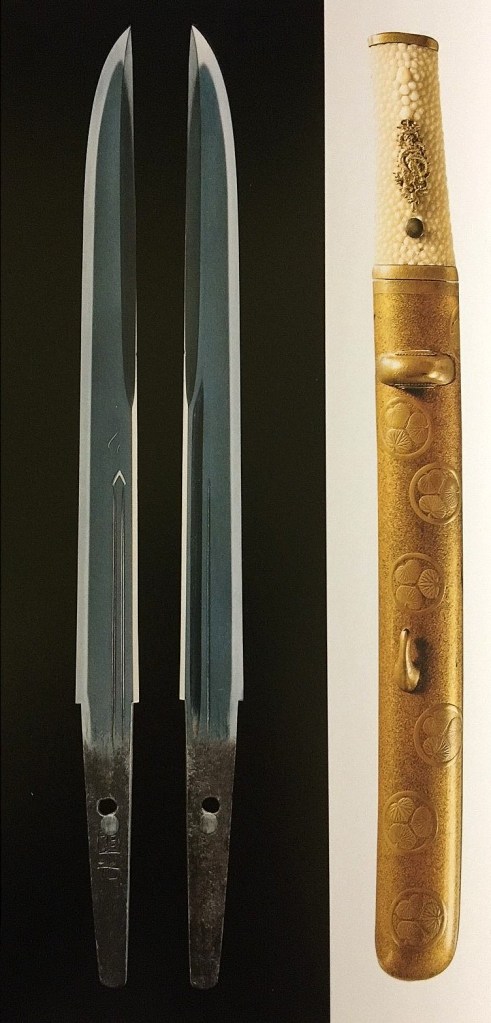
The style above is called kanmuri-otoshi (冠落); the mune side (opposite side of the  cutting edge) is shaved off.  The length is approx. 10 inches: woodgrain pattern surface  with nie on ji (refer to Chapter 3, Names of parts).   Very finely forgedThe hamon is a medium suguha (straight).  The boshi is ko-maru (small round).  Due to the kanmuri-otoshi style, it may not be easy to see the takenoko-zori; the mune side slightly bends inward.  Shintogo Kunimitsu is regarded as the top tanto maker.

13 «Part 2»Tanto photo with Saya

The above photo is also by Shintogo Kunimitsu (新藤五国光) with Saya.  Saya is the scabbard.  The handle of the scabbard (white part) is made of sharkskin.  Both photos are from the  Sano Museum Catalog “Reborn.”  Permission granted.                                                                     

45|Part 2 of –11 Ikubi Kissaki (continued from Chapter 44)

This chapter is a detailed section of Chapter 11, Ikubi-kissaki, and continues from Chapter 44|Part 2 of 11 Ikubi-kissaki Sword.  Please read Chapter 11 and Chapter 44 before proceeding with this section.

0-timeline - size 24 Middle Kamakura

 The red circle above indicates the time we discuss in this section.

Bizen Saburo Kunimune (備前三郎国宗)

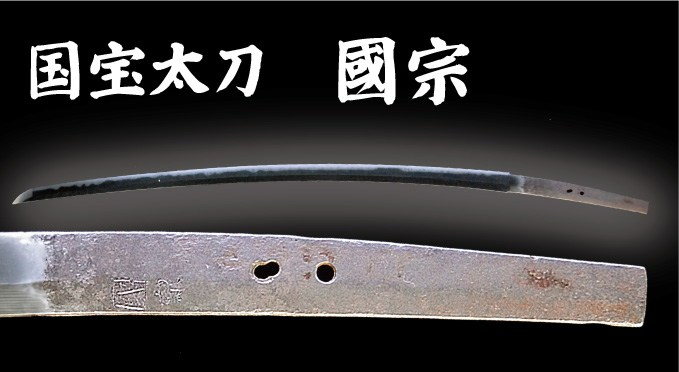
Another swordsmith worth mentioning in this section is Bizen Saburo Kunimune (備前三郎国宗).  During the middle Kamakura period, the Hojo clan invited top swordsmiths to Kamakura.  Awataguchi Kunitsuna (粟田口国綱) from Yamashiro in Kyoto, Fukuoka Ichimonji Sukezane (福岡一文字助真) from the Bizen area, and Bizen Kunimune (備前国宗) from the Bizen area moved to Kamakura with their circle of people.  These three groups started the Soshu-den (相州伝).  Refer to Chapter 14, Late Kamakura Period Swords.

  • Sugata (shape)  ——————— Ikubi-kissaki style.  Sometimes Chu-gissaki.  Thick body.  Koshi-zori. Narrow Shinogi width.                                                                                                
  • Horimono (Engravings)  —————- Often narrow Bo-hi (single groove)
  • Hamon (Tempered line) ————- O-choji Midare (irregular large clove shape) with Ashi.  Or Ko-choji Midare (irregular small clove shape) with AshiNioi base with Ji-nie (Nie in the Hada area).  Some Hamon appear squarish with less Kubire (less narrow at the bottom of the clove).   Hajimi (刃染み rough surface) may show.  The Kunimune swords often show a lower part with Choji and an upper part with less activity without Ashi                                                                                                                                                                                                                        

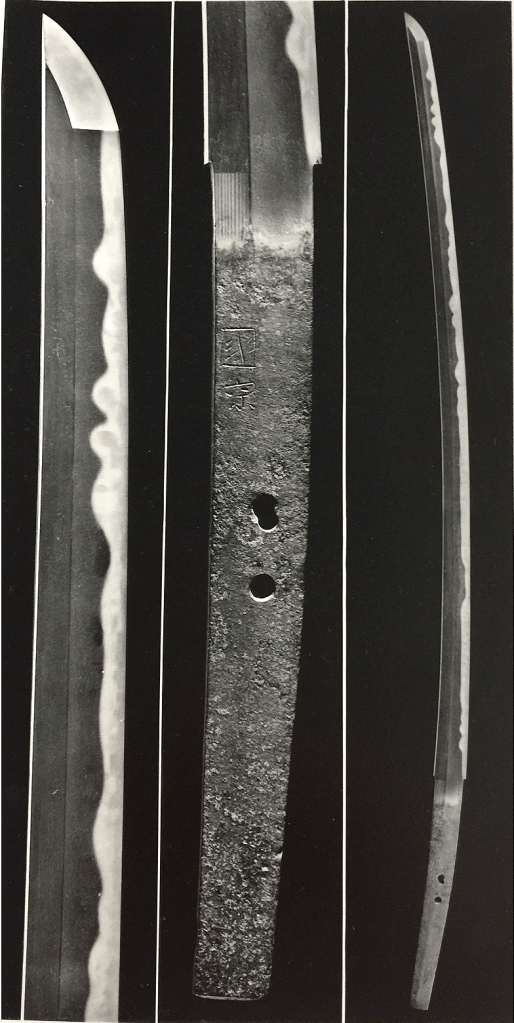
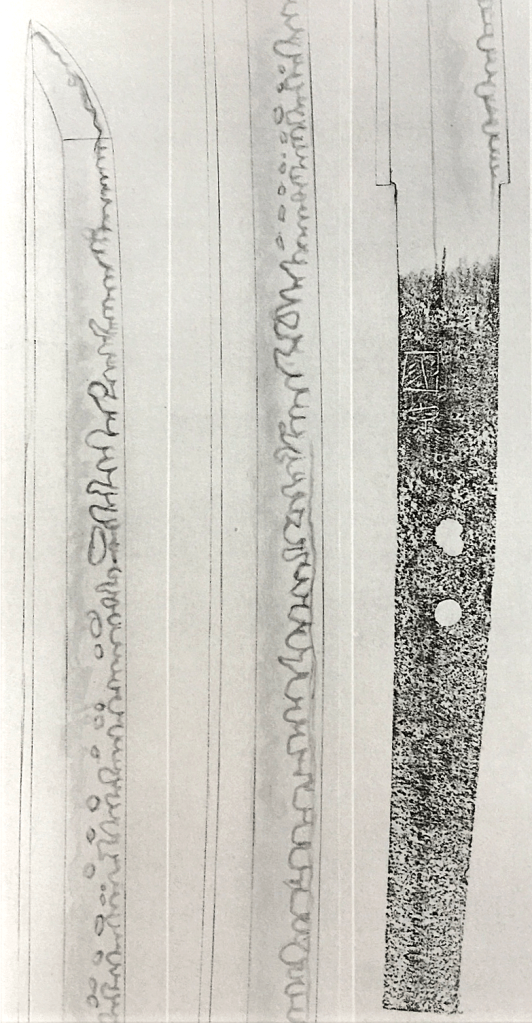
Kunimune Compton 1 Kunimune Compton 2Bizen Saburo Kunimune (備前三郎国宗)   Photo from “Nippon-to Art Sword of Japan, ” The Walter A. Compton Collection.   National Treasure

  • Boshi  ———————— Small irregular.  Yakizume or short turn back.
  • Ji-hada —————-Wood-grain pattern.  Fine Ji-hada with some Ji-nie (Nie inside Ji-hada).  Midare-utsuri (irregular shadow) is visible.  A few Hajimi (rough surface).

12 (second part 2) 照国神社The above photo is from the official website of the Terukuni Jinja Shrine in Kyushu.    http://terukunijinja.pkit.com/page222400.html

This is the national treasure, Kunimune, preserved at the Terukuni Jinja Shrine in Kagoshima Prefecture.  See the photos on the previous page.  This Kunimune sword was lost after WWII.  Dr. Compton, chairman of the board at Miles Laboratories in Elkhart, Indiana, found it in an antique shop in Atlanta.  I mentioned Dr. Compton in Chapter 32, Japanese Swords, after World War II.  When he saw this sword, he realized it was not just an ordinary sword.  He bought it and inquired at the Nihon Bijutsu Token Hozon Kyokai (The Japanese Sword Museum) in Tokyo.  It turned out to be the famous missing national treasure, Kunimune, from the Terukuni Jinja shrineHe returned the sword to the shrine without compensation in 1963. 

My father became close friends with him around this time through Dr. Homma and Dr. Sato, both leading sword experts.  Later, Dr. Compton asked Dr. Honma and my father to examine his collection of swords at his house, where he had many, as well as those at the Metropolitan Museum of Art in New York, the Philadelphia Museum of Art, and the Museum of Fine Arts in Boston.  My father wrote about this trip and the swords he examined in those museums and published a book in 1965 titled “Katana Angya (刀行脚).” 

For Dr. Compton and my father, those days must have been the best times of their lives.  Their business was doing well, and they could spend a lot of time on their interests and enjoy themselves.  It was also the best time for me.  One time, when I visited Compton’s house, he spent hours showing me his swords in the basement for hours, nearly all day.  His house was large, and the basement, which he had built as his study, had a fire prevention system. The lighting system was perfect for viewing swords and other art objects. 

His wife, Phoebe, told him he shouldn’t keep a young girl (I was a college student at the time) in the basement all day.  He agreed and took me to his cornfield to pick some corn for dinner.  From a basement to a cornfield, not much of an improvement?  So, Phoebe decided to take me shopping and have lunch in Chicago.  Good idea,  but it was too far.  Compton’s house was in Elkhart, Indiana.  The distance between Elkhart and Chicago was about 2.5 hours by car. It was too far just for shopping and lunch.  To my surprise, the company’s employee flew us to the rooftop of a department store, we did some shopping, had lunch, and then flew back.

Miles Laboratories and a well-known Japanese large pharmaceutical company had a business partnership at that time.  Dr. Compton frequently traveled to Japan for business purposes.  However, whenever he visited Japan, he spent days with sword people, including my father, and I usually followed him.  One of the female workers’ jobs at this pharmaceutical company was to translate the sword book into English. 

My parents’ house was filled with Miles’ products.  Miles Laboratories had a large research facility in Elkhart, Indiana.  I visited there several times.  One day, I sat with Dr. Compton in his office, looking into a sword book with our heads close together.  That day, movie actor John Forsythe visited the research lab.  He was the host of a TV program sponsored by  Miles Laboratories.  All the female employees were making a big fuss over him.  Then he entered Dr. Compton’s room to greet him, expecting the chairman to be sitting in his big chair at his desk, looking like a chairman.  But he saw Dr. Compton looking into the sword book seriously, with his head against mine.  Dr. Compton’s appearance was just like that of any chairman of the board of a major company, as one might imagine, and I was a Japanese college student looking like a college student.  John Forsythe showed a strange expression as if he did not know what to think.


28|Shin-to Sword — Main Seven Regions (part B 主要7刀匠地)


0-timeline - size 24 Shin-to
 The red circle indicates the subject of this chapter

64Map with number with 8

3Musashi ( 武蔵 ) in Edo ( 江戸 )

The katana and wakizashi made in the Musashi area have a shallow sori (curvature).  Often, the width of the blade’s upper part is narrow.  Usually, the hamon begins with a slight irregular pattern, then gradually shifts to a larger irregular pattern, and a few inches below the yokote line, it becomes a small irregular pattern again.  The boshi is usually a komaru-boshi.  The ji-hada may be rough.  Masame-hada shows on shinogi-ji.

Well-known swordsmiths in Musashi ———————————-Noda Hannkei (野田繁慶)                                                      Nagasone Okisato Nyudo Kotetsu (長曽根興里入道虎徹)

Nagasone Okisato Nyudo Kotetsu                        Noda Hankei (野田繫慶)                                   (長曽根興里入道虎徹)                                   from Compton’s collection “Nippon-to”    Once, my family sword                                                                                                               

4. Echizen ( 越前 ) and 5. Kaga (加賀 )

Many swordsmiths from the Mino (美濃) area moved to the Echizen and Kaga areas (#4  & #5 on the map above).  Therefore, swords made in these areas are called Echizen-seki and Kaga-seki.  Refer to Chapter 23 Sengoku Period (戦国) Sword for Mino-den.             The style of Echizen Yasutsugu (越前康継) is similar to that of Mino-den.

Well-known swordsmith in Echizen ————————-Echizen Yasutsugu (越前康継 )

6. Hizen (肥前)

Both the katana and wakizashi from Hizen have well-balanced shapes.  The Hizen region tends to produce swords with a chu-suguha-hotsure (a medium-width straight hamon resembling frayed fabric) with fine nie (沸).  The boshi has a clean, regular line with a uniform width tempered line, as shown in the illustration below.  If you see a shin-to sword that has a chu-suguha hamon and a boshi that looks like the one below, it is often made by Hizen Tadayoshi (肥前忠吉).  Very fine Ji-hada (surface), sometimes called nukame-hada.

29 Hizen Tadayoshi Boshi

Well-known swordsmith in Hizen ——————————— Hizen Tadayoshi ( 肥前忠吉)

  1. Satsuma (薩摩 )

The swords made in Satsuma appear solid for both katana and wakizashi.  The kissaki (the top pointed area) is slightly stretched.  Yakidashi (a few inches above the machi ) shows a small, irregular hamon.  The hamon is o-midare with coarse nie called ara-nie. The ara-nie forms togari-ba (a pointed pattern; see the drawing below)One of the characteristics of this region.

The region is well known for its Satsuma-nie.  That is, the ara-nie around the hamon continues and blends into the ji-hada area.  Therefore, the border between ha-nie and ji-nie is unclear.  Inside the hamon, it sometimes shows a thick line shaped like lightning.  This line is called Satsuma-no-imozuru (sweet potato vine), and is less desirable than inazume and kinsiji.  This is the most prominent feature of the Satsuma sword.  Boshi has a narrow-tempered line with a small irregular patternThis is called satsuma-boshi.  On the ji-hada surface, chikei (a long, dark line) appears.  This is called Satsuma-gane (薩摩金).

29 Satsuma Togari-ba

Well-known swordsmiths in Satsuma ——————  Izunokami Masafusa (伊豆守正房)                                                                                                 Ichinohira Yasuyo (一平安代)                                                                                       Mondonosho Masakiyo (主水正正清)


24| Sengoku Period Tanto (戦国時代短刀)

0-timeline - size 24 Sengoku Period                             The red circle above indicates the time we discuss in this section

25 Chukanzori Tanto

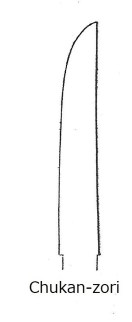
Chukan-zori (中間反り) ————– The chukan-zori tanto features a straight mune (back).  Its back does not curve either inward or outward.   

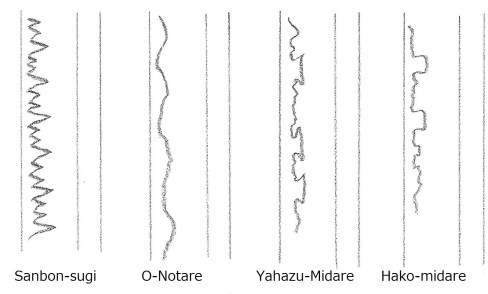
Hamon (刃文: Tempered line) ————————————-Sanbon-sugi (三本杉), o-notare (大湾), yahazu-midare (矢筈乱), hako-midare (箱乱), gunome-choji (互の目丁子), chu-suguha (中直刃).   See below.

24 Sannbon sugi,hako, yahazu, O-midare)

Horimono (彫り物: Carving) —————Often Hi (grooves) is curved

Tanto Length ————————— The standard tanto length should not exceed one shaku*¹ (about 12 inches, 30.5cm).  The standard size tanto is called a Jo-sun tanto, which is roughly 8.5 shaku (about 10 inches, 25.7cm).  Longer than jo-sun is called sun-nobi tanto (寸延)Shorter than jo-sun is called sun-zumari tanto (寸詰).

             Sun-nobi Tanto  >  Jo-sun Tanto (approx. 10 inches) >  Sun-zumari Tanto

*Shaku is a traditional Japanese unit of length measurement.

Takenoko-zori jo-sun tanto (筍反定寸短刀)————– The takenoko-zori jo-sun tanto was made during the Sengoku period.  It resembles swords made by Rai Kunimitsu of Yamashiro–den.  (illustration below)

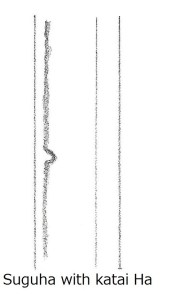
Hamon (刃文: Tempered line) ————– Hoso-suguha (細直刃: Narrow straight hamon). Katai-ha (illustration below) appears somewhere on the blade.  Masamehada (straight grain pattern) may be visible on the mune side.

                13 Middle Kamakura Period Tanto                 24 Suguha katai-ha

Ji-hada (地肌: The area between the shinogi and the tempered line)————– Some shirake (白け: a whitish surface) may sometimes appear.  Some utsuri (a light, whitish, cloud-like effect) appears on the ji-hada.

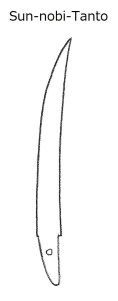
Sun-nobi Tanto (寸延短刀)————–This type of tanto resembles the sakizori tanto from the late Soshu-den period.  You may see a hitatsura-type hamon.  (illustration below).   Unlike the Soshu-den style, the hitatsura pattern is more visible in the lower part of the tanto and less in the upper part.

                                             25 Sun-Nobi Tanto      25 Hitatsura

Hirazukuri Takenokozori Sunzumari Tanto (平造筍反寸詰短刀)                                  

This is a unique tanto from the Sengoku period.   Hirazukuri means a flat-surfaced sword without a shinogi, yokote line, or obvious kissaki.   Takenoko-zori refers to a bamboo shoot shape (the back of the sword curves inward).   Sun-zumari indicates a blade shorter than 10 inches (less than 8.5 shaku or 25.7 cm).  The lower part of the blade is wide and thick, while the tip is narrow and thin.  It has a piercing, sharp appearance.

  • Horimono (彫物: Engraving) ————- Deeply carved ken-maki ryu (a dragon wrapped around a spear).
  • Hamon (刃文: Tempered line)——— Wide tempered line, with a nioi baseIrregular hamon, with wide suguha (straight), and chu-suguha (medium straight).  The hamon in the boshi area curves back deeply.
  • Ji-hada (地肌)———– fine ji-gane and wood burl pattern.

Moroha-tanto (諸刃短刀: Double-edged sword)

A double-edged sword with a hamon on both cutting edges.  Often, Bonji (Sanskrit) is curved.

  • Hamon (刃文: Tempered line) ——— Wide tempered line.   Nioi base.  Irregular hamon, wide suguha (straight tempered line), and chu-suguha (medium straight  tempered line).  The hamon turns back deeply.
  • Ji-hada (地肌: The area between the shinogi and the tempered line)——- Fine ji-gane and wood burl pattern.

25-moroha-tanto1 Moroha Tanto

The Swordsmith for Tanto during the Sengoku Period 

The Bizen swords from the Sengoku period are called sue-bizenSue is pronounced “su” and “e“ as in egg.   Bizen Osafune Yoso-Zaemon Sukesada (与三左衛門祐定) is the most famous swordsmith of the Sengoku period.  He also forged tantos.  One thing to note is that many swordsmiths had the name Sukesada.  Yoso-Zaemon Sukesada is the one who best represents the era.

19 | Nanboku-Cho Period Tanto(南北朝短刀)

0-timeline - size 24 Nanboku-cho
The circle indicates the time we discuss in this section

During the Nanboku-cho period, a type of tanto called hirazukuri ko-wakizashi sun-nobi tanto was made.  Hirazukuri means flat swords without the yokote line or shinogi.  Ko-wakizashi refers to a shorter sword.  Sun-nobi tanto means longer than a standard tanto.  This type is also known as Enbun Jyoji ko-wakizashi tanto because most of these tantos were created during the Enbun and Jyoji eras of the imperial period.  In Japan, a new imperial era begins when a new emperor ascends to the throne.  The Enbun era spanned 1356-1361, while the Jyoji period spanned 1362-1368.

20 Enbun Jyoji Kowakizashi Tanto

Sugata (姿: shape) ————A standard tanto measure is approximately one shaku.  Shaku is an old Japanese unit of measurement for length, and one shaku is roughly equal to one foot.  

8.5 sun (the sun is another old Japanese measurement unit of length) is approximately ten inches.  Ten inches is the standard size for a tanto, known as a josun tanto.  Anything longer than a josun tanto is called a sun-nobi tanto.  Anything shorter than a josun is called a sun-zumari tanto. 

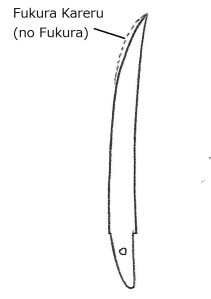
Most of the Nanboku-cho tantos are longer than a josun tanto, approximately one foot two inches.  Therefore, they are called hirazukuri ko-wakizashi sun-nobi tantoSaki-zori (curved outward at the top.  See the illustration above).   Wide in width and thin in body.  Fukura kareru (no fukura means less arc).  Shin-no-mune.  See the drawing below.

20 Fukura           20 Shin-no-Mune

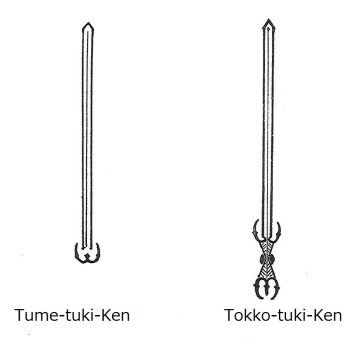
Hi, (: Grooves) and Horimono (彫り物: Engraving) ——- A groove or grooves on the mune side.  Bonji (Sanskrit, see Chapter 16 Late Kamakura Period (Early Soshu-Den Tanto),  koshi-bi (short groove),  tumetuki ken, and tokko-tsuki ken (see below) appear. The ken (dagger) is curved widely and deeply in the upper part and shallower and narrower in the lower part.  This is called Soshu-bori (Soshu-style carving).

20 Tokko, tume Ken

Hamon (: Tempered line) ——- The narrowly tempered section at the lower part gradually widens toward the top.  A similar wide hamon pattern extends into the boshi area.  The hamon in the kissaki area is kaeri-fukashi (deep turn back).  See the illustration below.  Coarse nie.  O-midare (large irregular hamon pattern).

20 Hitatsura

                                        From Sano Museum Catalogue

Ji-hada (地肌: the area between shinogi-ji and the tempered line) ——– a loose wood grain pattern called itame.  Yubashiri (see Chapter 16, Late Kamakura Period) and tobiyaki (irregular patchy tempered spots) appear.  Dense tobiyaki is called hitatsura (see the drawing above).

Nakago (: Tang) —- Short tanago-bara.  Tanago-bara refers to the shape of the belly of a Japanese fish called tanago (bitterling).

20 Tanago Bara

Tanto Swordsmiths during the Nanboku-Cho Period

Soshu Den ———————————————————-Hiromitu( 広光) Akihiro (秋広) Yamashiro Den ————————————————–Hasebe Kunishige (長谷部国重)   Bizen Den ——————————————————— Kanemitu (兼光) Chogi (長義 )

    Soshu Hiromitsu     “Nippon-To Art Sword of Japan “   The Walter A. Compton Collection

18| Nanboku-Cho Period Sword (南北朝太刀)

0-timeline - size 24 Nanboku-cho

                           The circle indicates the time we discuss in this section

During the Nanboku-cho period, samurai sought large, elaborate, impressive, yet practical swords.  The Soshu-den style sword from Nanboku-cho time was just that.    This was the most popular style at the time.  The Nanboku-cho period marked the peak and height of the Soshu-den sword.  Many swordsmiths moved from other provinces to the Kamakura area and forged Soshu-den style swords.  Other schools and provinces outside the Kamakura area also produced Soshu-den-style swords in their own areas.


19 Nanboku-cho Sword style

Sugata (姿: Shape) —————–The original length of a sword ranged from three to five feet, but it was later shortened to about two and a half feet.  A significantly shortened blade is called o-suriage. 

The Nanboku-cho style sword features shallow kyo-zori (also called torii-zori).  Refer to Chapter 5, Heian Period Sword.  The highest curvature occurs around the middle of the body. It has a wide body, high shinogi, narrow shinogi-ji  (Chapter 3, Names of parts),  and thin kasane (blade thickness), which are distinctive features of the Nanboku-cho style.  High gyo-no-mune or shin-no-mune, and sometimes a maru-mune (round back).

19 Nanboku-cho 3 kinds Mune

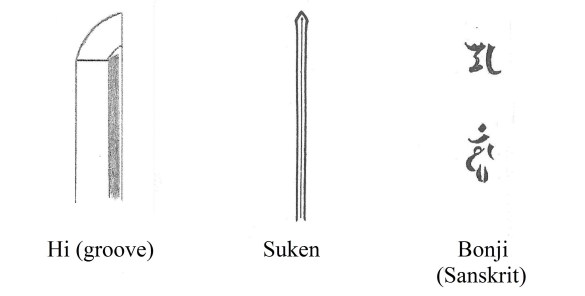
Hi (: groove) and Horimono (彫刻: engraving) ——– Often, a single hi (bo-hi), double hi, suken (dagger), Bonji (Sanskrit), and/or dragon are engraved on the shinogi-ji area.  Refer to Chapter 3, Names of Parts.

9 Hi, Suken, Bonji

Hamon (: Tempered line) —- The lower part of the body exhibits a narrow-tempered line; gradually, this line becomes wider and showier.  Course nie. O-midare (large, irregular, wavy hamon), Notare-midare (wavy, irregular hamon), and Gunome-midare (a combination of repeated half-circular and irregular hamon). Inazuma and kinsuji (see Chapter 14, Late Kamakura Period Sword) sometimes appear.

19 Hamon Notare 319 Mamon choji gunome19 Hitatsura Hamon Hiromitsu

                                  *From Sano Museum Catalogue ( Permission granted).

Ji-hada (地肌: the area between the shinogi and the tempered line) ———————-Wood-grain pattern (itame 板目). Sometimes tobiyaki (patchy tempered spots) appear on ji-hada.  For ji-hada, refer to Chapter 3, Names of Parts.

Kissaki (切っ先) and Boshi (tempered line at the kissaki area) ———- O-kissaki (long and large kissaki). Fukura kareru (less arc kissaki).  Midare-komi (the body and boshi have a similar tempered pattern), with kaeri-fukashi (hamon deeply turns back), and sometimes hitatsura (entirely tempered).  See the illustration above.

Sword-smiths during Nanboku-Cho Period Soshu Den (school)

  • From Soshu—————————————————Hiromitsu (広光)  Akihiro (秋広)  
  • From Yamashiro ———————————————Hasebe Kunishige (長谷部国重) 
  • From Bizen (called So-den Bizen)——-Chogi (長儀 )group  Kanemitsu (兼光 ) group 
  • From Chikuzen ———————————————————-Samoji (左文字 ) group

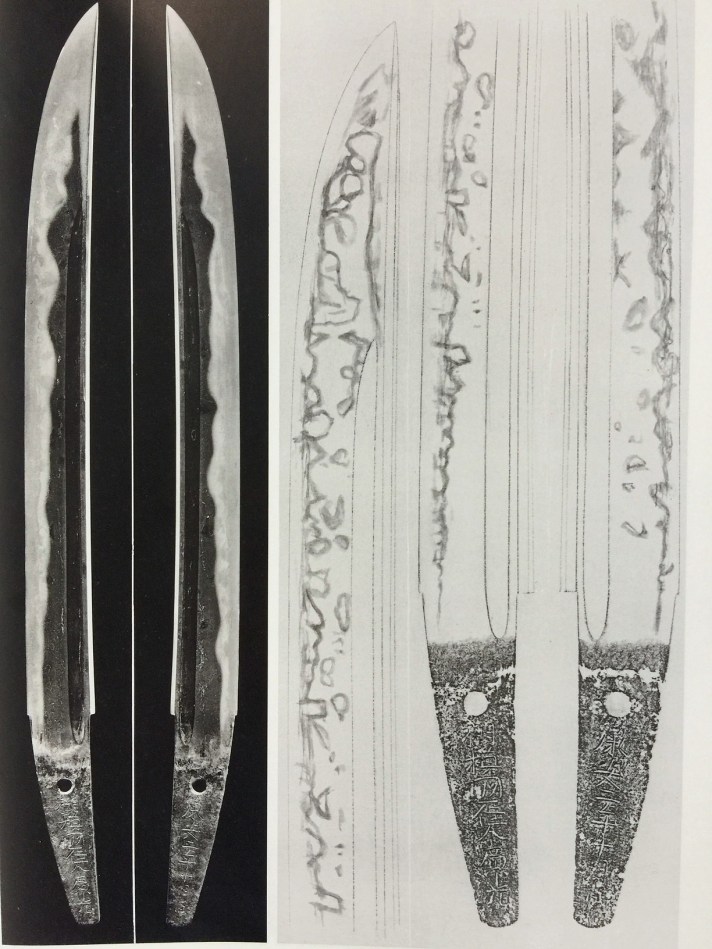
Chogi (長義)from The Sano Museum catalog. Permission to use is granted

The distinctive characteristics of the Nanboku-Cho period sword in the photo above      

  • The trace of an engraving of suken on the inside of the nakago indicates that this area was once a part of the main body.
  • Large and long kissaki