64| Part 2 of –30 Shin Shin-To : Bakumatsu sword (新々刀)

This Chapter is a detailed Chapter of the 30|Bakumatsu Period, Shin Shin-to.  Please read Chapter 30 before reading this chapter.

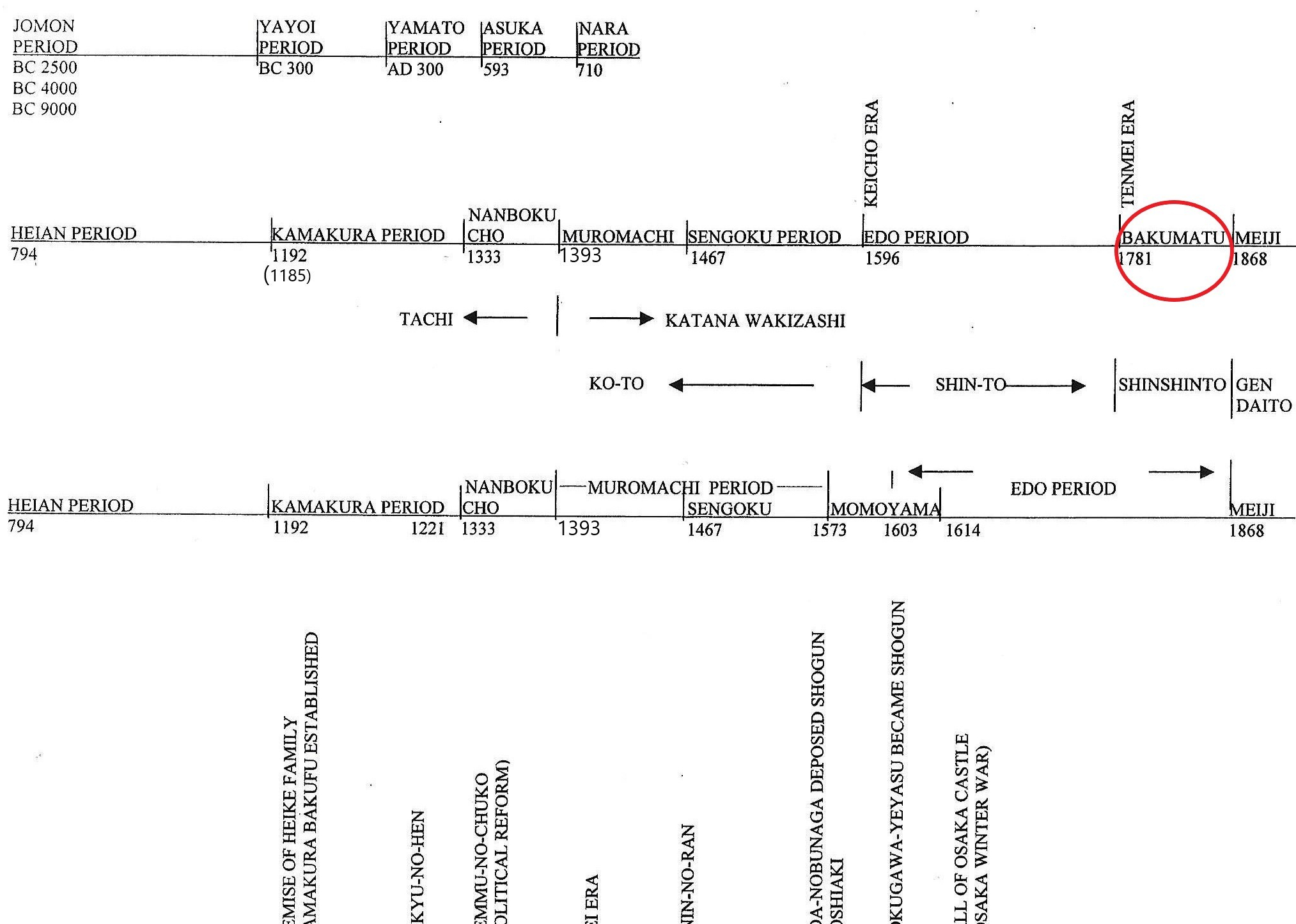
0-timeline - size 24 Bakumatsu

                  The circle Above indicates the time we discuss in this chapter.

Swords made between the Tennmei era (天明 1781) and the end of the Keio era (慶應) are called shin shin-to.  Please refer to the timeline above.  This period was when Japan was moving toward the Meiji Restoration, known as the Bakumatsu era.  During this time, sword-making became active again.  Below are the well-known swordsmiths from the main areas.

Musashi no Kuni  (武蔵の国: Tokyo today)                                                       

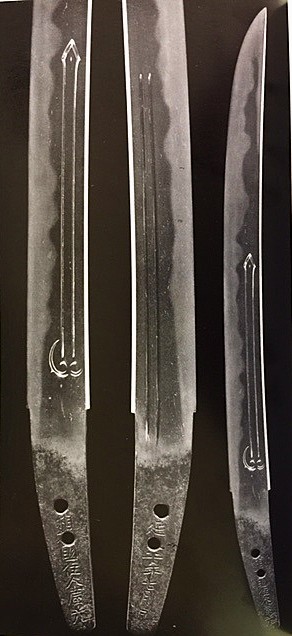
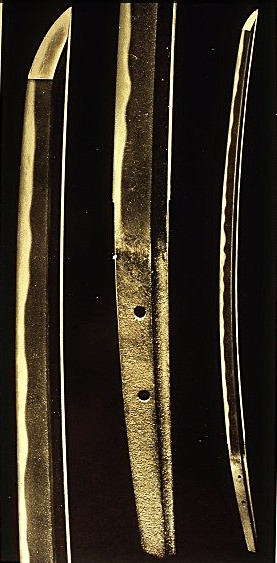
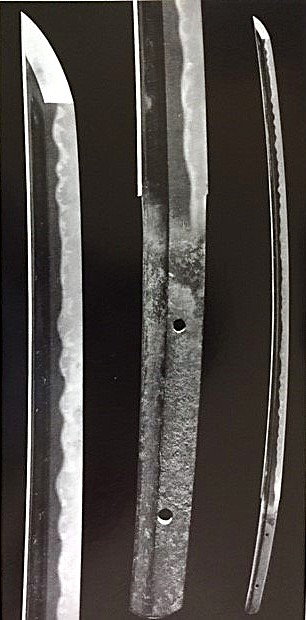
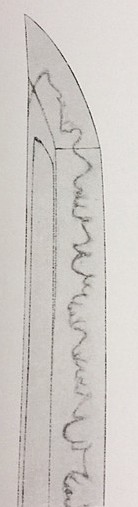
Suishinshi Masahide (水心子正秀) ——— When Suishinshi Masahide made Yamashiro-den style swords, their shapes resembled those of ko-to period swords; funbari, an elegant shape; chu-suguha (medium straight); komaru-boshi, with fine wood grain. When he forged in the Bizen style, he made a Koshi-zori shape, similar to a ko-to made by Bizen Osafune.  Nioi with ko-choji, and katai-ha (refer to  30| Bakumatsu Period Sword 新々刀).  In my old sword textbook, I noted that  I saw Suishinshi in November 1970 and October 1971.

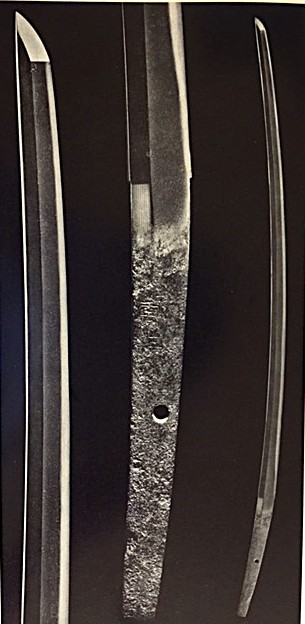
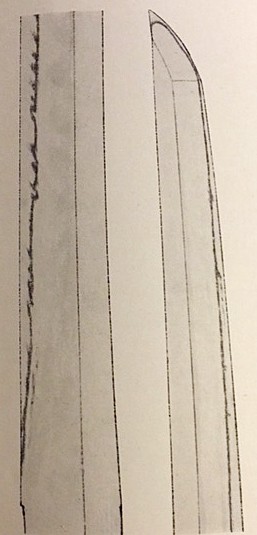
Taikei Naotane (大慶直胤) ————————–Although Taikei Naotane was part of the Suishinshi group, he was one of the top swordsmiths.  He had an exceptional ability to forge a wide range of sword styles beautifully.  When he made a Bizen-den style, it resembled Nagamitsu from the Ko-to era, with nioi.  Also, he did sakasa-choji as Katayama Ichimonji had done.  Katai-ha appearsThe notes in my old textbook indicate I saw Naotane in August 1971.

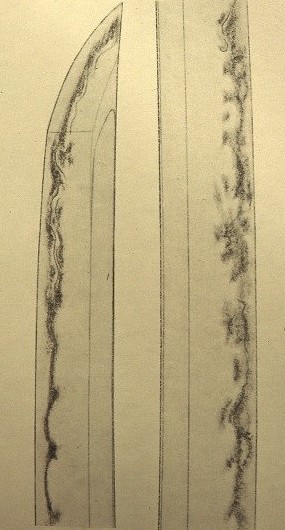
Minamoto no Kiyomaro (源清麿) ————————– Kiyomaro wanted to join the Meiji Restoration movement as a samurai; however, his guardian recognized Kiyomaro’s talent as a master swordsmith and helped him become one.  It is said that because Kiyomaro had a drinking problem, he was not very eager to make swords.  At age 42, he committed seppukuKiyomaro, who lived in Yotsuya (now part of Shinjuku, Tokyo), was called Yotsuya Masamune because he was as good as Masamune.  His swords featured wide-width, shallow sori, stretched kissaki, and fukura-kereru.  The boshi is komaru-boshi.  Fine wood grain ji-gane.

Settsu no Kuni   ( 摂津の国:  Osaka today)

Gassan Sadakazu (月山貞一) ———- Gassan excelled in the Soshu-den and Bizen-den styles, but he was capable of making in any style.  He was as much a genius as Taikei Naotane.  You must pay close attention to notice a sword made by Gassan from genuine ko-to.  He also had remarkable carving skills.  His hirazukuri-kowakizashi, forged in the Soshu-den style, looks just like a Masamune or a Yukimitsu.  He forged in the Yamashiro-den style, with Takenoko-zori, hoso-suguha, or chu-suguha in nie.  Additionally, he forged the Yamato-den style with masame-hada.


61|Part 2 of — 27 Shin-to Main 7 Regions (part A)

Chapter 61 is a detailed part of Chapter 27, Shinto Main 7 Regions (part A).  Please read Chapter 27 before reading this section. 

0-timeline - size 24 Shin-to                        The red circle above indicates the time we discuss in this section

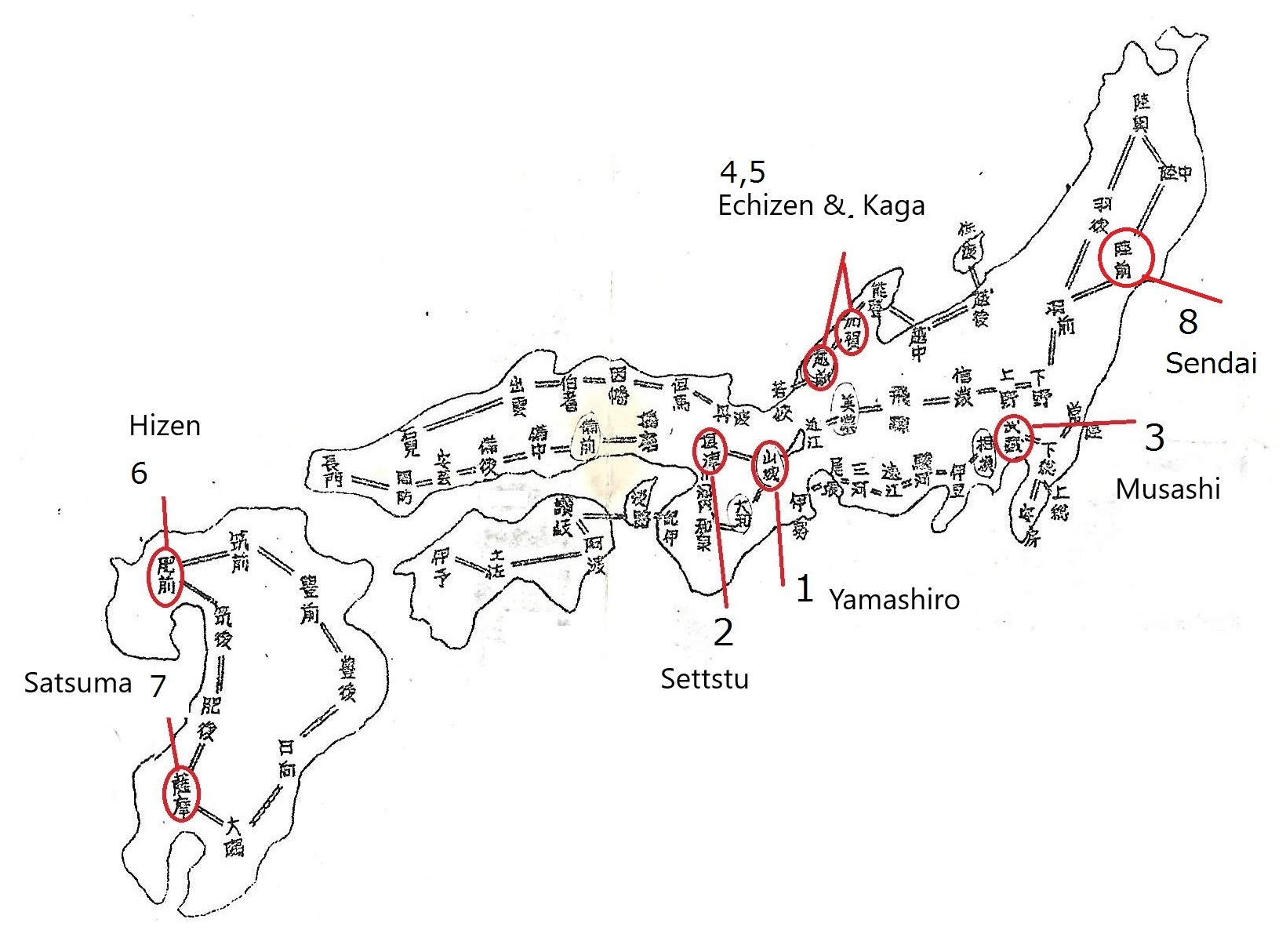
Chapter 27, Shin-to Main 7 Regions (Part A), and Chapter 28, Shin-to Main 7 Regions (Part B), describe an overview of the seven main regions.  This chapter and the next chapter show photos of representative swords from these regions.  They are Yamashiro (山城, in Kyoto), Settsu (摂津, today’s Osaka), Musashi (武蔵, Edo), and Satsuma (薩摩, Kyushu).  However, Echizen (越前), Kaga (加賀), and Hizen (肥前) are omitted.
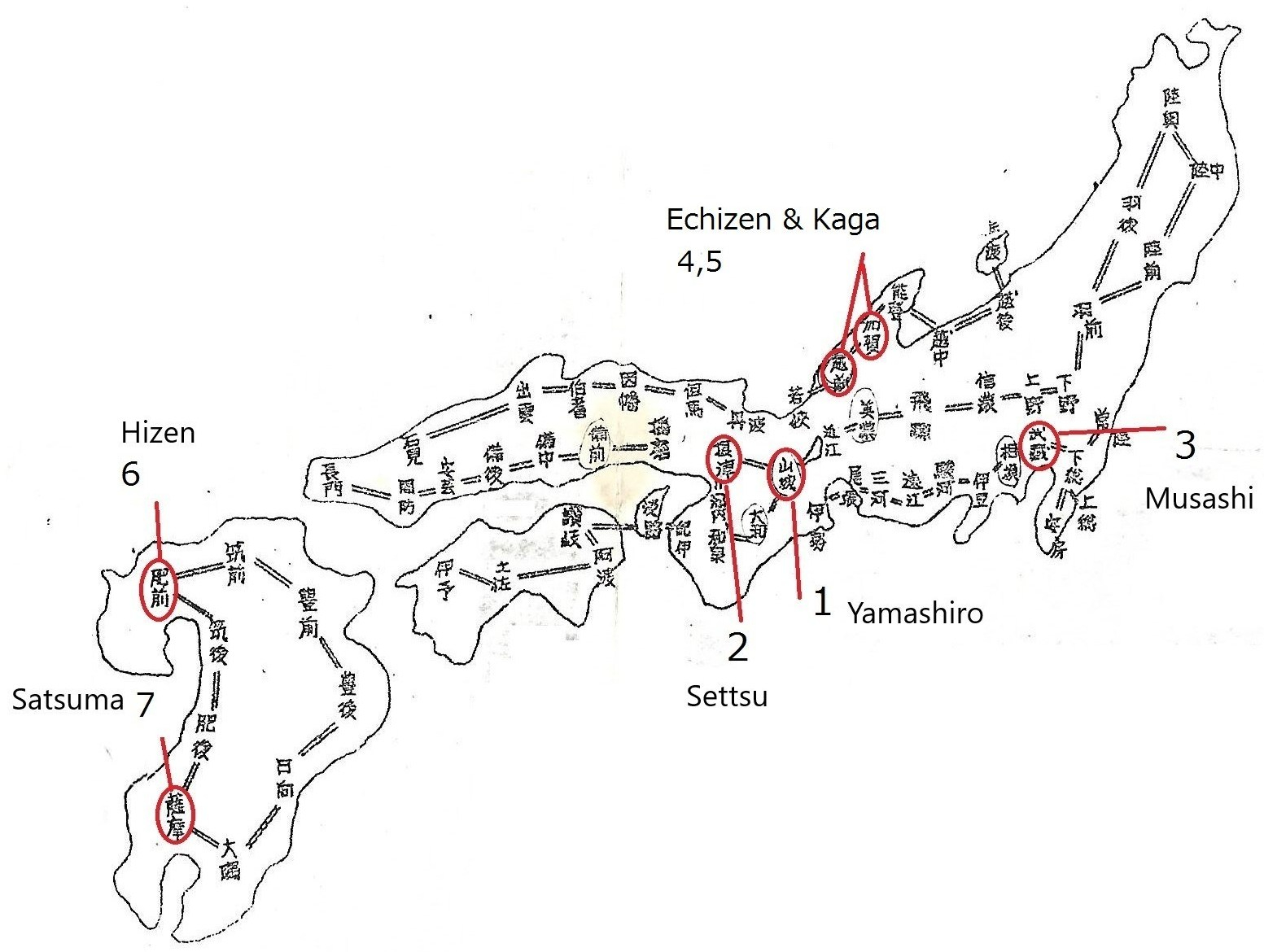
29 Map with number 7

With ko-to swords, features such as the condition of the hamon, kissaki size, length, and  shape of the nakago, etc., indicate when the sword was made.  During the ko-to period, Bizen swordsmiths produced Bizen-den swords, Yamashiro swordsmiths made Yamashiro-den swords, and Mino swordsmiths made Mino-den swords.  However, during the shin-to period, that is not the case.  The den and the swordsmith’s location often do not match.  For shin-to swords, we study the swordsmiths and swords from the seven main regions along with their characteristics.

Regarding swords made during the ko-to period, if a sword has a wide hamon line with  nie, usually, its ji-hada shows a large wood grain or a large burl grain.  Also, when you see a narrow hamon line, it typically features a fine ji-hada.

However, with shin-to swords, if a sword shows a wide hamon with nie, it often has a small wood grain or small burl grain pattern on ji-hada.  If it has a narrow hamon line, it may have a large wood grain pattern on the ji-hada.  This is a shin-to characteristic.   

Here is an exception: some early Soshu-den swords from the late Kamakura period may show a wide hamon with nie, which has small burls on the ji-hada.  Because of that, whether it is ko-to or shin-to can be confusing.  Even so, other features such as ji-hada or other parts should indicate whether it is shin-to or ko-to.

Yamashiro (山城: Kyoto)
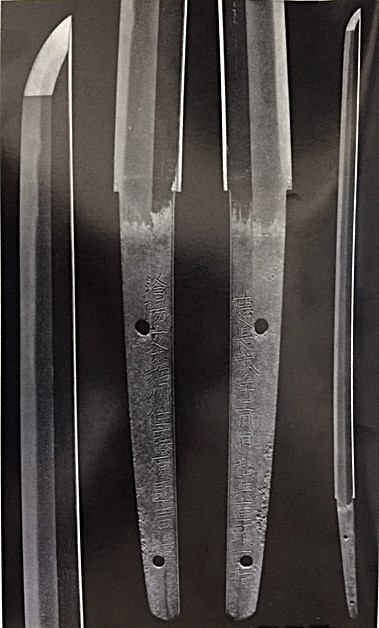
 Horikawa Kunihiro   (堀川国広)   From Sano Museum Catalogue (permission granted)

Horikawa Kunihiro (堀川国広)

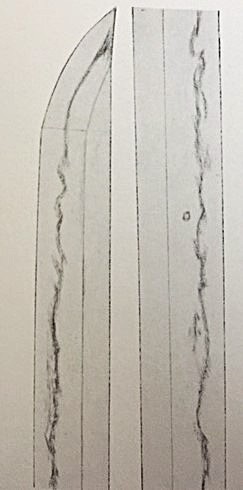
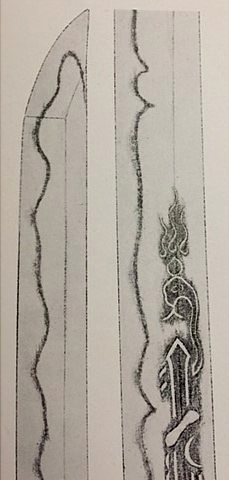
Horikawa Kunihiro was regarded as a master swordsmith among shin-to swordsmiths.  He forged swords in many styles with various characteristics.  The hamon types are o-notare, o-gunome, togari-ba (pointed hamon), chu-suguha with hotsure (frayed look), hiro-suguha with a sunagashi effect, inazuma, and kinsujiKunihiro preferred to shape his swords to resemble an o-suriage (shortened Nanboku-cho style long sword).  Kunihiro‘s blades give a powerful impression.  Kunihiro‘s swords often feature beautiful carvings; designs include dragons, Sanskrit letters, and more.  Because he created swords in many different styles, there is no general characteristic that defines his work other than the hamon mainly being nie.  His ji-hada is finely forged.                                                                                                                                                                                                                                                                                                                                                     
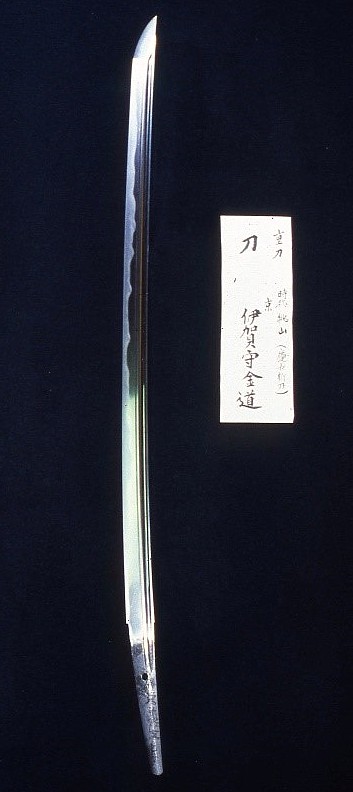
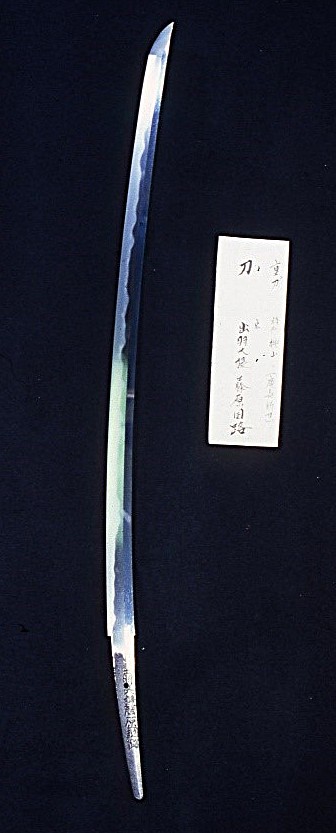
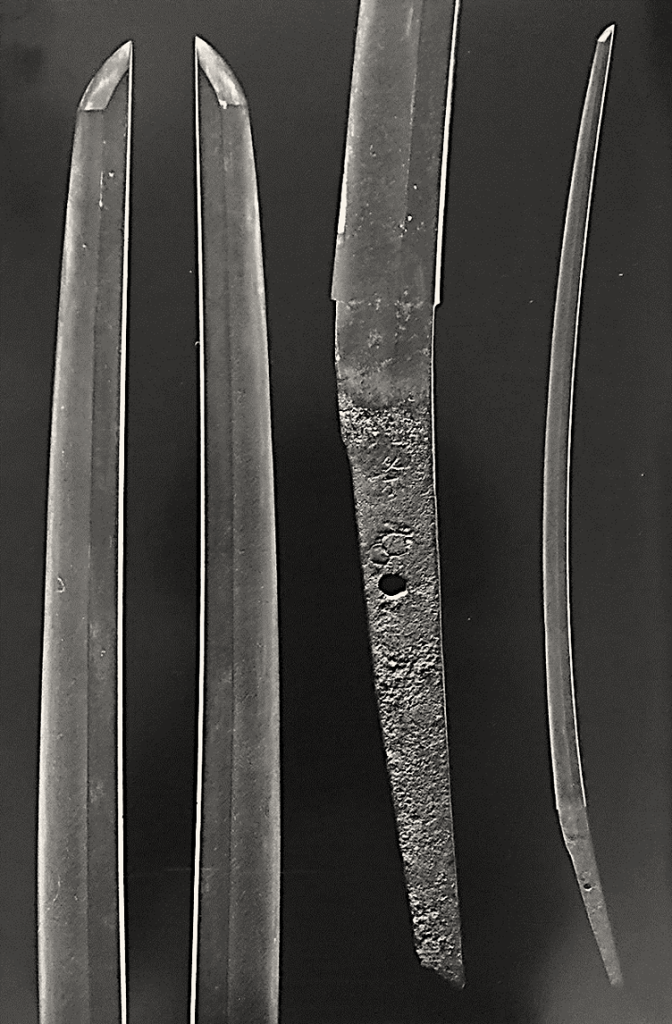
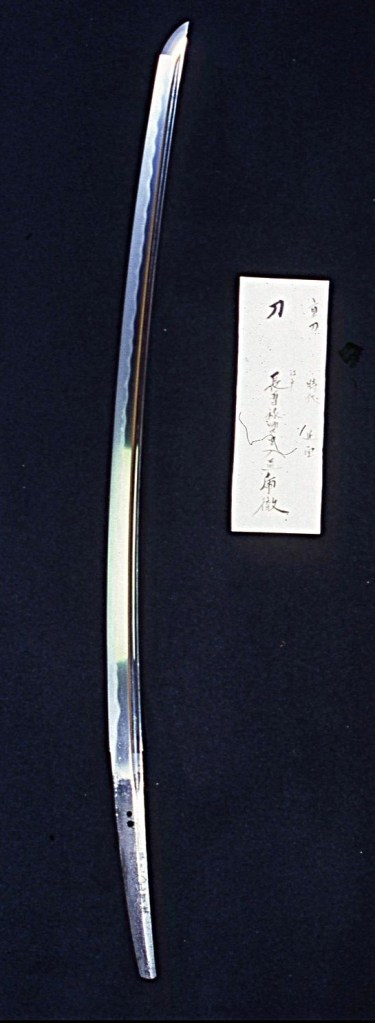
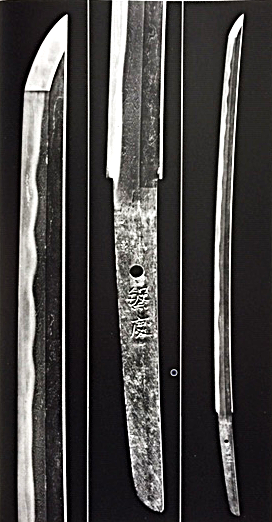
img067.jpg  img068.jpg      Iga-no-Kami Kinnmichi (伊賀守金道)           Dewa Daijyo Kunimichi (出羽大掾国路)        Both Juyo Token (重要刀剣), once my family owned, photos were taken by my father.

Iga-no-Kami Kinmichi ( 伊賀守金道)

The Kinmichi family is called the Mishina group.  Refer to 27 Shinto Main 7 Regions  Part A.   Iga-no-Kami Kinmichi was awarded the Japanese Imperial chrysanthemum crest. 

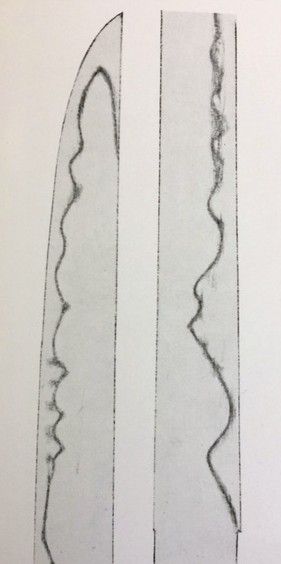
The characteristics of Kinmichi ——– Wide sword, shallow curvature, an extended kissaki, sakizori (curvature at 1/3 top),  a wide tempered line, kyo-yakidashi (see 27 Shinto Main 7 Regions  A ), hiro-suguha (wide straight hamon), o-notare (large wavy), yahazu-midare, hako-midare (refer to 24 Sengoku Period Tanto).  Mishina-boshi, refer to 27 Shin-to Main 7 Regions A.  Fine wood burl, masame appear in the shinogi-ji area.   

Dewa Daijo Kunimichi (出羽大掾国路)                                                                                 

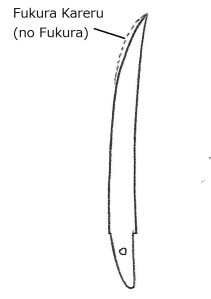
Dewa Daijo Kunimichi was the top student of Horikawa Kunihiro.  The right photo above.  Like Kunihiro, the sword resembles a shortened Nanboku-cho sword.  Shallow curvature, a wide body, a somewhat elongated kissaki, and fukura-kareru (less arch in fukura).  Wide tempered lines, large gunome, nie with sunagashi, or inazuma shows.  Double gunome (two gunome side by side) appears.  Fine ji-hada.                                                                                                                                                                                                                

  1. Settu (摂津) Osaka (大阪 )

Settu (Osaka) is home to many famous swordsmiths.  They are Kawachi-no-Kami Kunisuke (河内守国助), Tsuda Echizen-no-Kami Sukehiro (津田越前守助広), Inoue Shinkai (井上真改), and Ikkanshi Tadatsuna (一竿子忠綱), among others.                          The main characteristic of the Settsu (Osaka) sword ——– The surface is beautiful and fine, almost like a solid surface with no pattern or design.  The two photos below are of the Settsu sword.
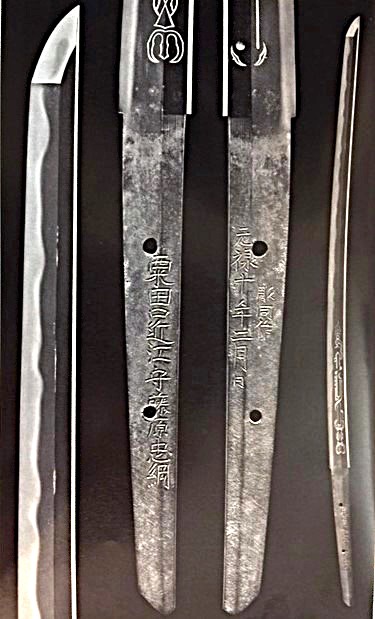
              Ikkanshi Tadatsuna from the Sano Museum Catalogue.  Permission granted to use.

Ikkanshi Tadatsuna (一竿子忠綱)

Ikkanshi Tadatsuna was famous for his carvings.  His father was also a well-known swordsmith, Omi-no-Kami Tadatsuna (近江守忠綱)Consequently, he was known as Awataguchi Omi-no-Kami Fujiwara Tadatsuna (粟田口近江守藤原忠綱), as shown in the nakago photo above.     

The characteristics of Ikkanshi Tadatsuna ——-A longer kissaki and a wide-tempered line with nie.  The Osaka yakidashi (transition between the suguha above machi and midare is smooth.  Refer to 27 Shin-to Sword – Main 7 Regions (Part A) for details on Osaka yakidashi.  O-notare with gunome, komaru-boshi with a turn back, and very fine ji-hada with almost no pattern on the surface.
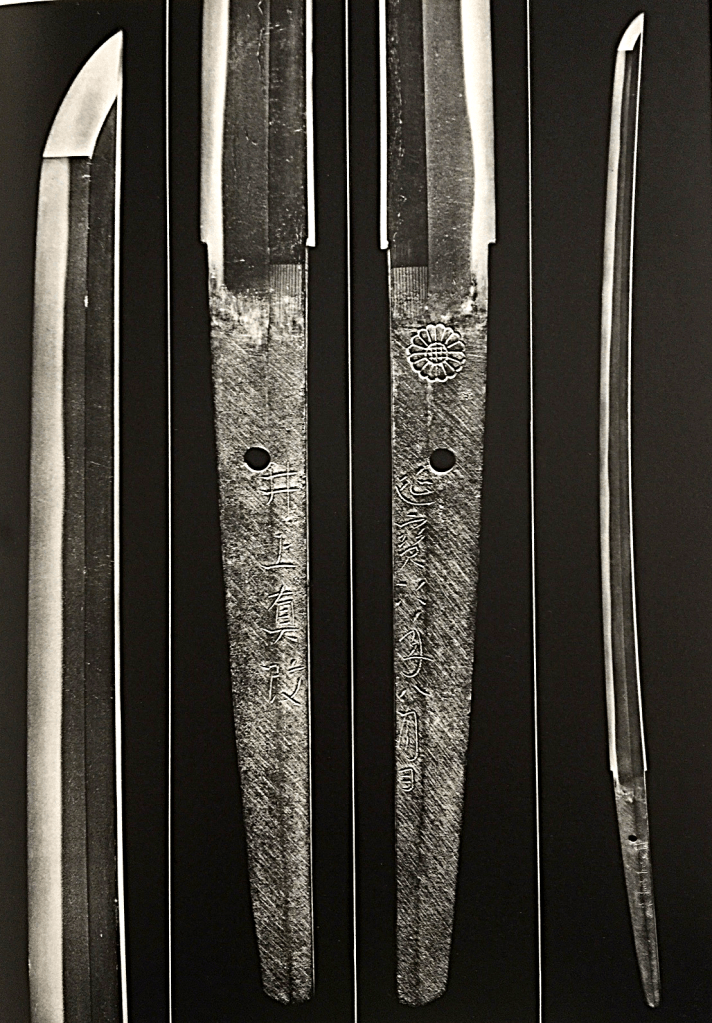
                        Inoue Shinkai (井上真改) from “Nippon-to Art Swords of Japan” The Walter A. Compton Collection

Inoue Shinkai (井上真改)

Inoue Shinkai was the second generation of Izumi-no-Kami Kunisada (和泉守国貞), who was a student of Kunihiro.                                                                                                  The characteristic of Inoue Shinkai’s swords —————- Osaka yakidashi, the tempered line gradually widens toward the top.  O-notare and deep nie.  Very fine ji-hada with almost no surface design.
58|Part 2 of — 24 Sengoku Period Tanto (戦国時代短刀)

Chapter 58 is a detailed section of Chapter 24, Sengoku Period Tanto.  Please read Chapter 24, Sengoku Period Tanto, before reading this part. 

0-timeline - size 24 Sengoku Period

           The red circle above indicates the time we discuss in this section  

Muramasa (村正)

This chapter discusses the famous Muramasa (村正).  Usually, many well-known swordsmiths come from one of the Goka-den (五家伝: the five main schools: Yamashiro-den, Bizen-den, Soshu-den, Yamato-den, and Mino-den).  However, Muramasa was not from Goka-den but from Ise Province.  The first-generation Muramasa was known as a student of He’ian-jo Nagayoshi (平安城長吉) of Yamashiro-den.  The Muramasa family existed through the mid-Muromachi period.  They spanned three generations from the mid-Muromachi to the Sengoku period

61 Ise map

Below is one of Muramasa’s tantos, made during the Sengoku period.  Since it was made during the Sengoku era, the blade shows the style of Sengoku-period swords.  It reflects Mino-den characteristics, combined with Soshu-den traits. 


 Muramasa (村正) from Sano Museum Catalogue (permission granted)

Characteristics  on this Tanto

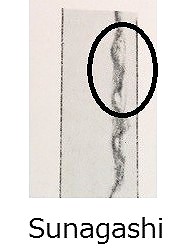
Muramasa’s tantos are typically about ten inches ± half an inch or so.  Hirazukuri (平作り). Thin blades with a sharp look.  The nioi base with small nie and sunagashi patterns (brushed sand-like patterns, as shown in the illustration below) appears.  The boshi (the top part of the hamon) is jizo (a side view of a human head).  The tempered line varies with both wide and narrow areas.  Some areas are so narrow, almost close to the edge of the blade, while others are broader.  Hako midare (box-like shape) and gunome (lined-up bead pattern) appear.  O-notare (large, gentle waviness) is a signature characteristic of Muramasa.  The pointed-tempered line is a typical characteristic of Mino-den (Sanbon-sugi).  Refer to Chapter 23, Sengoku Period Sword, and Chapter 24, Sengoku Period Tanto.


53| Part 2 of — 19 Nanboku-cho Period Tanto (南北朝短刀)

This chapter is a detailed section of Chapter 19.  Please read Chapter 19, Nanboku-cho Period Tanto, before proceeding on to this part. 

0-timeline - size 24 Nanboku-cho

                          The red circle above indicates the time we discuss in this section

20 Enbun Jyoji Kowakizashi Tanto

The drawing above shows a typical shape of a Nanboku-cho-period tanto. This drawing was in Chapter 19.  I exaggerated the features of the Enbun Joji ko-wakizashi tanto to better show you.  At the end of Chapter 19, Nanboku-cho Tanto, there is a list of swordsmiths’ names from that period.  Hiromitsu (広光) and Akihiro (秋広) represent the Nanboku-cho style.

56 cropped Hiromitu photo 20 HitatsuraHiromitsu from the Sano Museum Catalogue (permission to use granted)

Enbun Joji Ko-wakizashi tanto is also called Sun-nobi tanto (>10 inches) because its length is longer than the standard size (about 10 inches) tanto.  The upper part of the tanto curves outward slightly.  This type is called sakizori.

Characteristics of Hiromitsu (広光) and Akihiro (秋広)

  • Shape———————— Usually, one foot and one to two inches long (Sun-nobi).   Wide width.  Thin blade.  Sakizori.
  • Hamon ———————- A mix of wide and narrow hamon.  The hamon around the yakidashi (just above the machi) area is narrow but gradually widens as it moves up.  The hamon around the fukura area shows most work.  Mainly nie.  Sunagashi, kinsuji, gunome, umanoha-midare (horse teeth-shaped hamon), or hitatsura appear (drawing above).                 
  • Boshi———-Irregular and unevenly tempered.  The hamon covers almost the entire boshi. Deep turn back. 
  • Jihada ———————————————————Wood-grained pattern
  • Nakago —————–Tanago-bara shape.  Refer to 19 Nanboku-cho Period Tanto.

Nobukuni (Below is my sword)

Shodai Nobukuni (the first-generation Nobukuni) was a student of Sadamune.  He was one of the Sadamune San Tetsu (貞宗三哲, Sadamune’s top three students).  Nobukuni’s characteristics resembled those of Hiromitsu and Akihiro, as described above.  Nobukuni also created sun-nobi tanto.  The sword below has a hoso-suguha, ko-mokume (small burl pattern), and ko-maru boshi (small round). 

56 Nobukuni 1 Nobukuni4

56 Nobukuni 2This is the certification of my sword.  Shodai Nobukuni (初代信國).   Juyo Token (重要刀剣)

Certification

Number: Juyo 3220, Certification Juyo-Token

Wakizashi:  Nobukuni (信国), 31.4cm long, 0.3cm curvature, hirazukuri, mitsumune (three-sided mune), sun-nobi.  The ji-hada shows a wood grain and ji-nie (surface nie, between shinogi and hamon). The hamon is a chu-suguha (medium straight). The front carving shows bonji (Sanskrit) and sanko-ken. The back engraving is bonji and hoko (pike).   Original nakago.  Examined by the Nihon Bijutsu Token Hozon Kyokai.  It is certified as a Juyo Token.  The Chairman, Moritatu HosokawaShowa 45 June 1 (June 1, 1970)

48|Part 2 of — 14|Late Kamakura Period Sword : Early Soshu Den (鎌倉末刀)

This is a detailed section of Chapter 14| Late Kamakura Period Sword.  Please read Chapter 14 before this part.

0-timeline - size 24 Late Kamakura

                         The red circle above indicates the time we discuss in this section.

14 Ikubi kissaki Damadge

In Chapter 14, “Late Kamakura Period Sword (鎌倉末太刀),” the ikubi-kissaki sword is explained.  The illustration above shows a flaw caused when the damaged area was repaired.  To compensate for this flaw, swordsmiths developed a new sword style during the late Kamakura period.  They forged swords with a longer kissaki and lowered the tip of the hi below the yokote line.   This way, if the yokote line were lowered during repairs, the tip of the hi would remain below the yokote line.

15 Masamune (Sano)   15 Masamune hamon (Sano)

The above photo shows a sword by Goro Nyudo Masamune (五郎入道正宗).  Please observe the size and shape of the kissaki.  This differs from the previous ikubi-kissaki and ko-gissaki stylesThis style represents a typical late Kamakura period kissaki style.  It is o-suriage (a largely shortened form). 

Under the Kamakura Bakufu, many swordsmiths moved to KamakuraThey were Toroku Sakon Kunituna (藤六左近国綱) of the Yamashiro Awataguchi group (山城粟田口), Fukuoka Ichimonji Sukezane (福岡一文字助真), and Kunimune (国宗) from the Bizen area.  They were the origin of Soshu-den (相州伝)Eventually, Tosaburo Yukimitsu (藤三郎行光) and his famous son, Masamune (正宗), emergedIn the drawing above, kinsuji and inazuma are shown within the hamon.  The shining lines inside the hamon are inazuma and kinsuji.  Inazuma and kinsuji are collections of nie.  Masamune is well-known for his inazuma and kinsuji.  He lived in Kamakura, a seaside town, and his hamon resembles ocean waves when viewed from the side.

50 part 2 of 15 吉岡.photo 50 part 2 of 15 吉岡

The picture above shows a sword made by the swordsmith Yoshioka Ichimonji group (吉岡一文字).  The kissaki resembles one of Masamune’s swordsIt is longer than the previous ikubi-kissaki or ko-gissaki.  This is chu-gissaki.  The kissaki, like this, is one of the key points in determining the period when the sword was made.  The hamon has choji, gunome, togariba (pointed tip), and very tight nie.

50 part 2 of 15 運生 photo 50 part 2 of 15 運生 

The photo above shows a sword by Ukai Unsho (鵜飼雲生) from Bizen-den.  This sword is also from the late Kamakura period, but it has a ko-gissaki.  This sword does not have the late Kamakura period chu-gissaki style.  Narrow hoso-suguha are more characteristic of an earlier time than the late Kamakura periodThis sword indicates that swords do not always exhibit the style of their period.  To kantei*: first examine the style and shape, then give yourself an idea of the period it was made in.  However, the kissaki in this case does not indicate the late Kamakura period.  The next step is to look at the various characteristics of the sword one by one, such as the hamon, nie or nioi, ji-hada, etc., to determine the period, the den, and the province, and then come up with the name. This process is called kantei.

*Kantei – the process of identifying a swordsmith’s name by analyzing the sword’s characteristics without seeing the mei (the inscribed smith’s name).  The mei might be gone if it has been shortened.   All the photos above are from the Sano Museum Catalogue.  Permission to use them is granted.

46|Part 2 of — 12|Middle Kamakura Period: Tanto 鎌倉中期短刀

This chapter is a datiled part of chapter of 12| Middle Kamakura Period Tanto ( 短刀) .  Please read Chapter 12 before reading this section.

0-timeline - size 24 Middle Kamakura

                   The circle above indicates the time we discuss in this section


In Chapter 12, Middle Kamakura Period: Tanto, it is described that the tanto shape called takenoko-zori appeared during the middle Kamakura period.  This type of tanto  curves slightly inward at the tip.  The drawing below may be somewhat exaggerated to show the curve.  The actual curvature of the takenoko-zori is not very noticeable.  Perhaps only a few millimeters inward. 

Usually, the length of a tanto is around 12 inches.  Tantos are categorized as follows: if it is approximately ten inches, it is called a josun tanto (定寸短刀), longer than ten inches is called a sun-nobi tanto (寸延び短刀), and shorter than ten inches is called a sun-zumari tanto (寸詰短刀).

12Tanto drawing Mid Kamakur

Sun-nobi Tanto (寸延び)   >   Jyosun Tanto (定寸)   >  sun-zumari Tanto (寸詰り)  (longer than 10 inches)           (approx. 10 inches)                (less than 10 inches

13 «Part 2» Tanto photo

 46 Shintogo Kunimitsu Oshigata

Shintogo Kunimitsu (新藤五国光)  Sano Museum Catalogue, permission granted to use

The style above is called kanmuri-otoshi (冠落); the mune side (opposite side of the  cutting edge) is shaved off.  The length is approx. 10 inches: woodgrain pattern surface  with nie on ji (refer to Chapter 3, Names of parts).   Very finely forgedThe hamon is a medium suguha (straight).  The boshi is ko-maru (small round).  Due to the kanmuri-otoshi style, it may not be easy to see the takenoko-zori; the mune side slightly bends inward.  Shintogo Kunimitsu is regarded as the top tanto maker.

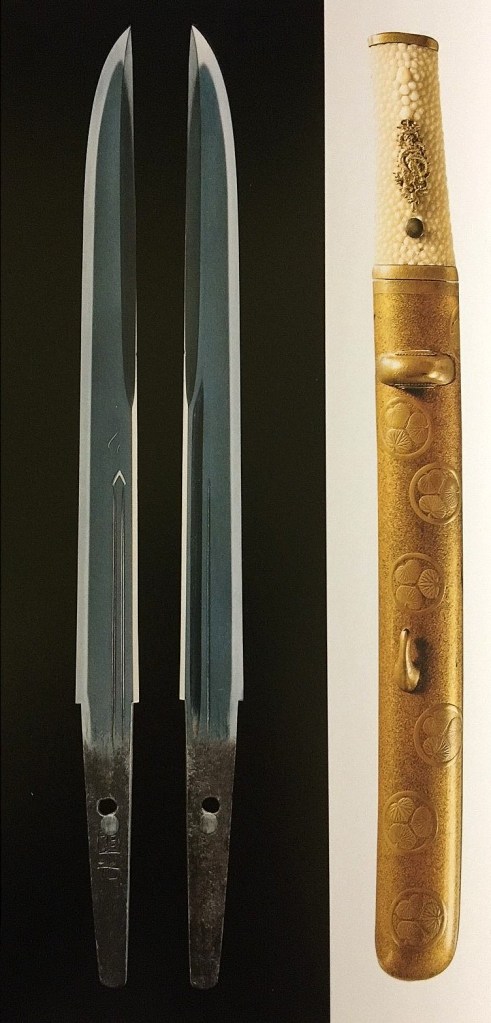
13 «Part 2»Tanto photo with Saya

The above photo is also by Shintogo Kunimitsu (新藤五国光) with Saya.  Saya is the scabbard.  The handle of the scabbard (white part) is made of sharkskin.  Both photos are from the  Sano Museum Catalog “Reborn.”  Permission granted.                                                                     

38|Part 2 of — 5 Heian Period Sword 794-1192 (平安太刀)

This chapter is a detailed part of  Chapter 5, Heian Period Sword.  Please read Chapter 5 before this section.  More sword terminology will be used in the upcoming chapters.  These terms were explained in Chapters 1-31.  If you encounter unfamiliar sword terms, please refer to Chapters 1 through 31.

0-timeline - size 24 Heian                   The red circle above indicates the time we discuss in this sect         

During the Heian period, several swordsmith schools were active.  We use the word “den” to refer to these schools.  These include Yamashiro-den (山城伝), Yamato-den (大和伝), and Bizen-den (備前伝).  Additionally, the following regions had other active groups during the Heian period: Hoki-no-kuni (伯耆の国) and Oo-u (奥羽).   Oo-u is pronounced “Oh,” and “U” as in uber.

 Yamashiro Den (山城伝 )

During the Heian period, among Yamashiro-den swords, the most famous sword was the “Mikazuki Munechika“ (三日月宗近) by Sanjo Munechika (三条宗近).  Mikazuki means crescent.  It was named Mikazuki Munechika because the crescent-shaped uchinoke (collection of Nie) pattern appears in the hamon.  It has a graceful shape, a narrow body, koshi-zori, funbari, and a small kissaki.  The sword shows a wood grain pattern on its surface, with suguha with nie mixed with small irregular lines, and sometimes a nijyu-ha (double hamon: 二重刃) appears.  Sanjo Munechika lived in the Sanjo area of Kyoto.  His sword style was passed down through his sons and grandsons: Sanjo Yoshiie (三条吉家), Gojo Kanenaga (五条兼永), and Gojo Kuninaga (五条国永).  Gojo is also a district in Kyoto

    三日月宗近    Mikazuki Munechika  東京国立博物館蔵 Tokyo National Museum           Photo from “Showa Dai Mei-to Zufu 昭和大名刀図譜” published by NBTHK

Houki -no-Kuni (伯耆の国)

Houki-no-kuni is the area now called Tottori Prefecture.  It is known for producing high-quality iron.  The sword, “Doujigiri Yasutsuna” (童子切安綱), made by Hoki-no-yasutsuna (伯耆の安綱), was one of the most famous swords of its time.                                                                                                 

The characteristics of Yasutsuna’s sword ——- It has a graceful shape with a small kissaki, a narrow hamon (often suguha with ko-choji), coarse nie in the hamon area, and a large wood grain pattern mixed with masame on the ji-hada.  The hamon area often shows inazuma and kinsuji.  The boshi area is yakizume, and the kaen (pronounced ka as in calf, en as in engineer) has a slight turn back. 

   伯耆の安綱 (Hoki no Yasutsuna) 佐野美術館図録 (Sano Musem Catalogue)                     Permission to use granted 

Bizen Den (備前伝 )

Bizen is in Okayama Prefecture today.  It is known for producing high-quality iron.  From the Heian period to the present, Bizen has been famous for its sword-making tradition.  The sword-making group in this area during the Heian period was called the Ko-bizen group.  The most famous swordsmiths in the Ko-bizen group included Bizen Tomonari (備前友成), Bizen Masatsune (備前正恒), and Bizen Kanehira (備前包平).                                                                   

Ko-bizen group’s characteristics ———- A graceful, narrow body, a small kissaki, and a narrow-tempered line with ko-choji (small irregular) with inazuma and kin-suji.  The ji-hada displays a small wood-grain pattern.

   Bizen Kanehira (備前包平) Sano Museum Catalogue (佐野美術館図録)                          (Permission to use granted)

I saw Ko-bizen Sanetsune (真恒) at Mori Sensei’s house.  That was one of the kantei-to of that day.  I received a dozen*ᴵ.  The book written by Hon’ami Koson was used as our textbook.  Each time I saw a sword at Mori Sensei’s house, I recorded the date next to the swordsmith’s name in the book we used.  It was Nov. 22, 1970.  It had a narrow body line, a small kissaki (Ko-bizen komaru), kamasu*2 (no fukura), and suguha.  Kamasu is a condition in which the fukura (arc) is much less than usual.  Looking back, it is amazing that we had the opportunity to study such famous swords as our study materials.

Kantei-Kai

Kantei-kai is a study meeting.  Usually, several swords are displayed, with the nakago area covered.  Attendees try to guess the sword maker’s name and submit their answer sheets to the judge.  Below are the grades.

Atari —– If your answer is the exact correct name, you get Atari. That is the best answer.

Dozen —— The second best is a dozen.  It means nearly a correct answer. The subject sword was made by the family or clan of the right den.   A dozen is considered very good.  It indicates that the student has solid knowledge of the particular group.

Kaido Yoshi —– This means it is correct regarding the line, but not about the family.

Jidai Yoshi — it means the time or period is correct.  Each Kantei-kai has its own grading system.  Some may not have a “Jidai Yoshi” grade.

Hazure——– the wrong answer. 

Once all answer sheets are submitted, they are graded and returned. The judge reveals the correct answer and explains why.

*1 Dozen:  Almost the same as the correct answer. *2 Kamasu:  A name of a fish that has a narrow, pointed head.


28|Shin-to Sword — Main Seven Regions (part B 主要7刀匠地)


0-timeline - size 24 Shin-to
 The red circle indicates the subject of this chapter

64Map with number with 8

3Musashi ( 武蔵 ) in Edo ( 江戸 )

The katana and wakizashi made in the Musashi area have a shallow sori (curvature).  Often, the width of the blade’s upper part is narrow.  Usually, the hamon begins with a slight irregular pattern, then gradually shifts to a larger irregular pattern, and a few inches below the yokote line, it becomes a small irregular pattern again.  The boshi is usually a komaru-boshi.  The ji-hada may be rough.  Masame-hada shows on shinogi-ji.

Well-known swordsmiths in Musashi ———————————-Noda Hannkei (野田繁慶)                                                      Nagasone Okisato Nyudo Kotetsu (長曽根興里入道虎徹)

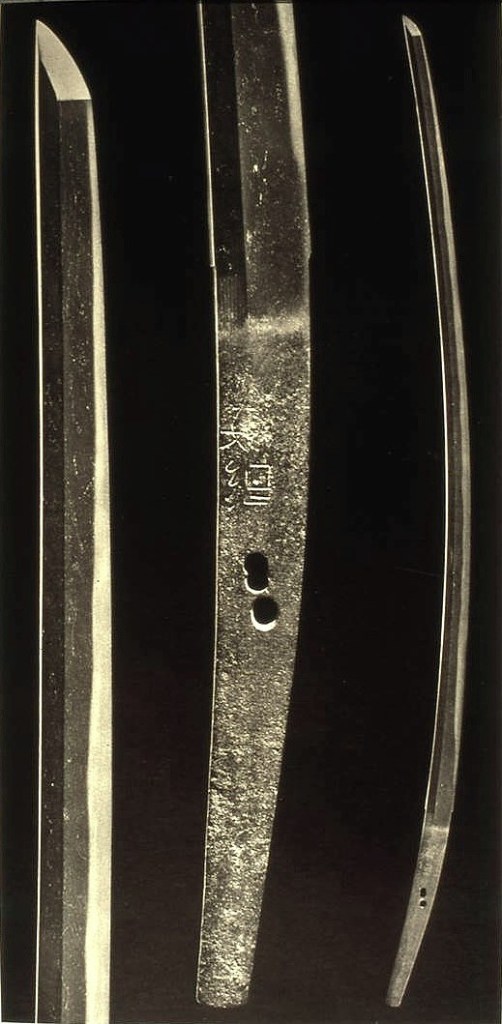
Nagasone Okisato Nyudo Kotetsu                        Noda Hankei (野田繫慶)                                   (長曽根興里入道虎徹)                                   from Compton’s collection “Nippon-to”    Once, my family sword                                                                                                               

4. Echizen ( 越前 ) and 5. Kaga (加賀 )

Many swordsmiths from the Mino (美濃) area moved to the Echizen and Kaga areas (#4  & #5 on the map above).  Therefore, swords made in these areas are called Echizen-seki and Kaga-seki.  Refer to Chapter 23 Sengoku Period (戦国) Sword for Mino-den.             The style of Echizen Yasutsugu (越前康継) is similar to that of Mino-den.

Well-known swordsmith in Echizen ————————-Echizen Yasutsugu (越前康継 )

6. Hizen (肥前)

Both the katana and wakizashi from Hizen have well-balanced shapes.  The Hizen region tends to produce swords with a chu-suguha-hotsure (a medium-width straight hamon resembling frayed fabric) with fine nie (沸).  The boshi has a clean, regular line with a uniform width tempered line, as shown in the illustration below.  If you see a shin-to sword that has a chu-suguha hamon and a boshi that looks like the one below, it is often made by Hizen Tadayoshi (肥前忠吉).  Very fine Ji-hada (surface), sometimes called nukame-hada.

29 Hizen Tadayoshi Boshi

Well-known swordsmith in Hizen ——————————— Hizen Tadayoshi ( 肥前忠吉)

  1. Satsuma (薩摩 )

The swords made in Satsuma appear solid for both katana and wakizashi.  The kissaki (the top pointed area) is slightly stretched.  Yakidashi (a few inches above the machi ) shows a small, irregular hamon.  The hamon is o-midare with coarse nie called ara-nie. The ara-nie forms togari-ba (a pointed pattern; see the drawing below)One of the characteristics of this region.

The region is well known for its Satsuma-nie.  That is, the ara-nie around the hamon continues and blends into the ji-hada area.  Therefore, the border between ha-nie and ji-nie is unclear.  Inside the hamon, it sometimes shows a thick line shaped like lightning.  This line is called Satsuma-no-imozuru (sweet potato vine), and is less desirable than inazume and kinsiji.  This is the most prominent feature of the Satsuma sword.  Boshi has a narrow-tempered line with a small irregular patternThis is called satsuma-boshi.  On the ji-hada surface, chikei (a long, dark line) appears.  This is called Satsuma-gane (薩摩金).

29 Satsuma Togari-ba

Well-known swordsmiths in Satsuma ——————  Izunokami Masafusa (伊豆守正房)                                                                                                 Ichinohira Yasuyo (一平安代)                                                                                       Mondonosho Masakiyo (主水正正清)


19 | Nanboku-Cho Period Tanto(南北朝短刀)

0-timeline - size 24 Nanboku-cho
The circle indicates the time we discuss in this section

During the Nanboku-cho period, a type of tanto called hirazukuri ko-wakizashi sun-nobi tanto was made.  Hirazukuri means flat swords without the yokote line or shinogi.  Ko-wakizashi refers to a shorter sword.  Sun-nobi tanto means longer than a standard tanto.  This type is also known as Enbun Jyoji ko-wakizashi tanto because most of these tantos were created during the Enbun and Jyoji eras of the imperial period.  In Japan, a new imperial era begins when a new emperor ascends to the throne.  The Enbun era spanned 1356-1361, while the Jyoji period spanned 1362-1368.

20 Enbun Jyoji Kowakizashi Tanto

Sugata (姿: shape) ————A standard tanto measure is approximately one shaku.  Shaku is an old Japanese unit of measurement for length, and one shaku is roughly equal to one foot.  

8.5 sun (the sun is another old Japanese measurement unit of length) is approximately ten inches.  Ten inches is the standard size for a tanto, known as a josun tanto.  Anything longer than a josun tanto is called a sun-nobi tanto.  Anything shorter than a josun is called a sun-zumari tanto. 

Most of the Nanboku-cho tantos are longer than a josun tanto, approximately one foot two inches.  Therefore, they are called hirazukuri ko-wakizashi sun-nobi tantoSaki-zori (curved outward at the top.  See the illustration above).   Wide in width and thin in body.  Fukura kareru (no fukura means less arc).  Shin-no-mune.  See the drawing below.

20 Fukura           20 Shin-no-Mune

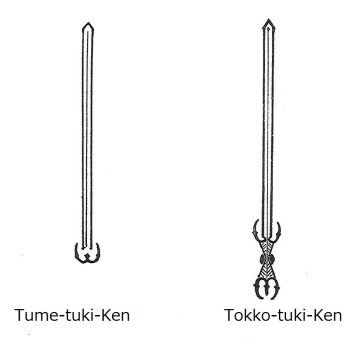
Hi, (: Grooves) and Horimono (彫り物: Engraving) ——- A groove or grooves on the mune side.  Bonji (Sanskrit, see Chapter 16 Late Kamakura Period (Early Soshu-Den Tanto),  koshi-bi (short groove),  tumetuki ken, and tokko-tsuki ken (see below) appear. The ken (dagger) is curved widely and deeply in the upper part and shallower and narrower in the lower part.  This is called Soshu-bori (Soshu-style carving).

20 Tokko, tume Ken

Hamon (: Tempered line) ——- The narrowly tempered section at the lower part gradually widens toward the top.  A similar wide hamon pattern extends into the boshi area.  The hamon in the kissaki area is kaeri-fukashi (deep turn back).  See the illustration below.  Coarse nie.  O-midare (large irregular hamon pattern).

20 Hitatsura

                                        From Sano Museum Catalogue

Ji-hada (地肌: the area between shinogi-ji and the tempered line) ——– a loose wood grain pattern called itame.  Yubashiri (see Chapter 16, Late Kamakura Period) and tobiyaki (irregular patchy tempered spots) appear.  Dense tobiyaki is called hitatsura (see the drawing above).

Nakago (: Tang) —- Short tanago-bara.  Tanago-bara refers to the shape of the belly of a Japanese fish called tanago (bitterling).

20 Tanago Bara

Tanto Swordsmiths during the Nanboku-Cho Period

Soshu Den ———————————————————-Hiromitu( 広光) Akihiro (秋広) Yamashiro Den ————————————————–Hasebe Kunishige (長谷部国重)   Bizen Den ——————————————————— Kanemitu (兼光) Chogi (長義 )

    Soshu Hiromitsu     “Nippon-To Art Sword of Japan “   The Walter A. Compton Collection

18| Nanboku-Cho Period Sword (南北朝太刀)

0-timeline - size 24 Nanboku-cho

                           The circle indicates the time we discuss in this section

During the Nanboku-cho period, samurai sought large, elaborate, impressive, yet practical swords.  The Soshu-den style sword from Nanboku-cho time was just that.    This was the most popular style at the time.  The Nanboku-cho period marked the peak and height of the Soshu-den sword.  Many swordsmiths moved from other provinces to the Kamakura area and forged Soshu-den style swords.  Other schools and provinces outside the Kamakura area also produced Soshu-den-style swords in their own areas.


19 Nanboku-cho Sword style

Sugata (姿: Shape) —————–The original length of a sword ranged from three to five feet, but it was later shortened to about two and a half feet.  A significantly shortened blade is called o-suriage. 

The Nanboku-cho style sword features shallow kyo-zori (also called torii-zori).  Refer to Chapter 5, Heian Period Sword.  The highest curvature occurs around the middle of the body. It has a wide body, high shinogi, narrow shinogi-ji  (Chapter 3, Names of parts),  and thin kasane (blade thickness), which are distinctive features of the Nanboku-cho style.  High gyo-no-mune or shin-no-mune, and sometimes a maru-mune (round back).

19 Nanboku-cho 3 kinds Mune

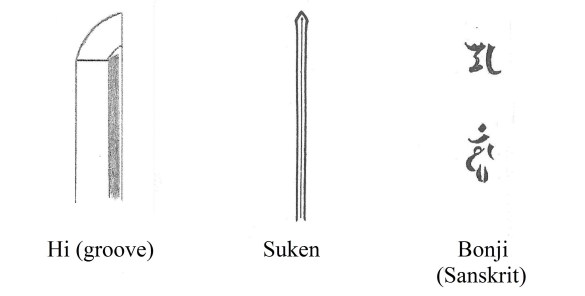
Hi (: groove) and Horimono (彫刻: engraving) ——– Often, a single hi (bo-hi), double hi, suken (dagger), Bonji (Sanskrit), and/or dragon are engraved on the shinogi-ji area.  Refer to Chapter 3, Names of Parts.

9 Hi, Suken, Bonji

Hamon (: Tempered line) —- The lower part of the body exhibits a narrow-tempered line; gradually, this line becomes wider and showier.  Course nie. O-midare (large, irregular, wavy hamon), Notare-midare (wavy, irregular hamon), and Gunome-midare (a combination of repeated half-circular and irregular hamon). Inazuma and kinsuji (see Chapter 14, Late Kamakura Period Sword) sometimes appear.

19 Hamon Notare 319 Mamon choji gunome19 Hitatsura Hamon Hiromitsu

                                  *From Sano Museum Catalogue ( Permission granted).

Ji-hada (地肌: the area between the shinogi and the tempered line) ———————-Wood-grain pattern (itame 板目). Sometimes tobiyaki (patchy tempered spots) appear on ji-hada.  For ji-hada, refer to Chapter 3, Names of Parts.

Kissaki (切っ先) and Boshi (tempered line at the kissaki area) ———- O-kissaki (long and large kissaki). Fukura kareru (less arc kissaki).  Midare-komi (the body and boshi have a similar tempered pattern), with kaeri-fukashi (hamon deeply turns back), and sometimes hitatsura (entirely tempered).  See the illustration above.

Sword-smiths during Nanboku-Cho Period Soshu Den (school)

  • From Soshu—————————————————Hiromitsu (広光)  Akihiro (秋広)  
  • From Yamashiro ———————————————Hasebe Kunishige (長谷部国重) 
  • From Bizen (called So-den Bizen)——-Chogi (長儀 )group  Kanemitsu (兼光 ) group 
  • From Chikuzen ———————————————————-Samoji (左文字 ) group

Chogi (長義)from The Sano Museum catalog. Permission to use is granted

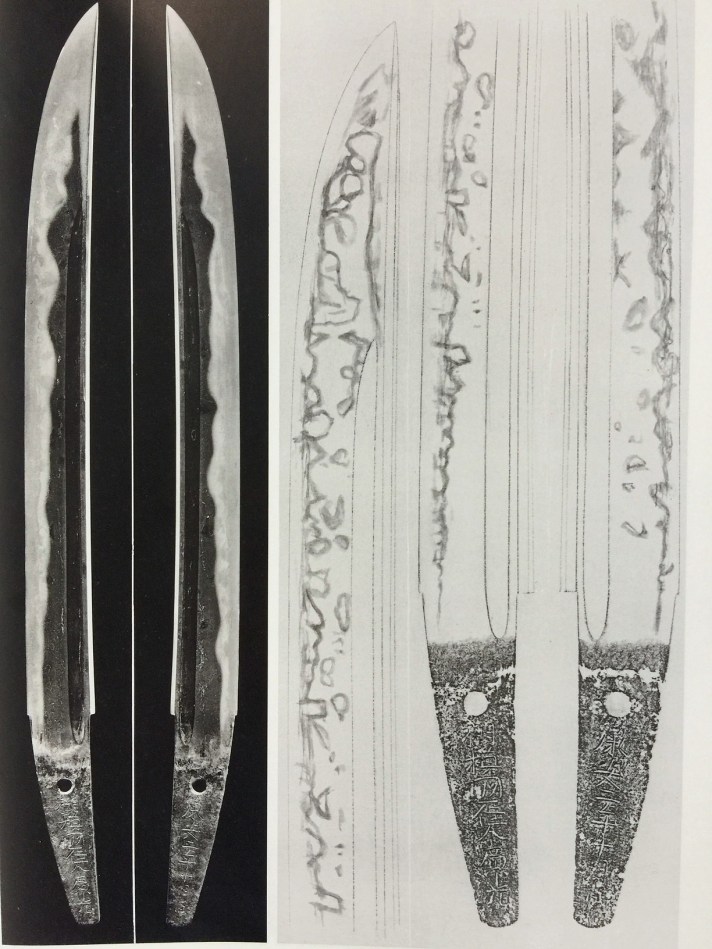
The distinctive characteristics of the Nanboku-Cho period sword in the photo above      

  • The trace of an engraving of suken on the inside of the nakago indicates that this area was once a part of the main body.
  • Large and long kissaki