53| Part 2 of — 19 Nanboku-cho Period Tanto (南北朝短刀)

This chapter is a detailed section of Chapter 19.  Please read Chapter 19, Nanboku-cho Period Tanto, before proceeding on to this part. 

0-timeline - size 24 Nanboku-cho

                          The red circle above indicates the time we discuss in this section

20 Enbun Jyoji Kowakizashi Tanto

The drawing above shows a typical shape of a Nanboku-cho-period tanto. This drawing was in Chapter 19.  I exaggerated the features of the Enbun Joji ko-wakizashi tanto to better show you.  At the end of Chapter 19, Nanboku-cho Tanto, there is a list of swordsmiths’ names from that period.  Hiromitsu (広光) and Akihiro (秋広) represent the Nanboku-cho style.
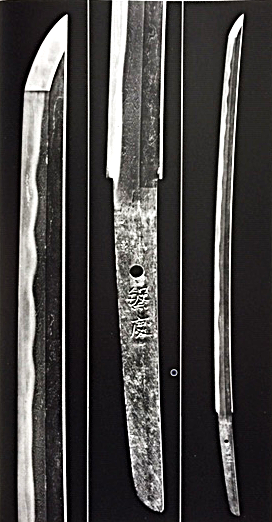
56 cropped Hiromitu photo 20 HitatsuraHiromitsu from the Sano Museum Catalogue (permission to use granted)

Enbun Joji Ko-wakizashi tanto is also called Sun-nobi tanto (>10 inches) because its length is longer than the standard size (about 10 inches) tanto.  The upper part of the tanto curves outward slightly.  This type is called sakizori.

Characteristics of Hiromitsu (広光) and Akihiro (秋広)

  • Shape———————— Usually, one foot and one to two inches long (Sun-nobi).   Wide width.  Thin blade.  Sakizori.
  • Hamon ———————- A mix of wide and narrow hamon.  The hamon around the yakidashi (just above the machi) area is narrow but gradually widens as it moves up.  The hamon around the fukura area shows most work.  Mainly nie.  Sunagashi, kinsuji, gunome, umanoha-midare (horse teeth-shaped hamon), or hitatsura appear (drawing above).                 
  • Boshi———-Irregular and unevenly tempered.  The hamon covers almost the entire boshi. Deep turn back. 
  • Jihada ———————————————————Wood-grained pattern
  • Nakago —————–Tanago-bara shape.  Refer to 19 Nanboku-cho Period Tanto.

Nobukuni (Below is my sword)

Shodai Nobukuni (the first-generation Nobukuni) was a student of Sadamune.  He was one of the Sadamune San Tetsu (貞宗三哲, Sadamune’s top three students).  Nobukuni’s characteristics resembled those of Hiromitsu and Akihiro, as described above.  Nobukuni also created sun-nobi tanto.  The sword below has a hoso-suguha, ko-mokume (small burl pattern), and ko-maru boshi (small round). 

56 Nobukuni 1 Nobukuni4

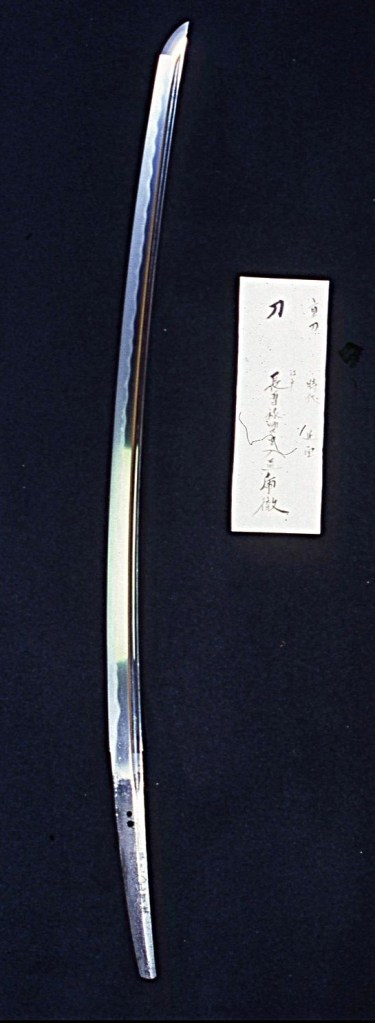
56 Nobukuni 2This is the certification of my sword.  Shodai Nobukuni (初代信國).   Juyo Token (重要刀剣)

Certification

Number: Juyo 3220, Certification Juyo-Token

Wakizashi:  Nobukuni (信国), 31.4cm long, 0.3cm curvature, hirazukuri, mitsumune (three-sided mune), sun-nobi.  The ji-hada shows a wood grain and ji-nie (surface nie, between shinogi and hamon). The hamon is a chu-suguha (medium straight). The front carving shows bonji (Sanskrit) and sanko-ken. The back engraving is bonji and hoko (pike).   Original nakago.  Examined by the Nihon Bijutsu Token Hozon Kyokai.  It is certified as a Juyo Token.  The Chairman, Moritatu HosokawaShowa 45 June 1 (June 1, 1970)

30| Shin-Shin-To 1781-1867 (Bakumatsu Period Sword 新々刀)

0-timeline - size 24 BakumatsuThe red circle indicates the time we discuss in this section

The later part of the Edo period is called Bakumatsu.  See the circled area on the timeline above.  Swords made during this time are called shin shin-to.   They are also called Fukko-to (復古刀: revived sword).  Fukko-to replicates the shape, hamon, boshi, and other features of the Ko-to and Shin-to swords.  The characteristics of the Shin Shin-to (新々刀) and well-known swordsmiths are listed below.

The Characteristics of Shin Shin-to

  • Katana, wakizashi, and tanto all tend to resemble or imitate the ko-to and shin-to in shape.
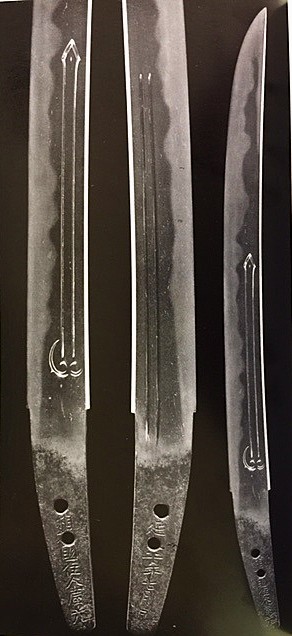
  • Many swords often have a Hi or detailed engravings.
  • One swordsmith would create multiple sword styles, such as Soshu-den, Bizen-den, and Shin-to style.
  • Often shows Katai-ha.

30 katai-ha

                                                                  Katai-ha

  • Weak (not tight) Nioi.
  • Yakidashi (2 to 3 inches above machi) is often suguha(straight line hamon), even though the rest of the area has irregular    Boshi is often irregular midare.
  • Detailed engravings are more realistic than those from earlier times.

Well-known swordsmiths of Shin Shin-to

  • Settsu (Osaka area) ——————Gassan Sadayoshi (月山貞吉), Gassan Sadakazu (月山貞一). The Gassan family is known for their detailed carvings.
  • Musashi no Kuni (Tokyo area) ————-Suishinshi Masahide (水心子正秀),  Minamoto Kiyomaro (源 清麿),  Taikei Naotane (大慶直胤),  Taikei Yoshitane (大慶義胤).  Yoshitane is well-known for his carvings.                                               

Minamoto Kiyomaro(源清麿)    Once my family possession

  • Tosa (四国: Shikoku area) ———————————————- Sa Yukihide (左行秀)
  • Satsuma (鹿児島: Kagoshima) ———— Oku Moptohira (奥元平) Namino Hira (波平)

Meiji Ishin-To

Right before the Meiji Restoration, long swords (about 3 feet) without any curvature were made.  Sa Yukihide (from the Tosa area) forged this type of sword.  Saigo Takamori (西郷隆盛) and Sakamoto Ryoma (坂本龍馬) owned such swords.  Both are well-known historical figures from the Meiji Restoration.  Both were part of the Kin’no-to (勤皇党) group, which supported the emperor and reformed the political system.


28|Shin-to Sword — Main Seven Regions (part B 主要7刀匠地)


0-timeline - size 24 Shin-to
 The red circle indicates the subject of this chapter

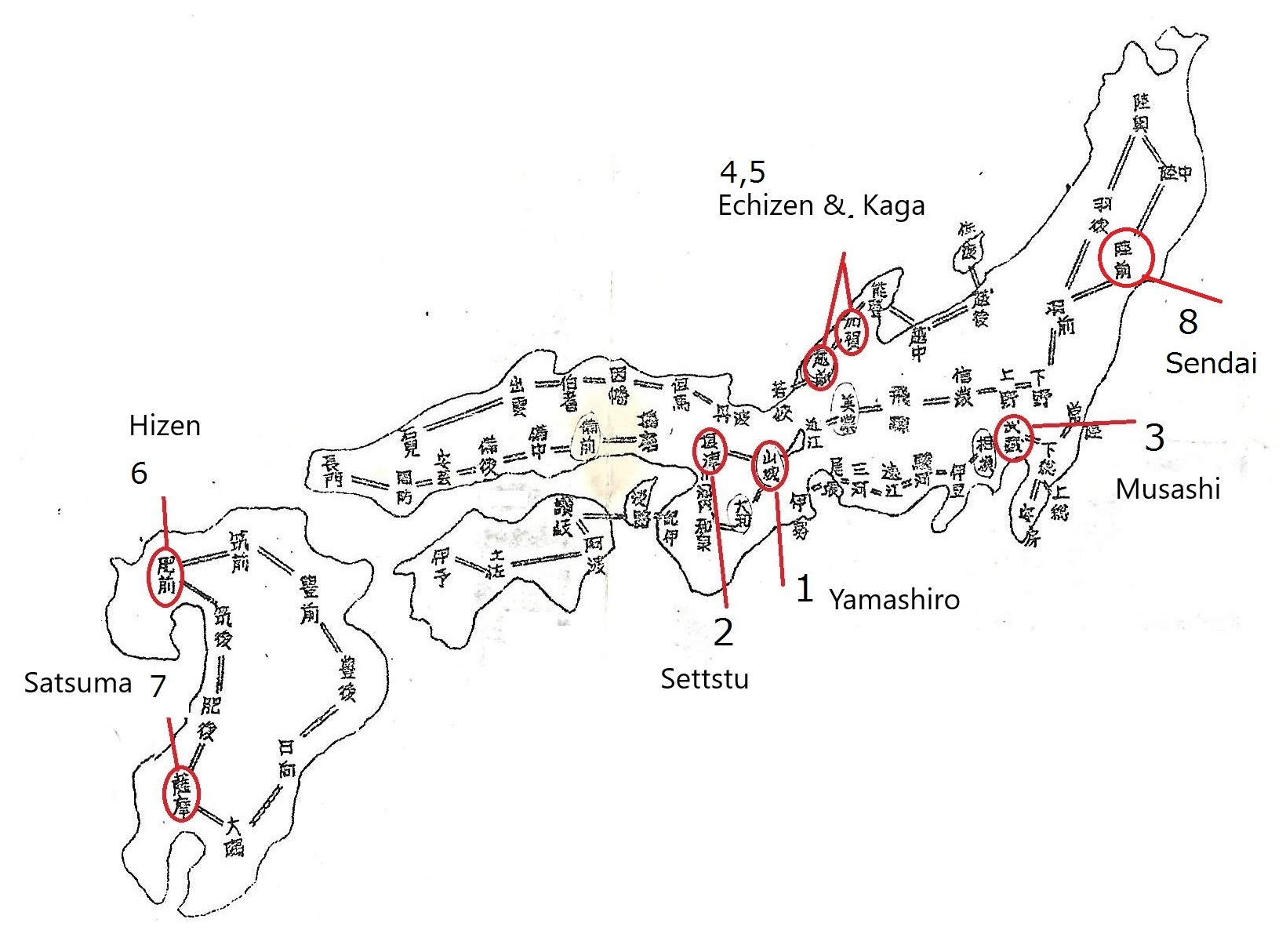
64Map with number with 8

3Musashi ( 武蔵 ) in Edo ( 江戸 )

The katana and wakizashi made in the Musashi area have a shallow sori (curvature).  Often, the width of the blade’s upper part is narrow.  Usually, the hamon begins with a slight irregular pattern, then gradually shifts to a larger irregular pattern, and a few inches below the yokote line, it becomes a small irregular pattern again.  The boshi is usually a komaru-boshi.  The ji-hada may be rough.  Masame-hada shows on shinogi-ji.

Well-known swordsmiths in Musashi ———————————-Noda Hannkei (野田繁慶)                                                      Nagasone Okisato Nyudo Kotetsu (長曽根興里入道虎徹)

Nagasone Okisato Nyudo Kotetsu                        Noda Hankei (野田繫慶)                                   (長曽根興里入道虎徹)                                   from Compton’s collection “Nippon-to”    Once, my family sword                                                                                                               

4. Echizen ( 越前 ) and 5. Kaga (加賀 )

Many swordsmiths from the Mino (美濃) area moved to the Echizen and Kaga areas (#4  & #5 on the map above).  Therefore, swords made in these areas are called Echizen-seki and Kaga-seki.  Refer to Chapter 23 Sengoku Period (戦国) Sword for Mino-den.             The style of Echizen Yasutsugu (越前康継) is similar to that of Mino-den.

Well-known swordsmith in Echizen ————————-Echizen Yasutsugu (越前康継 )

6. Hizen (肥前)

Both the katana and wakizashi from Hizen have well-balanced shapes.  The Hizen region tends to produce swords with a chu-suguha-hotsure (a medium-width straight hamon resembling frayed fabric) with fine nie (沸).  The boshi has a clean, regular line with a uniform width tempered line, as shown in the illustration below.  If you see a shin-to sword that has a chu-suguha hamon and a boshi that looks like the one below, it is often made by Hizen Tadayoshi (肥前忠吉).  Very fine Ji-hada (surface), sometimes called nukame-hada.

29 Hizen Tadayoshi Boshi

Well-known swordsmith in Hizen ——————————— Hizen Tadayoshi ( 肥前忠吉)

  1. Satsuma (薩摩 )

The swords made in Satsuma appear solid for both katana and wakizashi.  The kissaki (the top pointed area) is slightly stretched.  Yakidashi (a few inches above the machi ) shows a small, irregular hamon.  The hamon is o-midare with coarse nie called ara-nie. The ara-nie forms togari-ba (a pointed pattern; see the drawing below)One of the characteristics of this region.

The region is well known for its Satsuma-nie.  That is, the ara-nie around the hamon continues and blends into the ji-hada area.  Therefore, the border between ha-nie and ji-nie is unclear.  Inside the hamon, it sometimes shows a thick line shaped like lightning.  This line is called Satsuma-no-imozuru (sweet potato vine), and is less desirable than inazume and kinsiji.  This is the most prominent feature of the Satsuma sword.  Boshi has a narrow-tempered line with a small irregular patternThis is called satsuma-boshi.  On the ji-hada surface, chikei (a long, dark line) appears.  This is called Satsuma-gane (薩摩金).

29 Satsuma Togari-ba

Well-known swordsmiths in Satsuma ——————  Izunokami Masafusa (伊豆守正房)                                                                                                 Ichinohira Yasuyo (一平安代)                                                                                       Mondonosho Masakiyo (主水正正清)