61|Part 2 of — 27 Shin-to Main 7 Regions (part A)

Chapter 61 is a detailed part of Chapter 27, Shinto Main 7 Regions (part A).  Please read Chapter 27 before reading this section. 

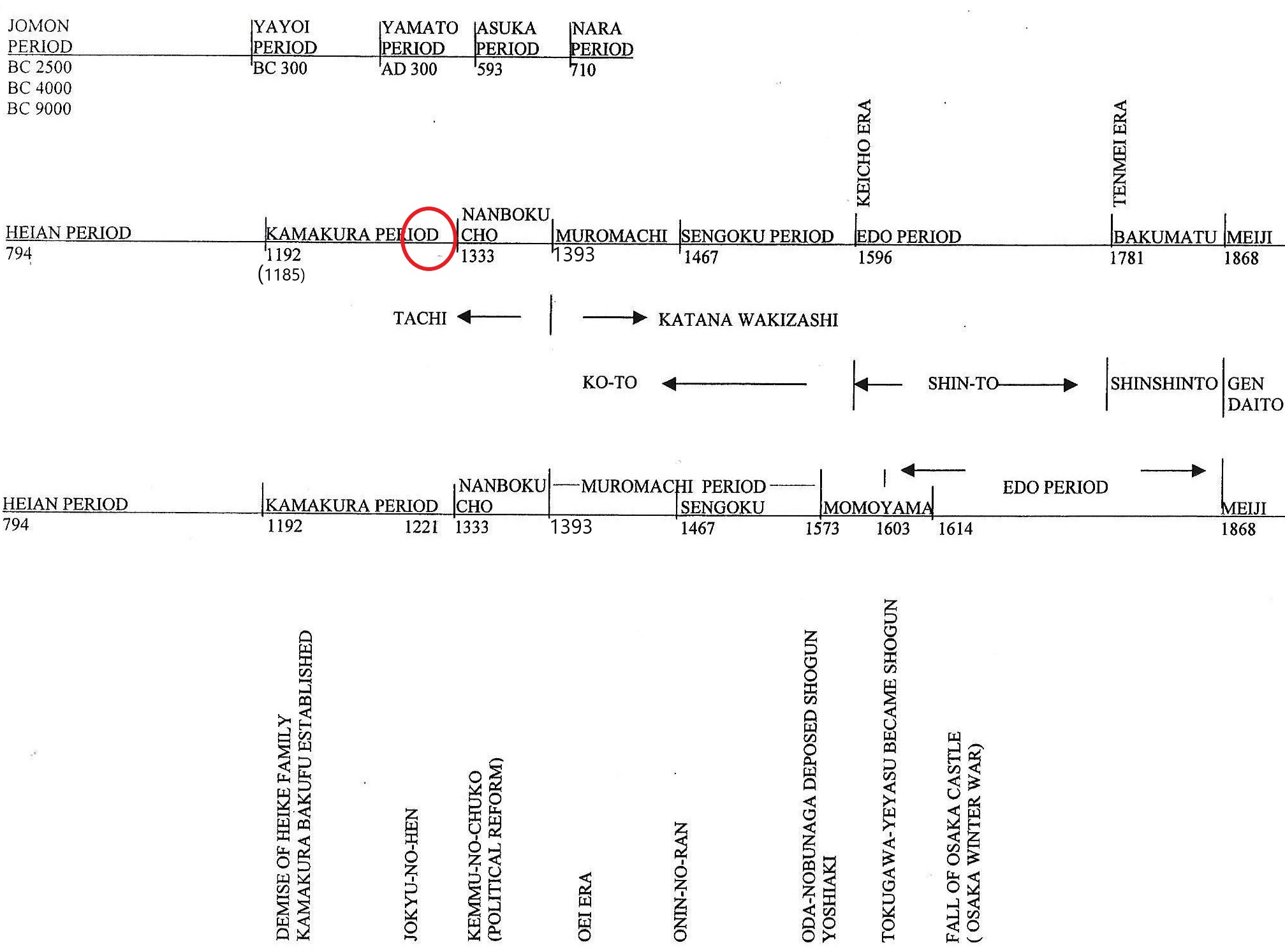
0-timeline - size 24 Shin-to                        The red circle above indicates the time we discuss in this section

Chapter 27, Shin-to Main 7 Regions (Part A), and Chapter 28, Shin-to Main 7 Regions (Part B), describe an overview of the seven main regions.  This chapter and the next chapter show photos of representative swords from these regions.  They are Yamashiro (山城, in Kyoto), Settsu (摂津, today’s Osaka), Musashi (武蔵, Edo), and Satsuma (薩摩, Kyushu).  However, Echizen (越前), Kaga (加賀), and Hizen (肥前) are omitted.
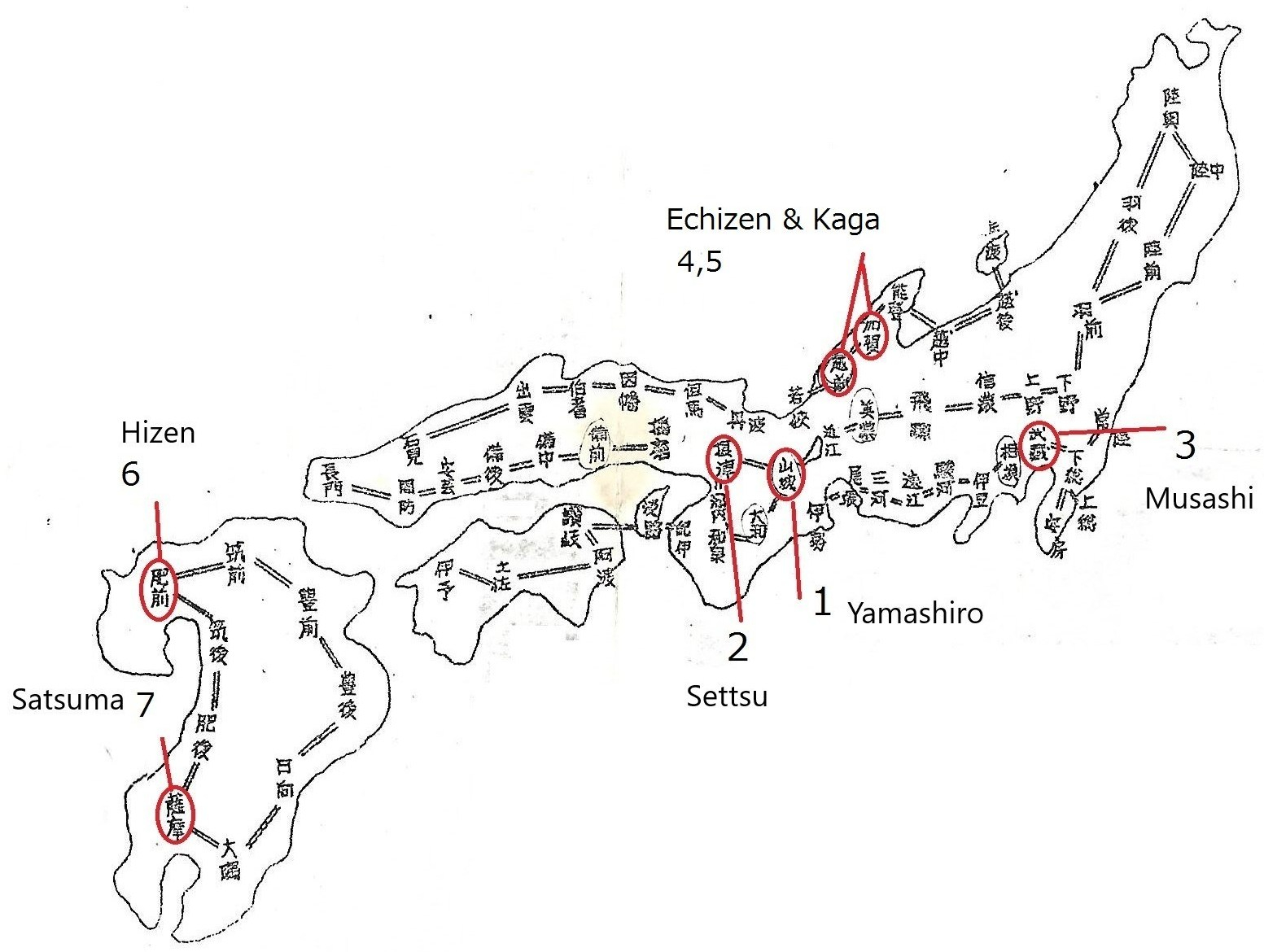
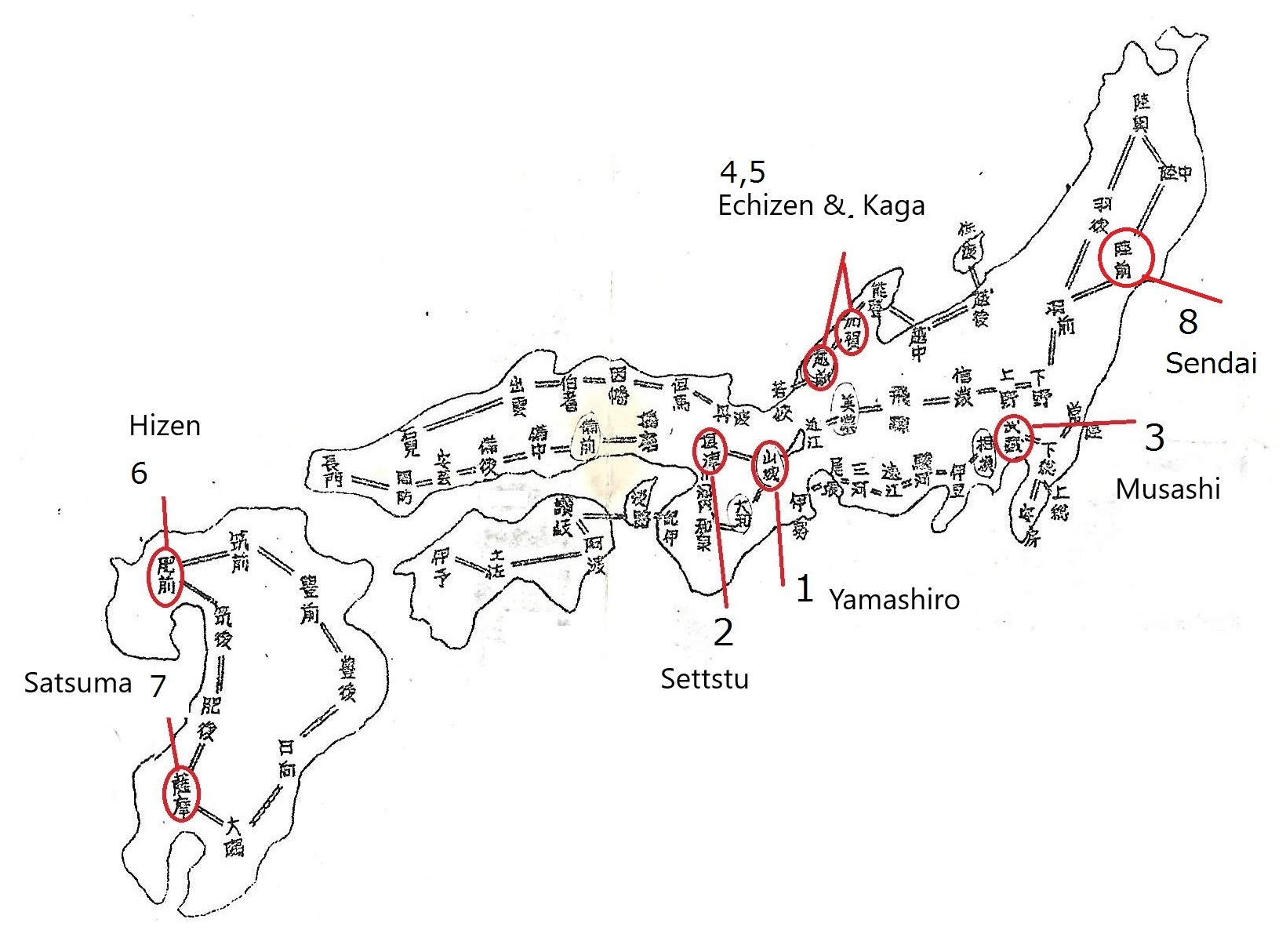
29 Map with number 7

With ko-to swords, features such as the condition of the hamon, kissaki size, length, and  shape of the nakago, etc., indicate when the sword was made.  During the ko-to period, Bizen swordsmiths produced Bizen-den swords, Yamashiro swordsmiths made Yamashiro-den swords, and Mino swordsmiths made Mino-den swords.  However, during the shin-to period, that is not the case.  The den and the swordsmith’s location often do not match.  For shin-to swords, we study the swordsmiths and swords from the seven main regions along with their characteristics.

Regarding swords made during the ko-to period, if a sword has a wide hamon line with  nie, usually, its ji-hada shows a large wood grain or a large burl grain.  Also, when you see a narrow hamon line, it typically features a fine ji-hada.

However, with shin-to swords, if a sword shows a wide hamon with nie, it often has a small wood grain or small burl grain pattern on ji-hada.  If it has a narrow hamon line, it may have a large wood grain pattern on the ji-hada.  This is a shin-to characteristic.   

Here is an exception: some early Soshu-den swords from the late Kamakura period may show a wide hamon with nie, which has small burls on the ji-hada.  Because of that, whether it is ko-to or shin-to can be confusing.  Even so, other features such as ji-hada or other parts should indicate whether it is shin-to or ko-to.

Yamashiro (山城: Kyoto)
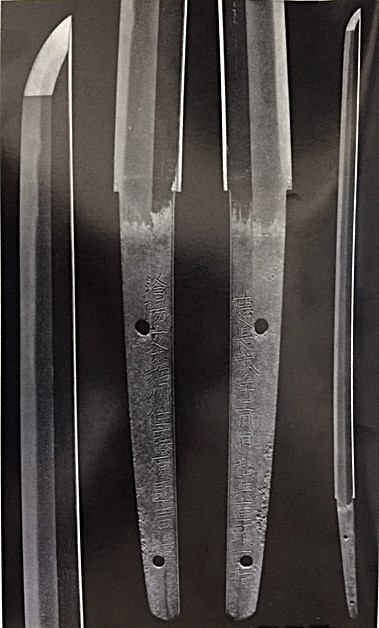
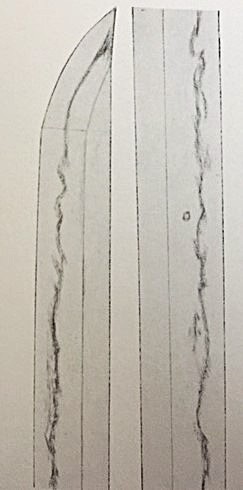
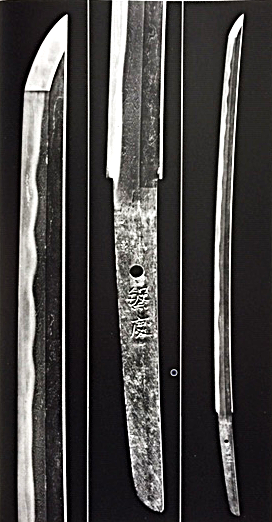
 Horikawa Kunihiro   (堀川国広)   From Sano Museum Catalogue (permission granted)

Horikawa Kunihiro (堀川国広)

Horikawa Kunihiro was regarded as a master swordsmith among shin-to swordsmiths.  He forged swords in many styles with various characteristics.  The hamon types are o-notare, o-gunome, togari-ba (pointed hamon), chu-suguha with hotsure (frayed look), hiro-suguha with a sunagashi effect, inazuma, and kinsujiKunihiro preferred to shape his swords to resemble an o-suriage (shortened Nanboku-cho style long sword).  Kunihiro‘s blades give a powerful impression.  Kunihiro‘s swords often feature beautiful carvings; designs include dragons, Sanskrit letters, and more.  Because he created swords in many different styles, there is no general characteristic that defines his work other than the hamon mainly being nie.  His ji-hada is finely forged.                                                                                                                                                                                                                                                                                                                                                     
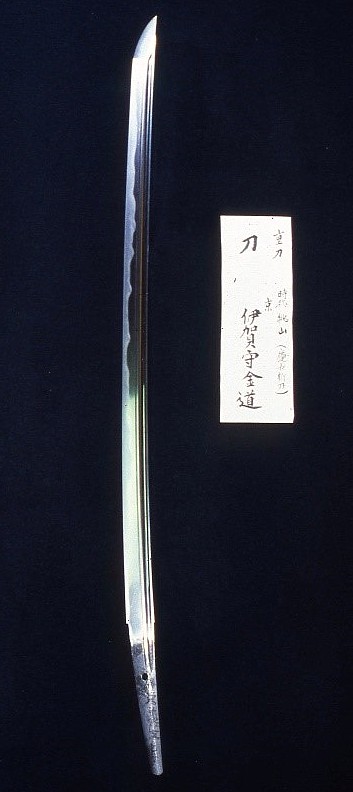
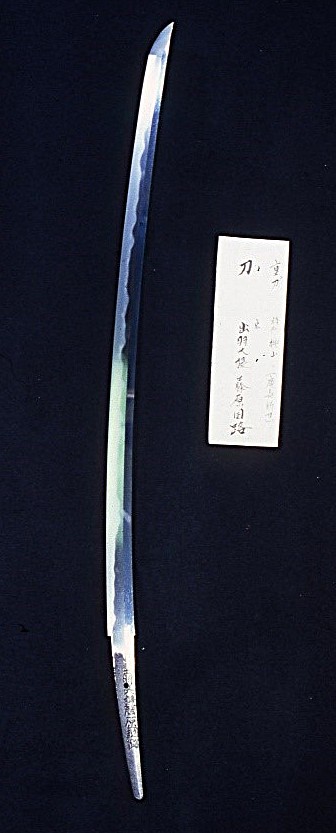
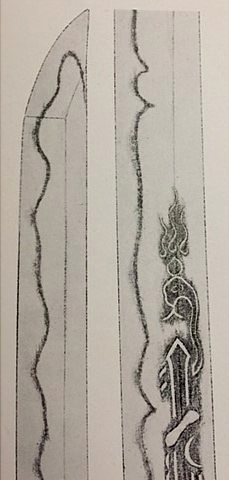
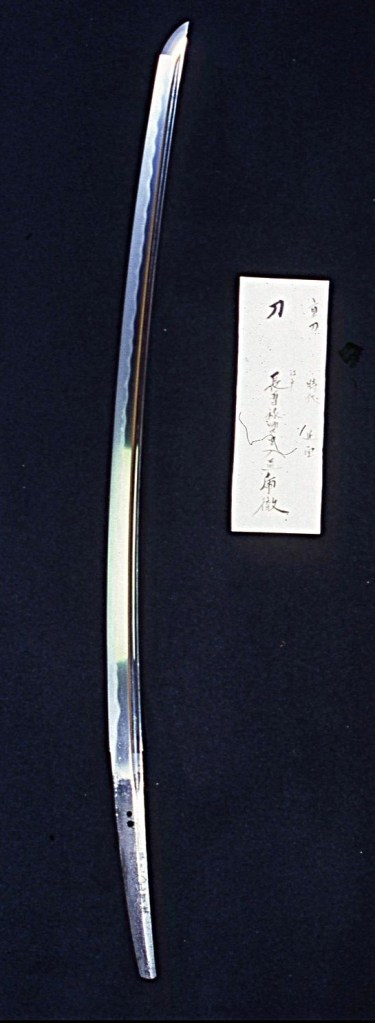
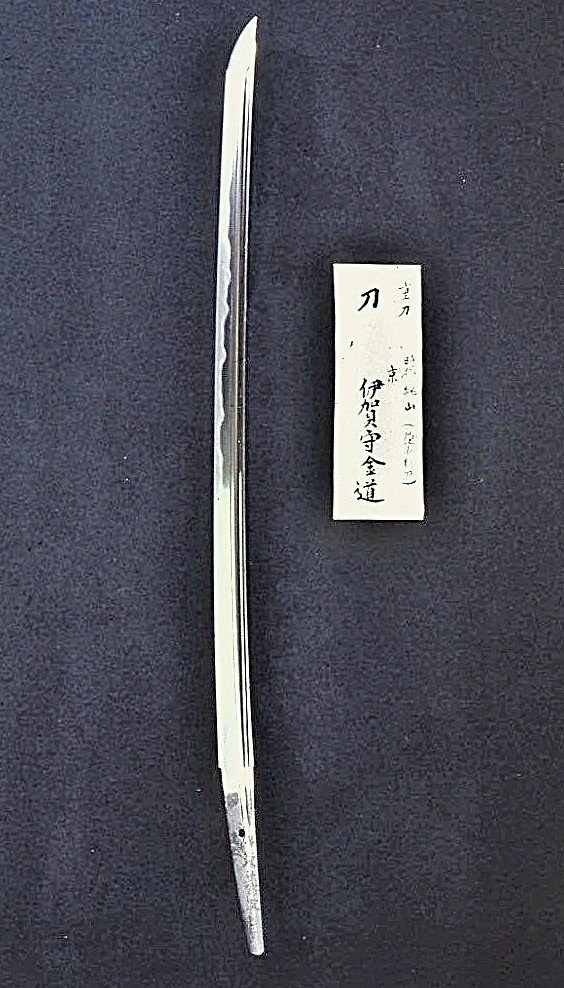
img067.jpg  img068.jpg      Iga-no-Kami Kinnmichi (伊賀守金道)           Dewa Daijyo Kunimichi (出羽大掾国路)        Both Juyo Token (重要刀剣), once my family owned, photos were taken by my father.

Iga-no-Kami Kinmichi ( 伊賀守金道)

The Kinmichi family is called the Mishina group.  Refer to 27 Shinto Main 7 Regions  Part A.   Iga-no-Kami Kinmichi was awarded the Japanese Imperial chrysanthemum crest. 

The characteristics of Kinmichi ——– Wide sword, shallow curvature, an extended kissaki, sakizori (curvature at 1/3 top),  a wide tempered line, kyo-yakidashi (see 27 Shinto Main 7 Regions  A ), hiro-suguha (wide straight hamon), o-notare (large wavy), yahazu-midare, hako-midare (refer to 24 Sengoku Period Tanto).  Mishina-boshi, refer to 27 Shin-to Main 7 Regions A.  Fine wood burl, masame appear in the shinogi-ji area.   

Dewa Daijo Kunimichi (出羽大掾国路)                                                                                 

Dewa Daijo Kunimichi was the top student of Horikawa Kunihiro.  The right photo above.  Like Kunihiro, the sword resembles a shortened Nanboku-cho sword.  Shallow curvature, a wide body, a somewhat elongated kissaki, and fukura-kareru (less arch in fukura).  Wide tempered lines, large gunome, nie with sunagashi, or inazuma shows.  Double gunome (two gunome side by side) appears.  Fine ji-hada.                                                                                                                                                                                                                

  1. Settu (摂津) Osaka (大阪 )

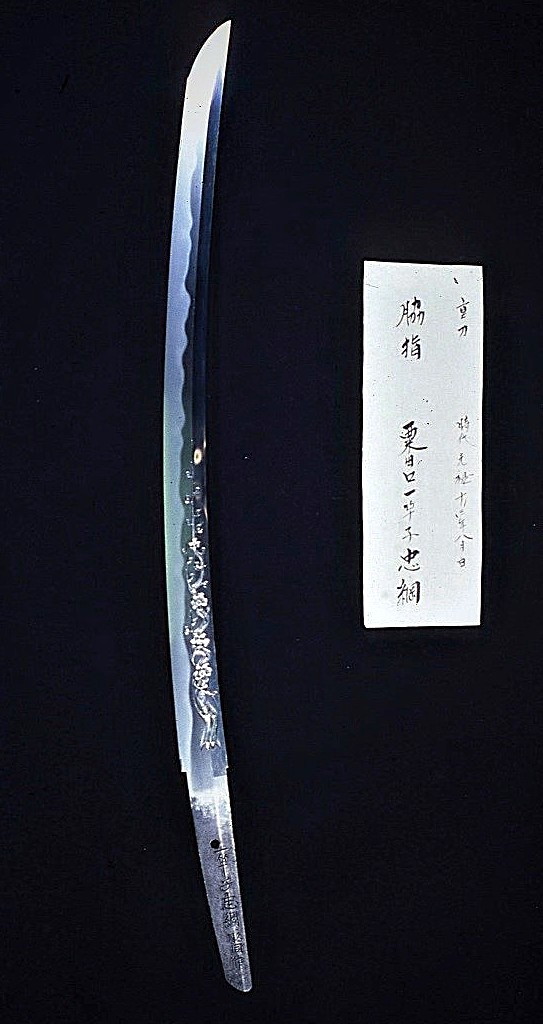
Settu (Osaka) is home to many famous swordsmiths.  They are Kawachi-no-Kami Kunisuke (河内守国助), Tsuda Echizen-no-Kami Sukehiro (津田越前守助広), Inoue Shinkai (井上真改), and Ikkanshi Tadatsuna (一竿子忠綱), among others.                          The main characteristic of the Settsu (Osaka) sword ——– The surface is beautiful and fine, almost like a solid surface with no pattern or design.  The two photos below are of the Settsu sword.
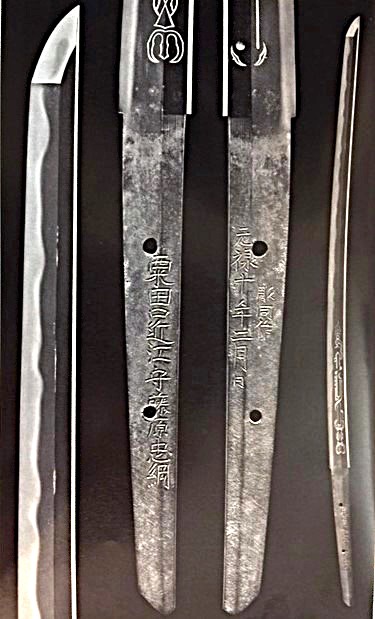
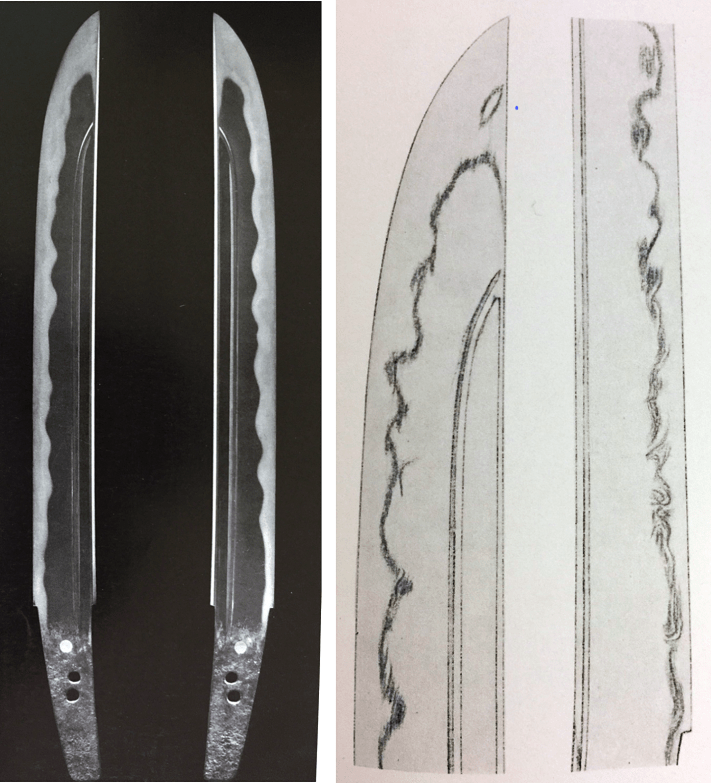
              Ikkanshi Tadatsuna from the Sano Museum Catalogue.  Permission granted to use.

Ikkanshi Tadatsuna (一竿子忠綱)

Ikkanshi Tadatsuna was famous for his carvings.  His father was also a well-known swordsmith, Omi-no-Kami Tadatsuna (近江守忠綱)Consequently, he was known as Awataguchi Omi-no-Kami Fujiwara Tadatsuna (粟田口近江守藤原忠綱), as shown in the nakago photo above.     

The characteristics of Ikkanshi Tadatsuna ——-A longer kissaki and a wide-tempered line with nie.  The Osaka yakidashi (transition between the suguha above machi and midare is smooth.  Refer to 27 Shin-to Sword – Main 7 Regions (Part A) for details on Osaka yakidashi.  O-notare with gunome, komaru-boshi with a turn back, and very fine ji-hada with almost no pattern on the surface.
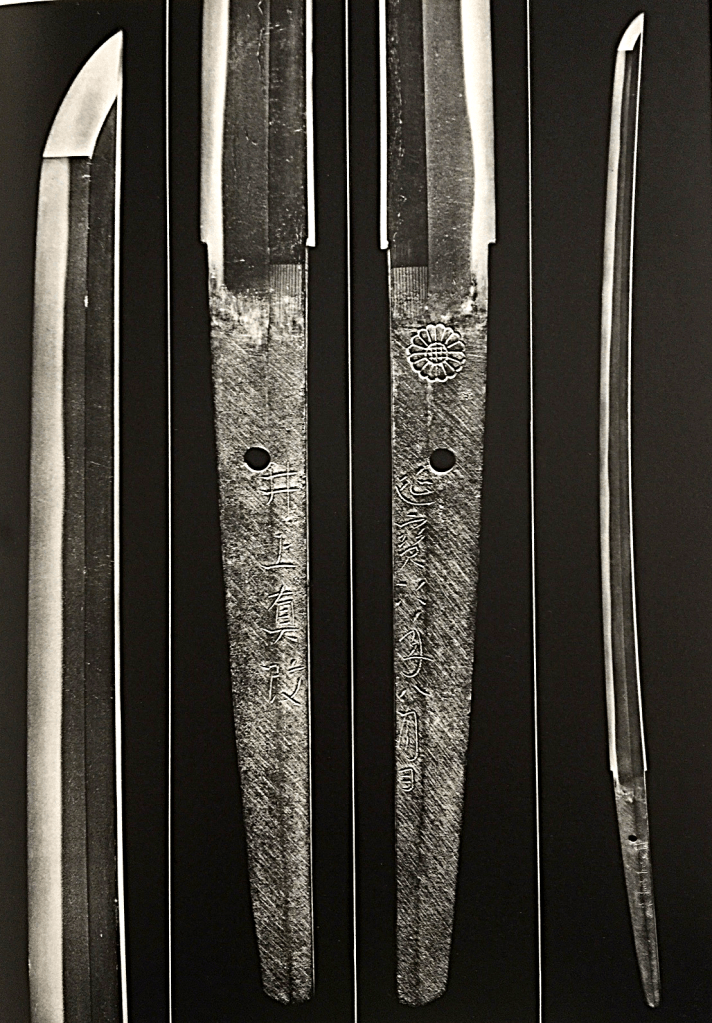
                        Inoue Shinkai (井上真改) from “Nippon-to Art Swords of Japan” The Walter A. Compton Collection

Inoue Shinkai (井上真改)

Inoue Shinkai was the second generation of Izumi-no-Kami Kunisada (和泉守国貞), who was a student of Kunihiro.                                                                                                  The characteristic of Inoue Shinkai’s swords —————- Osaka yakidashi, the tempered line gradually widens toward the top.  O-notare and deep nie.  Very fine ji-hada with almost no surface design.
50|Part 2 of –16 Late Kamakura Period: Tanto (Early Soshu-Den 鎌倉末短刀, 正宗墓)

Chapter 50 is a detailed part of  Chapter 16, Late Kamakura Period Tanto (Early Soshu-Den).  Please read Chapter 16 before this section.

0-timeline - size 24 Late Kamakura

                     The red circle above indicates the time we discuss in this section.

In  Chapter 16, Late Kamakura Period Tanto (Early Soshu-Den), the general features of the late Kamakura period tanto style (early Soshu-den) are described.  The following two photos show the typical characteristics of early Soshu-den tanto.

Masamune

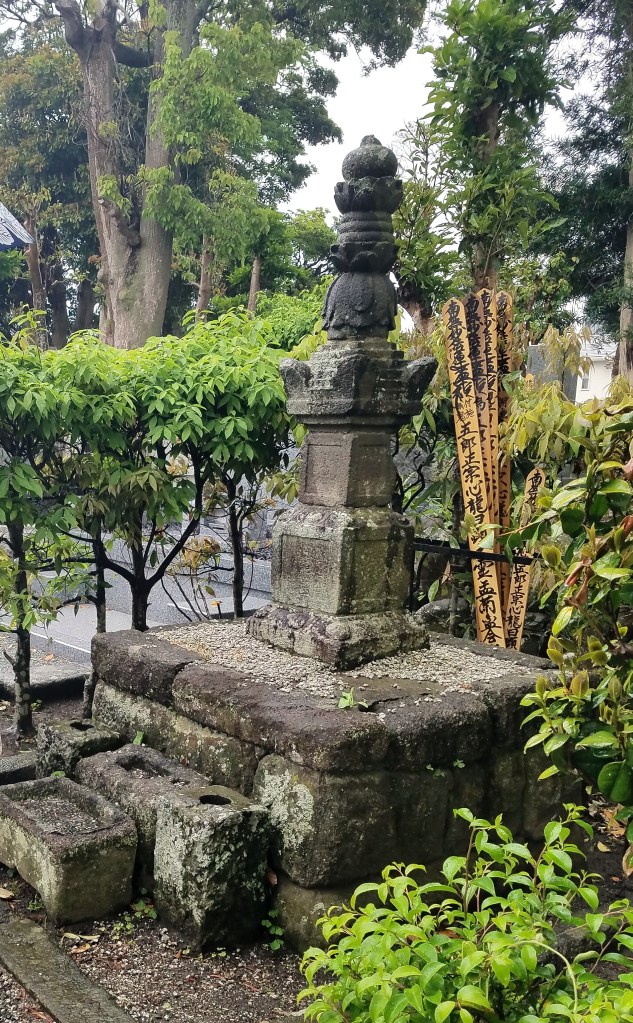
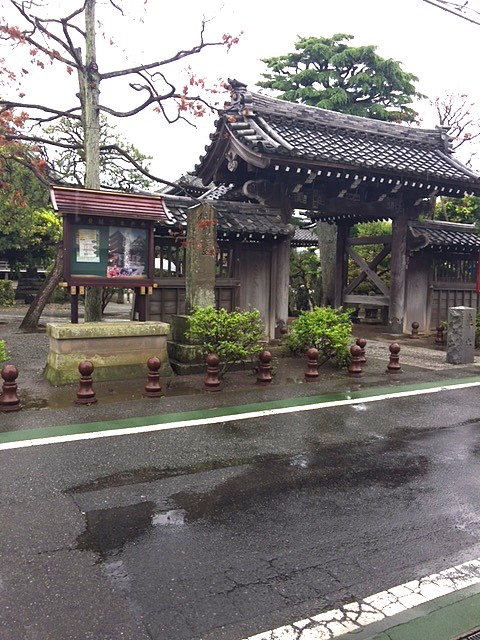
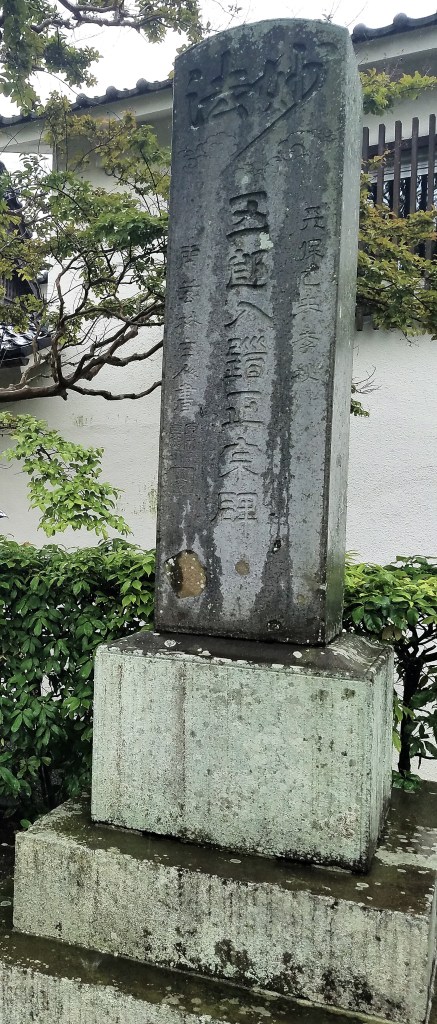
Goro Nyudo Masamune (五郎入道正宗) was born in Kamakura as the son of Tosaburo Yukimitu (藤三郎行光)Today, Masamune is a well-known swordsmith, even among those unfamiliar with Japanese swords.  His father, Tosaburo Yukimitsu, was also among the top swordsmiths in early Soshu-den.  Masamune’s tomb is located at Honkaku-ji (本覚寺) Temple, about a 6-minute walk from Kamakura Station. 

Goro Nyudo Masamune (五郎入道正宗) Sano Museum Catalog (permission granted)
Masamune photo (above) —– Hira-zukuri (flat).  Sakizori is very slightly curved (the tip area curves slightly outward).  Bo-hi and tsure-hi (parallel thin grooves).  Komaru-boshiItame-hada (wood grain pattern).  The Hamon is notare (wavy).  The illustration above shows sunagashi and niju-ba (double hamon).  This type of nakago is called tanago-bara.  The Masamune tanto is often mu-mei (unsigned). This particular tanto is called Komatsu Masamune (小松政宗).  The catalog from the Sano Museum’s description stated that connoisseurs in the past had difficulty determining this as a Masamune swordBecause the wide mihaba with sori and hamon slightly differed from those of another Masamune.  Judging from the clear nie, chikei, and kinsuji, it was determined to be a Masamune tanto.

Enju Photo below

               Higo Province Enju Kunisuke from Sano Museum Catalog (permission granted)
The Enju (延寿) group lived in Higo (肥後) Province on Kyushu.  The characteristics of the Enju group closely resemble those of the Yamashiro-den because Enju Kunimura was related to Rai Kuniyuki, a member of the Yamashiro-den.

Enju (photo above) —-Hamon is hoso-suguha (straight temper line).  The boshi is komaru.  The front engraving is suken (above left photo, left side), and the engraving on the back is gomabashi (left photo, right side).  Tight itame ji-hada.  It can be confusing to kantei (determine who made the sword) a sword like this because, although it is from the late Kamakura period, it does not have the typical early Soshu-den appearance.

Masamune’s Tomb in Honkaku-ji Temple

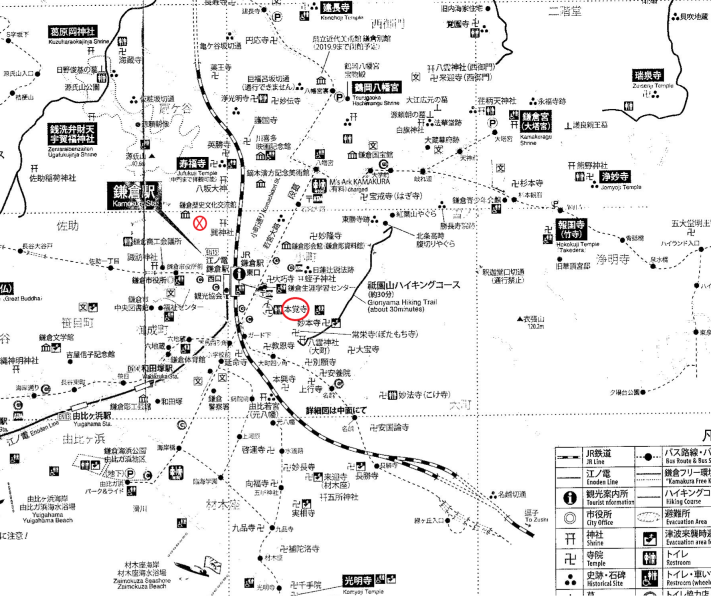
Masamune’s (正宗) tomb is located inside Honkaku-ji Temple (本覚寺) in Kamakura.  Here is a map of Honkaku-ji Temple and the Masamune Kogei store in Kamakura.  The store is owned by Tsunahiro Yamamura, the 24th generation of MasamuneHonkaku-ji Temple is circled on the map, and the Masamune Kogei store is a red circle with an X.  Both are about a 6 to 7-minute walk from Kamakura Station. 

To reach to Honkaku-Ji Temple from Tokyo                                                                           Take the Yokosuka Line train from Tokyo Station (approx. one hour) → Get off at Kamakura Station (one stop after Kita-Kamakura) → Exit through the East Exit (front exit) → Walk straight and cross the street → Turn right and walk to the post office → Turn left at the post office (Honkaku-ji Temple sign is at the corner of the post office)

From Kamakura Tourist map

52 Honnkakuji 2 54 large Masamune monument only

52 Honkakuji 54 Small Masamune tomb only

Honkakuji Temple (本覚寺) and Masamune Tomb (正宗墓 )

45|Part 2 of –11 Ikubi Kissaki (continued from Chapter 44)

This chapter is a detailed section of Chapter 11, Ikubi-kissaki, and continues from Chapter 44|Part 2 of 11 Ikubi-kissaki Sword.  Please read Chapter 11 and Chapter 44 before proceeding with this section.

0-timeline - size 24 Middle Kamakura

 The red circle above indicates the time we discuss in this section.

Bizen Saburo Kunimune (備前三郎国宗)

Another swordsmith worth mentioning in this section is Bizen Saburo Kunimune (備前三郎国宗).  During the middle Kamakura period, the Hojo clan invited top swordsmiths to Kamakura.  Awataguchi Kunitsuna (粟田口国綱) from Yamashiro in Kyoto, Fukuoka Ichimonji Sukezane (福岡一文字助真) from the Bizen area, and Bizen Kunimune (備前国宗) from the Bizen area moved to Kamakura with their circle of people.  These three groups started the Soshu-den (相州伝).  Refer to Chapter 14, Late Kamakura Period Swords.

  • Sugata (shape)  ——————— Ikubi-kissaki style.  Sometimes Chu-gissaki.  Thick body.  Koshi-zori. Narrow Shinogi width.                                                                                                
  • Horimono (Engravings)  —————- Often narrow Bo-hi (single groove)
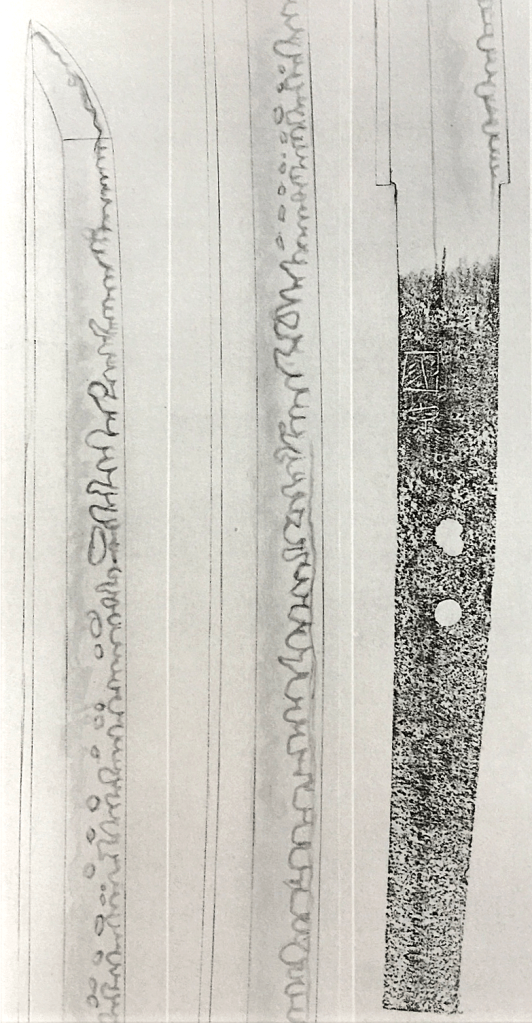
  • Hamon (Tempered line) ————- O-choji Midare (irregular large clove shape) with Ashi.  Or Ko-choji Midare (irregular small clove shape) with AshiNioi base with Ji-nie (Nie in the Hada area).  Some Hamon appear squarish with less Kubire (less narrow at the bottom of the clove).   Hajimi (刃染み rough surface) may show.  The Kunimune swords often show a lower part with Choji and an upper part with less activity without Ashi                                                                                                                                                                                                                        

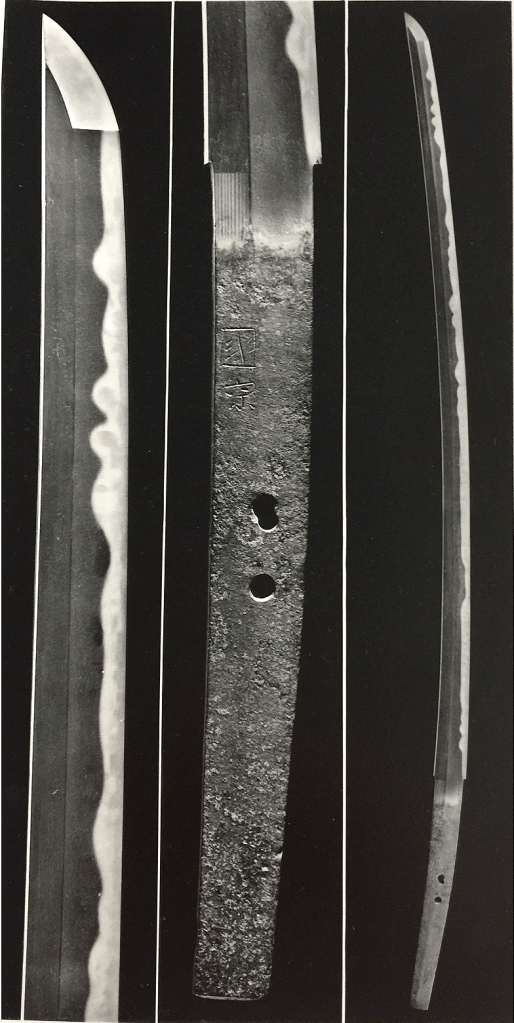
Kunimune Compton 1 Kunimune Compton 2Bizen Saburo Kunimune (備前三郎国宗)   Photo from “Nippon-to Art Sword of Japan, ” The Walter A. Compton Collection.   National Treasure

  • Boshi  ———————— Small irregular.  Yakizume or short turn back.
  • Ji-hada —————-Wood-grain pattern.  Fine Ji-hada with some Ji-nie (Nie inside Ji-hada).  Midare-utsuri (irregular shadow) is visible.  A few Hajimi (rough surface).

12 (second part 2) 照国神社The above photo is from the official website of the Terukuni Jinja Shrine in Kyushu.    http://terukunijinja.pkit.com/page222400.html

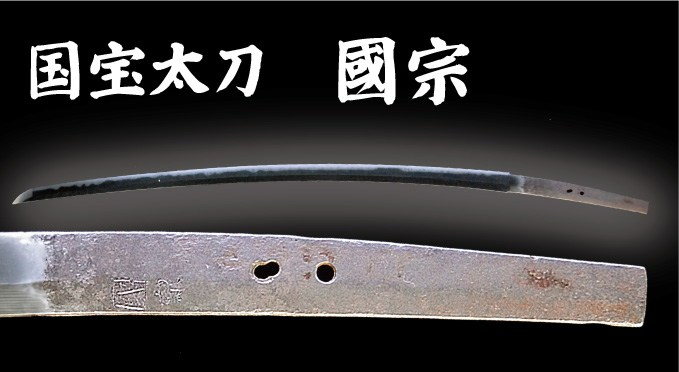
This is the national treasure, Kunimune, preserved at the Terukuni Jinja Shrine in Kagoshima Prefecture.  See the photos on the previous page.  This Kunimune sword was lost after WWII.  Dr. Compton, chairman of the board at Miles Laboratories in Elkhart, Indiana, found it in an antique shop in Atlanta.  I mentioned Dr. Compton in Chapter 32, Japanese Swords, after World War II.  When he saw this sword, he realized it was not just an ordinary sword.  He bought it and inquired at the Nihon Bijutsu Token Hozon Kyokai (The Japanese Sword Museum) in Tokyo.  It turned out to be the famous missing national treasure, Kunimune, from the Terukuni Jinja shrineHe returned the sword to the shrine without compensation in 1963. 

My father became close friends with him around this time through Dr. Homma and Dr. Sato, both leading sword experts.  Later, Dr. Compton asked Dr. Honma and my father to examine his collection of swords at his house, where he had many, as well as those at the Metropolitan Museum of Art in New York, the Philadelphia Museum of Art, and the Museum of Fine Arts in Boston.  My father wrote about this trip and the swords he examined in those museums and published a book in 1965 titled “Katana Angya (刀行脚).” 

For Dr. Compton and my father, those days must have been the best times of their lives.  Their business was doing well, and they could spend a lot of time on their interests and enjoy themselves.  It was also the best time for me.  One time, when I visited Compton’s house, he spent hours showing me his swords in the basement for hours, nearly all day.  His house was large, and the basement, which he had built as his study, had a fire prevention system. The lighting system was perfect for viewing swords and other art objects. 

His wife, Phoebe, told him he shouldn’t keep a young girl (I was a college student at the time) in the basement all day.  He agreed and took me to his cornfield to pick some corn for dinner.  From a basement to a cornfield, not much of an improvement?  So, Phoebe decided to take me shopping and have lunch in Chicago.  Good idea,  but it was too far.  Compton’s house was in Elkhart, Indiana.  The distance between Elkhart and Chicago was about 2.5 hours by car. It was too far just for shopping and lunch.  To my surprise, the company’s employee flew us to the rooftop of a department store, we did some shopping, had lunch, and then flew back.

Miles Laboratories and a well-known Japanese large pharmaceutical company had a business partnership at that time.  Dr. Compton frequently traveled to Japan for business purposes.  However, whenever he visited Japan, he spent days with sword people, including my father, and I usually followed him.  One of the female workers’ jobs at this pharmaceutical company was to translate the sword book into English. 

My parents’ house was filled with Miles’ products.  Miles Laboratories had a large research facility in Elkhart, Indiana.  I visited there several times.  One day, I sat with Dr. Compton in his office, looking into a sword book with our heads close together.  That day, movie actor John Forsythe visited the research lab.  He was the host of a TV program sponsored by  Miles Laboratories.  All the female employees were making a big fuss over him.  Then he entered Dr. Compton’s room to greet him, expecting the chairman to be sitting in his big chair at his desk, looking like a chairman.  But he saw Dr. Compton looking into the sword book seriously, with his head against mine.  Dr. Compton’s appearance was just like that of any chairman of the board of a major company, as one might imagine, and I was a Japanese college student looking like a college student.  John Forsythe showed a strange expression as if he did not know what to think.


28|Shin-to Sword — Main Seven Regions (part B 主要7刀匠地)


0-timeline - size 24 Shin-to
 The red circle indicates the subject of this chapter

64Map with number with 8

3Musashi ( 武蔵 ) in Edo ( 江戸 )

The katana and wakizashi made in the Musashi area have a shallow sori (curvature).  Often, the width of the blade’s upper part is narrow.  Usually, the hamon begins with a slight irregular pattern, then gradually shifts to a larger irregular pattern, and a few inches below the yokote line, it becomes a small irregular pattern again.  The boshi is usually a komaru-boshi.  The ji-hada may be rough.  Masame-hada shows on shinogi-ji.

Well-known swordsmiths in Musashi ———————————-Noda Hannkei (野田繁慶)                                                      Nagasone Okisato Nyudo Kotetsu (長曽根興里入道虎徹)

Nagasone Okisato Nyudo Kotetsu                        Noda Hankei (野田繫慶)                                   (長曽根興里入道虎徹)                                   from Compton’s collection “Nippon-to”    Once, my family sword                                                                                                               

4. Echizen ( 越前 ) and 5. Kaga (加賀 )

Many swordsmiths from the Mino (美濃) area moved to the Echizen and Kaga areas (#4  & #5 on the map above).  Therefore, swords made in these areas are called Echizen-seki and Kaga-seki.  Refer to Chapter 23 Sengoku Period (戦国) Sword for Mino-den.             The style of Echizen Yasutsugu (越前康継) is similar to that of Mino-den.

Well-known swordsmith in Echizen ————————-Echizen Yasutsugu (越前康継 )

6. Hizen (肥前)

Both the katana and wakizashi from Hizen have well-balanced shapes.  The Hizen region tends to produce swords with a chu-suguha-hotsure (a medium-width straight hamon resembling frayed fabric) with fine nie (沸).  The boshi has a clean, regular line with a uniform width tempered line, as shown in the illustration below.  If you see a shin-to sword that has a chu-suguha hamon and a boshi that looks like the one below, it is often made by Hizen Tadayoshi (肥前忠吉).  Very fine Ji-hada (surface), sometimes called nukame-hada.

29 Hizen Tadayoshi Boshi

Well-known swordsmith in Hizen ——————————— Hizen Tadayoshi ( 肥前忠吉)

  1. Satsuma (薩摩 )

The swords made in Satsuma appear solid for both katana and wakizashi.  The kissaki (the top pointed area) is slightly stretched.  Yakidashi (a few inches above the machi ) shows a small, irregular hamon.  The hamon is o-midare with coarse nie called ara-nie. The ara-nie forms togari-ba (a pointed pattern; see the drawing below)One of the characteristics of this region.

The region is well known for its Satsuma-nie.  That is, the ara-nie around the hamon continues and blends into the ji-hada area.  Therefore, the border between ha-nie and ji-nie is unclear.  Inside the hamon, it sometimes shows a thick line shaped like lightning.  This line is called Satsuma-no-imozuru (sweet potato vine), and is less desirable than inazume and kinsiji.  This is the most prominent feature of the Satsuma sword.  Boshi has a narrow-tempered line with a small irregular patternThis is called satsuma-boshi.  On the ji-hada surface, chikei (a long, dark line) appears.  This is called Satsuma-gane (薩摩金).

29 Satsuma Togari-ba

Well-known swordsmiths in Satsuma ——————  Izunokami Masafusa (伊豆守正房)                                                                                                 Ichinohira Yasuyo (一平安代)                                                                                       Mondonosho Masakiyo (主水正正清)


27|Shinto Sword — Main Seven Regions (Part A :主要7刀匠地)

0-timeline - size 24 Shin-to

                            The red circle indicates the subject we discuss in this section

During the Shinto era, there were seven main prosperous regions where many swordsmiths gathered and actively forged swords.  These are Yamashiro (山城) in Kyoto, Settsu (摂津) in Osaka, Musashi (武蔵 ) in Edo, Hizen (肥前) in Saga, Satsuma (薩摩) in Kagoshima, Echizen (越前) in Fukui,  and Kaga (加賀) in Kanazawa.  Swordsmiths from each area shared common regional characteristics of their places.  Knowing each of these characteristics is the easiest way to understand Shin-to.  However, it is important to remember that each swordsmith within a group had their own unique way of sword-making.  The following are only general descriptions of these characteristics.

Below is a map of Japan.  Hokkaido is not shown on the map because swords were not made there during that time.

64Map with number with 8

1.  Yamashiro (山城) Kyoto

The Yamashiro shin-to sword has a solid and strong look.  The hamon near the lower part of the blade, just above the machi (区) area, shows suguha (straight hamon).  This is called kyo-yakidashi (京焼出し, meaning it starts with a straight hamon.  Then, it shows a sudden shift to a design of o-midare (大乱).  The o-midare (large irregular waviness) becomes less wavy about one or two inches below the yokote line, then continues into the boshi as a wavy hamon.  The design in the boshi is komaru-boshi.   See the illustration below. 

Ji-hada ———— Somewhat rough, (depending on the swordsmith).  Masame-hada (straight grain pattern) may show on shinogi-ji (between the ridgeline and back). 

Among the Yamashiro shin-to group, there was a group called the Mishina group (三品).  They were related to Mino-den (美濃).  Therefore, their boshi was often jizo-boshi (地蔵鋩子).  This is called Mishina-boshi (三品鋩子).  Jizo-boshi is an image of a man’s head.

The Well-known swordsmiths in Yamashiro area: Umetada Myoju (梅忠明寿)                                                                                                   Horikawa Kunihiro (堀川国広)                                                                                               Dewadaijyo Kunimichi (出羽大掾国路)

28 Mishina-Boshi Komaru-boshi, Kyo-Yakidashi

                                                        Iganokami Kinnmichi (伊賀守金道) Yamashiro Den, once my family sword

2.Settu (摂津) Osaka (大阪)

Settsu (Osaka) produced more wakizashi than katana.  They tend to make it slightly sakizori (the top half curving outward) with a slightly stretched boshi. A Settsu sword also shows yakidashi, similar to the previous Yamashiro sword.  However, unlike Yamashiro’s sword, the transition is not abrupt but relatively smooth, where suguha changes into notare (wavy pattern).  This is called Osaka Yakidashi.

Osaka Boshi ——-Hamon continues up to the yokote line, then komaru with a turn back.   Ji-hada————-Very fine,  almost no pattern, a solid surface like, especially, shinogi-ji (between the ridgeline and the back).  This is called Osaka-tetsu (iron).

29 Osaka Yakidashi Komaru Boshi

Well-known swordsmiths in Settsu area— Osaka Tsuda Sukehiro (大阪津田助広)                                                                                 Tsuda Sukenao (津田助直)                                                                                                   Ikkanshi Tadatsuna (一竿子 忠綱)

                                                                 Ikkanshi Tadatsuna (一竿子忠綱), once my family sword