 The circle indicates the time we discuss in this section
The characteristics of Yamashiro Den swords
Sugata (shape)—– Generally, the blade is narrow, especially near the yokote line. The bottom of the blade has funbari (an A-line shape). Kasane is thick, and the curvature type is usually kyo-zori (the deepest curvature is around the middle). It has a small kissaki with fukura. Shinogi is thick, with gyo-no-mune or shin-no-mune. Please refer to the three illustrations below for sugata.

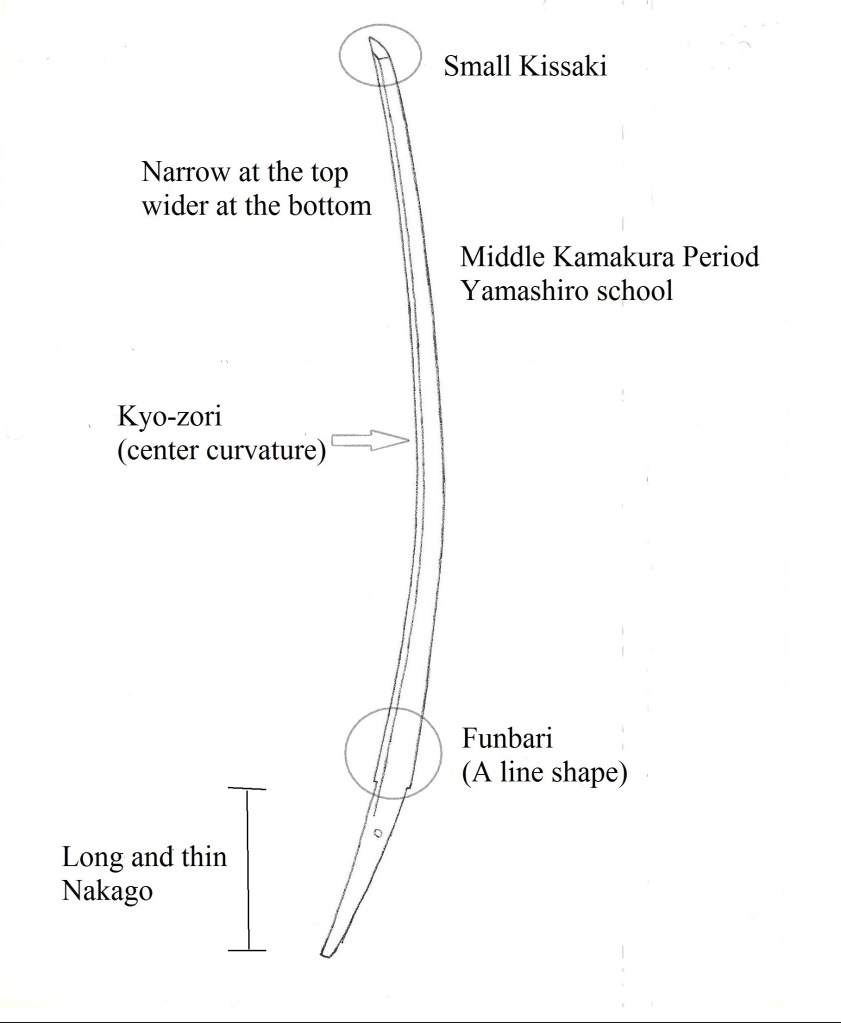

Horimono (Engraving)—– The tip of a Hi (樋, groove) follows the exact shape of the Ko-shinogi line. Sometimes you may see Bonj (Sanscrit) and Suken (see the illustration).

Nakago (hilt: 中心) ——————–Long and thin with a slight curve. Hamon (tempered line: 刃文) —————-Mostly suguha (straight line), niju-ba (double hamon), or suguha with an irregular wavy line. Sometimes, a thin gold lightning-like line called inazuma appears faintly. The tempered line is mostly nie. Below is suguha.

豊後国行平(Bungo-no-Kuni-Yukihira) Sano Museum Catalog permission granted
* Bungo-no-Kuni-Yukihira was a Yamashiro Den swordsmith from the Bungo region.
Boshi(鋩子)——– Komaru-boshi (small round) Omaru-boshi (large round) Ji-hada (地肌) ——-Well forged fine surface. Small burl pattern. Jinie (地沸) on the surface.
Names of the swordsmiths during the middle Kamakura period
- Ayano-Koji group ———————————– Ayano-Koji Sadatoshi (綾小路 定利 )
- Awataguchi group ————————————- Awataguchi kunitsuna (粟田口国綱)
- Rai group ————————-Rai kuniyuki (来国行) Rai Nijikunitoshi (来ニ字国俊)

Rai Kunitoshi (来国俊) Sano Museum Catalogue, Permission granted

 Study of Japanese Sword