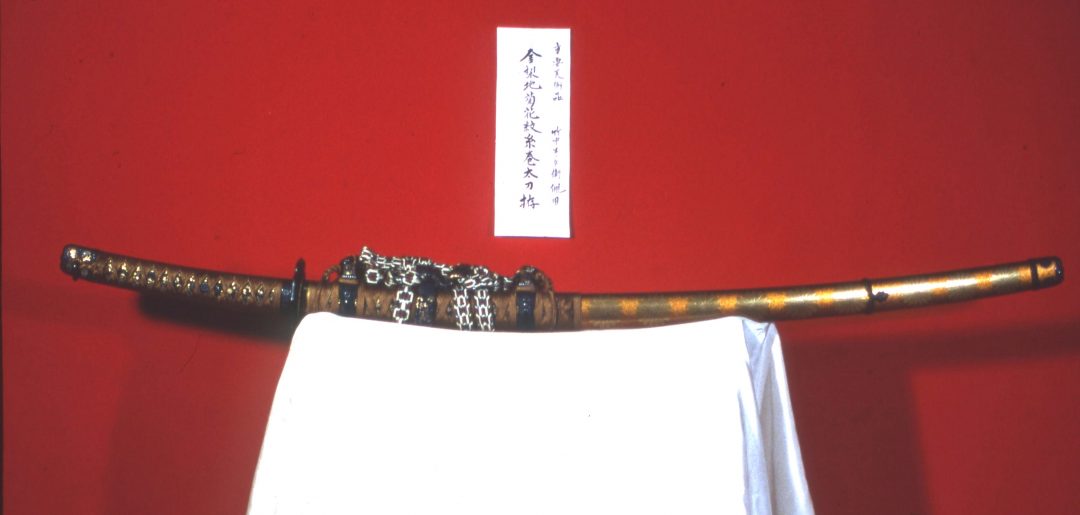
38|Part 2 of — 5 Heian Period Sword 794-1192 (平安太刀)

This chapter is a detailed part of  Chapter 5, Heian Period Sword.  Please read Chapter 5 before this section.  More sword terminology will be used in the upcoming chapters.  These terms were explained in Chapters 1-31.  If you encounter unfamiliar sword terms, please refer to Chapters 1 through 31.

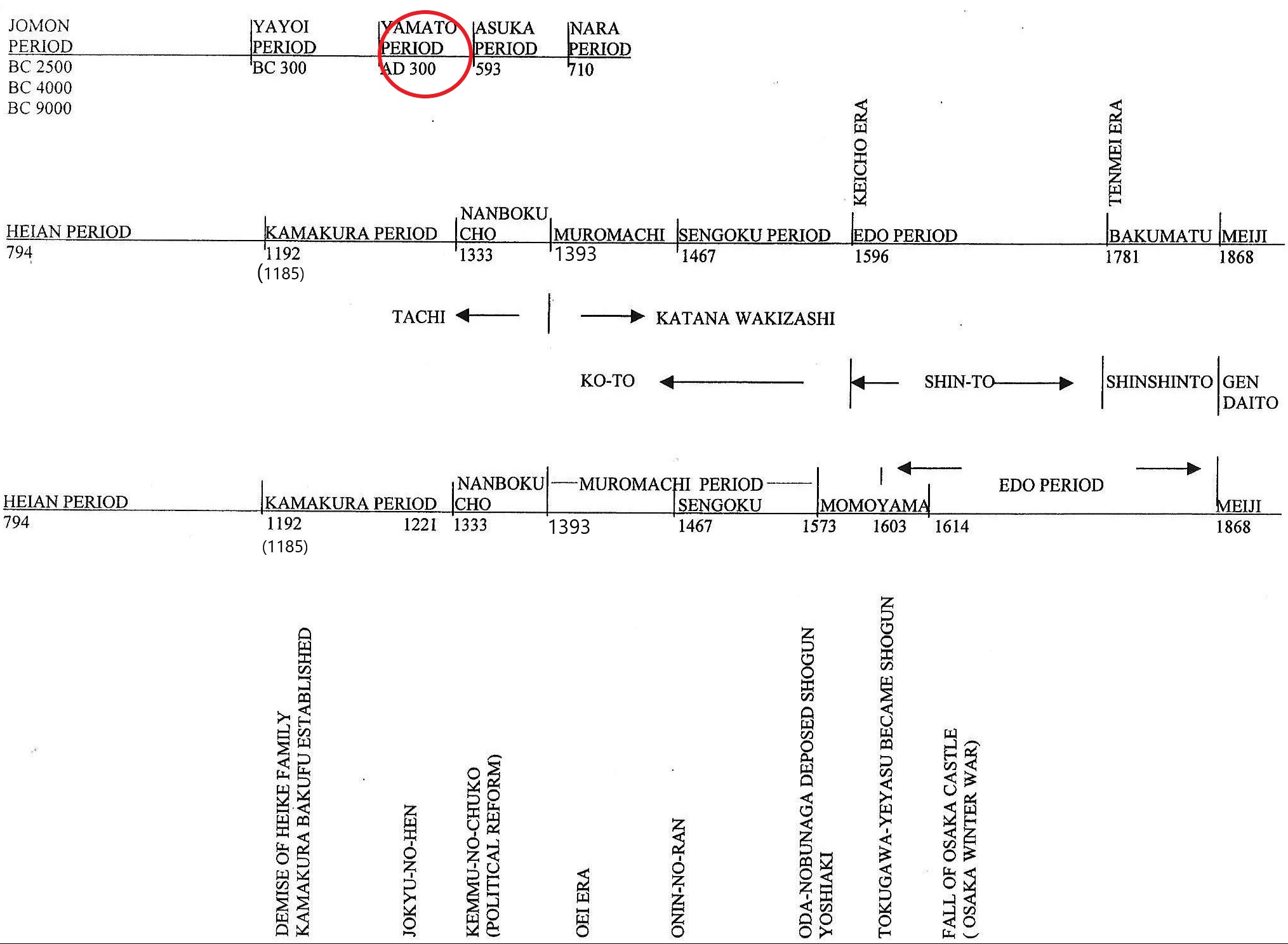
0-timeline - size 24 Heian                   The red circle above indicates the time we discuss in this sect         

During the Heian period, several swordsmith schools were active.  We use the word “den” to refer to these schools.  These include Yamashiro-den (山城伝), Yamato-den (大和伝), and Bizen-den (備前伝).  Additionally, the following regions had other active groups during the Heian period: Hoki-no-kuni (伯耆の国) and Oo-u (奥羽).   Oo-u is pronounced “Oh,” and “U” as in uber.

 Yamashiro Den (山城伝 )

During the Heian period, among Yamashiro-den swords, the most famous sword was the “Mikazuki Munechika“ (三日月宗近) by Sanjo Munechika (三条宗近).  Mikazuki means crescent.  It was named Mikazuki Munechika because the crescent-shaped uchinoke (collection of Nie) pattern appears in the hamon.  It has a graceful shape, a narrow body, koshi-zori, funbari, and a small kissaki.  The sword shows a wood grain pattern on its surface, with suguha with nie mixed with small irregular lines, and sometimes a nijyu-ha (double hamon: 二重刃) appears.  Sanjo Munechika lived in the Sanjo area of Kyoto.  His sword style was passed down through his sons and grandsons: Sanjo Yoshiie (三条吉家), Gojo Kanenaga (五条兼永), and Gojo Kuninaga (五条国永).  Gojo is also a district in Kyoto
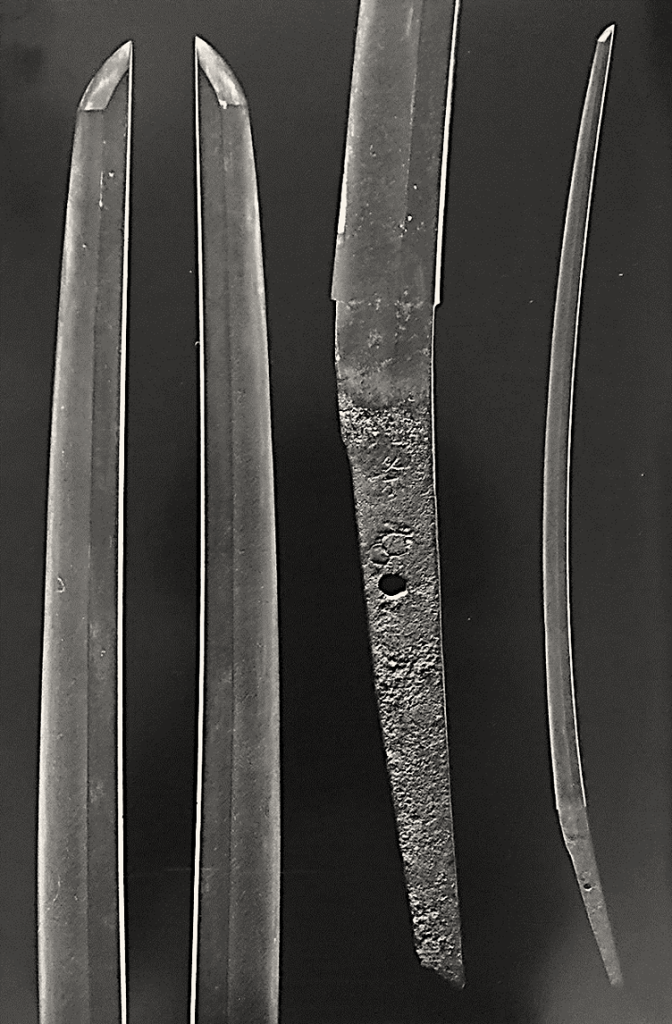
    三日月宗近    Mikazuki Munechika  東京国立博物館蔵 Tokyo National Museum           Photo from “Showa Dai Mei-to Zufu 昭和大名刀図譜” published by NBTHK

Houki -no-Kuni (伯耆の国)

Houki-no-kuni is the area now called Tottori Prefecture.  It is known for producing high-quality iron.  The sword, “Doujigiri Yasutsuna” (童子切安綱), made by Hoki-no-yasutsuna (伯耆の安綱), was one of the most famous swords of its time.                                                                                                 

The characteristics of Yasutsuna’s sword ——- It has a graceful shape with a small kissaki, a narrow hamon (often suguha with ko-choji), coarse nie in the hamon area, and a large wood grain pattern mixed with masame on the ji-hada.  The hamon area often shows inazuma and kinsuji.  The boshi area is yakizume, and the kaen (pronounced ka as in calf, en as in engineer) has a slight turn back. 
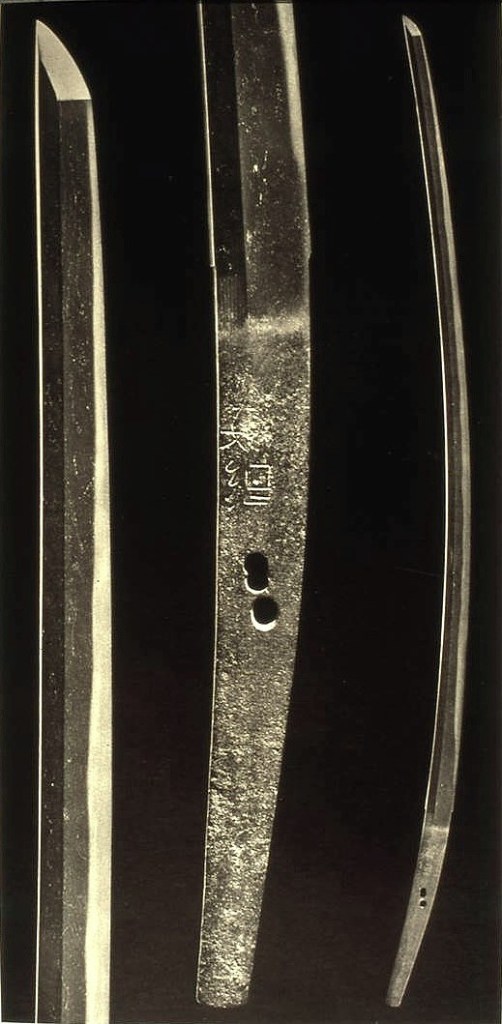
   伯耆の安綱 (Hoki no Yasutsuna) 佐野美術館図録 (Sano Musem Catalogue)                     Permission to use granted 

Bizen Den (備前伝 )

Bizen is in Okayama Prefecture today.  It is known for producing high-quality iron.  From the Heian period to the present, Bizen has been famous for its sword-making tradition.  The sword-making group in this area during the Heian period was called the Ko-bizen group.  The most famous swordsmiths in the Ko-bizen group included Bizen Tomonari (備前友成), Bizen Masatsune (備前正恒), and Bizen Kanehira (備前包平).                                                                   

Ko-bizen group’s characteristics ———- A graceful, narrow body, a small kissaki, and a narrow-tempered line with ko-choji (small irregular) with inazuma and kin-suji.  The ji-hada displays a small wood-grain pattern.
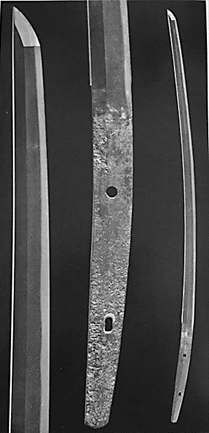
   Bizen Kanehira (備前包平) Sano Museum Catalogue (佐野美術館図録)                          (Permission to use granted)

I saw Ko-bizen Sanetsune (真恒) at Mori Sensei’s house.  That was one of the kantei-to of that day.  I received a dozen*ᴵ.  The book written by Hon’ami Koson was used as our textbook.  Each time I saw a sword at Mori Sensei’s house, I recorded the date next to the swordsmith’s name in the book we used.  It was Nov. 22, 1970.  It had a narrow body line, a small kissaki (Ko-bizen komaru), kamasu*2 (no fukura), and suguha.  Kamasu is a condition in which the fukura (arc) is much less than usual.  Looking back, it is amazing that we had the opportunity to study such famous swords as our study materials.

Kantei-Kai

Kantei-kai is a study meeting.  Usually, several swords are displayed, with the nakago area covered.  Attendees try to guess the sword maker’s name and submit their answer sheets to the judge.  Below are the grades.

Atari —– If your answer is the exact correct name, you get Atari. That is the best answer.

Dozen —— The second best is a dozen.  It means nearly a correct answer. The subject sword was made by the family or clan of the right den.   A dozen is considered very good.  It indicates that the student has solid knowledge of the particular group.

Kaido Yoshi —– This means it is correct regarding the line, but not about the family.

Jidai Yoshi — it means the time or period is correct.  Each Kantei-kai has its own grading system.  Some may not have a “Jidai Yoshi” grade.

Hazure——– the wrong answer. 

Once all answer sheets are submitted, they are graded and returned. The judge reveals the correct answer and explains why.

*1 Dozen:  Almost the same as the correct answer. *2 Kamasu:  A name of a fish that has a narrow, pointed head.


37|Part 2of — 4 Heian Period History  794-1192   (平安時代歴史)

This chapter continues from Chapter 4, Heian Period History. Please read Chapter 4 before proceeding with this section.

0-timeline - size 24 Heian

The circle above indicates the time we discuss in this section

Around the middle of the Heian period, a novel, “Genji Monogatari” (The Tales of Genji,源氏物語), was written by a female author, Murasaki Shikibu (紫式部).  She was a high-ranking court lady.  Her father, Fujiwara Tametoki (藤原為時), was a scholar. While several novels and essays were written by female authors around that time, “The Tales of Genji” is a world-renowned literary masterpiece, considered the greatest Japanese literary work.  “The Tales of Genji“ is a treasure for the Japanese.  We love this novel so much that the Japan Mint issued a 2000-yen bill*ᴵ.  See the photo below.  The author herself is shown in the lower right corner on the back of the bill.  The bill is so beautiful that people just keep it instead of using it.   Therefore, it does not circulate much.  I have four of these bills, and I cannot bring myself to use them.  It is too nice to use. 

The novel is about Hikaru Genji’s (the hero, 光源氏) love history (yes, history) from when he was around 16 years old until his death.  Ten chapters after his death are titled “Uji Jyu-jyo.”  This section tells the story of his son and grandson.  The chapter in which the hero Hikaru Genji dies is titled “Vanishes into the Cloud (雲隠れ),” a very poetic title.  The Tales of Genji depict the daily life, customs, lifestyle, and thoughts of the people in the aristocratic society of that time.  Surprisingly, although they did not have the technology we have today, their way of thinking was not significantly different from ours.  The description of the courting process is in Chapter 4, Heian Period History. 

The author created Hikaru Genji (光源氏), the main character, as a high-ranking aristocrat and the illegitimate son of an emperor. He is portrayed as a charming, handsome, intelligent, and sophisticated aristocrat, and all the women fall for him.  He would go around with various women, one after another: a beautiful woman, a not-so-attractive but brilliant woman, a young woman, an older woman, even his stepmother, a wealthy or not-so-wealthy woman, and more.   It sounds like a story from a tabloid magazine.  Still, Murasaki Shikibu depicted the heroes’ and heroines’ thoughts, emotions, and daily lives, as well as how the men thought about the women and vice versa, with her excellent writing skills.  The author, Murasaki Shikibu, wrote this novel to entertain the female audience at the court where she resided.  It became so popular that even the emperor asked her how the next story would develop.  “Genji Monogatari” has been translated into English.  You can purchase the translated book on Amazon or go to YouTube and search for “Genji Monogatari” or “The Tales of Genji.”   You will find many “Genji Monogatari” in anime, old TV programs, and classic movies, available in whole or as short clips. 

Another female author, Sei Sho-nagon (清少納言), wrote an essay titled “Makura no Soshi “(枕草子) around the same time.  In it, she described the daily lives of court ladies.   In one chapter, she mentioned kakigori (shaved ice: かき氷).  High-status people then must have had the chance to enjoy shaved ice, even though the ice was not easy to come by during the summer in the middle of the Heian period.  

Once you understand the life of a Heian aristocrat, you will see why the Heian sword is shaped the way it is.  It becomes easier to distinguish a Heian sword from other swords made in different periods and regions.  All sword styles reflect the society in which the swordsmiths lived.  During the Heian period, the Yamashiro-den style represented the sword style.  In the next chapter, the focus will be on the Yamashiro-den, even though other sword groups existed in different regions.

*1  The back of 2000 yen bill

39 Part 2 Shikibu with arrow

5 Heian 3 photoes.jpgPart of the Burke Album, a property of Mary Griggs Burke (Public Domain).  Paintings by Mitsukuni (土佐光国), 17th century.   The scenes are based on “The Tales of Genji.


36| Part 2 — 3 Names of the Parts

This chapter is a continuation of Chapter 3, Names of Parts.  Please read Chapter 3, Names of Parts, before reading this section.

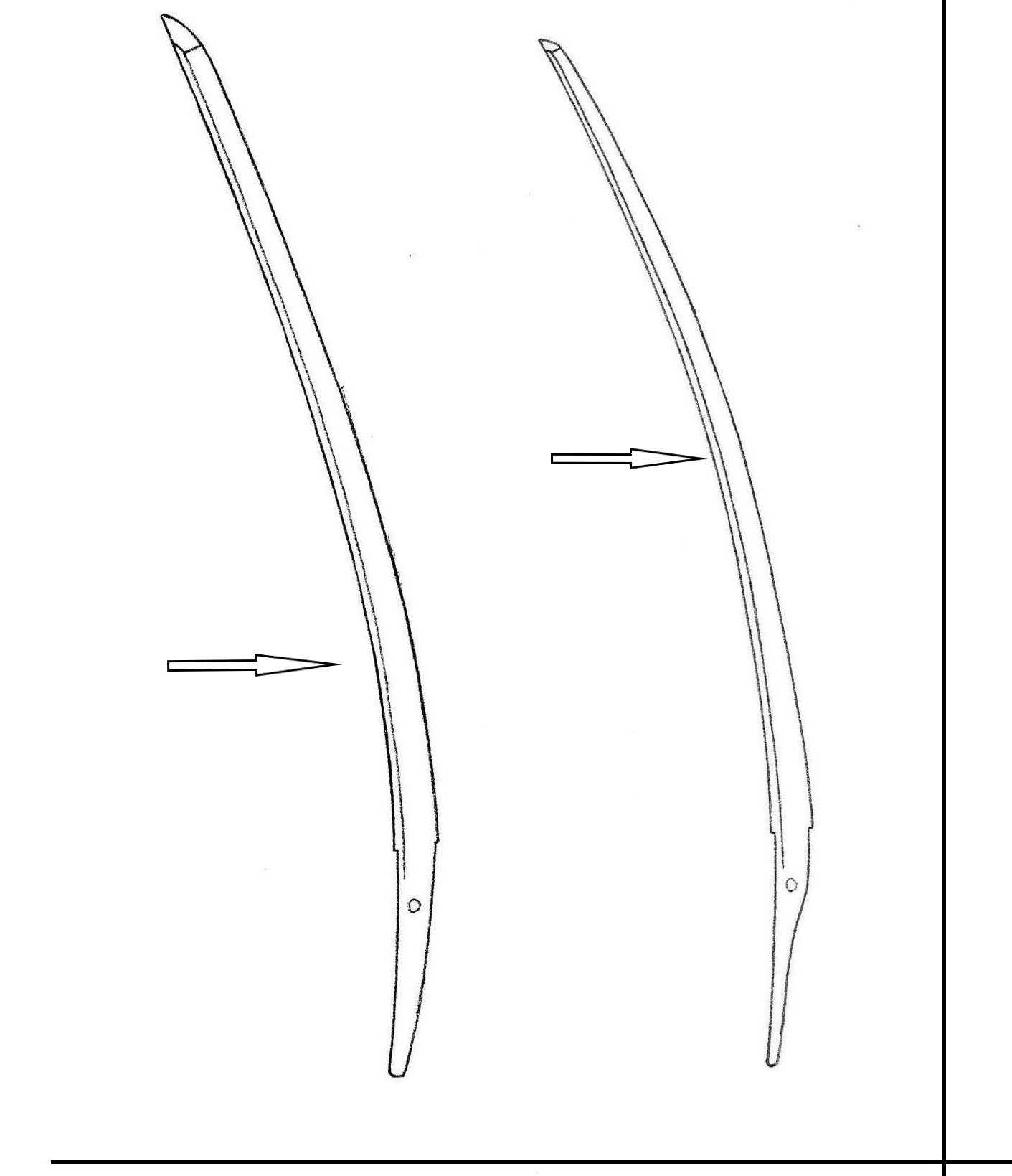
This chapter explains how to identify the koshi-zori or chukan-zoriChukan-zori is also called torii-zori or kyo-zori.   Chukan-zori means that the most curved part of the sword’s body is around the middle, and for koshi-zori, the most curved part is located lower than the center of the blade, approximately 1/3 down the body.   Every sword seems to have its curvature around the middle area, especially when looking at photos of swords in books.  This is because these swords are positioned to fit nicely within a given rectangular photo space. 

The correct way to check for the curvature is to hold the nakago (茎) vertically.  This way, you can see the location of the curvature more accurately.  If the nakago is not vertical, the curvature appears in the middle section of every sword.  When examining a sword, the first step is to hold the sword and make sure the nakago stands vertically. When looking at a sword in a book, rotate (shift or slide) the book slightly so that the nakago is perpendicular.  This way, you can see the precise location of the curvature.  Keep in mind that the difference can sometimes be subtle.

36 part 2 of -- 3 Sori (2)


35|Part 2 of — 2 Joko-To (上古刀)

This chapter is a detailed part of Chapter 2,  Joko-to (上古刀).  Please read Chapter 2 before this section. 

0-timeline - size 24 Yamato
 
                             The red circle indicates the time we discuss this section.

The Kofun (古墳) culture emerged around the fourth to sixth centuries.  Kofun are massive burial sites built for powerful rulers.  They are often Zenpo-koen-fun (前方後円墳), meaning the front part is square, and the back is rounded.  When viewed from above, their shape resembles a keyhole.  The largest kofun is the Nintoku Tenno Ryo (仁徳天皇陵) in Osaka.  This is the tomb of Emperor Nintoku.  Its size is 480 m X 305 m, and it is  roughly 35 meters high. Inside the kofun, we found swords, armor, bronze mirrors, jewelry, iron, and metal tools.  Sometimes, iron itself was found.  Only the ruling class owned iron because it was considered a precious item at the time.  On the outskirts of the kofun, many haniwa*¹ were placed.  There are several theories about the purpose of haniwa.  One suggests they served as retaining walls, while others say they act as a dividing line between sacred and common areas.  There are several more theories. 

Originally, haniwa were simple tube shapes.  Over time, they became interesting clay figurines, including smiling people, smiling soldiers, dogs with bells around their necks, women with hats, farmers, houses, monkeys, ships, and birds.  Some of these were very elaborately made and very cute.  Judging by their appearance, people in those times seemed to have worn elaborate clothing.  Haniwa figurines are quite popular among children in Japan.  We used to have a children’s TV show where haniwa was the main character. 

Haniwas suggests what people’s lives were like back then. Their facial expressions are happy and smiling.  According to the old Japanese history book Nihon Shoki (日本書紀, the oldest Japanese history book completed during the Nara period), haniwa replaced martyrs, although this has not yet been proven.

At another huge kofun, Ogonzuka Kofun (黄金塚古墳) in Osaka, they discovered swords, bronze mirrors, and other artifacts.  Refer to Chapter 2|Joko-to.  The writing below is from my college days notebook.   

My college professor explained how to determine the age of a specific item by reading partially faded characters on objects, such as a bronze mirror or a sword.  For example, there was a sword with a hilt made in Japan and a blade made in China.  It had a round hilt and, on it, showed some Chinese characters.  It read, “中平[ ]年.”   The third letter was not legible.  But we knew that the 中平 year was between 184 and 189 A.D., and “年” indicated “year.”  Therefore, it was made sometime between 184 and 189.  This sword was found in a fourth-century tomb. 

He also explained that many nested doutaku (銅鐸)*² had been excavated from various sites.  They were discovered nested inside one another.  Doutaku was a musical instrument used in rituals.  Therefore, scholars believe that people hurriedly hid the doutaku and fled quickly when enemies attacked.

In many countries, excavation can be a time-consuming and tedious process.  It often takes a long time to find anything.  However, in Japan, it is not as difficult as in other countries.   We often discover things.  They might not be what you are looking for, but we dig up artifacts quite often.

398px-群馬県大泉町古海出土_埴輪_腰かける巫女

   *ᴵ腰かける巫女 (群馬県大泉町古海出土)  国立博物館蔵    Sitting Shrine Maiden           (Excavated from Gunma Prefecture) Owned by National Museum,  Public Domain Photo

                   滋賀県野洲市小篠原字大岩山出土_突線紐5式銅鐸

*² 滋賀県野洲市小篠原字大岩屋出土突線紐5式銅鐸  東京国立博物館展示  Public Domain Photo     Dotaku:  Excavated from Shiga prefecture  Displayed at Tokyo National Museum.    

34| Part 2 — 1 Timeline

Chapter 34 is a continued part of Chapter 1 Time line.   Please read Chapter 1 before reading this section.

   0 timeline - Gendai-to                             The red circle indicates the time we discuss here

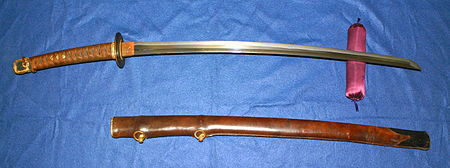
In the “Chapter 1 Timeline,” the gendai-to (現代刀) are swords made from the Meiji Restoration (明治維新1868) up to the present day.  It has been about 150 years since the Meiji Restoration.  Although all swords made after the Meiji Restoration are grouped under the gendai-to, there are many differences in quality and style.  One notably different type is the gun-to (軍刀).  These are military swords forged during World War I and World War II.  Some of them have a saber-like handle.  With a few exceptions, these were made without using traditional sword-making techniques of heating and folding.  Among the gendai-to, gun-to are usually considered less valuable.  The guns-to-swords made around and during World War II are called Showa-to.  It often has a brown leather scabbard.  Gun-to is not a part of the study of the Japanese sword.

*Refer to” https://en.wikipedia.org/wiki/Gunt%C5%8D”  for the Japanese military sword.

                                Gun-to    From Wikimedia Commons, the free media repository

At the time of the Meiji Restoration (明治維新), swords called Meiji-ishin-to (明治維新刀) or Kin’no-to (勤王刀) were made.  These swords were owned by famous historical figures such as Saigo Takamori (西郷隆盛) and Sakamoto Ryoma (坂本龍馬).  They are important historical figures who advanced the Meiji Restoration.  These swords are long, with some almost 3 feet long, and have no curvature.

Today, many famous swordsmiths are making excellent swords.  Some are recognized as living national treasures.  Gendai-to refers to swords made after the Meiji Restoration to the present, but keep in mind that there is a wide range of differences in quality, type, and purpose among them.

36img077

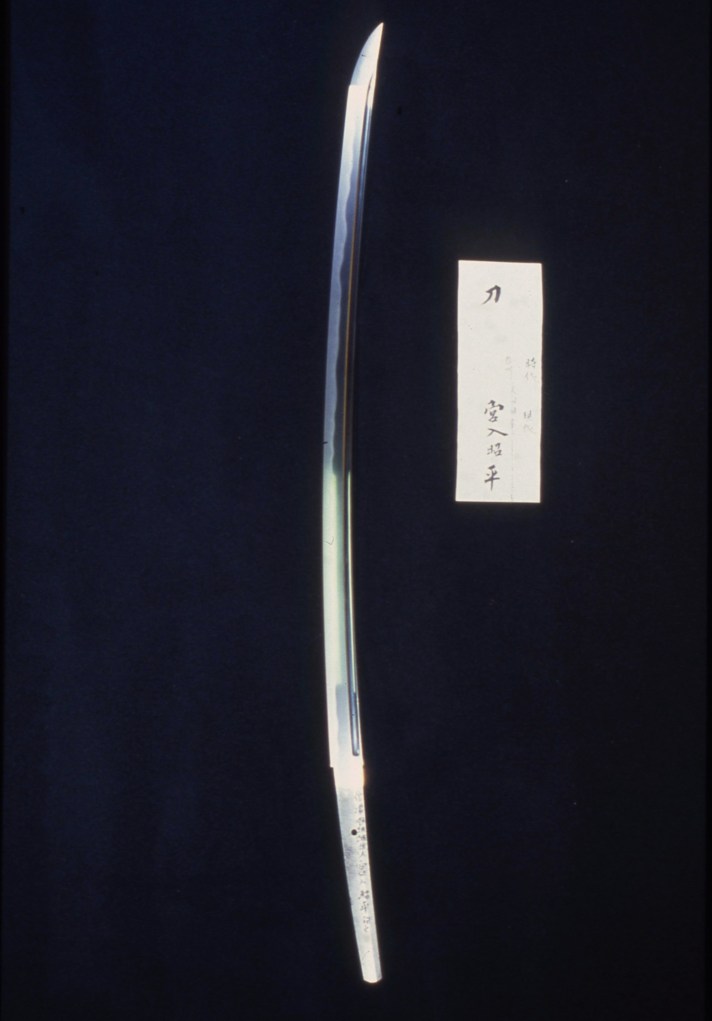
                       Sword forged by a Living National Treasure, Mr. Miyairi Shohei (宮入昭平)                         owned by my brother

33| Information on Today’s Swordsmiths

Currently, many skilled swordsmiths are in Japan.  I am good friends with two of them.  One is Mr. Yoshihara Yoshindo (吉原義人), and the other is Mr. Yamamura Tsunahiro (山村綱廣).  I met them when we were in our twenties.

I met Mr. Yoshihara at one of the sword meetings I attended with my father in the early 1970s. Since then, we have occasionally run into each other at various sword gatherings from time to time.  His son, Yoshihara Yoshikazu (吉原義一), is also a well-known swordsmith.  And his grandson has also decided to become a swordsmith. Naturally, my friend Yoshihara was very excited to train him.  He often shares fascinating stories whenever we meet at various sword meetings. Here are a few of them. 

Mr. Yoshihara once had an apprentice from a Middle Eastern country, sent by his king.  The apprentice lived in Yoshihara‘s house with other Japanese apprentices.  He was a quiet and good apprentice who had no problems with food and ate Japanese food with the other Japanese apprentices. 

Mr. Yoshihara also mentioned that a king from a European country once visited his studio.  The king gave Yoshihara a photo of himself, with his autograph, as a gift.   Another story was about a famous Hollywood movie director who ordered a couple of swords and visited his house.  It seems this was around the same time I ordered a sword for myself.  The photo below shows the sword he made for me at that time.

Yamamura-kun (we add “kun” at the end of male friends’ names and “san” for female friends), and we were students together in Mori Sensei‘s sword class.  He was the top student; I was almost the last.  He is a direct descendant of Goro Nyudo Masamune (五郎入道正宗), the twenty-fourth generation.  Back then, he had a store almost right in front of the Hachiman-gu Shrine (八幡宮) in Kamakura, and later moved his studio near Kamakura Station.

We had one more person in our group, Mr. Kurokawa (黒川).  He owns a large sword store in Tokyo called “Soken-do (霜剣堂).”   We were all residents of Kamakura at the time.  We used to gather at Yamamura-kun’s store in front of Hachiman-gu Shrine, enjoying good times and hanging out together.

Below is the information about their stores. 

To order a sword, you can contact:  Yoshihara Yoshindo (吉原義人)                                 11-12,8Chome Takasago, Katsushika-Ku,Tokyo 〒125  Japan  Tel (03)3607 – 5255

Masamune Kougei (正宗工芸)                                                                                            13-29 Onari-cho,  Kamakura-shi,  Kanagawa, 〒248-0012  Japan   Tel (0467) 22- 3962

Soken-Do (霜剣堂)                                                                                                             28-1, 6-Chome, Jingu-mae, Shibuya-ku, Tokyo 〒150-0001 Japan  Tel (03) 3499 – 8080        

IMG_1578 IMG_1584

IMG_1590 IMG_1582

My sword made by Mr. Yoshihara

吉原新刀 (Yoshihara sword description)

  • Shape:        Koshizori   Chu-gissaki (smaller Chu-gissakiBo-hi (one groove)
  • Boshi:         Midare-komi and Komaru-kaeshi (round turnback)
  • Hamon:      Komidare   Nioi
  • Hada :        very fine Komokume almost Muji
  • Mei:           Kaji Yoshindo    Heisei 二十三 nen  二月 Kichijitu
    • It means: Sword smith Yoshindo   Heisei year 23(2011)   February good day                                                                                                    

32| Japanese swords after WWII

Growing up in Azabu and Mita in Tokyo, and later in Kamakura, my father was deeply involved with a Japanese sword museum called “Nihon Bijutsu Token Hozon Kyokai.”   At that time, the organization’s heads were Dr. Honma and Dr. Sato. 

Initially, Dr. Honma and Dr. Sato worked in the sword department at the Tokyo National Museum in Ueno.  Later, a separate non-profit organization for the Japanese Sword Museum was built in Yoyogi, Shibuya.  Although its address was in Yoyogi, Shibuya, it was nearly in Shinjuku.  To construct this museum, my father, Mr. Watanabe (owner of Wataki, an apparel company), and Mr. Suzuki Katei (owner of a construction company) were heavily involved.  Those two friends used to come to our house all the time (literally all the time), spending hours talking and gossiping.  Currently, the museum has relocated to a new location, in Sumida-Ku (Sumida Ward), Tokyo, near the Sumo Arena in Ryogoku.  Please refer to the website below.

Dr. Honma, Dr. Sato, and all the other people involved at that time passed away many years ago, but they were in their prime then.  I am talking about the late 1960s to the 1970s. I was in my teens back then. 

Many people told me that Dr. Honma, Dr. Sato, and several other prominent figures visited General MacArthur’s headquarters during the occupation after World War II, and they convinced MacArthur that Japanese swords were not weapons but art objects.  They did this because MacArthur had ordered all Japanese to turn in their swords and forbidden them from owning any.  After considerable effort, Dr. Honma, Dr. Sato, and other high-ranking individuals changed MacArthur’s mind.  Yet, many swords had already been turned in at Akabane (a place in Tokyo), though some people hid valuable ones.  Those turned-in swords are called Akabane swords.

Many swords were taken by American soldiers and brought to the U.S. as souvenirs from Japan.  Those soldiers didn’t know whether they had taken a valuable or ordinary one.   About 25 years after the war, in the late 1960s and 1970s, Japanese sword dealers traveled to the U.S. to buy back many Japanese swords.  I have a few sword-dealer friends who did this.  They advertised in local newspapers that they would buy Japanese swords.  As you can imagine, many of those swords were in poor condition.  Some people used the wrong chemicals to remove the rust. Only a few swords were found in good condition.

Among those recovered was one of the famous missing national treasure swords that  Dr. Compton found.  He was the chairman of the board of Miles Laboratories in Elkhart, Indiana.  Miles Laboratories was a pharmaceutical company that produced a range of products, including Alka-Seltzer.  He had extensive knowledge of Japanese swords.  When he saw this sword in an antique store in Atlanta, he realized it was more than an ordinary sword.  He contacted Nihon Bijutsu Token Hozon Kyokai (日本美術刀剣保存協会) for consultation.  During this process, my father became close friends with him.  My father and I visited his house several times, and they visited ours.  Dr. Compton returned this sword to the Terukuni Shrine (照国神社) in Kagoshima Prefecture without compensation.  The story of Dr. Compton continues in the last part of  Chapter 45, Part 2 of — 11 Ikubi Kissak (猪首切先).  Although Japanese sword dealers bought many swords and brought them back to Japan, it seems many Japanese swords still remain in the U.S.

Nonprofit organization: Nihon Bijutsu Token Hozon Kyokai (日本美術刀剣保存協会)           1-12-9 Yokoami Sumida-Ku Tokyo Japan         〒130—0015                                                Tel: 03-6284-1000                                                                                            

https://www.touken.or.jp/   

*The above website explains access to the museum.

66| BIBLIOGRAPHY

REFERENCED RESOURCES (参考資料)

  • Nihon Bijutsu Token Hozon Kyokai.       “Nihon-to Taikan”                                            Supervising editors: Dr. Honma, J. and Dr. Sato, K. (1966)                                    Tokyo:  Otsuka Kogeisha  Co.,Ltd.   日本美術刀剣保存協会   本間順次, 佐藤貫一監修 (1966)  “日本刀大鑑”  東京: 大塚工芸社 
  • Hon’ami, K.  (1955)  “Nihonto no Okite to Tokucho”    Tokyo: Bijutsu Club Tokenbu.    本阿弥光遜著  (1955)  “日本刀の掟と特徴 “   東京:美術倶楽部刀剣部発行
  • Watanabe, T.  (1971)   “Sano Bijutsu-kan Zuroku”  Shizuoka: Sano Bijutsu-kan.             渡辺妙子著   (1971) “佐野美術館図録  静岡:佐野美術館発行 
  • Yoshihara, Y.,  Kapp, L., and Kapp, H. (2012) :The art of the Japanese Sword”            Italy: Paolo Saviolo   吉原義人, リーオン & ひろ子 キャップ著 (2012)  “日本刀美術”  イタリア:パオロ  サビオロ 発行  
  • Mochizuki, K. & Fujiki, K. (1966) “Shousetu Nihonshi”   Tokyo:Yamakawa Shuppan-sha  High school text book by the Ministry of Education   望月圭吾, 藤木邦彦著  (1966)   “詳説日本史”   東京:山川出版発行    文部省検定済教科書
  • Dr. Honma, J. & Dr. Sato, K. (1972)   “Shinpan Nihon-to Koza”                                      Tokyo: Yuzankaku Shuppan Inc.   本間順次,佐藤貫一著   (1972)   “新版日本刀講座”    東京: 雄山閣出版株式会社発行 
  • Dr. Honma, J. & Dr. Sato, K.  (1968)  “Nihon-to Zenshu”                                                  Tokyo: Tokuma Shoten Co., Ltd.   本間順次、佐藤貫一著 (1968)   “日本刀全集 “        東京: 徳間書店発行
  • Dr. Honma, J. & Dr. Sato, K.  (1979)  “Showa Dai Meito Zufu”                                     Tokyo: Nihon Bijutsu Token Hozon Kyokai     本間順次、佐藤貫一著 (1979)            “昭和大名刀図譜”  東京:日本美術刀剣保存協会 
  • Sano Museum.  (2019)  “Yomigaeru Meito (Reborn)”                                                      Shizuoka: Sano Museum Exhibition catalog.                                                                  佐野美術館 著   (2019)  “蘇る刀 Reborn”    静岡:佐野美術館編集発行
  • Hiroi, Y.    (1971)   “Token no Mikata”    Tokyo:  Dai-ichi Hoki Shuppan Co, Ltd.            広井雄一著   (1971)  “刀剣のみかた” 東京:第一法規出版株式会社発行   
  • The Japan House Gallery. Japan Society, Inc.  (1976)                                                    “Nippon-To Art Sword of Japan  The Walter A. Compton Collection”    Tokyo: Otsuka Kogeisha Co, Ltd.
  • Chapter 25                                                                                                                    *¹ヤン ヨーステン Jan Joosten van Lodenstijnhttps://www.weblio.jp  6/2018  *²  Names of Japan: Click the link Jipangu  on Wikipedia  6/2018 (閲覧日)  Cipangu described in the 1492 Martin Beham globe From Wikimedia Commons, the free media repository (Names of Japan)
  • Chapter 37                                                                                                                    Murasaki Shikibu, translated to modern Japanese by Tanizaki, J. (1967)                  Shin-shinyaku Tales of Genji.   Tokyo:  Chuo Koronsha, Inc.   谷崎潤一郎訳  (1967)  “新々訳源氏物語”  東京: 中央公論社
  •  Chapter 43                                                                                                                  *The three imperial regalia  www.touken-world.jp/tips/32747     Wikipedia                        三種の神器:ウキペディア 2/2019 (閲覧日)
  • Chapter 45                                                                                                                    Terukuni Jinjya website: http://terukunijinja.p-kit.com/page222400.html  2/2019            九州照国神社 ウエブサイト:http://terukunijinja.p-kit.com/page222400.html   
  • Chapter 47                                                                                                                 *Number of soldiers   https://kotobank.jp/word/元寇-60419.   Wikipedia                          兵力数 ウキペディア 3/2019 (閲覧日)   *Genko (元寇) https://kotobank.jp/word/%E5%85%83%E5%AF%87-60419              
  • Chapter 54                                                                                                                  Golden Pavillion (金閣寺):https://www.shokoku-ji.jp/kinkakuji/   6/2019 (閲覧日)
  • Chapter 56                                                                                                                   Honouji-no-hen (本能寺の変)   * Rekijin.com/?p=31448-キャッシュ    *Bushoojapan.com/scandal/2019/06/02/51145-キャッシュ    7/2019   (閲覧日)
  • Chapter 57                                                                                                                   Masamune Jittetsu ( 正宗十哲 ):                                                     https://www.touken-world.jp/tips/7194/        7/2019
  • Chapter 59  Osaka Summer campaign (大阪夏の陣)                                      www.thoughtco.com/toyoomi-hideyoshi-195660                                                     Battle of Sekigahara  (関ケ原の戦い)    senjp.com/Sekigahara     8/2019 (閲覧日)
  • Chapter 63   *Perry (ペリー) ja.wikipedia.org/wiki/黒船来航                   *Perry (ぺリー) ja.wikipedia.org/wiki/マシュー・ペリー   Wikipedia  9/2019 (閲覧日)


31|Sword Making Process

0-timeline - size 24 Kamakura Period

As part of the sword study, it is necessary to describe the process of making a sword. This chapter explains the basic procedure of sword-making.  It is a brief overview of the sword-making process, as I lack expertise in the field. 

When I was little, I watched the process of metal being heated in the furnace at my father’s factory.  He owned a machine tool company and a forging plant.  It was fascinating to see the metal heat up, be taken out of the furnace, pounded by two men, then put back in the furnace and pounded again and again.  To this day, I can still remember the exact color of the metal when it should be removed from the fire.  That was a strange thing for a little girl to learn.  Also, it was dangerous for children to be near the furnace when the metal was being heated.  But in those days, people’s idea of safety was different. 

I think the factory workers enjoyed seeing my brother and me, who were so impressed,  amazed, and looked up to them as heroes.  We kept visiting the shop until my father moved the factory to a larger location.  Today, I would never allow my grandchildren to be near a furnace.

Sword-making involves many detailed processes, and each swordsmith has his own secrets.  For those interested in more detailed explanations, please refer to a book written by a famous swordsmith, Mr. Yoshihara Yoshindo, and a DVD produced by his son. Their information is listed below.  Mr. Yoshihara’s book is available on Amazon.  And the DVD is available on Amazon Japan.  To purchase the DVD, you may need to use a proxy service, like Zen Market, since it is sold on Amazon Japan.

Book: The Art of the Japanese Sword:  The Craft of Sword Making and Its Appreciation by Yoshihara Yoshindo, Leon, and Hiroko Capp.  Published by Tuttle Publishing

DVD: Katana/On Ko So Shin (温故創新)——-Katana project by Yoshihara Yoshikazu (吉原義一).  Use the proxy service Zen Market, as only Amazon Japan sells it.

Tamahagane (玉鋼)

In the early days of sword-making time, swordsmiths extracted iron from iron sand and refined it themselves for sword material.  By the Kamakura period (see the timeline above), ironmaking was done by separate entities.  Swordsmiths bought iron known as “Tamahagane” from ironmakers.  Tamahagane is an essential part of sword-making.  It is iron produced using the tatara process, a unique Japanese smelting method.

32 Tamahagane 2

Tama-Hagane from Mr. Yoshihara

Kawa-gane (側鉄) and Shin-gane (芯鉄 )     

The Japanese sword is made from steel with two different hardness levels: kawa-gane for the outer steel and shin-gane for the inner steel.  Kawa-gane is the harder steel, with about 0.6% carbon content.  Shin-gane is a softer steel, with about 0.25% carbon content. Japanese swords are constructed with softer steel inside, wrapped around by harder steel; this design makes them resistant to bending and breaking.

Kawa-gane (側鉄: outer steel) —— Shita-gitae (下鍛: Base forging)

Heat a block of tamahagane → Strike it with a hammer to create flat pieces While the tamahagane is still hot, quickly quench it in water Break it into small pieces.

Forge a rectangular plate separately with tamahagane → attach this plate to a handle or lever to make a teko → carefully and closely attach the previously broken metal pieces onto the teko. 

32 Pile up drawing

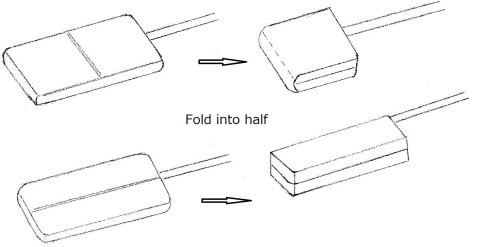
Cover the stacked tamahagane with ashes and clay for protection → Heat it in the furnace → Remove it from the furnace and strike it with a hammer Repeat this process multiple times to stretch the tamahagane to about twice its original length.

While the tamahagane is still hot, make a notch in the center and fold it in half. → Continue the same process of heating, hammering to stretch, and folding it in half (alternating widthwise and lengthwise, 6 or 7 times, depending on the original carbon level in tamahagane).  This process reduces the carbon content to the desired level.

32 folding drawing

Kawagane (側鉄: Outer steel) —– Age-gitae (上鍛: Finish forging )

At the end of shita-gitae, chisel the block of tamahagane so that it can be separated into two or three sections Quench in water Cool down Break it into pieces along the markings  Combine these pieces, and repeat the heating, hammering, and folding processes.       

Usually, the folding process happens 6 to 7 times for shita-gitae (base forging) and 6 to 7 times for age-gitae (finish forging).  The total is about 12 times, depending on the original carbon content in the tamahagane used.  This process is for kawa-gane (側金).

Purpose of heating hammering and folding

  • Each time the heating and folding process is done, tamahagane loses some carbon content.  For outer steel, the ideal carbon content should be about 0.6%.  If the carbon content is too high, the steel is hard, so the sword may crack.   If it is too low, the sword will be too soft and may bend.  Swordsmiths rely on their eyes to judge the correct level of carbon content. This is the professionalism and the artistry of sword-making.
  • Removing slag and impurities from tamahagane.
  • Each heating and folding process creates multiple layers of thin steel that form the ji-hada pattern (surface designs such as wood grain, burl look, straight grain, or a combination of these).

Shin-gane (inner steel 芯鉄)       

Shin-gane is the inner metal, which is a softer steel with less carbon.  Having a softer inside makes the sword more flexible.  Having a hard outer steel with higher carbon and softer steel inside prevents the sword from cracking or breaking.  To make the shin-gane, mix softer steel with tamahagane.   Repeat the same process as you would with kawa-gane.

Tsukuri-komi (造り込み) Sunobe (素延)

Wrap the shin-gane with the kawa-gane, then weld the two pieces together by heating, hammering, and stretching to form a steel bar.  There are several ways to wrap the shin-gane, but the most common is called kobuse (甲伏). The illustration below shows a cross-section.

32 Kobuse drawing

Sword Micro (3)

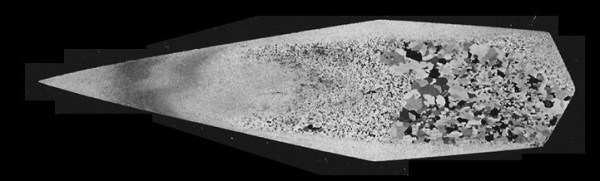
The photo above (taken by my husband) shows a cross-section of a sword. Many years ago, a member of our sword club gave us a very rusty, damaged sword.  My husband cut the blade and took a micro photo of the cross-section. This sword has a more complex construction than the usual kobuse method. It appears to have three or four different hardnesses of steel. It seems that this sword was once one of the finest made by a top sword-maker.

Hizukuri (火造)

Hizukuri is the process of shaping the final form of the sword from sunobe through heating and hammering.  At this stage, the ha (cutting edge) becomes thinner, the shinogi side rises higher, and the sword’s shape begins to take form.

Arashiage (荒仕上げ)

This process is a rough finish.

Tsuchitori (土取)

Mix clay, pine tree ash, ground stone, and water.  Coat the sword with this muddy mixture.  Scrape off a thin layer of the mixture slightly around the hamon area, then let it dry.  By doing the tsuchitori process, the hamon is created, and the cutting edge hardens at the same time.

Yaki-Ire (焼入れ)

After the muddy paste dries, heat the sword evenly in the furnace.  Judging by the color of the heated sword, pull it out of the furnace and quickly quench it in water.  Usually, this process is done after sunset so that the swordsmith can see the metal’s color and gauge the heated sword’s temperature more accurately. This is the most critical step, as all the work done up to this point can be ruined if he fails to judge the heated sword’s precise color, water temperature, and the timing of quenching.

The final step is to send the sword to a polisher.  The polisher, called a togishi, polishes and sharpens the blade.   He brings out the beauty of the surface and the sword’s sharpness.  This completes the entire sword-making process.  Every step is crucial, but the polisher’s final work is as important as all the other stages.


30| Shin-Shin-To 1781-1867 (Bakumatsu Period Sword 新々刀)

0-timeline - size 24 BakumatsuThe red circle indicates the time we discuss in this section

The later part of the Edo period is called Bakumatsu.  See the circled area on the timeline above.  Swords made during this time are called shin shin-to.   They are also called Fukko-to (復古刀: revived sword).  Fukko-to replicates the shape, hamon, boshi, and other features of the Ko-to and Shin-to swords.  The characteristics of the Shin Shin-to (新々刀) and well-known swordsmiths are listed below.

The Characteristics of Shin Shin-to

  • Katana, wakizashi, and tanto all tend to resemble or imitate the ko-to and shin-to in shape.
  • Many swords often have a Hi or detailed engravings.
  • One swordsmith would create multiple sword styles, such as Soshu-den, Bizen-den, and Shin-to style.
  • Often shows Katai-ha.

30 katai-ha

                                                                  Katai-ha

  • Weak (not tight) Nioi.
  • Yakidashi (2 to 3 inches above machi) is often suguha(straight line hamon), even though the rest of the area has irregular    Boshi is often irregular midare.
  • Detailed engravings are more realistic than those from earlier times.

Well-known swordsmiths of Shin Shin-to

  • Settsu (Osaka area) ——————Gassan Sadayoshi (月山貞吉), Gassan Sadakazu (月山貞一). The Gassan family is known for their detailed carvings.
  • Musashi no Kuni (Tokyo area) ————-Suishinshi Masahide (水心子正秀),  Minamoto Kiyomaro (源 清麿),  Taikei Naotane (大慶直胤),  Taikei Yoshitane (大慶義胤).  Yoshitane is well-known for his carvings.                                               

Minamoto Kiyomaro(源清麿)    Once my family possession

  • Tosa (四国: Shikoku area) ———————————————- Sa Yukihide (左行秀)
  • Satsuma (鹿児島: Kagoshima) ———— Oku Moptohira (奥元平) Namino Hira (波平)

Meiji Ishin-To

Right before the Meiji Restoration, long swords (about 3 feet) without any curvature were made.  Sa Yukihide (from the Tosa area) forged this type of sword.  Saigo Takamori (西郷隆盛) and Sakamoto Ryoma (坂本龍馬) owned such swords.  Both are well-known historical figures from the Meiji Restoration.  Both were part of the Kin’no-to (勤皇党) group, which supported the emperor and reformed the political system.