65| The Sword Observation Process

This chapter explains the process for handling the sword examination.

  1. Wear white gloves or hold a handkerchief in both hands.

how-to-handle-sword-1.jpg

  1. Lightly bow.  Hold the tsuka (hilt) with your right hand and the saya (scabbard) with your left hand.  Keep the back of the saya facing downward, and the ha facing up.  The mune should rest on the inside of the saya.  Carefully pull the blade out.  Do not let the ha touch the inside wall of the saya to avoid scratches.

How to handle sword 2

  1. .  Place the saya to the left of the sword.  Prepare the sword tool.

How to handle sword 3

  1. . Push out the mekugi (peg) from the tsuka using the sword tool. 

How to handle sword 4

5. Place the mekugi into the tsuka hole to prevent it from losing it.

How to handle sword 5

6.   Remove the habaki (the gold metal square piece above the tsuka) and set it on the right. 

How to handle sword 6.a  How to handle sword 6

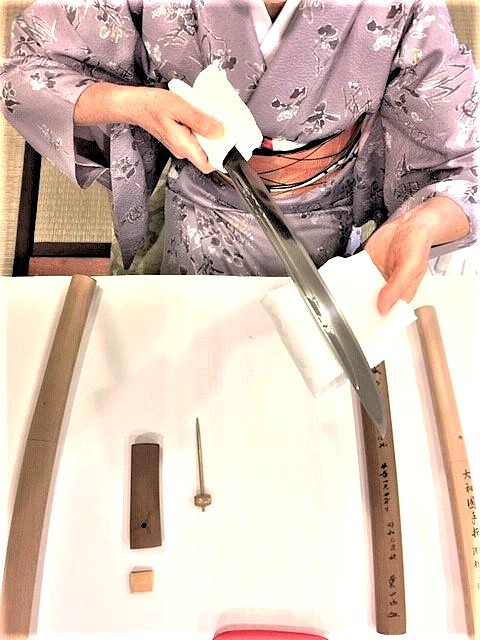
  1.   Hold the nakago in your right hand.  Support the blade from underneath with your left hand using washi (Japanese rice paper), a handkerchief, or tissue paper.


  1. Use light reflection on the blade’s surface, examine the jigane, hamon, boshi, mei, and other features.  To observe the hamon, jigane, and boshi clearly, move the sword up, down, or sideways, or rotate it to reflect the light at the proper angle.

1悦子の絵

  1. When you finish examining the sword, bow lightly, and put it back together by reversing the order process.


62|Part 2 of — 28 Shin-To Main 7 Region (part B)

This chapter is a detailed part of Chapter 28, Shin-t Main 7 Regions (part B).  Please read Chapter 28 before reading this chapter.  Below are regions 3 and 7.

0-timeline - size 24 Shin-to                           The red circle above indicates the time we discuss in this section    

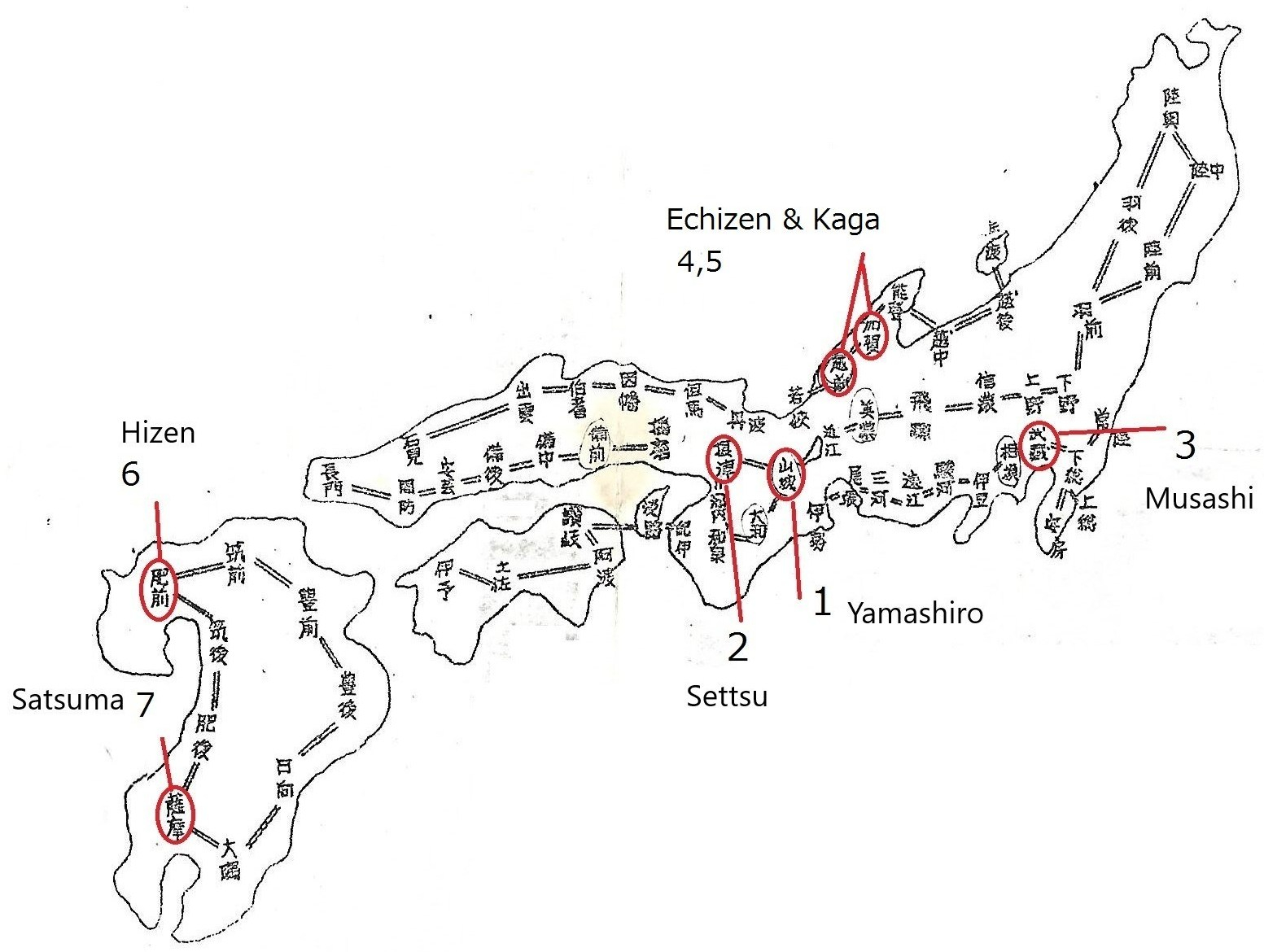
29 Map with number 7

3.Musashi (Edo)

We also find many famous swordsmiths in Edo.  They were Yasutsugu (康継), Kotetsu (虎徹), Noda Hankei (野田繁慶), Hojoji Masahiro (法成寺正弘), and their followers.

Two photos below are swordsmiths from Musashi (武蔵: Tokyo).  

                       Yasutsugu  From the Sano Museum Catalogue.  (Permission to use granted)

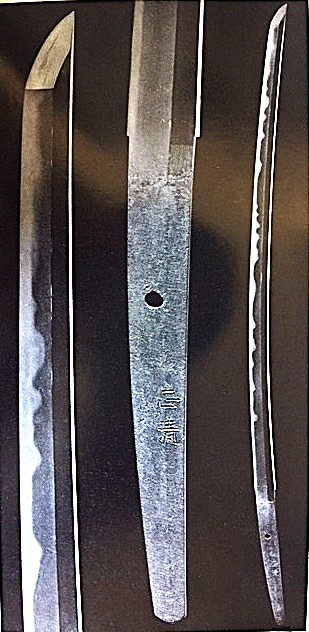
Characteristics of Yasutusgu (康継) ——Shallow curvature; chu-gissaki (medium kissaki); a wide notare hamon, midare, or o-gunome (occasionally double gunome); traces of Soshu-den and Mino-den; a wood-grain pattern mixed with masame on the shinogi-ji.


              Kotetsu (虎徹) from Sano Museum Catalogue, (permission to use granted)

Here is the famous Kotetsu.  His formal name was Nagasone Okisato Nyudo Kotetsu (長曽祢興里入道虎徹).   Kotetsu started making swords after turning 50.  Before that, he was an armor maker.  

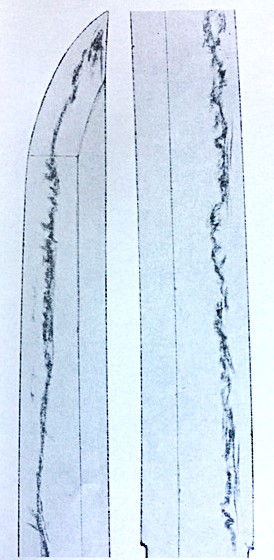
The characteristics of Kotetsu ———————— A shallow curvature and wide width, a wide tempered line with nie.  A small irregular hamon surrounds the machi area, transitioning into a wide suguha-like notare in the upper area.  Fine nie, komaruboshi with a short turn backThe ji-hada is a fine-grained wood with burl.  Occasionally, o-hada (black core iron shows through) appears in the lower part above the machi area.  The illustration above shows a thick-tempered line with nie, a typical feature of Kotetsu. Once you see it, you will remember it.   The next region is 7 (skip 4, 5, and 6)


  1. Satsuma (Kyushu) 

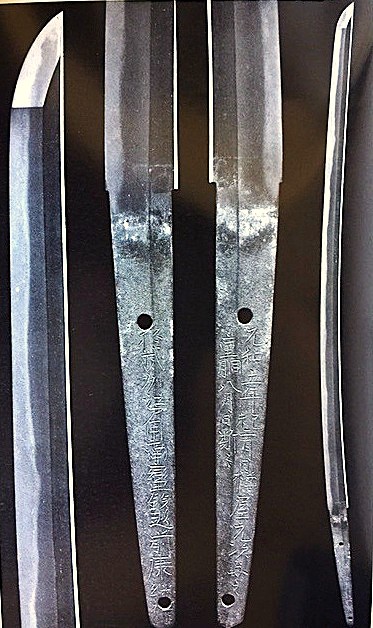
  Miyahara Mondonosho Masakiyo (宮原主水正正清) from Sano Museum Catalogue (permission to use granted).

Miyahara Mondonosho Masakiyo was highly respected by the Shimazu family of Satsuma- han (the Satsuma domain in Kyushu).  Later, he was chosen to travel to Edo to forge swords for Shogun Yoshimune

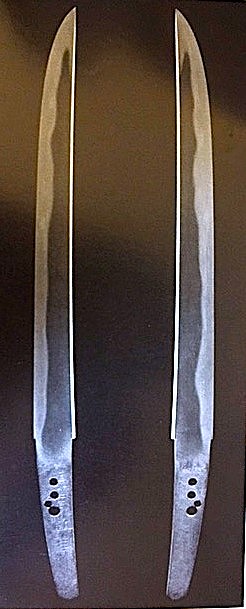
Mondonosho Masakiyo’s characteristics————- Well-balanced sword shape, shallow curvature, and wide and narrow hamon mixed with squarish hamon and pointed hamon as shown in the photo above.  He engraved the Tokugawa family’s Aoi crest (the hollyhock crest) on the nakago.

41| Part 2 of — 8 Middle Kamakura Period: Yamashiro Den 鎌倉中期山城伝

This chapter is a detailed part of Chapter 8| Middle Kamakura Period –Yamashiro Den(鎌倉中期山城伝).   Please read Chapter 8 before reading this chapter.

0-timeline - size 24 Middle Kamakura

      The red circle indicates the time we discuss in this section

During the middle Kamakura period, the Yamashiroden consisted of 3 main groups: the Ayano-koji (綾小路) group, the Awataguchi (粟田口) group, and the Rai (来) group.

When referring to a specific group, we use terms like “xxx ha,” “xxx ippa,” or “xxx ichimon.”   We use these three terms interchangeably.  They all mean “group.”   For example, when we say “Ayano-koji ippa,” we refer to the Ayano-koji group.

Ayano-koji Ippa (綾小路)

Sugata (shape) —————–Generally, a gentle or graceful kyo-zori shape.  The difference in width between the yokote line and the machi is minimal.  The sword is slender, yet thick, with a small kissaki.                                                                                                                         

Hi and Engraving ———————– Bo-hi (single groove) or futasuji-hi (double grooves) 

Hamon ——————— Nie base with ko-choji (small clove shape) and ko-midare (small irregular).  Small inazuma (lightning-like lines) and kinsuji (golden streaks) may be present.   Double ko-choji (two ko-choji side by side) may appear.   

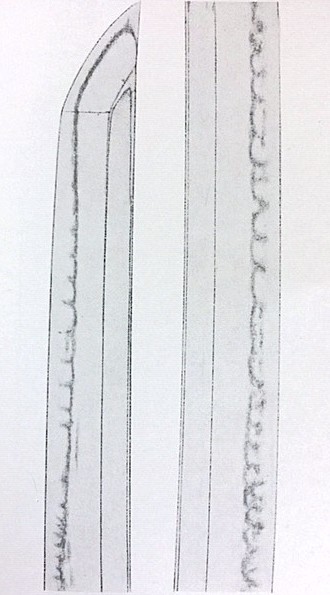
Boshi (tempered line at the kissaki area) ———————– Ko-maru (small round), yakizume (see the illustration below ), and kaen (flame-like pattern)   

Ji-hada —————– Small wood grain with a little masame (straight grain).  Ji-nie shows. 

Nakago (hilt) ———————— Long, slightly thick feel  

Ayano-koji Ippa swordsmiths ———-Ayano-koji Sadatoshi (綾小路定利)  Sadanori (定則)        

Awataguchi Ichimon (粟田口)

Many swordsmiths from the Awataguchi Ichimon (or Awataguchi group) were honored as the Goban Kaji (the top swordsmith) by Gotoba Joko, Emperor Gotoba (後鳥羽上皇).  Their general characteristics are as follows.

Sugata (Shape) ————————- Elegant torii-zori (or kyo-zori) shape.     

Hi and Engraving ————– The tip of the hi extends all the way up and fills in the ko-shinogi.   The end of the hi can be maru-dome (the end is round), kaku-dome (the end is square), or kakinagashi.
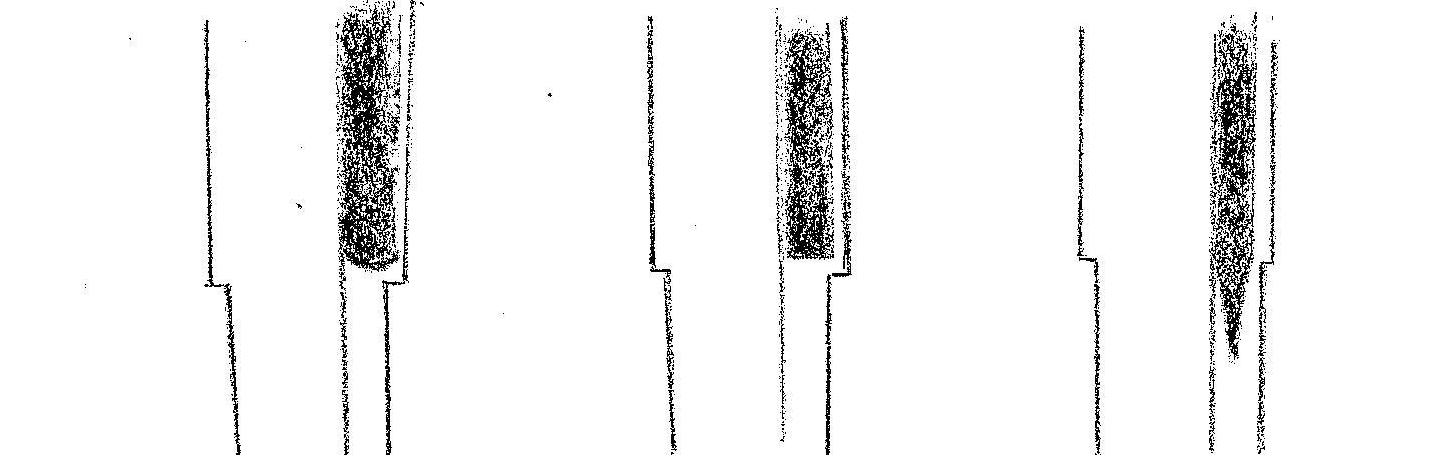
 

9 «part 2» 大小丸,焼詰,丸角止, 掻流     

              Maru-dome (rounded end)             Kaku-dome (square)          Kakinagashi

  • Hamon ———— The slightly wider tempered line at the bottom, then it becomes narrower at the top.  Nie base (called Nie-hon’i).  A straight tempered line mixed with ko-choji (small cloves) or a wide straight line combined with choji.  Awataguchi-nie appears.  Awataguchi-nie, which refers to a fine, deep, sharp, shiny nie that appears around the tempered line area. Fine inazuma (lightning-like lines) and kinsuji (golden streaks) emerge.

  • Boshi (tempered line at the tip area) —————— Ko-maru (small round)  and/or O-maru (large round).   The return is sharrow.  Yakizume, Nie Kuzure, and Kaen (flame)9-«part-2»-大小丸焼詰丸角止-掻流-1-e1547925390685.jpg

       Yakizume      O-maru     Ko-maru         Yakikuzure

  • Ji-hada ————– Fine ko-mokume (wood swirls) with ji-nie.  Ji-nie is nie on ji-hada. Yubashiri and/or chikei appear.                                                                               
  • Nakago ——————————– Often featuresa two-letter inscription
  • Names of Awataguchi swordsmiths —– Awataguchi Kunitomo (粟田口国友 ),  Hisakuni (久国), Kuniyasu (国安),  Kuniyasu (国安), Kunikiyo (国清)

 Rai Ha ()

The general characteristics of the Rai group are as follows.  However, each swordsmith has their own unique traits.

Sugata (shape) ——– Graceful and dignified.  Thick body.  Rai forged Ikubi Kissaki.         Hi and Engravings ————————- Wide and shallow hi.                                      Hamon ————————- Nie base.  Suguha (straight).  Wide suguha with ko-midare (small irregular) and choji (cloves).  Sometimes, there is a large choji at the lower part and a narrow suguha at the top.  Inazuma and Kinsuji appear around the yokote area.      Boshi ————————————- Komaru, yakizume (see the illustration above)            Ji-hada ——————— Finely forged itame (small wood grain).  Sometimes mixed with masame (parallel grain).  Fine nie.  Rai group’s swords occasionally show yowai tetsu (weak surface), which may be the core iron.    

Rai Ha swordsmiths———————- Rai Kuniyuki (来国行),  Rai Kunitoshi (来国俊) or Niji Kunitoshi (二字国俊),  Ryokai (了戒 ).  Rai Kunitoshi is said to be the son of Rai Kuniyuki. Ryokai is said to be the son of Rai Kunitoshi.
img017

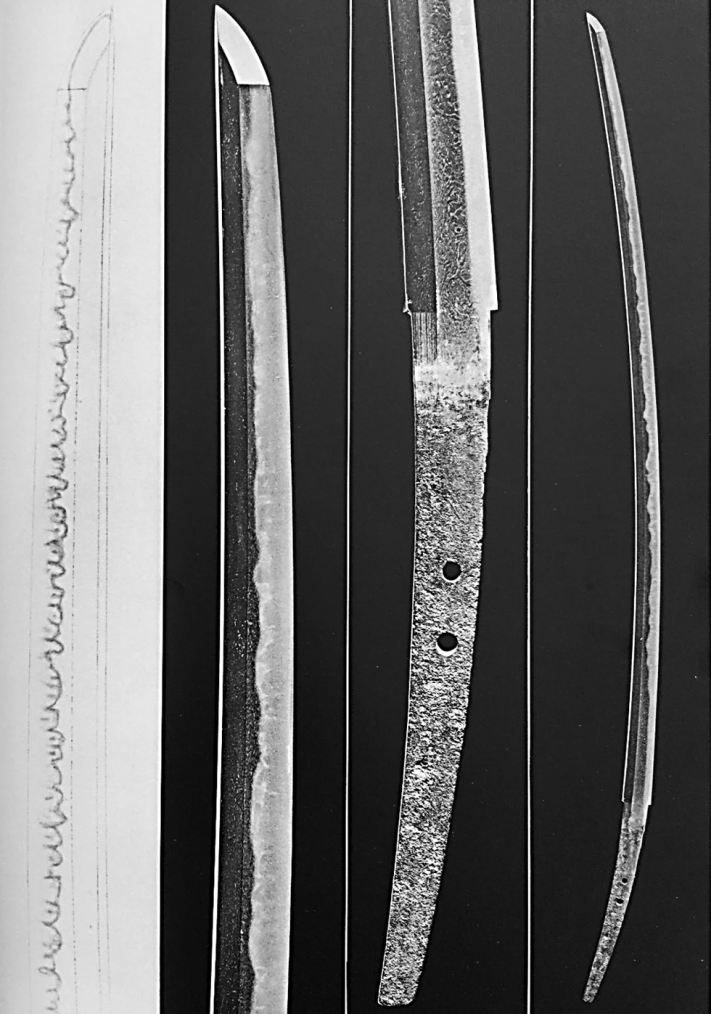
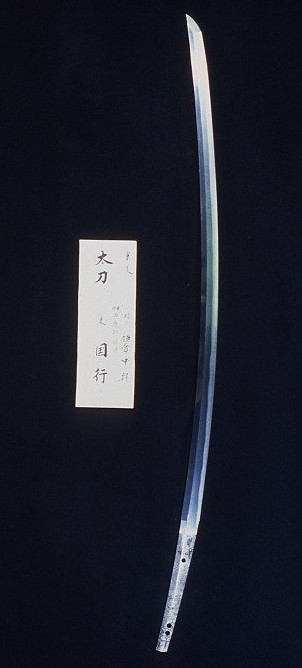
    Rai Kuniyuki (来国行)Once my family sword, photo taken by my father with his  writing.    
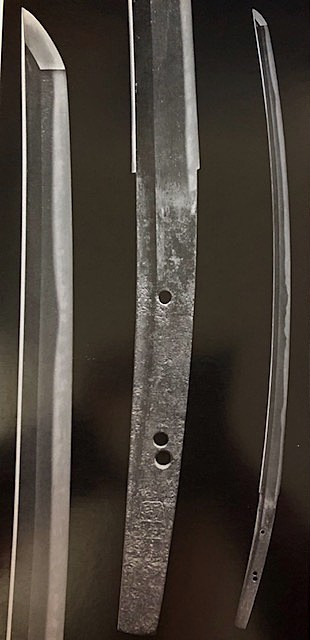
9 «part 2» Rai Kuniyuki photo.jpg       Rai Kuniyuki hamon
 
Rai Kuniyuki (来国行)Sano Museum Catalogue (佐野美術館)  (permission granted)

36| Part 2 — 3 Names of the Parts

This chapter is a continuation of Chapter 3, Names of Parts.  Please read Chapter 3, Names of Parts, before reading this section.

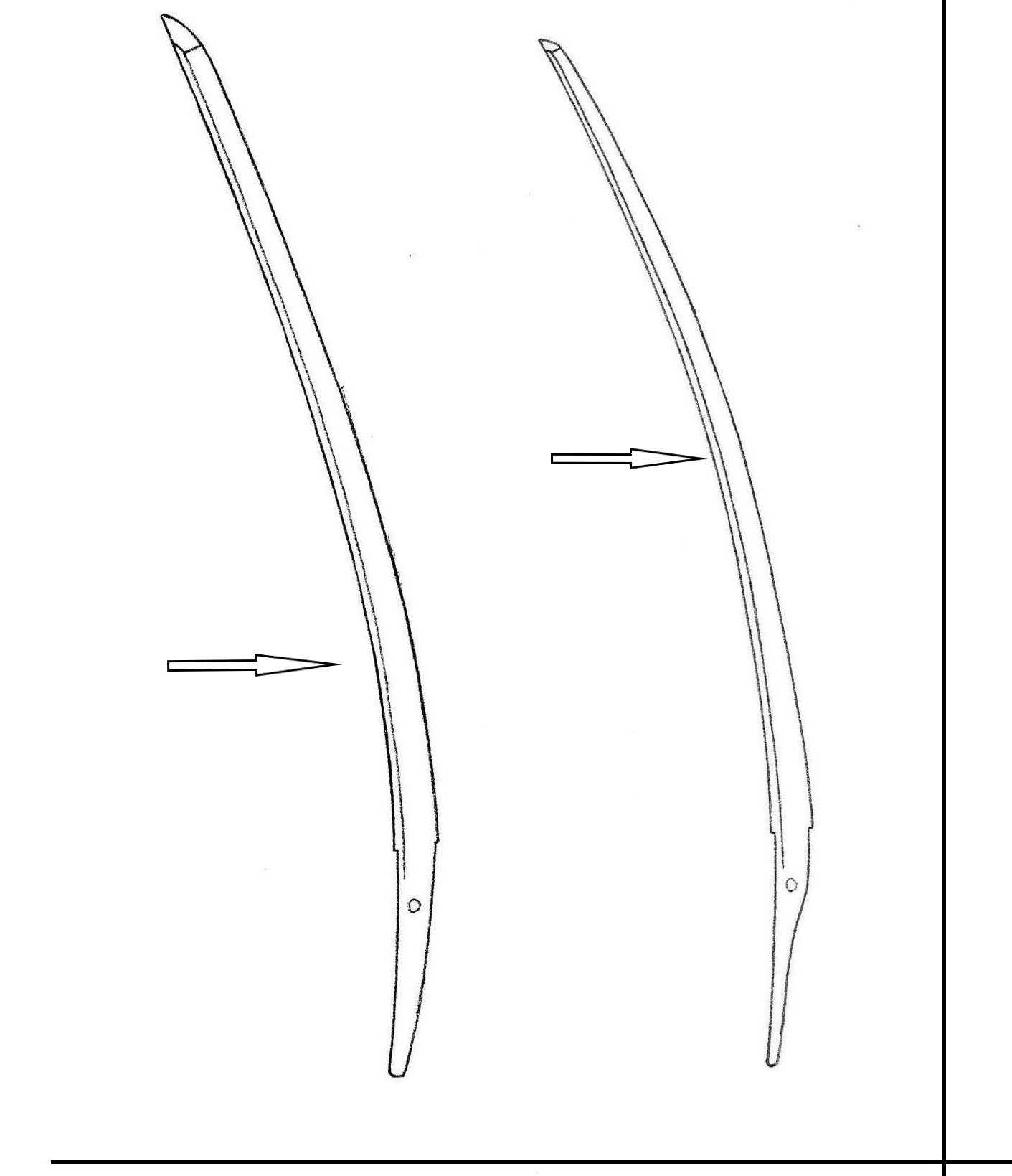
This chapter explains how to identify the koshi-zori or chukan-zoriChukan-zori is also called torii-zori or kyo-zori.   Chukan-zori means that the most curved part of the sword’s body is around the middle, and for koshi-zori, the most curved part is located lower than the center of the blade, approximately 1/3 down the body.   Every sword seems to have its curvature around the middle area, especially when looking at photos of swords in books.  This is because these swords are positioned to fit nicely within a given rectangular photo space. 

The correct way to check for the curvature is to hold the nakago (茎) vertically.  This way, you can see the location of the curvature more accurately.  If the nakago is not vertical, the curvature appears in the middle section of every sword.  When examining a sword, the first step is to hold the sword and make sure the nakago stands vertically. When looking at a sword in a book, rotate (shift or slide) the book slightly so that the nakago is perpendicular.  This way, you can see the precise location of the curvature.  Keep in mind that the difference can sometimes be subtle.

36 part 2 of -- 3 Sori (2)


19 | Nanboku-Cho Period Tanto(南北朝短刀)

0-timeline - size 24 Nanboku-cho
The circle indicates the time we discuss in this section

During the Nanboku-cho period, a type of tanto called hirazukuri ko-wakizashi sun-nobi tanto was made.  Hirazukuri means flat swords without the yokote line or shinogi.  Ko-wakizashi refers to a shorter sword.  Sun-nobi tanto means longer than a standard tanto.  This type is also known as Enbun Jyoji ko-wakizashi tanto because most of these tantos were created during the Enbun and Jyoji eras of the imperial period.  In Japan, a new imperial era begins when a new emperor ascends to the throne.  The Enbun era spanned 1356-1361, while the Jyoji period spanned 1362-1368.

20 Enbun Jyoji Kowakizashi Tanto

Sugata (姿: shape) ————A standard tanto measure is approximately one shaku.  Shaku is an old Japanese unit of measurement for length, and one shaku is roughly equal to one foot.  

8.5 sun (the sun is another old Japanese measurement unit of length) is approximately ten inches.  Ten inches is the standard size for a tanto, known as a josun tanto.  Anything longer than a josun tanto is called a sun-nobi tanto.  Anything shorter than a josun is called a sun-zumari tanto. 

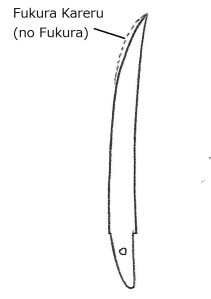
Most of the Nanboku-cho tantos are longer than a josun tanto, approximately one foot two inches.  Therefore, they are called hirazukuri ko-wakizashi sun-nobi tantoSaki-zori (curved outward at the top.  See the illustration above).   Wide in width and thin in body.  Fukura kareru (no fukura means less arc).  Shin-no-mune.  See the drawing below.

20 Fukura           20 Shin-no-Mune

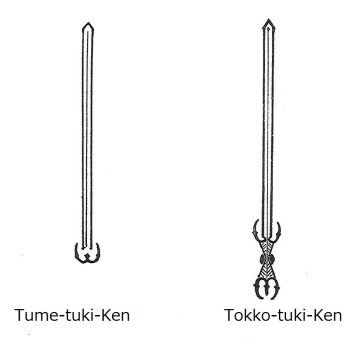
Hi, (: Grooves) and Horimono (彫り物: Engraving) ——- A groove or grooves on the mune side.  Bonji (Sanskrit, see Chapter 16 Late Kamakura Period (Early Soshu-Den Tanto),  koshi-bi (short groove),  tumetuki ken, and tokko-tsuki ken (see below) appear. The ken (dagger) is curved widely and deeply in the upper part and shallower and narrower in the lower part.  This is called Soshu-bori (Soshu-style carving).

20 Tokko, tume Ken

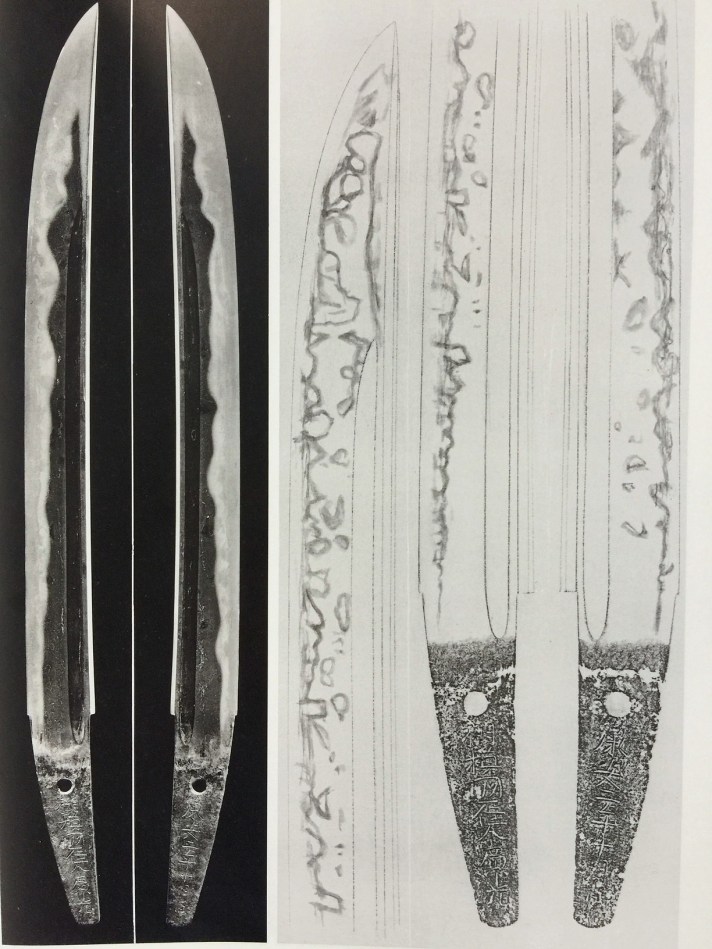
Hamon (: Tempered line) ——- The narrowly tempered section at the lower part gradually widens toward the top.  A similar wide hamon pattern extends into the boshi area.  The hamon in the kissaki area is kaeri-fukashi (deep turn back).  See the illustration below.  Coarse nie.  O-midare (large irregular hamon pattern).

20 Hitatsura

                                        From Sano Museum Catalogue

Ji-hada (地肌: the area between shinogi-ji and the tempered line) ——– a loose wood grain pattern called itame.  Yubashiri (see Chapter 16, Late Kamakura Period) and tobiyaki (irregular patchy tempered spots) appear.  Dense tobiyaki is called hitatsura (see the drawing above).

Nakago (: Tang) —- Short tanago-bara.  Tanago-bara refers to the shape of the belly of a Japanese fish called tanago (bitterling).

20 Tanago Bara

Tanto Swordsmiths during the Nanboku-Cho Period

Soshu Den ———————————————————-Hiromitu( 広光) Akihiro (秋広) Yamashiro Den ————————————————–Hasebe Kunishige (長谷部国重)   Bizen Den ——————————————————— Kanemitu (兼光) Chogi (長義 )

    Soshu Hiromitsu     “Nippon-To Art Sword of Japan “   The Walter A. Compton Collection

15| The Revival of Yamato Den(大和伝復活)

0-timeline - size 24 Late Kamakura

        The red circle above indicates the time we discuss in this section

It is believed that sword-making first started in Yamato province (now Nara Prefecture) during the Nara period (710 to 794).  In the early days of sword-making, the forging techniques were primitive.  At that time, many swordsmiths lived in Yamato, but over time, sword-making in this region declined.

At the end of the Kamakura period, several powerful Buddhist temples emerged in the Yamato area, leading to conflicts among them.  Temples held significant political and military power to control large territories called shoen (荘園) through their large numbers of warrior monks, known as sohei (僧兵).  The most dominant group was Nanto Sohei (南都僧兵)*.  These groups of sohei demanded more swords to arm themselves, which revitalized the Yamato-den (school) and increased the number of swordsmiths in the Yamato area.   As a result, the Yamato-den group became active again.  The Yamato-den style is somewhat similar to the Yamashiro-den.    

*Nanto Sohei (南都僧兵)—————-Since around the 11th century, Buddhist temples grew powerful under the protection of the Joko (retired emperors).  These temples had many sohei (low-level monks who also served as soldiers). When power struggles arose among the temples, sohei fought as their soldiers on the battlefields.  Nanto Sohei were such soldiers at Kofuku-Ji Temple (興福寺).  Several large temples, such as Todai-ji (東大寺) Temple, controlled the Yamato area.

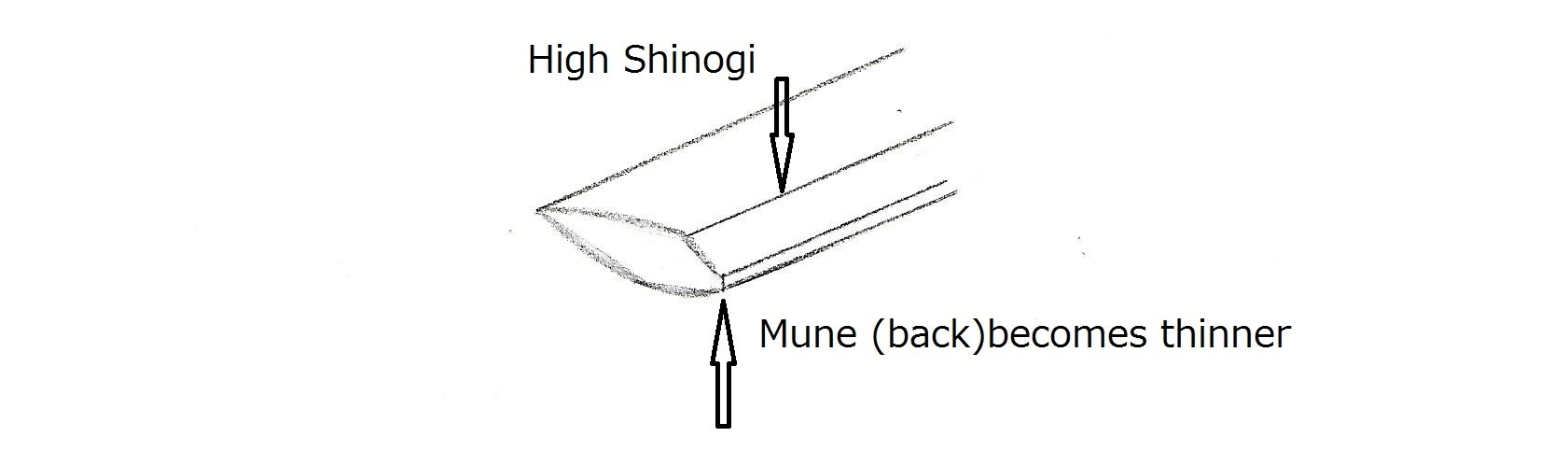
Sugata (姿: Shape) —————- Not much difference in style during the early part of Yamatoden and Yamashiro-den.  Shinogi is high.  Mune is thin.   Some Yamato-den have a shallow sori (curvature).

16 Yamato sword cross section

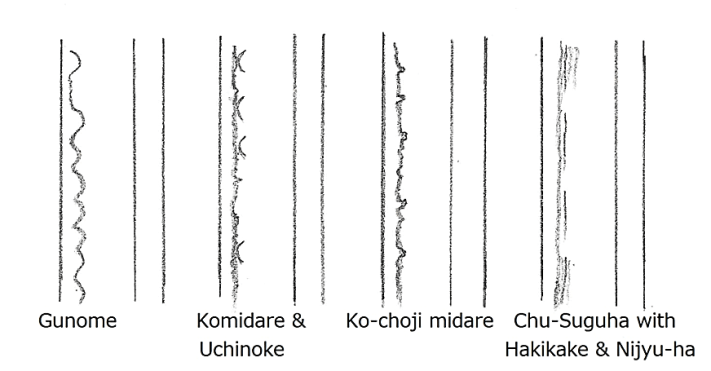
Hamon (刃文Tempered line) ——————Narrow tempered line.  Mainly nie (沸).  Chu-suguha-hotsure (中直刃ほつれ: a medium straight line with a frayed pattern), ko-choji-midare (小丁子: a mixture of small clove-like patterns and irregular wavy lines), ko-midare (小乱: small irregular wavy lines), ko-gunome-komidare (小五の目小乱: small continuous half-circles mixed with wavy lines). 

The main features of the Yamatoden style sword are masame (straight grain).  Its tempered line often shows nijyu-ha (double straight lines), hakikake (brush mark trace), uchinoke (a crescent-shaped line), or a combination of these.   See the illustration below.


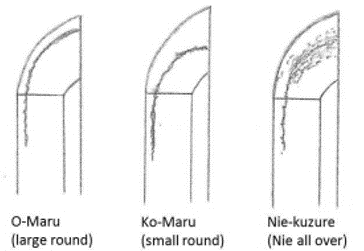
Boshi (鋩子: Tempered line at Kissaki area) ———- In the boshi area, a straight grain hamon pattern appears.  Yakizume or kaen. (Refer to Chapter 12, Middle Kamakura period: Tanto).  O-maru, ko-maru, nie-kuzure.  (Refer to Chapter 14, Late Kamakura Period Sword.  See the illustration below.)


15 Omaru Komaru Niekuzure

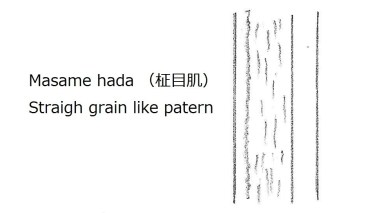
Ji-hada (地肌):Area between the shinogi and the tempered line)———— mostly masame-hada (straight grain pattern 柾目肌). Fine ji-nie, chikei, or yubashiri.  (Refer to Chapter 14, Late Kamakura Period Sword (鎌倉末太刀).  See below.)

16 Masame Hada

Nakago (Hilt) ———————– Often displays Higaki Yasuri (檜垣), the finishing file pattern, as illustrated below. 

16 Higaki Yasuri

Names of the Yamato School Sword-smiths

Taema(当麻) Group————–Taema Kuniyuki(当麻国行) Taema Tomokiyo(当麻友清) Shikkake (尻懸) Group———————————————-Shikkake Norinaga (尻懸則長) Tegai (手掻) group ——————Tegai Kanenaga (手掻包永) Tegai Kanekiyo(手掻包清) Hoshou (保昌) group———Hosho Sadayoshi ( 保昌貞吉) Hosho Sadamune (保昌貞宗)

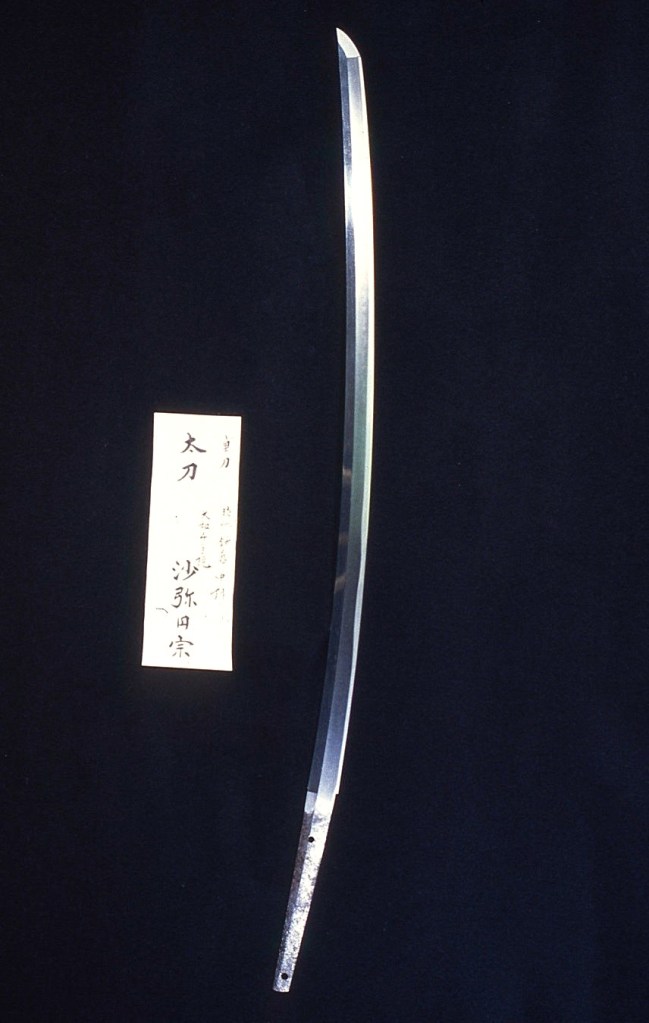
Yamato Senjuin Saya Enso (大和千手院沙弥円宗)  once my family sword

9 | Middle Kamakura Period: Bizen Den (鎌倉中期備前伝)

0-timeline - size 24 Middle Kamakura
The circle indicates the time we discuss in this section 

Many swordsmiths worked in the Bizen (備前) school during the early Kamakura period.  However, their sword style is generally somewhat similar to the Yamashiro style.  Therefore, they are called Ko-bizen (古備前), meaning old Bizen.

The true Bizen school style appeared during the Middle Kamakura period.  Bizen Province had many advantages for producing great swords.  The area produced high-quality iron and abundant firewood.  Also, its location was conveniently located for people to travel from different regions.  As a result, many swordsmiths gathered there and produced large quantities of swords.  Due to competition among these smiths, the quality of Bizen swords is generally higher than that of other schools.  Therefore, it is often difficult to appraise Bizen swords because of the many subtle differences among the different swordsmiths.

The following three features are the most distinctive characteristics of the Bizen school.  

1.   Nioi-base tempered line.  The Nioi-base tempered line has finer dots than the Nie-base.   These dots are so small that they almost appear as a line. Technically, the tempering processes of these two are identical.  See the illustration below.                        2.   Ji-hada (surface of the body) appears soft.                                                                  3.  Reflection (utsuri) appears on the surface.

10 Nie & Nioi

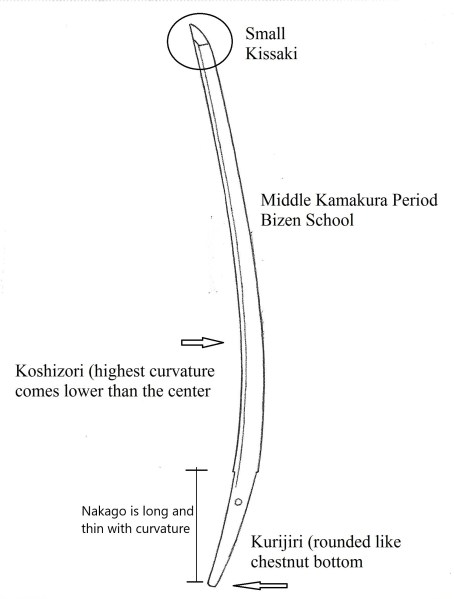
Sugata (shape) —The length is approximately 33 inches ± a few inches. The blade is slightly wide and appears sturdy. The curvature of the blade is koshizori (腰反), meaning the deepest curve is at the lower part.  The body has an average thickness, and the kissaki is small.

 10 Middle Kamakura ---備前刀姿

Horimono (engraving) ——Engravings are rare.  The tip of the hi extends all the way to ko-shinogi, filling the entire area.

8 Hi

Nakago ——– Long and thin with a curve. The end of the nakago is rounded and resembles the bottom of a chestnut (kuri).  This shape is called kurijiri.   Refer to the illustration of the sword above.

Hamon (tempered area pattern)—— Nioi base. The tempered area is wide and consistent width.  The size of the midare (irregular wavy tempered pattern) is uniform.

Boshi ——– The same tempered pattern continues upward to the boshi area, and it often shows choji- midare (clove-shaped wavy pattern) or yakizume.

10 Boshi --- Bizen

Ji-hada ———— Fine and well forged.  The steel appears soft.  On the steel surface,  small and large wood-grain patterns are mixed.  Chikei (condensation of nie) and utsuri (cloud-like reflection) appear.

Bizen School Sword Smiths during Middle Kamakura Period

  • Fukuoka Ichimonji (福岡一文字) group ————-Norimune (則宗)  Sukemune (助宗) 
  • Yoshioka Ichimonji (吉岡一文字) group ——–Sukeyoshi (助吉) Sukemitsu (助光)        
  • Sho-chu Ichimonji (正中一文字) group —————Yoshiuji (吉氏)   Yoshimori (吉守)     
  • Osafune (長船) group ———–Mitsutada (光忠)  Nagamitsu (長光) Kagemitsu (景光)   
  • Hatakeda(畠田) group ————————————-Moriie (守家)  Sanemori (真守)  
  • Ugai (鵜飼) group ————————————————- Unsho (雲生) Unji (雲次)

              9 Middle Kamakura Bizen Fukuoka ichimonji 

Fukuoka Ichimonji (一文字) from “Nippon-to Art Swords of Japan”                                     The Walter A. Compton Collection

5 |Heian Period Swords  (平安時代太刀)

0-timeline - size 24 Heian

                       
                                      The circle indicates the time we discuss in this section

The Heian period is when the sword shape changed to the current curved form.  Before that, swords were straight.  It is widely accepted that the study of Japanese swords begins in the Heian period.   Swords made before the Heian period are considered archaeological artifacts.  The main reason is that sword-making techniques improved significantly after the start of the Heian period.

The elegant and graceful lifestyle of Heian culture is reflected in the style of swords.  A group of swordsmiths in the Kyoto region developed a specific sword style called Yamashiro-den (Yamashiro School).  The shape of their swords exhibits a graceful line.  The most famous sword of this period is Sanjo-Munechika (三条宗近 page 20), a national treasure today.  The Yamashiro-den represents the swords of the Heian period.                                                                                                                                 


                                                                                                      6a Heian period sword style

General Heian period sword style

The shape —————The length of a sword is about 30 inches ± a few inches.  It has an elegant, graceful shape, with a narrow blade and a small kissaki (小切先).  The curvature is deep.  This style is called Kyo-zori (京反り) or Torii-zori (鳥居ぞり).  In the Kyo-zori style, the deepest part of the curvature is near the middle of the blade.  The lower part of the sword flares out, creating an A-line shape similar to the lower part of the Eiffel Tower.  This flared shape is called funbari (踏ん張り).                                                                      

6b A line bottom

Hamon(刃文)———- Hamon is the line formed during the process of tempering.  The hamon on Heian period swords is narrow and usually suguha (直刃).  Suguha means a straight line.  The hamon is also Nie-based.  Nie(沸) are tiny particles in the hamon.   As shown below, if you look closely, you can see fine sand-like particles within the hamon line.

6 Straigh tempered line(Suguha)

10 Nie & Nioi

Ji-hada (地肌) ——–Fine wood-grained pattern.  The location of ji-hada (or ji-tetsu) is between the hamon and shinogi (see Chapter 3 |Names of Parts).

Nakago (中心)——– The nakago is the hilt area.  Sword makers inscribed their names there. During the Heian period, the nakago was often shaped like a kijimomo (雉腿), meaning a pheasant’s thigh.

6 Kijimomo-nakago

Hi and engrave ———- Hi (樋) means an engraved straight line.  Hi and other engraved designs were rare during the Heian period.  These became more common later on.

Kissaki (切先) ———– The shape of kissaki on a Heian sword is ko-gissaki, meaning small kissaki. The hamon line at the kissaki is called boshi.  During this period, the type of boshi design is called komaru, meaning small, round, and wrapping around the tip.

Names of the Heian period swordsmiths

  • Yamashiro School——–  Sanjo Munechika(三条宗近) Sanjo Yoshiie(三条吉家)                                                 Gojo Kanenaga(五条兼長) Gojo Kuninaga (五条国永)
  • Yamato School ————-Senju-in (千手院)
  • Bizen School ————— Bizen Tomonari(備前友成) Bizen Masatsune(備前正恒)                                                  Bizen Kanehira (備前包平)
  • Hoki (伯耆) —————–  Yasutsuna (安綱) Sanemori (真守)
  • Buzen (豊前) ————–   Cho-en (長円) Sinsoku (神息)
  • Satsuma (薩摩) ———— Naminohira (波平)