35|Part 2 of — 2 Joko-To (上古刀)

This chapter is a detailed part of Chapter 2,  Joko-to (上古刀).  Please read Chapter 2 before this section. 
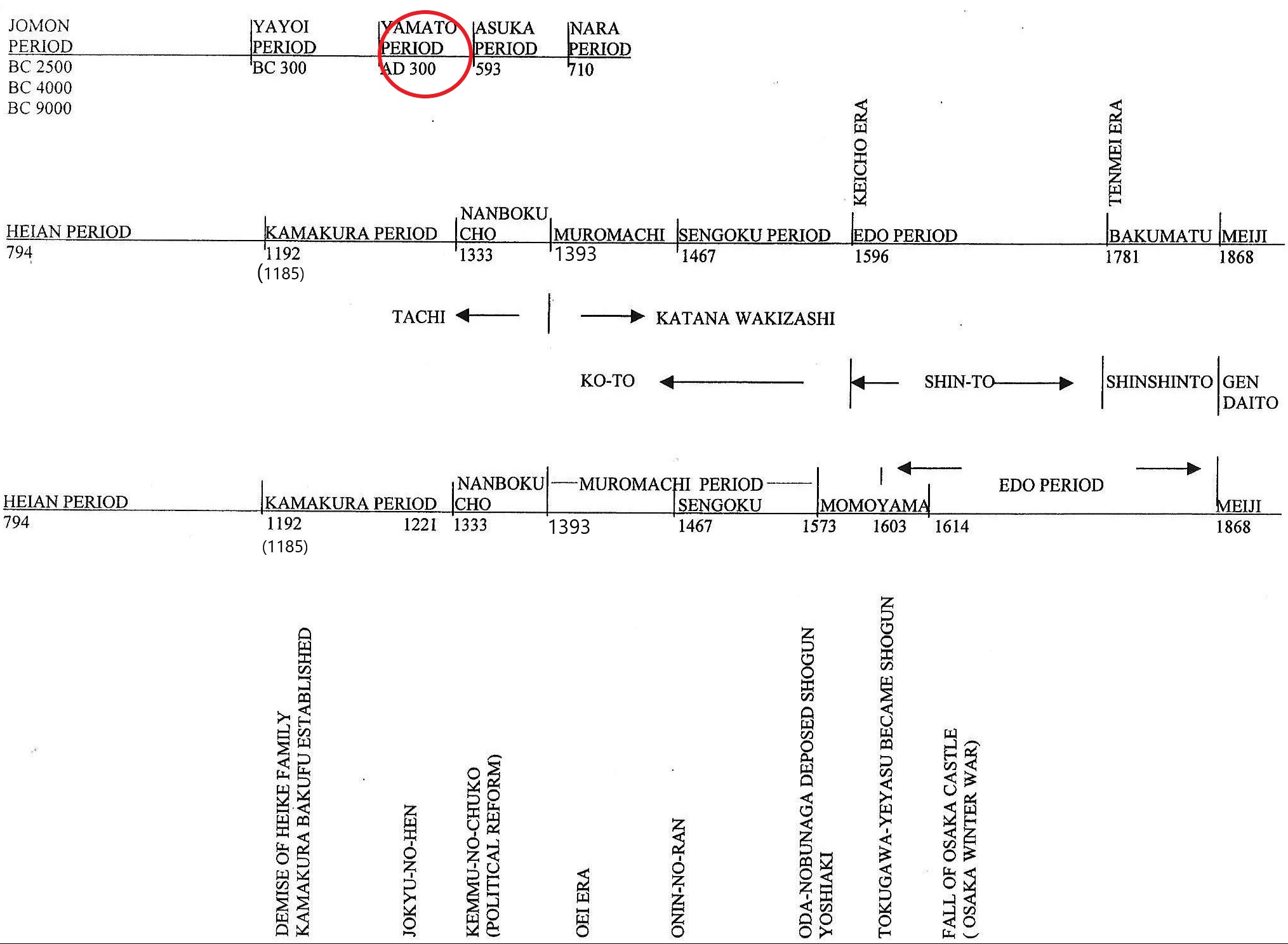
0-timeline - size 24 Yamato
 
                             The red circle indicates the time we discuss this section.

The Kofun (古墳) culture emerged around the fourth to sixth centuries.  Kofun are massive burial sites built for powerful rulers.  They are often Zenpo-koen-fun (前方後円墳), meaning the front part is square, and the back is rounded.  When viewed from above, their shape resembles a keyhole.  The largest kofun is the Nintoku Tenno Ryo (仁徳天皇陵) in Osaka.  This is the tomb of Emperor Nintoku.  Its size is 480 m X 305 m, and it is  roughly 35 meters high. Inside the kofun, we found swords, armor, bronze mirrors, jewelry, iron, and metal tools.  Sometimes, iron itself was found.  Only the ruling class owned iron because it was considered a precious item at the time.  On the outskirts of the kofun, many haniwa*¹ were placed.  There are several theories about the purpose of haniwa.  One suggests they served as retaining walls, while others say they act as a dividing line between sacred and common areas.  There are several more theories. 

Originally, haniwa were simple tube shapes.  Over time, they became interesting clay figurines, including smiling people, smiling soldiers, dogs with bells around their necks, women with hats, farmers, houses, monkeys, ships, and birds.  Some of these were very elaborately made and very cute.  Judging by their appearance, people in those times seemed to have worn elaborate clothing.  Haniwa figurines are quite popular among children in Japan.  We used to have a children’s TV show where haniwa was the main character. 

Haniwas suggests what people’s lives were like back then. Their facial expressions are happy and smiling.  According to the old Japanese history book Nihon Shoki (日本書紀, the oldest Japanese history book completed during the Nara period), haniwa replaced martyrs, although this has not yet been proven.

At another huge kofun, Ogonzuka Kofun (黄金塚古墳) in Osaka, they discovered swords, bronze mirrors, and other artifacts.  Refer to Chapter 2|Joko-to.  The writing below is from my college days notebook.   

My college professor explained how to determine the age of a specific item by reading partially faded characters on objects, such as a bronze mirror or a sword.  For example, there was a sword with a hilt made in Japan and a blade made in China.  It had a round hilt and, on it, showed some Chinese characters.  It read, “中平[ ]年.”   The third letter was not legible.  But we knew that the 中平 year was between 184 and 189 A.D., and “年” indicated “year.”  Therefore, it was made sometime between 184 and 189.  This sword was found in a fourth-century tomb. 

He also explained that many nested doutaku (銅鐸)*² had been excavated from various sites.  They were discovered nested inside one another.  Doutaku was a musical instrument used in rituals.  Therefore, scholars believe that people hurriedly hid the doutaku and fled quickly when enemies attacked.

In many countries, excavation can be a time-consuming and tedious process.  It often takes a long time to find anything.  However, in Japan, it is not as difficult as in other countries.   We often discover things.  They might not be what you are looking for, but we dig up artifacts quite often.

398px-群馬県大泉町古海出土_埴輪_腰かける巫女

   *ᴵ腰かける巫女 (群馬県大泉町古海出土)  国立博物館蔵    Sitting Shrine Maiden           (Excavated from Gunma Prefecture) Owned by National Museum,  Public Domain Photo

                   滋賀県野洲市小篠原字大岩山出土_突線紐5式銅鐸

*² 滋賀県野洲市小篠原字大岩屋出土突線紐5式銅鐸  東京国立博物館展示  Public Domain Photo     Dotaku:  Excavated from Shiga prefecture  Displayed at Tokyo National Museum.    

34| Part 2 — 1 Timeline

Chapter 34 is a continued part of Chapter 1 Time line.   Please read Chapter 1 before reading this section.

   0 timeline - Gendai-to                             The red circle indicates the time we discuss here

In the “Chapter 1 Timeline,” the gendai-to (現代刀) are swords made from the Meiji Restoration (明治維新1868) up to the present day.  It has been about 150 years since the Meiji Restoration.  Although all swords made after the Meiji Restoration are grouped under the gendai-to, there are many differences in quality and style.  One notably different type is the gun-to (軍刀).  These are military swords forged during World War I and World War II.  Some of them have a saber-like handle.  With a few exceptions, these were made without using traditional sword-making techniques of heating and folding.  Among the gendai-to, gun-to are usually considered less valuable.  The guns-to-swords made around and during World War II are called Showa-to.  It often has a brown leather scabbard.  Gun-to is not a part of the study of the Japanese sword.

*Refer to” https://en.wikipedia.org/wiki/Gunt%C5%8D”  for the Japanese military sword.

                                Gun-to    From Wikimedia Commons, the free media repository

At the time of the Meiji Restoration (明治維新), swords called Meiji-ishin-to (明治維新刀) or Kin’no-to (勤王刀) were made.  These swords were owned by famous historical figures such as Saigo Takamori (西郷隆盛) and Sakamoto Ryoma (坂本龍馬).  They are important historical figures who advanced the Meiji Restoration.  These swords are long, with some almost 3 feet long, and have no curvature.

Today, many famous swordsmiths are making excellent swords.  Some are recognized as living national treasures.  Gendai-to refers to swords made after the Meiji Restoration to the present, but keep in mind that there is a wide range of differences in quality, type, and purpose among them.

36img077

                       Sword forged by a Living National Treasure, Mr. Miyairi Shohei (宮入昭平)                         owned by my brother

33| Information on Today’s Swordsmiths

Currently, many skilled swordsmiths are in Japan.  I am good friends with two of them.  One is Mr. Yoshihara Yoshindo (吉原義人), and the other is Mr. Yamamura Tsunahiro (山村綱廣).  I met them when we were in our twenties.

I met Mr. Yoshihara at one of the sword meetings I attended with my father in the early 1970s. Since then, we have occasionally run into each other at various sword gatherings from time to time.  His son, Yoshihara Yoshikazu (吉原義一), is also a well-known swordsmith.  And his grandson has also decided to become a swordsmith. Naturally, my friend Yoshihara was very excited to train him.  He often shares fascinating stories whenever we meet at various sword meetings. Here are a few of them. 

Mr. Yoshihara once had an apprentice from a Middle Eastern country, sent by his king.  The apprentice lived in Yoshihara‘s house with other Japanese apprentices.  He was a quiet and good apprentice who had no problems with food and ate Japanese food with the other Japanese apprentices. 

Mr. Yoshihara also mentioned that a king from a European country once visited his studio.  The king gave Yoshihara a photo of himself, with his autograph, as a gift.   Another story was about a famous Hollywood movie director who ordered a couple of swords and visited his house.  It seems this was around the same time I ordered a sword for myself.  The photo below shows the sword he made for me at that time.

Yamamura-kun (we add “kun” at the end of male friends’ names and “san” for female friends), and we were students together in Mori Sensei‘s sword class.  He was the top student; I was almost the last.  He is a direct descendant of Goro Nyudo Masamune (五郎入道正宗), the twenty-fourth generation.  Back then, he had a store almost right in front of the Hachiman-gu Shrine (八幡宮) in Kamakura, and later moved his studio near Kamakura Station.

We had one more person in our group, Mr. Kurokawa (黒川).  He owns a large sword store in Tokyo called “Soken-do (霜剣堂).”   We were all residents of Kamakura at the time.  We used to gather at Yamamura-kun’s store in front of Hachiman-gu Shrine, enjoying good times and hanging out together.

Below is the information about their stores. 

To order a sword, you can contact:  Yoshihara Yoshindo (吉原義人)                                 11-12,8Chome Takasago, Katsushika-Ku,Tokyo 〒125  Japan  Tel (03)3607 – 5255

Masamune Kougei (正宗工芸)                                                                                            13-29 Onari-cho,  Kamakura-shi,  Kanagawa, 〒248-0012  Japan   Tel (0467) 22- 3962

Soken-Do (霜剣堂)                                                                                                             28-1, 6-Chome, Jingu-mae, Shibuya-ku, Tokyo 〒150-0001 Japan  Tel (03) 3499 – 8080        

IMG_1578 IMG_1584

IMG_1590 IMG_1582

My sword made by Mr. Yoshihara

吉原新刀 (Yoshihara sword description)

  • Shape:        Koshizori   Chu-gissaki (smaller Chu-gissakiBo-hi (one groove)
  • Boshi:         Midare-komi and Komaru-kaeshi (round turnback)
  • Hamon:      Komidare   Nioi
  • Hada :        very fine Komokume almost Muji
  • Mei:           Kaji Yoshindo    Heisei 二十三 nen  二月 Kichijitu
    • It means: Sword smith Yoshindo   Heisei year 23(2011)   February good day                                                                                                    

32| Japanese swords after WWII

Growing up in Azabu and Mita in Tokyo, and later in Kamakura, my father was deeply involved with a Japanese sword museum called “Nihon Bijutsu Token Hozon Kyokai.”   At that time, the organization’s heads were Dr. Honma and Dr. Sato. 

Initially, Dr. Honma and Dr. Sato worked in the sword department at the Tokyo National Museum in Ueno.  Later, a separate non-profit organization for the Japanese Sword Museum was built in Yoyogi, Shibuya.  Although its address was in Yoyogi, Shibuya, it was nearly in Shinjuku.  To construct this museum, my father, Mr. Watanabe (owner of Wataki, an apparel company), and Mr. Suzuki Katei (owner of a construction company) were heavily involved.  Those two friends used to come to our house all the time (literally all the time), spending hours talking and gossiping.  Currently, the museum has relocated to a new location, in Sumida-Ku (Sumida Ward), Tokyo, near the Sumo Arena in Ryogoku.  Please refer to the website below.

Dr. Honma, Dr. Sato, and all the other people involved at that time passed away many years ago, but they were in their prime then.  I am talking about the late 1960s to the 1970s. I was in my teens back then. 

Many people told me that Dr. Honma, Dr. Sato, and several other prominent figures visited General MacArthur’s headquarters during the occupation after World War II, and they convinced MacArthur that Japanese swords were not weapons but art objects.  They did this because MacArthur had ordered all Japanese to turn in their swords and forbidden them from owning any.  After considerable effort, Dr. Honma, Dr. Sato, and other high-ranking individuals changed MacArthur’s mind.  Yet, many swords had already been turned in at Akabane (a place in Tokyo), though some people hid valuable ones.  Those turned-in swords are called Akabane swords.

Many swords were taken by American soldiers and brought to the U.S. as souvenirs from Japan.  Those soldiers didn’t know whether they had taken a valuable or ordinary one.   About 25 years after the war, in the late 1960s and 1970s, Japanese sword dealers traveled to the U.S. to buy back many Japanese swords.  I have a few sword-dealer friends who did this.  They advertised in local newspapers that they would buy Japanese swords.  As you can imagine, many of those swords were in poor condition.  Some people used the wrong chemicals to remove the rust. Only a few swords were found in good condition.

Among those recovered was one of the famous missing national treasure swords that  Dr. Compton found.  He was the chairman of the board of Miles Laboratories in Elkhart, Indiana.  Miles Laboratories was a pharmaceutical company that produced a range of products, including Alka-Seltzer.  He had extensive knowledge of Japanese swords.  When he saw this sword in an antique store in Atlanta, he realized it was more than an ordinary sword.  He contacted Nihon Bijutsu Token Hozon Kyokai (日本美術刀剣保存協会) for consultation.  During this process, my father became close friends with him.  My father and I visited his house several times, and they visited ours.  Dr. Compton returned this sword to the Terukuni Shrine (照国神社) in Kagoshima Prefecture without compensation.  The story of Dr. Compton continues in the last part of  Chapter 45, Part 2 of — 11 Ikubi Kissak (猪首切先).  Although Japanese sword dealers bought many swords and brought them back to Japan, it seems many Japanese swords still remain in the U.S.

Nonprofit organization: Nihon Bijutsu Token Hozon Kyokai (日本美術刀剣保存協会)           1-12-9 Yokoami Sumida-Ku Tokyo Japan         〒130—0015                                                Tel: 03-6284-1000                                                                                            

https://www.touken.or.jp/   

*The above website explains access to the museum.

66| BIBLIOGRAPHY

REFERENCED RESOURCES (参考資料)

  • Nihon Bijutsu Token Hozon Kyokai.       “Nihon-to Taikan”                                            Supervising editors: Dr. Honma, J. and Dr. Sato, K. (1966)                                    Tokyo:  Otsuka Kogeisha  Co.,Ltd.   日本美術刀剣保存協会   本間順次, 佐藤貫一監修 (1966)  “日本刀大鑑”  東京: 大塚工芸社 
  • Hon’ami, K.  (1955)  “Nihonto no Okite to Tokucho”    Tokyo: Bijutsu Club Tokenbu.    本阿弥光遜著  (1955)  “日本刀の掟と特徴 “   東京:美術倶楽部刀剣部発行
  • Watanabe, T.  (1971)   “Sano Bijutsu-kan Zuroku”  Shizuoka: Sano Bijutsu-kan.             渡辺妙子著   (1971) “佐野美術館図録  静岡:佐野美術館発行 
  • Yoshihara, Y.,  Kapp, L., and Kapp, H. (2012) :The art of the Japanese Sword”            Italy: Paolo Saviolo   吉原義人, リーオン & ひろ子 キャップ著 (2012)  “日本刀美術”  イタリア:パオロ  サビオロ 発行  
  • Mochizuki, K. & Fujiki, K. (1966) “Shousetu Nihonshi”   Tokyo:Yamakawa Shuppan-sha  High school text book by the Ministry of Education   望月圭吾, 藤木邦彦著  (1966)   “詳説日本史”   東京:山川出版発行    文部省検定済教科書
  • Dr. Honma, J. & Dr. Sato, K. (1972)   “Shinpan Nihon-to Koza”                                      Tokyo: Yuzankaku Shuppan Inc.   本間順次,佐藤貫一著   (1972)   “新版日本刀講座”    東京: 雄山閣出版株式会社発行 
  • Dr. Honma, J. & Dr. Sato, K.  (1968)  “Nihon-to Zenshu”                                                  Tokyo: Tokuma Shoten Co., Ltd.   本間順次、佐藤貫一著 (1968)   “日本刀全集 “        東京: 徳間書店発行
  • Dr. Honma, J. & Dr. Sato, K.  (1979)  “Showa Dai Meito Zufu”                                     Tokyo: Nihon Bijutsu Token Hozon Kyokai     本間順次、佐藤貫一著 (1979)            “昭和大名刀図譜”  東京:日本美術刀剣保存協会 
  • Sano Museum.  (2019)  “Yomigaeru Meito (Reborn)”                                                      Shizuoka: Sano Museum Exhibition catalog.                                                                  佐野美術館 著   (2019)  “蘇る刀 Reborn”    静岡:佐野美術館編集発行
  • Hiroi, Y.    (1971)   “Token no Mikata”    Tokyo:  Dai-ichi Hoki Shuppan Co, Ltd.            広井雄一著   (1971)  “刀剣のみかた” 東京:第一法規出版株式会社発行   
  • The Japan House Gallery. Japan Society, Inc.  (1976)                                                    “Nippon-To Art Sword of Japan  The Walter A. Compton Collection”    Tokyo: Otsuka Kogeisha Co, Ltd.
  • Chapter 25                                                                                                                    *¹ヤン ヨーステン Jan Joosten van Lodenstijnhttps://www.weblio.jp  6/2018  *²  Names of Japan: Click the link Jipangu  on Wikipedia  6/2018 (閲覧日)  Cipangu described in the 1492 Martin Beham globe From Wikimedia Commons, the free media repository (Names of Japan)
  • Chapter 37                                                                                                                    Murasaki Shikibu, translated to modern Japanese by Tanizaki, J. (1967)                  Shin-shinyaku Tales of Genji.   Tokyo:  Chuo Koronsha, Inc.   谷崎潤一郎訳  (1967)  “新々訳源氏物語”  東京: 中央公論社
  •  Chapter 43                                                                                                                  *The three imperial regalia  www.touken-world.jp/tips/32747     Wikipedia                        三種の神器:ウキペディア 2/2019 (閲覧日)
  • Chapter 45                                                                                                                    Terukuni Jinjya website: http://terukunijinja.p-kit.com/page222400.html  2/2019            九州照国神社 ウエブサイト:http://terukunijinja.p-kit.com/page222400.html   
  • Chapter 47                                                                                                                 *Number of soldiers   https://kotobank.jp/word/元寇-60419.   Wikipedia                          兵力数 ウキペディア 3/2019 (閲覧日)   *Genko (元寇) https://kotobank.jp/word/%E5%85%83%E5%AF%87-60419              
  • Chapter 54                                                                                                                  Golden Pavillion (金閣寺):https://www.shokoku-ji.jp/kinkakuji/   6/2019 (閲覧日)
  • Chapter 56                                                                                                                   Honouji-no-hen (本能寺の変)   * Rekijin.com/?p=31448-キャッシュ    *Bushoojapan.com/scandal/2019/06/02/51145-キャッシュ    7/2019   (閲覧日)
  • Chapter 57                                                                                                                   Masamune Jittetsu ( 正宗十哲 ):                                                     https://www.touken-world.jp/tips/7194/        7/2019
  • Chapter 59  Osaka Summer campaign (大阪夏の陣)                                      www.thoughtco.com/toyoomi-hideyoshi-195660                                                     Battle of Sekigahara  (関ケ原の戦い)    senjp.com/Sekigahara     8/2019 (閲覧日)
  • Chapter 63   *Perry (ペリー) ja.wikipedia.org/wiki/黒船来航                   *Perry (ぺリー) ja.wikipedia.org/wiki/マシュー・ペリー   Wikipedia  9/2019 (閲覧日)


28|Shin-to Sword — Main Seven Regions (part B 主要7刀匠地)


0-timeline - size 24 Shin-to
 The red circle indicates the subject of this chapter

64Map with number with 8

3Musashi ( 武蔵 ) in Edo ( 江戸 )

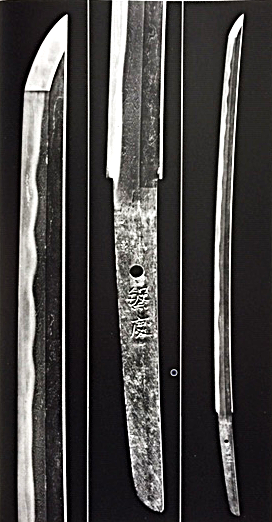
The katana and wakizashi made in the Musashi area have a shallow sori (curvature).  Often, the width of the blade’s upper part is narrow.  Usually, the hamon begins with a slight irregular pattern, then gradually shifts to a larger irregular pattern, and a few inches below the yokote line, it becomes a small irregular pattern again.  The boshi is usually a komaru-boshi.  The ji-hada may be rough.  Masame-hada shows on shinogi-ji.

Well-known swordsmiths in Musashi ———————————-Noda Hannkei (野田繁慶)                                                      Nagasone Okisato Nyudo Kotetsu (長曽根興里入道虎徹)

Nagasone Okisato Nyudo Kotetsu                        Noda Hankei (野田繫慶)                                   (長曽根興里入道虎徹)                                   from Compton’s collection “Nippon-to”    Once, my family sword                                                                                                               

4. Echizen ( 越前 ) and 5. Kaga (加賀 )

Many swordsmiths from the Mino (美濃) area moved to the Echizen and Kaga areas (#4  & #5 on the map above).  Therefore, swords made in these areas are called Echizen-seki and Kaga-seki.  Refer to Chapter 23 Sengoku Period (戦国) Sword for Mino-den.             The style of Echizen Yasutsugu (越前康継) is similar to that of Mino-den.

Well-known swordsmith in Echizen ————————-Echizen Yasutsugu (越前康継 )

6. Hizen (肥前)

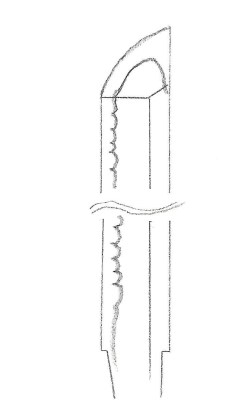
Both the katana and wakizashi from Hizen have well-balanced shapes.  The Hizen region tends to produce swords with a chu-suguha-hotsure (a medium-width straight hamon resembling frayed fabric) with fine nie (沸).  The boshi has a clean, regular line with a uniform width tempered line, as shown in the illustration below.  If you see a shin-to sword that has a chu-suguha hamon and a boshi that looks like the one below, it is often made by Hizen Tadayoshi (肥前忠吉).  Very fine Ji-hada (surface), sometimes called nukame-hada.

29 Hizen Tadayoshi Boshi

Well-known swordsmith in Hizen ——————————— Hizen Tadayoshi ( 肥前忠吉)

  1. Satsuma (薩摩 )

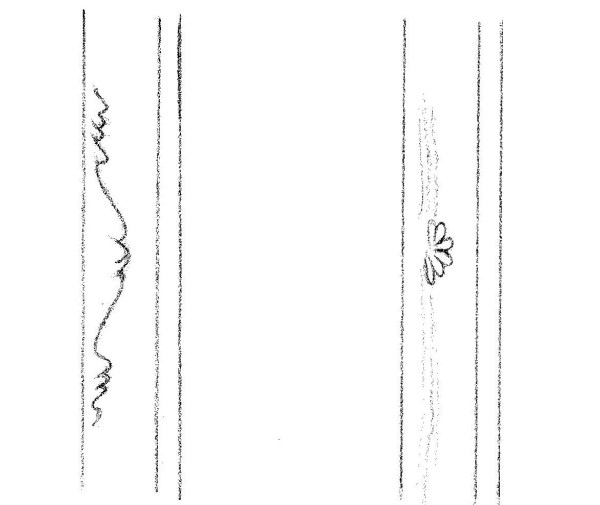
The swords made in Satsuma appear solid for both katana and wakizashi.  The kissaki (the top pointed area) is slightly stretched.  Yakidashi (a few inches above the machi ) shows a small, irregular hamon.  The hamon is o-midare with coarse nie called ara-nie. The ara-nie forms togari-ba (a pointed pattern; see the drawing below)One of the characteristics of this region.

The region is well known for its Satsuma-nie.  That is, the ara-nie around the hamon continues and blends into the ji-hada area.  Therefore, the border between ha-nie and ji-nie is unclear.  Inside the hamon, it sometimes shows a thick line shaped like lightning.  This line is called Satsuma-no-imozuru (sweet potato vine), and is less desirable than inazume and kinsiji.  This is the most prominent feature of the Satsuma sword.  Boshi has a narrow-tempered line with a small irregular patternThis is called satsuma-boshi.  On the ji-hada surface, chikei (a long, dark line) appears.  This is called Satsuma-gane (薩摩金).

29 Satsuma Togari-ba

Well-known swordsmiths in Satsuma ——————  Izunokami Masafusa (伊豆守正房)                                                                                                 Ichinohira Yasuyo (一平安代)                                                                                       Mondonosho Masakiyo (主水正正清)


27|Shinto Sword — Main Seven Regions (Part A :主要7刀匠地)

0-timeline - size 24 Shin-to

                            The red circle indicates the subject we discuss in this section

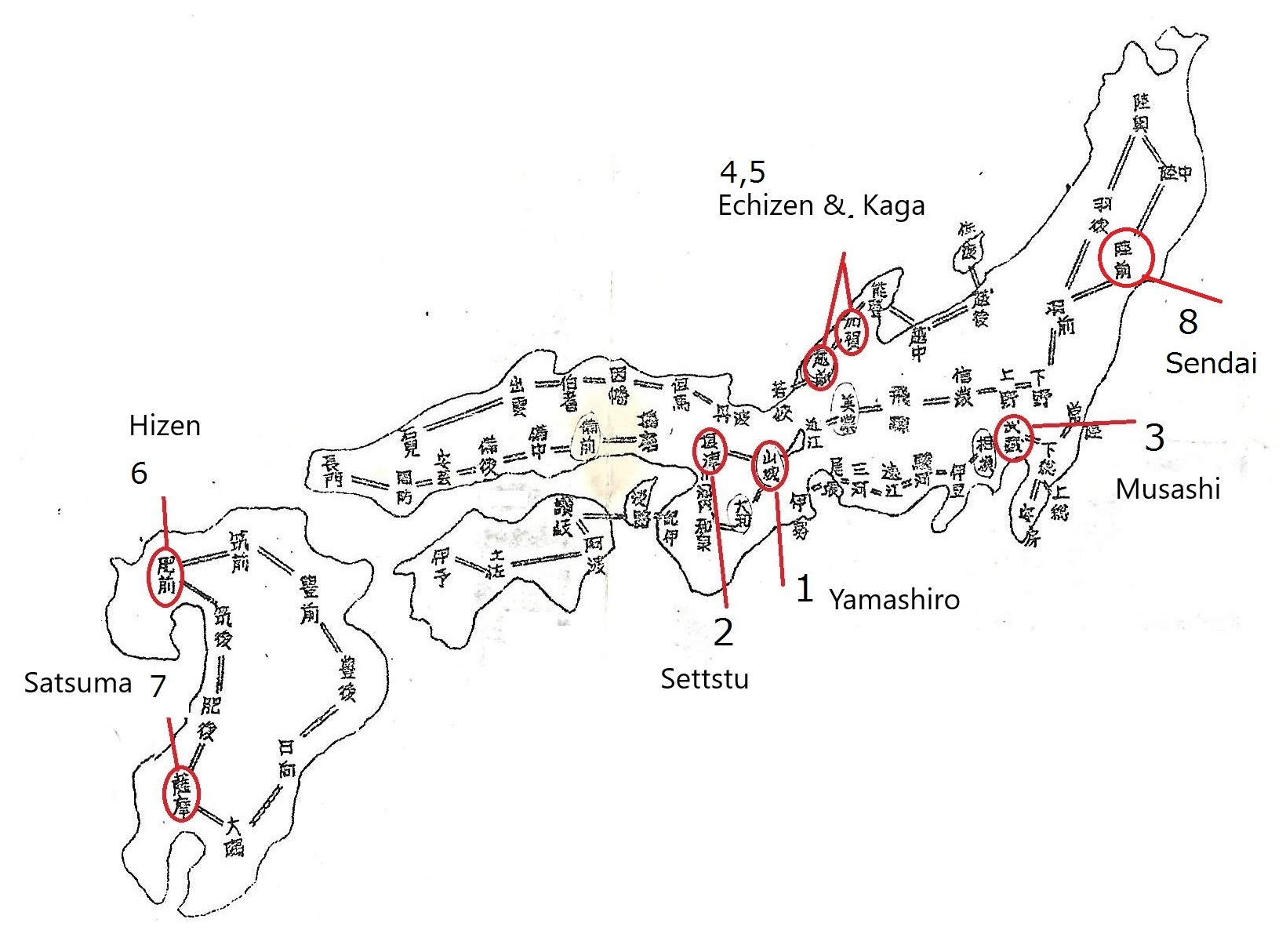
During the Shinto era, there were seven main prosperous regions where many swordsmiths gathered and actively forged swords.  These are Yamashiro (山城) in Kyoto, Settsu (摂津) in Osaka, Musashi (武蔵 ) in Edo, Hizen (肥前) in Saga, Satsuma (薩摩) in Kagoshima, Echizen (越前) in Fukui,  and Kaga (加賀) in Kanazawa.  Swordsmiths from each area shared common regional characteristics of their places.  Knowing each of these characteristics is the easiest way to understand Shin-to.  However, it is important to remember that each swordsmith within a group had their own unique way of sword-making.  The following are only general descriptions of these characteristics.

Below is a map of Japan.  Hokkaido is not shown on the map because swords were not made there during that time.

64Map with number with 8

1.  Yamashiro (山城) Kyoto

The Yamashiro shin-to sword has a solid and strong look.  The hamon near the lower part of the blade, just above the machi (区) area, shows suguha (straight hamon).  This is called kyo-yakidashi (京焼出し, meaning it starts with a straight hamon.  Then, it shows a sudden shift to a design of o-midare (大乱).  The o-midare (large irregular waviness) becomes less wavy about one or two inches below the yokote line, then continues into the boshi as a wavy hamon.  The design in the boshi is komaru-boshi.   See the illustration below. 

Ji-hada ———— Somewhat rough, (depending on the swordsmith).  Masame-hada (straight grain pattern) may show on shinogi-ji (between the ridgeline and back). 

Among the Yamashiro shin-to group, there was a group called the Mishina group (三品).  They were related to Mino-den (美濃).  Therefore, their boshi was often jizo-boshi (地蔵鋩子).  This is called Mishina-boshi (三品鋩子).  Jizo-boshi is an image of a man’s head.

The Well-known swordsmiths in Yamashiro area: Umetada Myoju (梅忠明寿)                                                                                                   Horikawa Kunihiro (堀川国広)                                                                                               Dewadaijyo Kunimichi (出羽大掾国路)

28 Mishina-Boshi Komaru-boshi, Kyo-Yakidashi

                                                        Iganokami Kinnmichi (伊賀守金道) Yamashiro Den, once my family sword

2.Settu (摂津) Osaka (大阪)

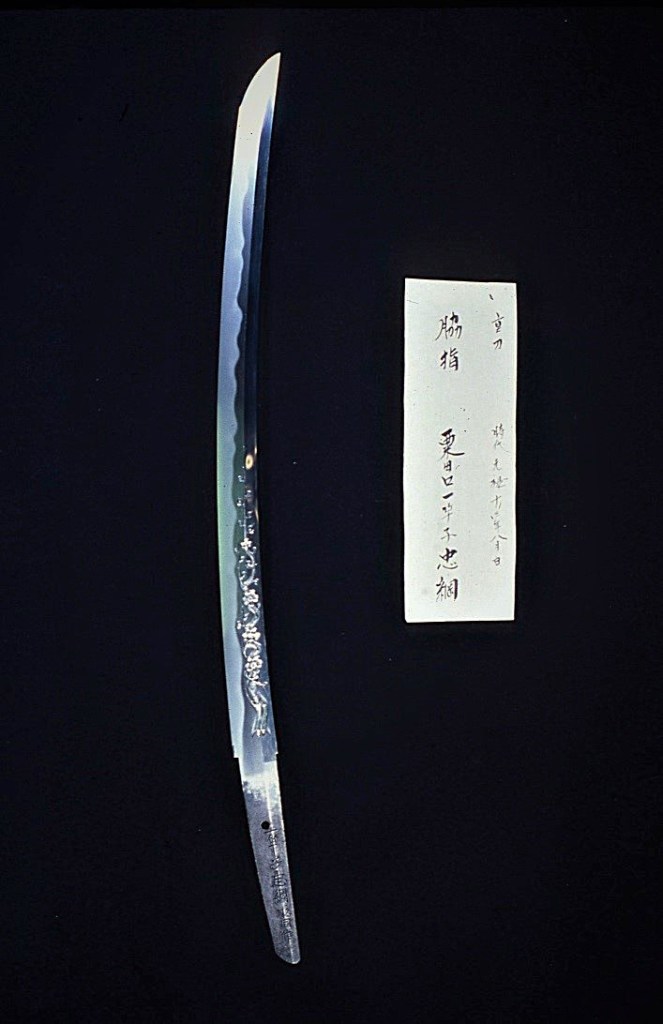
Settsu (Osaka) produced more wakizashi than katana.  They tend to make it slightly sakizori (the top half curving outward) with a slightly stretched boshi. A Settsu sword also shows yakidashi, similar to the previous Yamashiro sword.  However, unlike Yamashiro’s sword, the transition is not abrupt but relatively smooth, where suguha changes into notare (wavy pattern).  This is called Osaka Yakidashi.

Osaka Boshi ——-Hamon continues up to the yokote line, then komaru with a turn back.   Ji-hada————-Very fine,  almost no pattern, a solid surface like, especially, shinogi-ji (between the ridgeline and the back).  This is called Osaka-tetsu (iron).

29 Osaka Yakidashi Komaru Boshi

Well-known swordsmiths in Settsu area— Osaka Tsuda Sukehiro (大阪津田助広)                                                                                 Tsuda Sukenao (津田助直)                                                                                                   Ikkanshi Tadatsuna (一竿子 忠綱)

                                                                 Ikkanshi Tadatsuna (一竿子忠綱), once my family sword 

26 |Over view of Shinto (新刀概要)

                                   
0-timeline - size 24 Shin-to
                           The circle indicates the subject discuss in this section 

The previous chapter 25 stated that the Edo period lasted from 1603 to 1868.  This is for political history.  The third timeline above shows that the Momoyama period overlaps with the Edo period.  Some people believe the Momoyama period was from 1573 to 1600. In general history, there are several opinions on how to divide these transitional periods.  For sword history, it is straightforward.  Swords made between approximately 1596 (慶長: Keicho era) and 1781 (天明: Tenmei era) are called shin-to.  Swords made between the Tenmei and Meiji eras are referred to as shin-to. 

After Toyotomi Hideyoshi nearly unified the country, the people could enjoy a period of peace.  This period of peace shifted the geographic distribution of swordsmiths. There were three main regions where sword forging took place.  These areas include Kyoto, Osaka, and Edo (Tokyo now).  The remaining swordsmiths gathered near the castles of major daimyo (大名: feudal lords).

Kyoto—- The Umetada Myoju (梅忠明寿) group thrived, followed by swordsmiths such as  Horikawa Kunihiro (堀川国広), Kunimichi (国路), Kunisada (国貞), and Kunisuke (国助).

Osaka——–Osaka was established as a commercial city and became the center of commerce.  It produced swords and distributed them to other regions across the country.  The well-known swordsmiths in Osaka: Tsuda Sukehiro (津田助広) and Inoue Shinkai (井上真改).

Edo————-Many swordsmiths gathered in Edo (江, now Tokyo), where Shogun Tokugawa Iyeyasu livedThe well-known swordsmiths in EdoNagasone Kotetsu (長曽祢虎徹), Yasutsugu (康継), Noda Hannkei (野田繁慶).

By the time Tokugawa Iyeyasu’s grandson, Tokugawa Iyemitsu, became shogun (寛永:Kan’ei era 1624 – 1643), swordsmiths had spread beyond the three areas mentioned above.  In each daimyo territory, swordsmiths operated shops near the castles to meet the needs of the daimyo and their subjects.  By the Genroku era (元禄: 1695), sword-making had declined, and people preferred more picturesque hamon designs, such as kikusui (菊水: flower design) and fujimi (富士見: Mount Fuji).

63 fuji sakura hamon
Fujimi                           Kikusui

Difference between Koto  and Shinto 

The following section describes the differences between Ko-to and Shin-to.   However, remember that there are always exceptions to these rules.

  1. The length of the shin-to katana is typically about two feet three inches ± a little.  The wakizashi is about one foot six inches.   Shallow curvature.  Wide width.  Thick body.   Gyo-no-mune.  Chu-gissaki with a slightly stretched appearance.

13 Mune drawing

  1. The ko-to sword feels light, while the shin-to feels heavy.
  2. The bottom of the hi is rounded above the machi. Shin-to’s bo-hi ends slightly below the yokote line.

27. Hisaki & marudome

  1. Generally, carvings are less common on shin-to. However, some swordsmiths are famous for their carvings.  The designs are refined and detailed.  Umetada Myoju (埋忠明寿) is well-known for his carvings.
  2. For shin-to, if it is mainly nie, it is usually a coarse nie.
  3. In the machi area, the hamon begins with a straight tempered line (the bottom part of the blade shown in the illustration below), followed by midare, or various types of hamon in the middle, and ends with suguha (straight hamon) in the boshi area (the top part).  Generally, this is the standard Hamon style of shin-to, but there are always exceptions. 

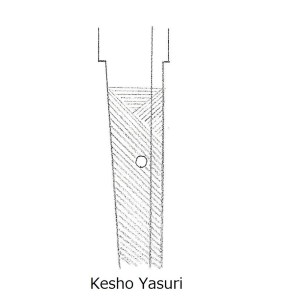
27 Keshou Yasuri & suguha

  1. For shin-to, the type of iron used for the blade is consistent throughout Japan.  A few variations of iron were used across Japan, with a very hard, dark color and a glossy look.
  2. The nakago has a well-balanced shape.  The bottom of the nakagotapers gradually.  The type of yasuri-me (file mark) is often a kesho-yasuri. Engraved inscriptions display the swordsmith’s name, location, province, and year of creation.

27 Keshou Yasuri & suguha

25| Edo Period History 1603 – 1867  (江戸時代歴史)

 
edo Period with Momoym
The circle above indicates where we discuss in this chapter.

Between the Sengoku period (戦国時代) and the Edo period (江戸時代) in Japanese political history, there was a time called the Azuchi-Momoyama period (安土桃山).  It lasted from around 1573 to 1614, as shown in the third (bottom) timeline above.  This was the era when Oda Nobunaga (織田信長), Toyotomi Hideyoshi (豊臣秀吉), and Tokugawa Ieyasu (徳川家康) played central roles in politics. 

After Tokugawa Ieyasu (徳川家康) won the Battle of Sekigahara (関ヶ原の戦い) in 1600 and defeated Toyotomi’s vassals (Toyotomi Hideyoshi had already passed away by then), Tokugawa Iyeyasu became the shogun (将軍) in 1603.  This marked the start of the Edo Period (江戸).  In sword history, as shown in the middle timeline above, the Edo period follows immediately after the Sengoku period.

At the end of the Sengoku period and throughout the Azuchi-Momoyama period, the economy grew significantly, and new cultures flourished.  Beautiful and impressive art forms, such as paintings, architecture, and interior design, were created.  The tea ceremony was developed by Sen No Rikyu (千の利休), and Kabuki began to be performed during this period.  This era was somewhat similar to the European Renaissance. Interestingly, this emergence occurred in Japan and Europe around the same time.  

Around this time, many Europeans came to Japan.  That was during the era of European exploration in the East.  They were from England, Spain, Holland, and Portugal.  The novel “Shogun” by James Clavell is based on the true stories of William Adams and Jan Joosten Van Londersteyn*¹ from that period.  Today, you can see Jan Joosten’s statue at Tokyo Station.  I stay at a hotel near Tokyo Station on my yearly trip to Japan.  I often pass by in front of “Jan Joosten’s” statue.   It is located underground inside Tokyo Station, right in the busy shopping area.  It can be easily missed unless you look for it.  There is also another statue of him outside the station.

Shogun Tokugawa Iyeyasu hired William Adams and Jan Joosten (the Japanese call him Jan Joosten, not his full name) as his advisors, and he gained information about Europe from them.  Shogun Tokugawa Iyeyasu treated them well.  The area where Jan Joosten lived is now called Yaesu (八重洲), named after him.  William Adams changed his name to Miura Anjin and lived in the Miura area.  This place is about an hour and a half south of Tokyo today.  The records of these two men are well-kept and easily accessible. 

Europeans introduced many European goods and ideas to Japan.  Although Christianity became popular and spread widely during the early Azuchi-Momoyama period, Toyotomi Hideyoshi later banned it.  After the Meiji Era (1868), religious restrictions were lifted.

The Edo period started when Tokugawa Iyeyasu became shogun (1603) and ended with the Meiji (明治) Restoration in 1868. The Tokugawa bakufu, or Tokugawa government, was the sole governing entity in the country during this period.  Although emperors still existed, political power shifted to the Tokugawa bakufu.  

Gradually, ports for European ships were restricted.  Eventually, Spaniards were no longer allowed to come to Japan, and then the Portuguese.  The Japanese were also banned from traveling abroad.  By around 1640, Dejima, a port town in Hirato, Nagasaki Prefecture, was the only place in Japan where foreigners could do business with the Japanese.  Only the Dutch were allowed to arrive from Europe.  Japan isolated itself from the outside world until the Meiji Restoration (1868).

During the Azuchi-Momoyama and early Edo periods, many European ships visited Japan. Strangely, a lot of these ships wrecked near Japan’s shores. One reason is that Japan is a volcanic island. Even if the sea’s surface appears calm, there are many obstacles beneath the surface, such as underwater mountains and large hidden reefs. The Europeans lacked the waterway information common among Japanese seamen.

Additional stories to share just for fun

Another reason many ships were wrecked was that they were searching for gold.  When Marco Polo traveled to China, he heard from the Chinese people about a small island country farther to the east.  This land was prosperous, and the emperor’s palace was made of gold and silver.  After Marco Polo returned to Italy, he published a book (in the late 1300s) about his journey.  In his book, he mentioned what he had heard about the island nation of Japan in China, even though he had never visited Japan himself.  The book was widely read across many European countries.  Once traveling to the East became possible for Europeans, they came to Japan in search of gold. 

Yes, Japan produced a large amount of gold.  However, for the Europeans, it was too late.  By then, the Fujiwara family had already mined most of the gold in the Oh-shu area (奥州, northern Japan).  This area includes the present-day prefectures of Aomori, Akita, Fukushima, and Miyagi, where the devastating tsunami hit in 2011.  Toyotomi Hideyoshi also owned many gold mines, but they had already been mined as much as possible with the skills available at that time.  Japan once had many gold and silver mines across the country.  Those mines are now depleted, and only a few remain available for mining today.

Throughout history, there have been facts and rumors about “maizo-kin: 埋蔵金.”  Maizo-kin refers to gold buried or hidden by people such as the Tokugawa Shogun, Toyotomi Hideyoshi, wealthy daimyo, and merchants.  Without vaults, the only way to store gold was to bury it in secret places.  Several maizo-kins have been discovered, including one in the middle of Tokyo, Ginza.  There are still several large ones that haven’t been found yet.  These include Hideyoshi’s maizo-kin, the Tokugawa bakufu maizo-kin, and several othersAlthough several maps indicated the locations of these maizo-kin, they were, of course, fake.  Today, whenever the ground is dug up to build a large structure, people start discussing the discovery of a big maizo-kin.

Gold gradually flowed out of Japan over the centuries until the Meiji Restoration, because the exchange rate between gold and silver was much cheaper in Japan than elsewhere. Today, we still mine gold on a small scale.

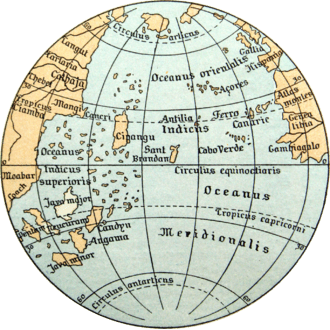
It is said that the name of the country, Japan, originates from Marco Polo’s book.  He referred to Japan as “Chipangu,” which means “gold country,” in his book. *²   From “Chipangu” to “Zipang” to ‘Jipang,” it eventually became “Japan.”  The Japanese don’t call the country Japan but “Nihon” or “Nippon” (日本).

ヤン ヨーステン Jan Joosten van Lodenstijn https://www.weblio.jp Or Jan Joosten van Londensteyn 

*² Wikipedia “Names of Japan” or Check (Click) right to go to the link Jipangu 

26 map of Cipangu1492

Cipangu was described in 1492 by Martin Beham’s globe                                                    From Wikimedia Commons, the free media repository (Names of Japan)

24| Sengoku Period Tanto (戦国時代短刀)

0-timeline - size 24 Sengoku Period                             The red circle above indicates the time we discuss in this section

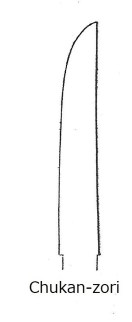
25 Chukanzori Tanto

Chukan-zori (中間反り) ————– The chukan-zori tanto features a straight mune (back).  Its back does not curve either inward or outward.   

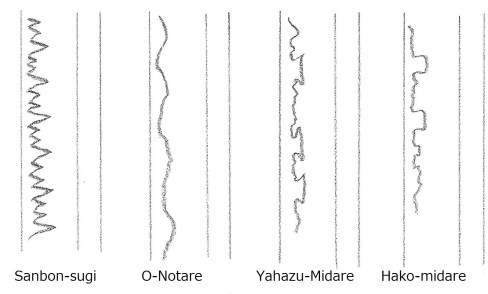
Hamon (刃文: Tempered line) ————————————-Sanbon-sugi (三本杉), o-notare (大湾), yahazu-midare (矢筈乱), hako-midare (箱乱), gunome-choji (互の目丁子), chu-suguha (中直刃).   See below.

24 Sannbon sugi,hako, yahazu, O-midare)

Horimono (彫り物: Carving) —————Often Hi (grooves) is curved

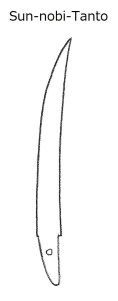
Tanto Length ————————— The standard tanto length should not exceed one shaku*¹ (about 12 inches, 30.5cm).  The standard size tanto is called a Jo-sun tanto, which is roughly 8.5 shaku (about 10 inches, 25.7cm).  Longer than jo-sun is called sun-nobi tanto (寸延)Shorter than jo-sun is called sun-zumari tanto (寸詰).

             Sun-nobi Tanto  >  Jo-sun Tanto (approx. 10 inches) >  Sun-zumari Tanto

*Shaku is a traditional Japanese unit of length measurement.

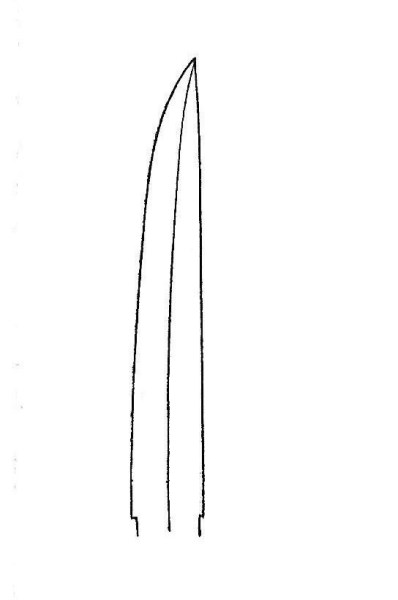
Takenoko-zori jo-sun tanto (筍反定寸短刀)————– The takenoko-zori jo-sun tanto was made during the Sengoku period.  It resembles swords made by Rai Kunimitsu of Yamashiro–den.  (illustration below)

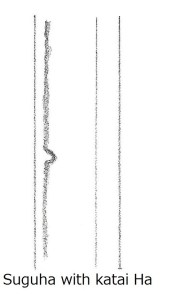
Hamon (刃文: Tempered line) ————– Hoso-suguha (細直刃: Narrow straight hamon). Katai-ha (illustration below) appears somewhere on the blade.  Masamehada (straight grain pattern) may be visible on the mune side.

                13 Middle Kamakura Period Tanto                 24 Suguha katai-ha

Ji-hada (地肌: The area between the shinogi and the tempered line)————– Some shirake (白け: a whitish surface) may sometimes appear.  Some utsuri (a light, whitish, cloud-like effect) appears on the ji-hada.

Sun-nobi Tanto (寸延短刀)————–This type of tanto resembles the sakizori tanto from the late Soshu-den period.  You may see a hitatsura-type hamon.  (illustration below).   Unlike the Soshu-den style, the hitatsura pattern is more visible in the lower part of the tanto and less in the upper part.

                                             25 Sun-Nobi Tanto      25 Hitatsura

Hirazukuri Takenokozori Sunzumari Tanto (平造筍反寸詰短刀)                                  

This is a unique tanto from the Sengoku period.   Hirazukuri means a flat-surfaced sword without a shinogi, yokote line, or obvious kissaki.   Takenoko-zori refers to a bamboo shoot shape (the back of the sword curves inward).   Sun-zumari indicates a blade shorter than 10 inches (less than 8.5 shaku or 25.7 cm).  The lower part of the blade is wide and thick, while the tip is narrow and thin.  It has a piercing, sharp appearance.

  • Horimono (彫物: Engraving) ————- Deeply carved ken-maki ryu (a dragon wrapped around a spear).
  • Hamon (刃文: Tempered line)——— Wide tempered line, with a nioi baseIrregular hamon, with wide suguha (straight), and chu-suguha (medium straight).  The hamon in the boshi area curves back deeply.
  • Ji-hada (地肌)———– fine ji-gane and wood burl pattern.

Moroha-tanto (諸刃短刀: Double-edged sword)

A double-edged sword with a hamon on both cutting edges.  Often, Bonji (Sanskrit) is curved.

  • Hamon (刃文: Tempered line) ——— Wide tempered line.   Nioi base.  Irregular hamon, wide suguha (straight tempered line), and chu-suguha (medium straight  tempered line).  The hamon turns back deeply.
  • Ji-hada (地肌: The area between the shinogi and the tempered line)——- Fine ji-gane and wood burl pattern.

25-moroha-tanto1 Moroha Tanto

The Swordsmith for Tanto during the Sengoku Period 

The Bizen swords from the Sengoku period are called sue-bizenSue is pronounced “su” and “e“ as in egg.   Bizen Osafune Yoso-Zaemon Sukesada (与三左衛門祐定) is the most famous swordsmith of the Sengoku period.  He also forged tantos.  One thing to note is that many swordsmiths had the name Sukesada.  Yoso-Zaemon Sukesada is the one who best represents the era.