29| Bakumatsu Period History 1781 – 1868 (幕末歴史 )


0-timeline - size 24 Bakumatsu

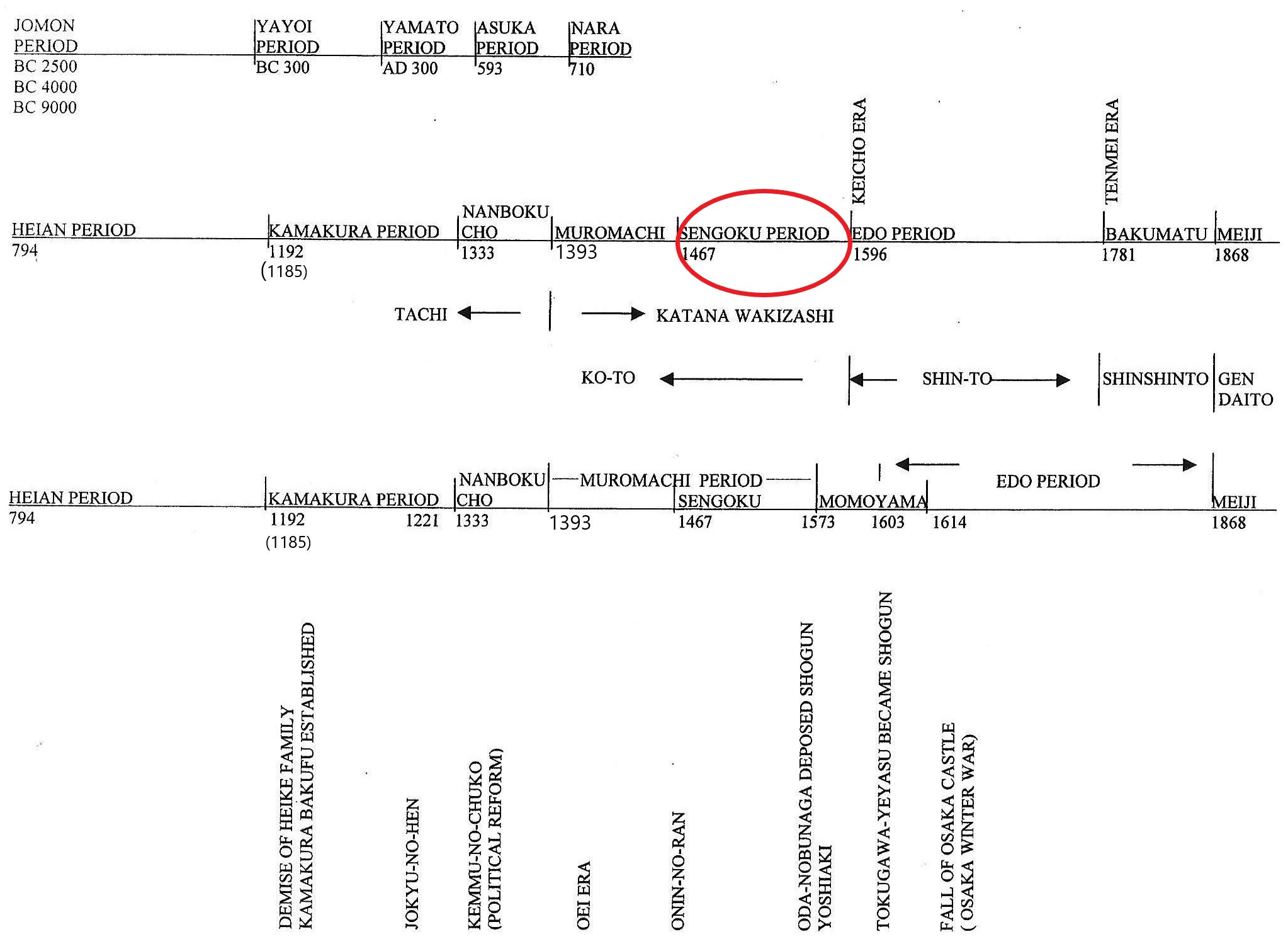
The red circle above  indicate the time we discuss in this chapter

The Bakumatsu period is the last part of the Edo period in sword history. See the circle on the middle timeline above. However, political history does not divide the Edo and Bakumatsu periods, and there is no specific date that separates them.

The Azuchi-Momoyama period (安土桃山) falls between when Oda Nobunaga (織田信長) deposed Shogun Ashikaga Yoshiaki (将軍足利義昭) in 1573 until Tokugawa Iyeyasu became shogun in 1603, or when Tokugawa Iyeyasu defeated Toyotomi Hideyori (Hideyoshi’s son) during the Osaka Winter Campaign in 1615.  The Azuchi-Momoyama period was a brief era during which Oda Nobunaga (織田信長), Toyotomi Hideyoshi (豊臣秀吉), and Tokugawa Iyeyasu (徳川家康) engaged in intricate political struggles.  During this period, Japan experienced significant cultural and economic growth.  After a long period of war, the country was finally reunited and entered a peaceful period. 

The stories of Oda Nobunaga, Toyotomi Hideyoshi, and Tokugawa Iyeyasu are the most popular among the Japanese. These stories are often shown on TV programs and  movies. The Tokugawa family ruled Japan during the Edo period. 

The Tokugawa government was called the Tokugawa Bakufu.   Throughout the Edo period, the Tokugawa family’s direct descendants, usually the firstborn sons, became the shoguns.  However, the emperors co-existed at the same time.  Even though they did not hold political power, the imperial family still maintained imperial status.

The Edo period was peaceful. Unlike previous periods, there were no wars. Yet, later in the period, the long-lasting Edo period (which lasted about 260 years) became stagnant and began to show structural and financial problems in its rule. This is the Bakumatsu (幕末) time,  the final phase of the Edo bakufu 

In the previous chapter, Chapter 25, Edo Period History explained that the Edo bakufu closed the country to the outside world for most of that era.  The only place in Japan with access to foreign countries was Dejima in Nagasaki (the southern part of Japan).  During the Bakumatsu period, several European ships visited Japan, asking (more like demanding) that Japan open its ports to provide water and other supplies for whaling ships.  Also,  some countries sought to trade with Japan.   Those countries were England, Russia, America, and others.

In 1792, the Russian government sent an official messenger to Japan, demanding that Japan open its ports to trade.  In 1853, Commodore Perry from the U.S. arrived with four massive warships at the port of Uraga (浦賀: now in Kanagawa Prefecture) and demanded that Japan open its ports to water, fuel, and other supplies for  U.S. whaling ships. 

At the end of the Bakumatsu period, the Tokugawa bakufu faced political and financial difficulties in governing the country.  Also, intellectuals feared that Japan might face trouble, similar to that China faced during the Opium War (1839-1842) with England.  Pressures to open the country were building up.  It became evident that Japan could no longer keep the country closed.  At that time, Commodore Perry arrived at Uraga with four massive black warships and demanded that Japan open its ports.   These warships scared the Japanese and fueled the wave of anti-bakufu sentiment.    The Meiji Revolution was ready to happen, and Perry’s warships were the final push.

The Tokugawa bakufu signed treaties with several foreign countries and opened a few ports for trade.   The bakufu’s authority weakened, and Japan was divided into several political groups.  While they fought chaotically, the Meiji Restoration movement continued.  In 1868, the Tokugawa bakufu vacated Edo Castle in Edo (now Tokyo), and the Meiji Emperor moved in.  The Meiji Shin Seifu (Meiji’s new government) was formed, centered around the Meiji Emperor, and the Tokugawa bakufu came to an end. 

Commodore-Perry-Visit-Kanagawa-1854       File:Commodore-Perry-Visit-Kanagawa-1854.jpg      From ja.wikipedia.org/wiki/黒船 Public Domain

Commodore Matthew C. Perry’s visit of Kanagawa, near the site of present-day Yokohama on March 8, 1854. Lithography. New York: E. Brown, Jr.

28|Shin-to Sword — Main Seven Regions (part B 主要7刀匠地)


0-timeline - size 24 Shin-to
 The red circle indicates the subject of this chapter

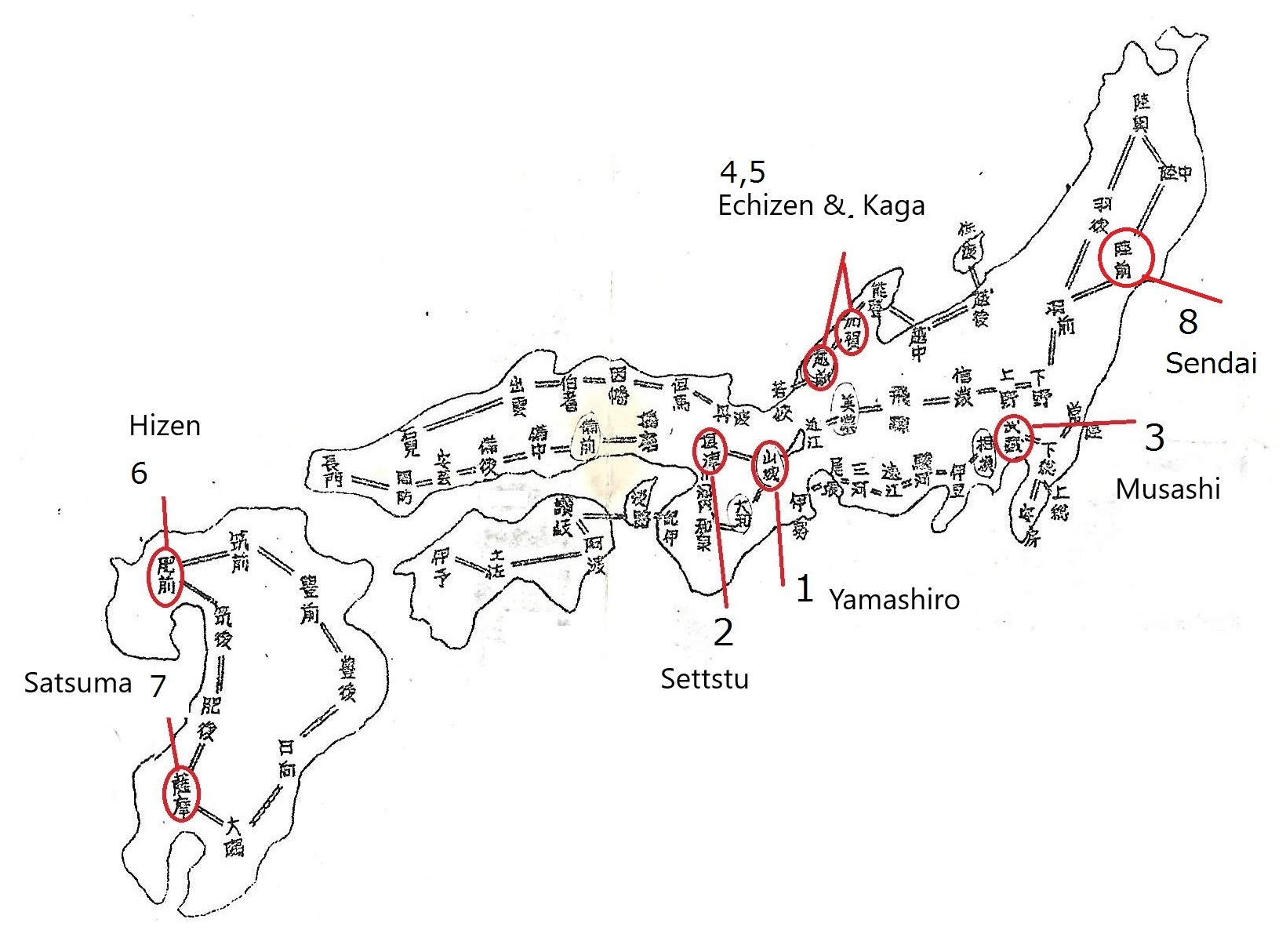
64Map with number with 8

3Musashi ( 武蔵 ) in Edo ( 江戸 )

The katana and wakizashi made in the Musashi area have a shallow sori (curvature).  Often, the width of the blade’s upper part is narrow.  Usually, the hamon begins with a slight irregular pattern, then gradually shifts to a larger irregular pattern, and a few inches below the yokote line, it becomes a small irregular pattern again.  The boshi is usually a komaru-boshi.  The ji-hada may be rough.  Masame-hada shows on shinogi-ji.

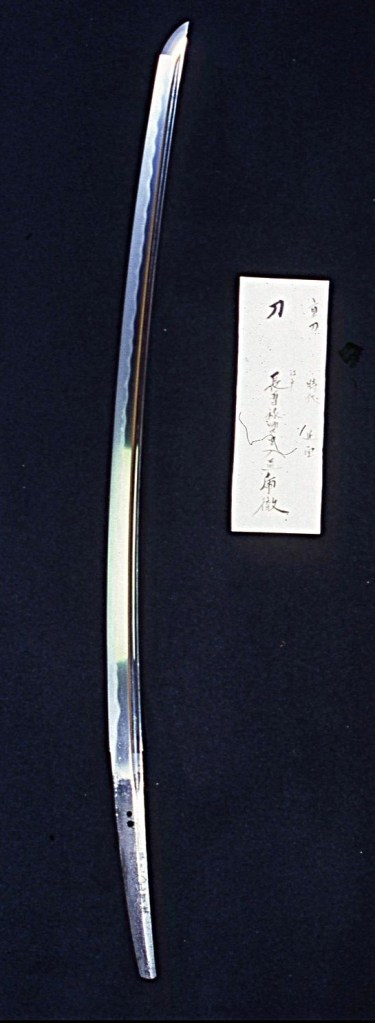
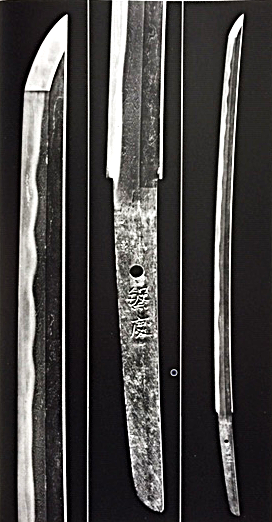
Well-known swordsmiths in Musashi ———————————-Noda Hannkei (野田繁慶)                                                      Nagasone Okisato Nyudo Kotetsu (長曽根興里入道虎徹)

Nagasone Okisato Nyudo Kotetsu                        Noda Hankei (野田繫慶)                                   (長曽根興里入道虎徹)                                   from Compton’s collection “Nippon-to”    Once, my family sword                                                                                                               

4. Echizen ( 越前 ) and 5. Kaga (加賀 )

Many swordsmiths from the Mino (美濃) area moved to the Echizen and Kaga areas (#4  & #5 on the map above).  Therefore, swords made in these areas are called Echizen-seki and Kaga-seki.  Refer to Chapter 23 Sengoku Period (戦国) Sword for Mino-den.             The style of Echizen Yasutsugu (越前康継) is similar to that of Mino-den.

Well-known swordsmith in Echizen ————————-Echizen Yasutsugu (越前康継 )

6. Hizen (肥前)

Both the katana and wakizashi from Hizen have well-balanced shapes.  The Hizen region tends to produce swords with a chu-suguha-hotsure (a medium-width straight hamon resembling frayed fabric) with fine nie (沸).  The boshi has a clean, regular line with a uniform width tempered line, as shown in the illustration below.  If you see a shin-to sword that has a chu-suguha hamon and a boshi that looks like the one below, it is often made by Hizen Tadayoshi (肥前忠吉).  Very fine Ji-hada (surface), sometimes called nukame-hada.

29 Hizen Tadayoshi Boshi

Well-known swordsmith in Hizen ——————————— Hizen Tadayoshi ( 肥前忠吉)

  1. Satsuma (薩摩 )

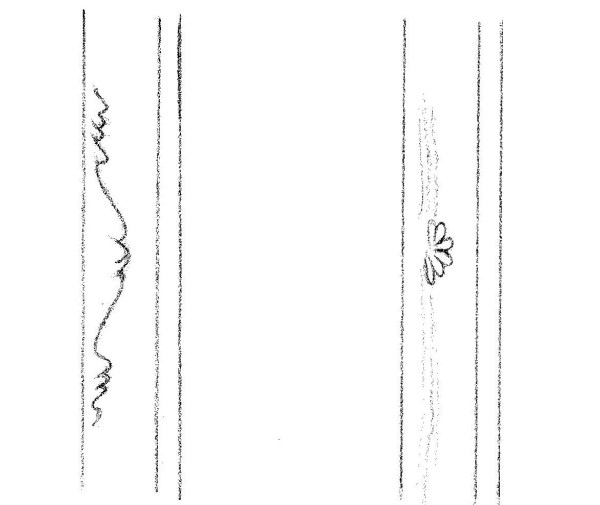
The swords made in Satsuma appear solid for both katana and wakizashi.  The kissaki (the top pointed area) is slightly stretched.  Yakidashi (a few inches above the machi ) shows a small, irregular hamon.  The hamon is o-midare with coarse nie called ara-nie. The ara-nie forms togari-ba (a pointed pattern; see the drawing below)One of the characteristics of this region.

The region is well known for its Satsuma-nie.  That is, the ara-nie around the hamon continues and blends into the ji-hada area.  Therefore, the border between ha-nie and ji-nie is unclear.  Inside the hamon, it sometimes shows a thick line shaped like lightning.  This line is called Satsuma-no-imozuru (sweet potato vine), and is less desirable than inazume and kinsiji.  This is the most prominent feature of the Satsuma sword.  Boshi has a narrow-tempered line with a small irregular patternThis is called satsuma-boshi.  On the ji-hada surface, chikei (a long, dark line) appears.  This is called Satsuma-gane (薩摩金).
29 Satsuma Togari-ba

Well-known swordsmiths in Satsuma ——————  Izunokami Masafusa (伊豆守正房)                                                                                                 Ichinohira Yasuyo (一平安代)                                                                                       Mondonosho Masakiyo (主水正正清)


27|Shinto Sword — Main Seven Regions (Part A :主要7刀匠地)

0-timeline - size 24 Shin-to

                            The red circle indicates the subject we discuss in this section

During the Shinto era, there were seven main prosperous regions where many swordsmiths gathered and actively forged swords.  These are Yamashiro (山城) in Kyoto, Settsu (摂津) in Osaka, Musashi (武蔵 ) in Edo, Hizen (肥前) in Saga, Satsuma (薩摩) in Kagoshima, Echizen (越前) in Fukui,  and Kaga (加賀) in Kanazawa.  Swordsmiths from each area shared common regional characteristics of their places.  Knowing each of these characteristics is the easiest way to understand Shin-to.  However, it is important to remember that each swordsmith within a group had their own unique way of sword-making.  The following are only general descriptions of these characteristics.

Below is a map of Japan.  Hokkaido is not shown on the map because swords were not made there during that time.

64Map with number with 8

1.  Yamashiro (山城) Kyoto

The Yamashiro shin-to sword has a solid and strong look.  The hamon near the lower part of the blade, just above the machi (区) area, shows suguha (straight hamon).  This is called kyo-yakidashi (京焼出し, meaning it starts with a straight hamon.  Then, it shows a sudden shift to a design of o-midare (大乱).  The o-midare (large irregular waviness) becomes less wavy about one or two inches below the yokote line, then continues into the boshi as a wavy hamon.  The design in the boshi is komaru-boshi.   See the illustration below. 

Ji-hada ———— Somewhat rough, (depending on the swordsmith).  Masame-hada (straight grain pattern) may show on shinogi-ji (between the ridgeline and back). 

Among the Yamashiro shin-to group, there was a group called the Mishina group (三品).  They were related to Mino-den (美濃).  Therefore, their boshi was often jizo-boshi (地蔵鋩子).  This is called Mishina-boshi (三品鋩子).  Jizo-boshi is an image of a man’s head.

The Well-known swordsmiths in Yamashiro area: Umetada Myoju (梅忠明寿)                                                                                                   Horikawa Kunihiro (堀川国広)                                                                                               Dewadaijyo Kunimichi (出羽大掾国路)

28 Mishina-Boshi Komaru-boshi, Kyo-Yakidashi

                                                        Iganokami Kinnmichi (伊賀守金道) Yamashiro Den, once my family sword

2.Settu (摂津) Osaka (大阪)

Settsu (Osaka) produced more wakizashi than katana.  They tend to make it slightly sakizori (the top half curving outward) with a slightly stretched boshi. A Settsu sword also shows yakidashi, similar to the previous Yamashiro sword.  However, unlike Yamashiro’s sword, the transition is not abrupt but relatively smooth, where suguha changes into notare (wavy pattern).  This is called Osaka Yakidashi.

Osaka Boshi ——-Hamon continues up to the yokote line, then komaru with a turn back.   Ji-hada————-Very fine,  almost no pattern, a solid surface like, especially, shinogi-ji (between the ridgeline and the back).  This is called Osaka-tetsu (iron).

29 Osaka Yakidashi Komaru Boshi

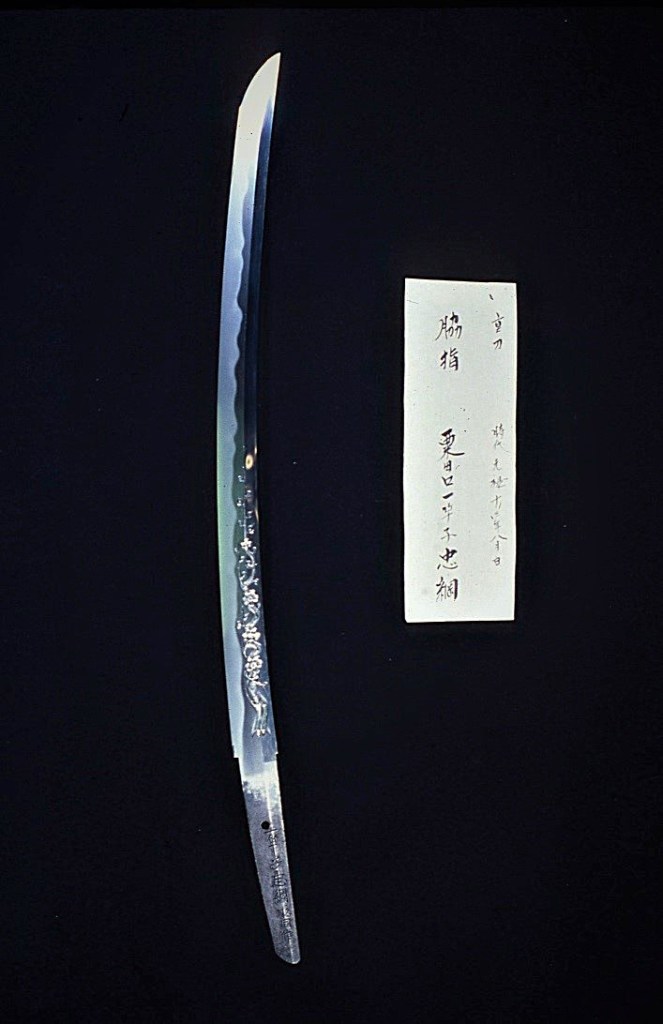
Well-known swordsmiths in Settsu area— Osaka Tsuda Sukehiro (大阪津田助広)                                                                                 Tsuda Sukenao (津田助直)                                                                                                   Ikkanshi Tadatsuna (一竿子 忠綱)

                                                                 Ikkanshi Tadatsuna (一竿子忠綱), once my family sword 

26 |Over view of Shinto (新刀概要)

                                   
0-timeline - size 24 Shin-to
                           The circle indicates the subject discuss in this section 

The previous chapter 25 stated that the Edo period lasted from 1603 to 1868.  This is for political history.  The third timeline above shows that the Momoyama period overlaps with the Edo period.  Some people believe the Momoyama period was from 1573 to 1600. In general history, there are several opinions on how to divide these transitional periods.  For sword history, it is straightforward.  Swords made between approximately 1596 (慶長: Keicho era) and 1781 (天明: Tenmei era) are called shin-to.  Swords made between the Tenmei and Meiji eras are referred to as shin-to. 

After Toyotomi Hideyoshi nearly unified the country, the people could enjoy a period of peace.  This period of peace shifted the geographic distribution of swordsmiths. There were three main regions where sword forging took place.  These areas include Kyoto, Osaka, and Edo (Tokyo now).  The remaining swordsmiths gathered near the castles of major daimyo (大名: feudal lords).

Kyoto—- The Umetada Myoju (梅忠明寿) group thrived, followed by swordsmiths such as  Horikawa Kunihiro (堀川国広), Kunimichi (国路), Kunisada (国貞), and Kunisuke (国助).

Osaka——–Osaka was established as a commercial city and became the center of commerce.  It produced swords and distributed them to other regions across the country.  The well-known swordsmiths in Osaka: Tsuda Sukehiro (津田助広) and Inoue Shinkai (井上真改).

Edo————-Many swordsmiths gathered in Edo (江, now Tokyo), where Shogun Tokugawa Iyeyasu livedThe well-known swordsmiths in EdoNagasone Kotetsu (長曽祢虎徹), Yasutsugu (康継), Noda Hannkei (野田繁慶).

By the time Tokugawa Iyeyasu’s grandson, Tokugawa Iyemitsu, became shogun (寛永:Kan’ei era 1624 – 1643), swordsmiths had spread beyond the three areas mentioned above.  In each daimyo territory, swordsmiths operated shops near the castles to meet the needs of the daimyo and their subjects.  By the Genroku era (元禄: 1695), sword-making had declined, and people preferred more picturesque hamon designs, such as kikusui (菊水: flower design) and fujimi (富士見: Mount Fuji).

63 fuji sakura hamon
Fujimi                           Kikusui

Difference between Koto  and Shinto 

The following section describes the differences between Ko-to and Shin-to.   However, remember that there are always exceptions to these rules.

  1. The length of the shin-to katana is typically about two feet three inches ± a little.  The wakizashi is about one foot six inches.   Shallow curvature.  Wide width.  Thick body.   Gyo-no-mune.  Chu-gissaki with a slightly stretched appearance.

13 Mune drawing

  1. The ko-to sword feels light, while the shin-to feels heavy.
  2. The bottom of the hi is rounded above the machi. Shin-to’s bo-hi ends slightly below the yokote line.

27. Hisaki & marudome

  1. Generally, carvings are less common on shin-to. However, some swordsmiths are famous for their carvings.  The designs are refined and detailed.  Umetada Myoju (埋忠明寿) is well-known for his carvings.
  2. For shin-to, if it is mainly nie, it is usually a coarse nie.
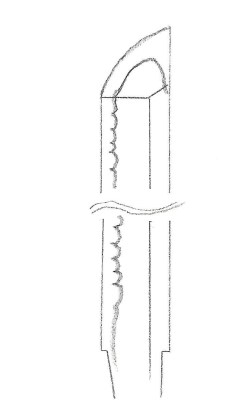
  3. In the machi area, the hamon begins with a straight tempered line (the bottom part of the blade shown in the illustration below), followed by midare, or various types of hamon in the middle, and ends with suguha (straight hamon) in the boshi area (the top part).  Generally, this is the standard Hamon style of shin-to, but there are always exceptions. 

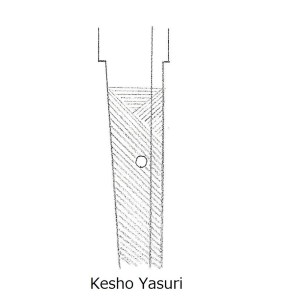
27 Keshou Yasuri & suguha

  1. For shin-to, the type of iron used for the blade is consistent throughout Japan.  A few variations of iron were used across Japan, with a very hard, dark color and a glossy look.
  2. The nakago has a well-balanced shape.  The bottom of the nakagotapers gradually.  The type of yasuri-me (file mark) is often a kesho-yasuri. Engraved inscriptions display the swordsmith’s name, location, province, and year of creation.

27 Keshou Yasuri & suguha

25| Edo Period History 1603 – 1867  (江戸時代歴史)

 
edo Period with Momoym
The circle above indicates where we discuss in this chapter.

Between the Sengoku period (戦国時代) and the Edo period (江戸時代) in Japanese political history, there was a time called the Azuchi-Momoyama period (安土桃山).  It lasted from around 1573 to 1614, as shown in the third (bottom) timeline above.  This was the era when Oda Nobunaga (織田信長), Toyotomi Hideyoshi (豊臣秀吉), and Tokugawa Ieyasu (徳川家康) played central roles in politics. 

After Tokugawa Ieyasu (徳川家康) won the Battle of Sekigahara (関ヶ原の戦い) in 1600 and defeated Toyotomi’s vassals (Toyotomi Hideyoshi had already passed away by then), Tokugawa Iyeyasu became the shogun (将軍) in 1603.  This marked the start of the Edo Period (江戸).  In sword history, as shown in the middle timeline above, the Edo period follows immediately after the Sengoku period.

At the end of the Sengoku period and throughout the Azuchi-Momoyama period, the economy grew significantly, and new cultures flourished.  Beautiful and impressive art forms, such as paintings, architecture, and interior design, were created.  The tea ceremony was developed by Sen No Rikyu (千の利休), and Kabuki began to be performed during this period.  This era was somewhat similar to the European Renaissance. Interestingly, this emergence occurred in Japan and Europe around the same time.  

Around this time, many Europeans came to Japan.  That was during the era of European exploration in the East.  They were from England, Spain, Holland, and Portugal.  The novel “Shogun” by James Clavell is based on the true stories of William Adams and Jan Joosten Van Londersteyn*¹ from that period.  Today, you can see Jan Joosten’s statue at Tokyo Station.  I stay at a hotel near Tokyo Station on my yearly trip to Japan.  I often pass by in front of “Jan Joosten’s” statue.   It is located underground inside Tokyo Station, right in the busy shopping area.  It can be easily missed unless you look for it.  There is also another statue of him outside the station.

Shogun Tokugawa Iyeyasu hired William Adams and Jan Joosten (the Japanese call him Jan Joosten, not his full name) as his advisors, and he gained information about Europe from them.  Shogun Tokugawa Iyeyasu treated them well.  The area where Jan Joosten lived is now called Yaesu (八重洲), named after him.  William Adams changed his name to Miura Anjin and lived in the Miura area.  This place is about an hour and a half south of Tokyo today.  The records of these two men are well-kept and easily accessible. 

Europeans introduced many European goods and ideas to Japan.  Although Christianity became popular and spread widely during the early Azuchi-Momoyama period, Toyotomi Hideyoshi later banned it.  After the Meiji Era (1868), religious restrictions were lifted.

The Edo period started when Tokugawa Iyeyasu became shogun (1603) and ended with the Meiji (明治) Restoration in 1868. The Tokugawa bakufu, or Tokugawa government, was the sole governing entity in the country during this period.  Although emperors still existed, political power shifted to the Tokugawa bakufu.  

Gradually, ports for European ships were restricted.  Eventually, Spaniards were no longer allowed to come to Japan, and then the Portuguese.  The Japanese were also banned from traveling abroad.  By around 1640, Dejima, a port town in Hirato, Nagasaki Prefecture, was the only place in Japan where foreigners could do business with the Japanese.  Only the Dutch were allowed to arrive from Europe.  Japan isolated itself from the outside world until the Meiji Restoration (1868).

During the Azuchi-Momoyama and early Edo periods, many European ships visited Japan. Strangely, a lot of these ships wrecked near Japan’s shores. One reason is that Japan is a volcanic island. Even if the sea’s surface appears calm, there are many obstacles beneath the surface, such as underwater mountains and large hidden reefs. The Europeans lacked the waterway information common among Japanese seamen.

Additional stories to share just for fun

Another reason many ships were wrecked was that they were searching for gold.  When Marco Polo traveled to China, he heard from the Chinese people about a small island country farther to the east.  This land was prosperous, and the emperor’s palace was made of gold and silver.  After Marco Polo returned to Italy, he published a book (in the late 1300s) about his journey.  In his book, he mentioned what he had heard about the island nation of Japan in China, even though he had never visited Japan himself.  The book was widely read across many European countries.  Once traveling to the East became possible for Europeans, they came to Japan in search of gold. 

Yes, Japan produced a large amount of gold.  However, for the Europeans, it was too late.  By then, the Fujiwara family had already mined most of the gold in the Oh-shu area (奥州, northern Japan).  This area includes the present-day prefectures of Aomori, Akita, Fukushima, and Miyagi, where the devastating tsunami hit in 2011.  Toyotomi Hideyoshi also owned many gold mines, but they had already been mined as much as possible with the skills available at that time.  Japan once had many gold and silver mines across the country.  Those mines are now depleted, and only a few remain available for mining today.

Throughout history, there have been facts and rumors about “maizo-kin: 埋蔵金.”  Maizo-kin refers to gold buried or hidden by people such as the Tokugawa Shogun, Toyotomi Hideyoshi, wealthy daimyo, and merchants.  Without vaults, the only way to store gold was to bury it in secret places.  Several maizo-kins have been discovered, including one in the middle of Tokyo, Ginza.  There are still several large ones that haven’t been found yet.  These include Hideyoshi’s maizo-kin, the Tokugawa bakufu maizo-kin, and several othersAlthough several maps indicated the locations of these maizo-kin, they were, of course, fake.  Today, whenever the ground is dug up to build a large structure, people start discussing the discovery of a big maizo-kin.

Gold gradually flowed out of Japan over the centuries until the Meiji Restoration, because the exchange rate between gold and silver was much cheaper in Japan than elsewhere. Today, we still mine gold on a small scale.

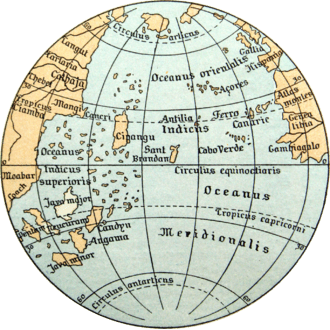
It is said that the name of the country, Japan, originates from Marco Polo’s book.  He referred to Japan as “Chipangu,” which means “gold country,” in his book. *²   From “Chipangu” to “Zipang” to ‘Jipang,” it eventually became “Japan.”  The Japanese don’t call the country Japan but “Nihon” or “Nippon” (日本).

ヤン ヨーステン Jan Joosten van Lodenstijn https://www.weblio.jp Or Jan Joosten van Londensteyn 

*² Wikipedia “Names of Japan” or Check (Click) right to go to the link Jipangu 

26 map of Cipangu1492

Cipangu was described in 1492 by Martin Beham’s globe                                                    From Wikimedia Commons, the free media repository (Names of Japan)

24| Sengoku Period Tanto (戦国時代短刀)

0-timeline - size 24 Sengoku Period                             The red circle above indicates the time we discuss in this section

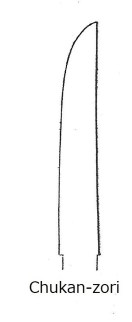
25 Chukanzori Tanto

Chukan-zori (中間反り) ————– The chukan-zori tanto features a straight mune (back).  Its back does not curve either inward or outward.   

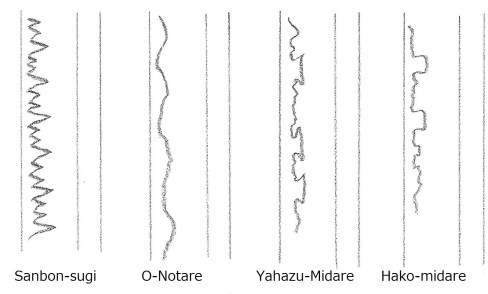
Hamon (刃文: Tempered line) ————————————-Sanbon-sugi (三本杉), o-notare (大湾), yahazu-midare (矢筈乱), hako-midare (箱乱), gunome-choji (互の目丁子), chu-suguha (中直刃).   See below.

24 Sannbon sugi,hako, yahazu, O-midare)

Horimono (彫り物: Carving) —————Often Hi (grooves) is curved

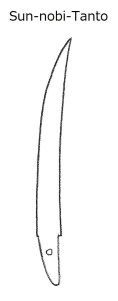
Tanto Length ————————— The standard tanto length should not exceed one shaku*¹ (about 12 inches, 30.5cm).  The standard size tanto is called a Jo-sun tanto, which is roughly 8.5 shaku (about 10 inches, 25.7cm).  Longer than jo-sun is called sun-nobi tanto (寸延)Shorter than jo-sun is called sun-zumari tanto (寸詰).

             Sun-nobi Tanto  >  Jo-sun Tanto (approx. 10 inches) >  Sun-zumari Tanto

*Shaku is a traditional Japanese unit of length measurement.

Takenoko-zori jo-sun tanto (筍反定寸短刀)————– The takenoko-zori jo-sun tanto was made during the Sengoku period.  It resembles swords made by Rai Kunimitsu of Yamashiro–den.  (illustration below)

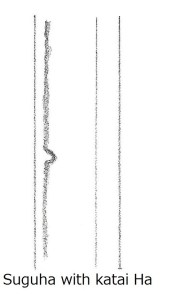
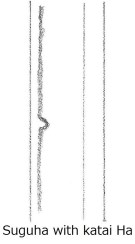
Hamon (刃文: Tempered line) ————– Hoso-suguha (細直刃: Narrow straight hamon). Katai-ha (illustration below) appears somewhere on the blade.  Masamehada (straight grain pattern) may be visible on the mune side.

                13 Middle Kamakura Period Tanto                 24 Suguha katai-ha

Ji-hada (地肌: The area between the shinogi and the tempered line)————– Some shirake (白け: a whitish surface) may sometimes appear.  Some utsuri (a light, whitish, cloud-like effect) appears on the ji-hada.

Sun-nobi Tanto (寸延短刀)————–This type of tanto resembles the sakizori tanto from the late Soshu-den period.  You may see a hitatsura-type hamon.  (illustration below).   Unlike the Soshu-den style, the hitatsura pattern is more visible in the lower part of the tanto and less in the upper part.

                                             25 Sun-Nobi Tanto      25 Hitatsura

Hirazukuri Takenokozori Sunzumari Tanto (平造筍反寸詰短刀)                                  

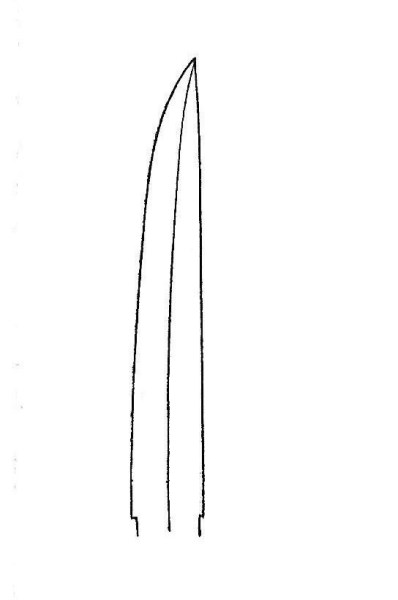
This is a unique tanto from the Sengoku period.   Hirazukuri means a flat-surfaced sword without a shinogi, yokote line, or obvious kissaki.   Takenoko-zori refers to a bamboo shoot shape (the back of the sword curves inward).   Sun-zumari indicates a blade shorter than 10 inches (less than 8.5 shaku or 25.7 cm).  The lower part of the blade is wide and thick, while the tip is narrow and thin.  It has a piercing, sharp appearance.

  • Horimono (彫物: Engraving) ————- Deeply carved ken-maki ryu (a dragon wrapped around a spear).
  • Hamon (刃文: Tempered line)——— Wide tempered line, with a nioi baseIrregular hamon, with wide suguha (straight), and chu-suguha (medium straight).  The hamon in the boshi area curves back deeply.
  • Ji-hada (地肌)———– fine ji-gane and wood burl pattern.

Moroha-tanto (諸刃短刀: Double-edged sword)

A double-edged sword with a hamon on both cutting edges.  Often, Bonji (Sanskrit) is curved.

  • Hamon (刃文: Tempered line) ——— Wide tempered line.   Nioi base.  Irregular hamon, wide suguha (straight tempered line), and chu-suguha (medium straight  tempered line).  The hamon turns back deeply.
  • Ji-hada (地肌: The area between the shinogi and the tempered line)——- Fine ji-gane and wood burl pattern.

25-moroha-tanto1 Moroha Tanto

The Swordsmith for Tanto during the Sengoku Period 

The Bizen swords from the Sengoku period are called sue-bizenSue is pronounced “su” and “e“ as in egg.   Bizen Osafune Yoso-Zaemon Sukesada (与三左衛門祐定) is the most famous swordsmith of the Sengoku period.  He also forged tantos.  One thing to note is that many swordsmiths had the name Sukesada.  Yoso-Zaemon Sukesada is the one who best represents the era.

23| Sengoku Period Sword (戦国時代刀)

0-timeline - size 24 Sengoku period

The red circle above indicate the time we discuss in this section

After the Onin-no-ran, Kyoto was left in a devastated state.  Almost all the distinguished swordsmiths in the Kyoto area were gone.  Many Sengoku daimyo (warlords or feudal lords) needed swords from nearby regions.  The Mino and Bizen areas were the main centers of sword production during the Sengoku period, because Mino Province was conveniently located for many feudal lords.  Also, the Shizu group from Yamato-den (school) moved to Mino Province.  Tegai Kaneyoshi from Yamato-den moved to Mino, and many swordsmiths from the Yamashiro and Yamato areas also moved to Mino.  As a result, Mino could supply a large demand for swords.  During this wartime period, samurai sought practical swords that would not bend or break yet still cut well.  Along with swordsmiths in the Mino area, Bizen Osafune swordsmiths also met the high demand.

Kazu-Uchi-Mono  and  Chumon-Uchi

  • Kazu-uchi-mono was a sword made just well enough for one battle. They were not intended for long-term preservation.

  • Chumon-uchi was a custom-made sword.  They were well-shaped, well-forged, and often engraved with the swordsmith’s name as well as the name of the person who ordered it.

Characteristics of Mino-Den Swords

Sugata (姿shape) ————– Shallow curvature, low gyo-no-mune, chukissaki with fukura. The width and thickness are neither too wide nor too thick.  Engraving is rare on Mino-den swords.  On Bizen-den swords, the bottom of the bo-hi (single groove) has a rounded end (see the photo on P.100) just above the machi area (for machi, see the diagram in  Chapter 3: Names of parts).

13 Mune drawing

Hamon (刃文: Tempered line)

Mino Den ——–Mostly Nioi.   Sanbon-sugi (pointed Gunome ), O-notare, Yahazu-midare, Hako-midare (box shape), Chu-suguha with Katai-ha.  See the drawings below.  Also, Mino Koshi-ba appeared.  Mino Koshi-ba: approx. 1-inch Sugu-ha at the bottom, followed by irregular Hamon, then Chu-suguha at the top.

Mino-Den Hamon

24 Sannbon sugi,hako, yahazu, O-midare)24 Suguha katai-ha

   Bizen-Den ———-Mostly Nioi.  Wide tempered line.  Koshi-hiraita-midare.  See the drawings below.

                                             Bizen-Den Hamon

22Hamon (Koshi Hiraita midare)
from Sano Museum Catalogue

Boshi ((鋩子: Tempered line at the kissaki area)—————————–Turn back deep.  Jizo-boshi (side view of a monk’s head), Ko-maru (small round), kaeri-yoru (lean)

24 jizo-boshi Keri-yoru

Ji-hada (地肌: the area between shinogi and the tempered area)————Mokume (wood burl) mixed with masame (straight grain).  It often shows masame in the shinogi area.  Sometimes, mokume stands out.

Swordsmiths during the Sengoku Period

Mino-Den———Magoroku Kanemoto (孫六兼元) Izuminokami Kanesada (和泉守兼定) Bizen-Den —-Yosozaemon Sukesada (興三左衛門祐定) Norimitsu (則光) Tadamitu(忠光)


Yosozaemon Sukesada (Sano Museum) 興三左衛門祐定(佐野美術館) Permission granted

22| Sengoku Period History (戦国時代歴史)

0-timeline - size 24 Sengoku Period 0

The red circle above indicates the time we discuss in this section

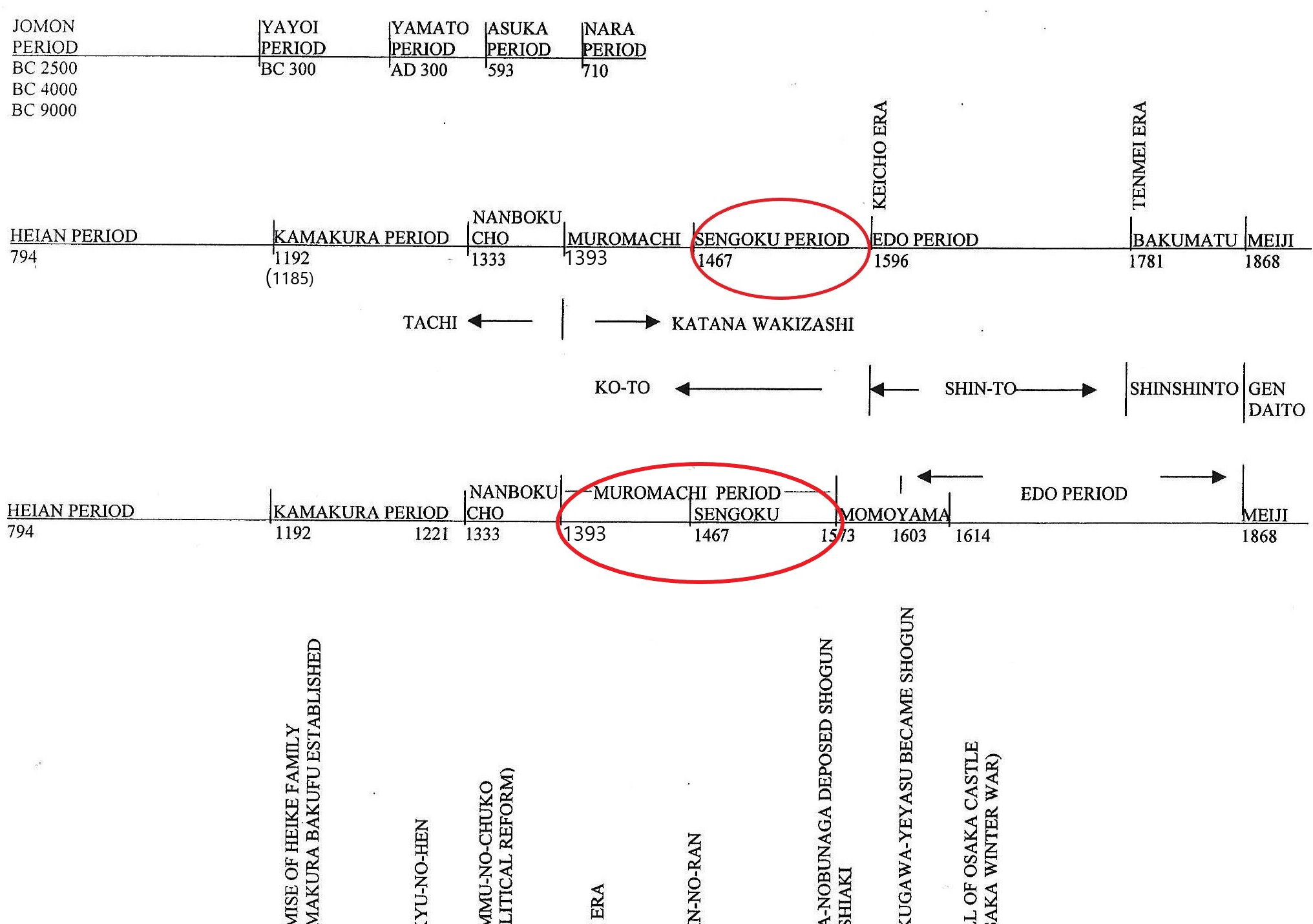
The timeline above shows two circles.  In political history, the Sengoku period (戦国時代) is part of the Muromachi period (室町), which is the lower circle.   However, in sword history, we separate the Muromachi and Sengoku periods (Warring States period), the top circle.  In sword history, we divide the time this way because, during those two periods, sword styles changed, and the environment of sword-making also changed.

After the Onin-no-ran (応仁の乱) began (discussed in 20|Muromachi Period History), the beautiful capital city of Kyoto (京都) was in a devastated condition.  The shogun’s (将軍) power reached only over a small area.  The rest of the country was divided into about thirty small independent states.  The leaders of these independent states were called shugo daimyo (守護大名).  They were originally government officials who were appointed and sent there by the central government.

Powerful local samurai often became the leaders of these states.  They fought against each other to take over each other’s land.  During the Sengoku period, vassals would kill their lords and steal their domains, or farmers would revolt against their lords.  A state like this is called “gekoku-jo” (lower-class samurai overthrow the superior). 

This was the time of the Warring States, known as the Sengoku period.  The leader of each state was called a Sengoku daimyo (戦国大名: Warlord).  The Sengoku period lasted about 100 years.  Gradually, powerful states defeated weaker ones through long, fierce battles, expanding their territory.  Around thirty small countries became twenty, then ten, and so on.  Eventually, only a few dominant sengoku daimyo (warlords) remained.  Each daimyo from those states fought their way to Kyoto and tried to become the top ruler of Japan.  The first one who almost succeeded was Oda Nobunaga (織田信長).  However, he was killed by his vassal, Akechi Mitsuhide (明智光秀), and soon Akechi was killed by his colleague, Toyotomi Hideyoshi (豊臣秀吉).  

After Toyotomi Hideyoshi defeated Akechi Mitsuhide, his troops, and other major warlords, he nearly completed the unification of Japan.  Yet, Hideyoshi still had one more rival to deal with to finish his goal.  That was Tokugawa Iyeyasu (徳川家康).  Now, Toyotomi Hideyoshi and Tokugawa Ieyasu are the last contenders for the top position.  Both recognized that their opponents were smart and capable.  Any wrong move could be disastrous.  Therefore, they decided to maintain a friendly coexistence on the surface for the time being.  Although Toyotomi Hideyoshi tried to make Tokugawa Ieyasu his vassal, Tokugawa Ieyasu somehow managed to avoid that.  In Tokugawa Ieyasu’s mind, being younger than Toyotomi Hideyoshi, he knew he could simply wait until Hideyoshi‘s natural death, which eventually happened. 

After Hideyoshi’s death, Tokugawa Ieyasu fought Hideyoshi’s vassals and won at the Battle of Sekigahara (関ヶ原の戦い) in 1600.  Then, in 1615, at the Battle of the Osaka Natsu-no-jin (Osaka Summer Campaign: 大阪夏の陣), Tokugawa defeated Hideyoshi’s son’s army.  Following this, the Toyotomi clan was dissolved entirely, and the Edo (江戸) period began.  It is called the Edo period because Tokugawa Ieyasu lived in Edo, which is now Tokyo (東京).

*The Sengoku period is frequently depicted in TV dramas and movies.  People who lived through that era had a tough time, but it was also the most exciting time for creating TV shows and films.  The lives of Oda Nobunaga, Toyotomi Hideyoshi, and Tokugawa Ieyasu are among the most popular stories in Japan.  In particular, the story of Toyotomi Hideyoshi is among the most popular.  His background was that of a poor farmer, but he rose to become the top ruler of Japan.  That is a fascinating success story.


23 Toyotomi_hideyoshi

Portrait of Toyotomi Hideyoshi (豊臣秀吉) by Kano Mitsunobu, owned by Kodai-Ji Temple      From Wikimedia Commons, the free media repositon.

21| Muromachi Period Sword (室町時代刀)

0-timeline - size 24 Muromach

       The red circle above indicates the time we discuss in this section

The Muromachi period was a relatively peaceful and prosperous time until shortly before the “Onin-no-ran,” which occurred at the end of the Muromachi periodRefer to Chapter 20, Muromachi Period History (室町時代歴史).   The Nanboku-cho style long swords became outdated; as a result, they were shortened.  The shortened blade is called suriage.  Overall, the Muromachi period was a declining time for sword-making.

Tachi and Katana 

Until the end of the Nanboku-cho period or the beginning of the Muromachi period, samurai wore swords suspended from their waists with the blade facing down.  When a sword was worn this way, the swordsmith inscribed his name on the side facing outward, meaning the blade is on your right when you see the inscription.  In this case, the sword is called a tachi.

During the Muromachi period, a sword was worn between the belt, with the blade facing up.   The swordsmith inscribed his name so that it faced outward when it was worn. Therefore, when you see the inscription, the cutting edge is to your left.  This is classified as a katana. 

Around the beginning of the Muromachi period, samurai started to wear a pair of swords called dai-sho (大小), meaning large and small.  The longer sword is a katana, and the shorter one is a wakizashi.  In general, a tachi is longer than a katana.  A katana is longer than a wakizashi, and a wakizashi is longer than a tanto.  Here is the order of their lengths. 

                                       Tachi   >   Katana   >   Wakizashi   >  Tanto                                  Tachi and katana differ in how they are worn, not in length.   

O-suriage ( 大磨上: Katana shortened by great length) 

How much the sword should be shortened depends on its original length and how much the owner wants it shortened.  O-suriage is a type of sword that is significantly shortened.  Once the blade is shortened by that length, the inscription of the maker’s name is cut off.  When the Hon’ami family (本阿弥家, a family of sword connoisseurs who have appraised Japanese swords for generations from the Muromachi period to today) appraises such a suriage sword, they write the make of the sword and the swordsmith’s name on the front side of the hilt, and the connoisseur’s name with his kaou (similar to a signature) on the back.  There are several levels of writing.  The level at which it should be done depends on the sword’s quality and the owner’s preference.  Below is the order of levels (high to low).

Shu-Mei (朱明 )————————————————————-name written in Vermilion  Kinpun-Mei (金粉名 )———————————————–name lacquered in gold powder  Gin-Zougan (銀象嵌 )————————————————————name inlaid in silver  Kin-Zougan (金象嵌 )————————————————————-name inlaid in gold

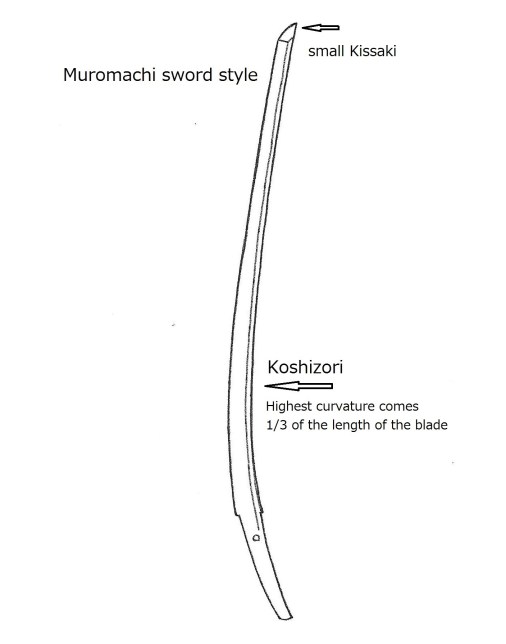
Sugata (姿: Shape) ——— The average length is typically two feet three to four inches (68~71cm).  The shape of the Muromachi period katana is somewhat similar to that of the Heian period tachi.  However, Muromachi katana are less grand or graceful than those from the Heian period swords.  The curvature is usually of the koshizori style.  Koshizori refers to the highest curvature being near the lower part of the blade.  The length and shape are suitable for wearing between the body and the belt.  The width and thickness are well-balanced with the size of the sword.  Small kissaki.

22 Muromachi sword shape

Hirazukuri-Wakizashi ———– Hirazukuri refers to a flat surface without a shinogi or yokote line.  Usually, it is 1 foot and 1 to 2 inches long.  No curvature.  Hirazukuri-wakizashi appeared during the Muromachi period.

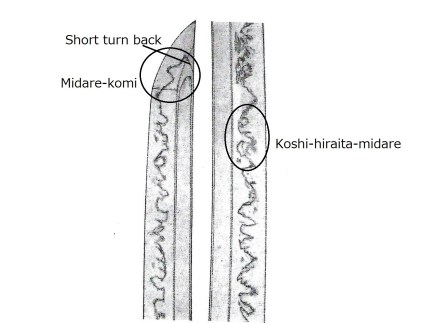
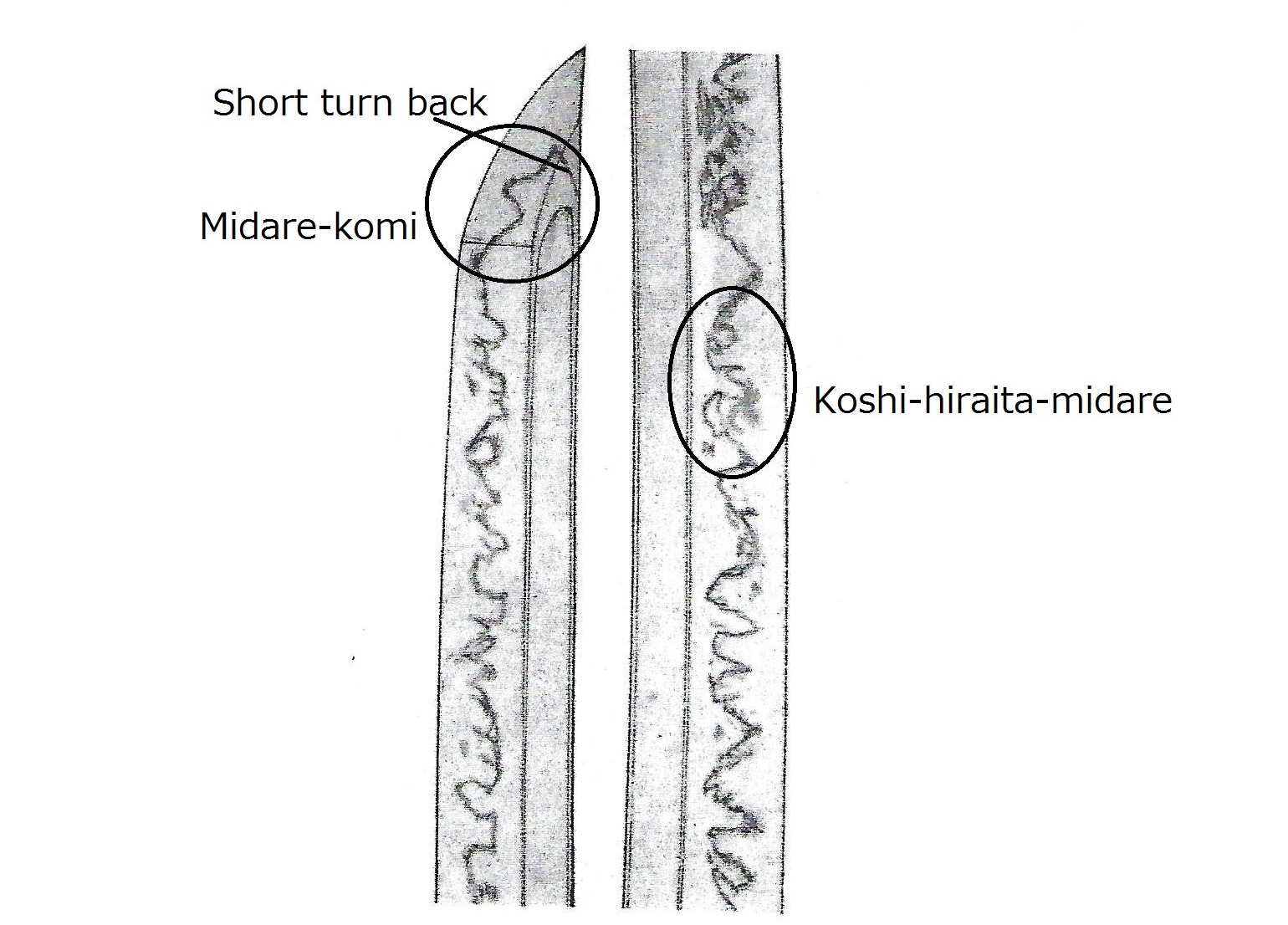
Hamon (刃文: tempered line) ———————- Nioi base.  The tempered area is well balanced with the blade’s width.  Koshi-hiraita-midare is mixed with choji-midare.

22Hamon (Koshi Hiraita midare)
from Sano Museum Catalogue (permission granted)
  • Boshi (Tempered line at Kissaki area) ————– Midare-komi, a short turn back.  See the above illustration.  Midare is an irregular wave-like pattern.
  • Ji-hada (地肌: An area between the tempered line and Shinogi)- Soft look, a large wood grain pattern, Ji-utsuri (faint smoke or cloud-like effect) shows.
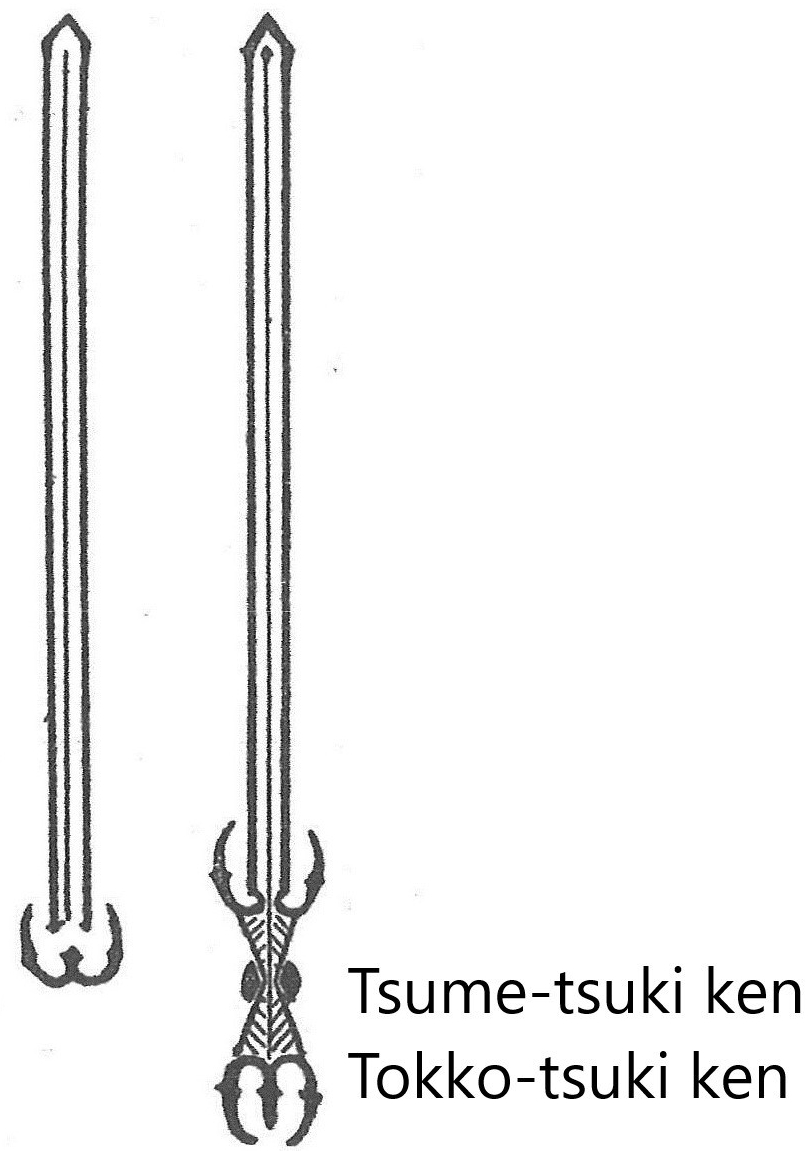
  • Horimono (彫物Engravings) ———- Bo-hi (single groove), Soe-hi (a thin groove alongside the main hi), Futasuji-hi (double narrow groove), Sanskrit, Tokko-tsuki ken, Tsume-tsuki Ken, name of God, and dragon.  Carvings became elaborate.

8 Hi, Suken, Bonji                  21 Tsume-tuki-ken tokko with caption

Sword Smiths during Muromachi Period

  • Bizen Den ——–Osafune Morimitsu (長船盛光), Yasumitsu (康光), Moromitsu (師光)
  • Yamashiro Den————————————————-Yamashiro Nobukuni (山城信国)

21 Muromachi sword from Sano

Ise Masashige (伊勢正重),                     Bizen Osafune Naomitsu (備前長船尚光)         Juyo Token(重要刀剣)                           Sano Museum Catalogue (permission granted)    once my family sword


20|Muromachi Period History (室町時代歴史)    

0-timeline - size 24 Muromach
                   The red circle iabove ndicates the time we discuss in this section

The Muromachi period started after Ashikaga Takauji (足利尊氏) and several other key leaders ended the Nanboku-cho period.  Discussed in 17|Nanboku-cho Period History (1333-1393).

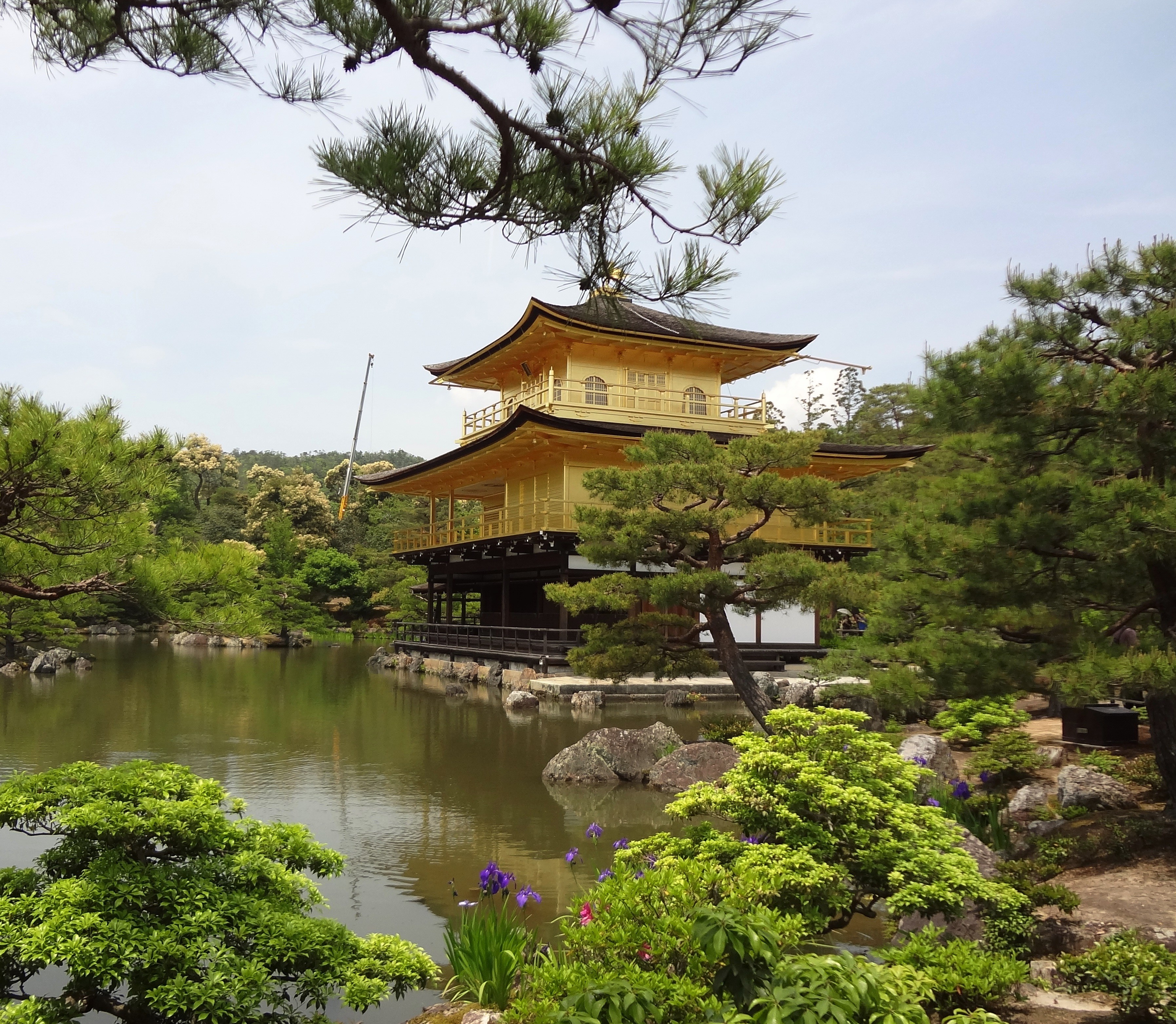
The grandson of Ashikaga Takauji, Ashikaga Yoshimitsu (足利義満, often called Shogun Yoshimitsu), constructed a beautiful new palace in the Muromachi (室町) area of Kyoto.  The palace became the center of government, known as the Muromachi bakufu (室町幕府: Muromachi government).   This is the beginning of the Muromachi period.  Ashikaga Yoshimitsu also built the famous “Kinkaku-ji Temple” * (Golden Pavilion) in Kyoto as his second residence.

Kinkaku-ji Temple* (金閣寺: Golden Pavilion) —————Ashikaga Yoshimitsu (足利義満) built Kinkaku-ji in 1397.   Later, it became a Rinzai-Shu (臨済宗) Buddhist temple, but it was originally built as the secondary residence of Ashikaga Yoshimitsu and a guest house for official visitors.  Today, it is a designated World Heritage site.  The temple was burned down by an arsonist in 1950 but was rebuilt in 1955.  Novelist Mishima Yukio wrote a novel, “Kinkaku-ji,” which relates to this temple and the arsonist.  A famous quote from his book is, “The ho-oh (a mythic golden bird, a Chinese version of the phoenix) on the roof of Kinkaku-ji Temple is stationary, but it flies through time eternally.”

During the Muromachi period, the emperor’s power declined.  The shogun (将軍) held all the political power.  Gradually, several groups of samurai who were officially appointed as shugo daimyo (守護大名: high-ranking officials) began to gain political and economic power by occupying key positions in the Muromachi bakufu.  They also owned extensive land.  Two powerful shugo daimyo families were the Hosokawa (細川) and Yamana (山名).

The Ashikaga family made great efforts to establish the Muromachi bakufu as a stable and strong government through political measures.  The beginning of the Muromachi period was peaceful and prosperous.  However, by the time Ashikaga Yoshimasa (足利義政) became the eighth shogun, the Muromachi bakufu had become severely corrupt.  Shogun Yoshimasa paid little attention to governing the country.  Instead, he pursued women (his mother scolded him for this), spent large amounts of money building the Silver Pavilion called “Ginkaku-ji Temple (銀閣寺),” and retreated there.  Since Shogun Yoshimasa did not have an heir, his brother, Yoshimi (義視), was appointed as the next shogun.

However, later, Yoshimasa’s wife, Hino Tomiko (日野富子)*, gave birth to a son, Yoshihisa (義尚).  Now, brother Yoshimi (義視) allied with the high-ranking officials, the Hosokawa (細川), while his son, Yoshihisa, allied with another powerful family, the Yamana (山名).  Several smaller samurai groups allied with either side, and the war broke out.  This war, called Onin-no-ran (応仁の乱), occurred in 1467.  It spread across the country and lasted for eleven years.

Hino Tomiko (日野富子)*————————-The wife of Shogun Yoshimasa.  She took advantage of her political privileges to generate substantial income by investing in the rice market, thereby controlling prices and selling at high profits.  Then, she loans this money to high-ranking officials at steep interest rates.  The corruption reached an uncontrollable level.

As a result of the Onin-no-ran, beautiful Kyoto was burned to the ground.  The authority of the Muromachi bakufu only extended to small areas of nearby Kyoto.  The Onin-no-ran led to the next period called the Sengoku period (戦国時代), or the Warring States period.  During the Sengoku period, Japan was divided into approximately thirty small, independent states that fought one another until Oda Nobunaga, Toyotomi Hideyoshi, and Tokugawa Ieyasu unified them.

57 Kinkakuji trip 2019

 The photo was taken in May 2019, a family trip to Kyoto