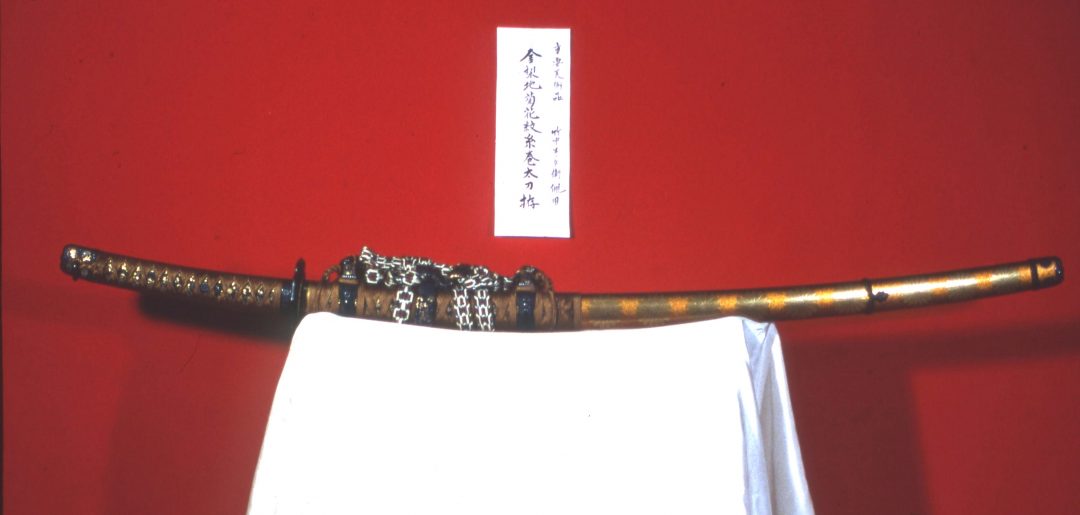
9 | Middle Kamakura Period: Bizen Den (鎌倉中期備前伝)

0-timeline - size 24 Middle Kamakura
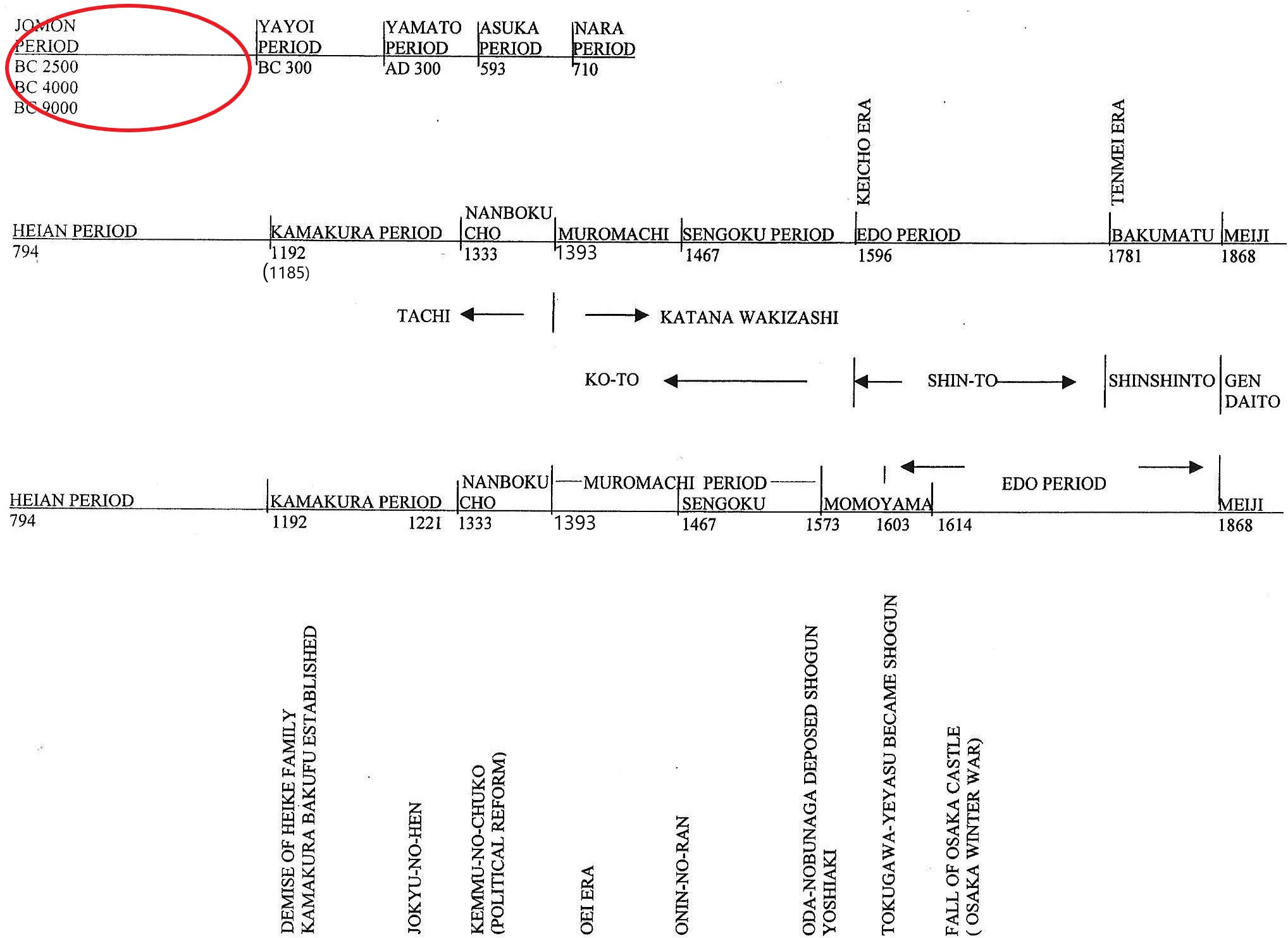
The circle indicates the time we discuss in this section 

Many swordsmiths worked in the Bizen (備前) school during the early Kamakura period.  However, their sword style is generally somewhat similar to the Yamashiro style.  Therefore, they are called Ko-bizen (古備前), meaning old Bizen.

The true Bizen school style appeared during the Middle Kamakura period.  Bizen Province had many advantages for producing great swords.  The area produced high-quality iron and abundant firewood.  Also, its location was conveniently located for people to travel from different regions.  As a result, many swordsmiths gathered there and produced large quantities of swords.  Due to competition among these smiths, the quality of Bizen swords is generally higher than that of other schools.  Therefore, it is often difficult to appraise Bizen swords because of the many subtle differences among the different swordsmiths.

The following three features are the most distinctive characteristics of the Bizen school.  

1.   Nioi-base tempered line.  The Nioi-base tempered line has finer dots than the Nie-base.   These dots are so small that they almost appear as a line. Technically, the tempering processes of these two are identical.  See the illustration below.                        2.   Ji-hada (surface of the body) appears soft.                                                                  3.  Reflection (utsuri) appears on the surface.

10 Nie & Nioi

Sugata (shape) —The length is approximately 33 inches ± a few inches. The blade is slightly wide and appears sturdy. The curvature of the blade is koshizori (腰反), meaning the deepest curve is at the lower part.  The body has an average thickness, and the kissaki is small.
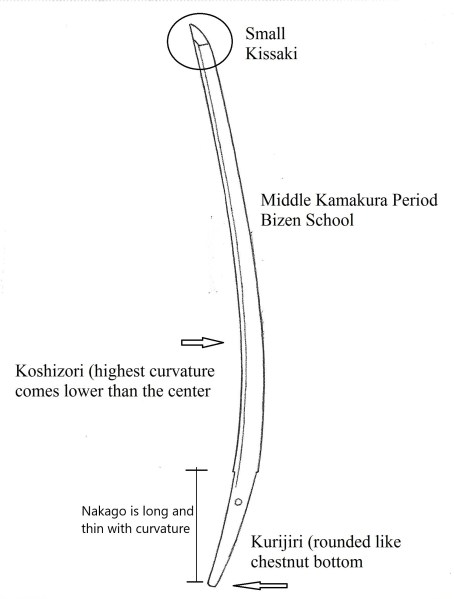
 10 Middle Kamakura ---備前刀姿

Horimono (engraving) ——Engravings are rare.  The tip of the hi extends all the way to ko-shinogi, filling the entire area.

8 Hi

Nakago ——– Long and thin with a curve. The end of the nakago is rounded and resembles the bottom of a chestnut (kuri).  This shape is called kurijiri.   Refer to the illustration of the sword above.

Hamon (tempered area pattern)—— Nioi base. The tempered area is wide and consistent width.  The size of the midare (irregular wavy tempered pattern) is uniform.

Boshi ——– The same tempered pattern continues upward to the boshi area, and it often shows choji- midare (clove-shaped wavy pattern) or yakizume.

10 Boshi --- Bizen

Ji-hada ———— Fine and well forged.  The steel appears soft.  On the steel surface,  small and large wood-grain patterns are mixed.  Chikei (condensation of nie) and utsuri (cloud-like reflection) appear.

Bizen School Sword Smiths during Middle Kamakura Period

  • Fukuoka Ichimonji (福岡一文字) group ————-Norimune (則宗)  Sukemune (助宗) 
  • Yoshioka Ichimonji (吉岡一文字) group ——–Sukeyoshi (助吉) Sukemitsu (助光)        
  • Sho-chu Ichimonji (正中一文字) group —————Yoshiuji (吉氏)   Yoshimori (吉守)     
  • Osafune (長船) group ———–Mitsutada (光忠)  Nagamitsu (長光) Kagemitsu (景光)   
  • Hatakeda(畠田) group ————————————-Moriie (守家)  Sanemori (真守)  
  • Ugai (鵜飼) group ————————————————- Unsho (雲生) Unji (雲次)

              9 Middle Kamakura Bizen Fukuoka ichimonji 

Fukuoka Ichimonji (一文字) from “Nippon-to Art Swords of Japan”                                     The Walter A. Compton Collection

8| Middle Kamakura Period: Yamashiro Den (鎌倉中期山城伝)


0-timeline - size 24 Middle Kamakura                          The circle indicates the time we discuss in this section

The characteristics of Yamashiro Den swords

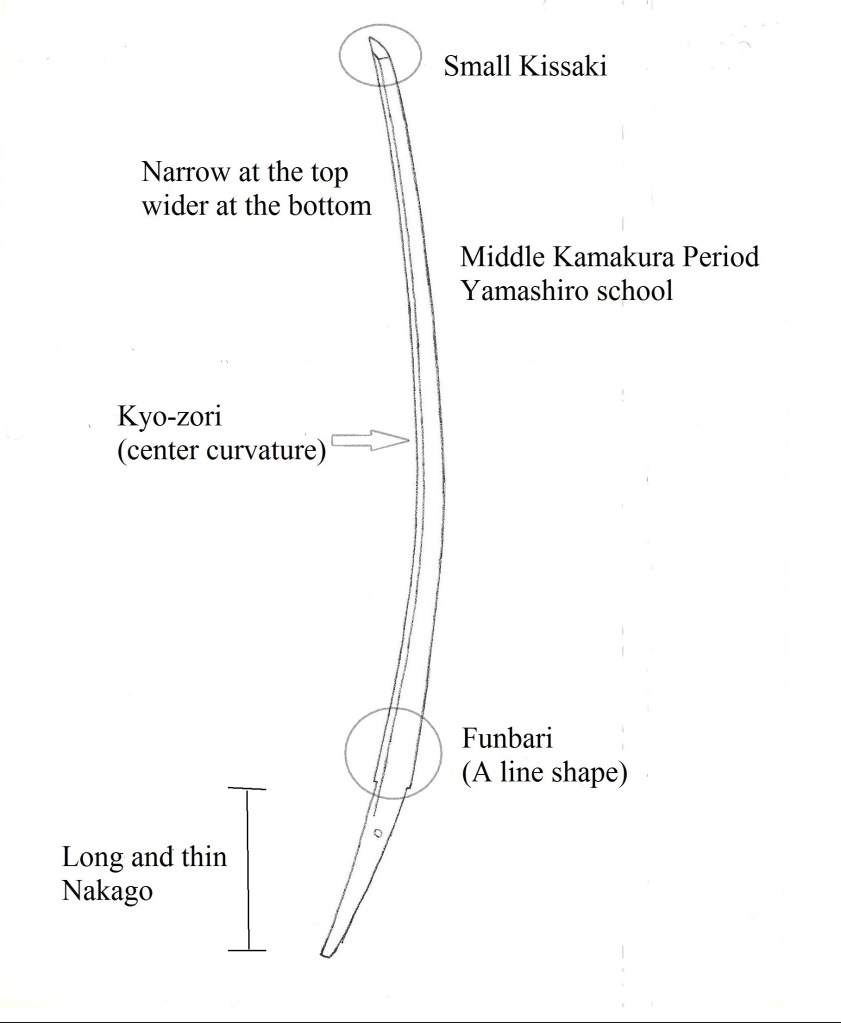
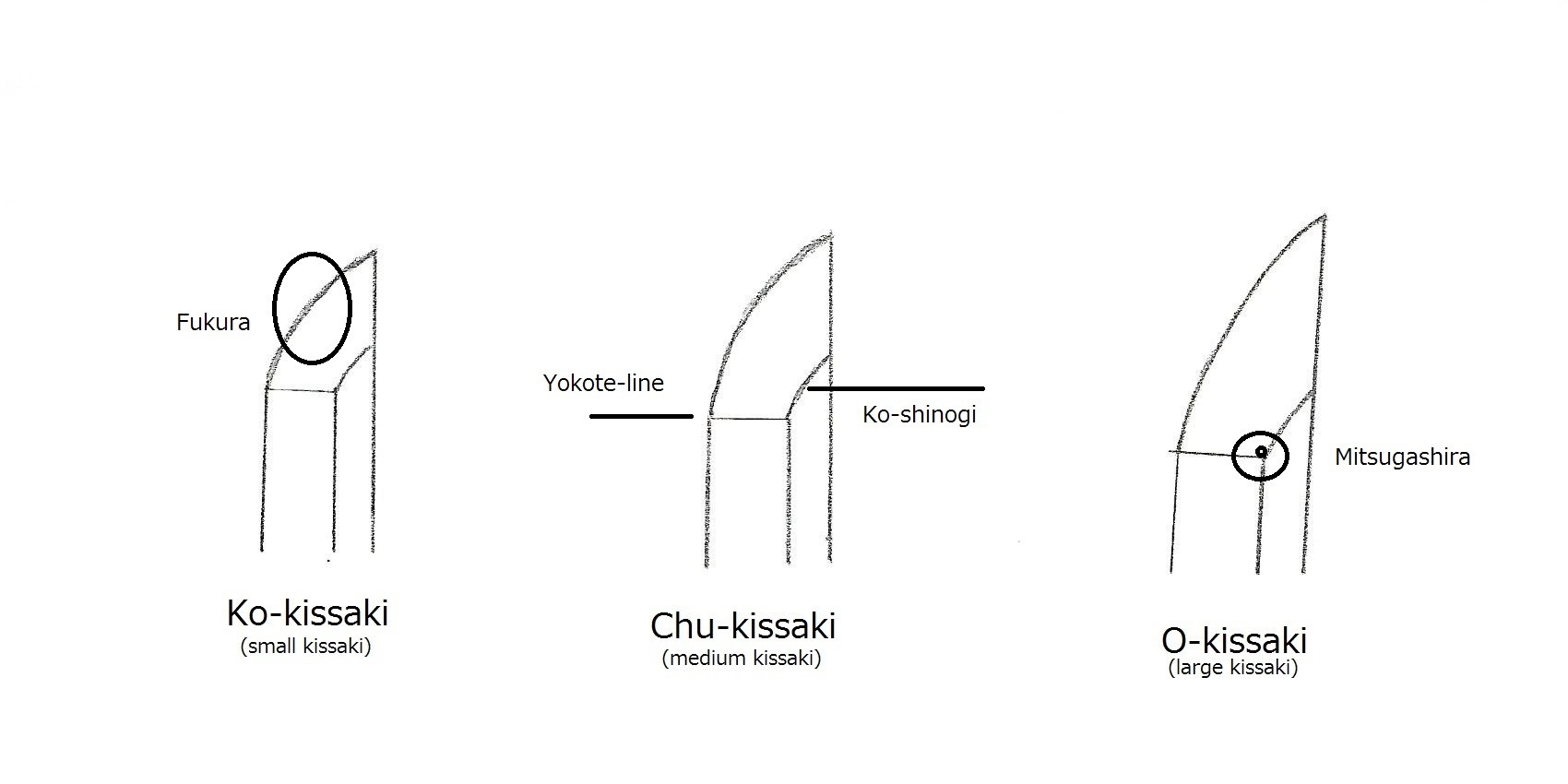
Sugata (shape)—– Generally, the blade is narrow, especially near the yokote line.  The bottom of the blade has funbari (an A-line shape).  Kasane is thick, and the curvature type is usually kyo-zori (the deepest curvature is around the middle).  It has a small kissaki with fukura.   Shinogi is thick, with gyo-no-mune or shin-no-mune.  Please refer to the three illustrations below for sugata.

13 Mune drawing

9 鎌倉中期刀姿

8 Fukura

Horimono (Engraving)—– The tip of a Hi (樋, groove) follows the exact shape of the Ko-shinogi line.  Sometimes you may see Bonj (Sanscrit) and Suken (see the illustration).

9 Hi, Suken, Bonji

Nakago (hilt: 中心) ——————–Long and thin with a slight curve.                                  Hamon (tempered line: 刃文) —————-Mostly suguha (straight line), niju-ba (double hamon), or suguha with an irregular wavy line.  Sometimes, a thin gold lightning-like line called inazuma appears faintly.  The tempered line is mostly nie.  Below is suguha.

 
豊後国行平(Bungo-no-Kuni-Yukihira)  Sano Museum Catalog permission granted

   * Bungo-no-Kuni-Yukihira was a Yamashiro Den swordsmith from the Bungo region.

Boshi(鋩子)——– Komaru-boshi (small round)   Omaru-boshi (large round)                    Ji-hada (地肌) ——-Well forged fine surface.  Small burl pattern.  Jinie (地沸) on the surface.

Names of the swordsmiths during the middle Kamakura period

  • Ayano-Koji group ———————————– Ayano-Koji Sadatoshi (綾小路 定利 )
  • Awataguchi group ————————————- Awataguchi kunitsuna (粟田口国綱)
  • Rai group ————————-Rai kuniyuki (来国行) Rai Nijikunitoshi (来ニ字国俊)

Rai Kunitoshi (来国俊)       Sano Museum Catalogue, Permission granted


7| Overview of the Kamakura Period Swords (鎌倉時代刀概要)


0-timeline - size 24 Kamakura Period

The circle above indicates the time we discuss in this section

Introduction of the Five Main Sword Schools (Den)

There are five major sword schools (den): Yamashiro-den (山城), Bizen-den (備前), Soshu-den (相州), Yamato-den (大和), and Mino-den (美濃).  During the Heian period, Yamashiro-den was the main and most active school.  A school called Ko-bizen (meaning old Bizen) during the Heian period is part of the Bizen-den.  However, we treat Ko-bizen separately because its style is slightly different from the later Bizen-den, yet it is somewhat similar to Yamashiro-den, as seen later.

During the Heian period, the swordsmiths of Yamashiro-den lived around Kyoto, which was Japan’s capital at the time.  In the early Kamakura period, Yamashiro-den maintained a sword style similar to the one they had created during the Heian period.  Bizen-den emerged in the middle Kamakura period.  Soshu-den appeared in the late Kamakura period in the Kamakura area.  Mino-den appeared later during the Muromachi period, which came much later.

The Early Kamakura Period (鎌倉) (1184-1218)

We divide the Kamakura period into three stages: Early, Middle, and Late Kamakura periods. The sword style during the early Kamakura period was almost the same as in the previous Heian period.  Yamashiro-den remained the most active school throughout the early Kamakura period.

The Middle Kamakura Period (1219-1277)

During the middle Kamakura period, there were three main sword styles to discuss: the Yamashiro-den style, the Bizen-den style, and the Ikubi-kissaki (猪首切先) style, which was a new development at the time. We can say that among Ikubi-kissaki swords, it is rare to find a mediocre one.

The previous section explained how the Kamakura Bakufu (鎌倉幕府: government) held political and military power, but the emperor remained on the throne in Kyoto.  Emperor Gotoba raised an army and attacked the Kamakura government to regain political control.  This war (1221) is known as Jyokyu-no-ran (承久の乱).  The war led to a change in sword shape to a sturdier form.  This style is what we now call the Ikubi-kissaki.

The Late Kamakura Period (1278-1333  after the Mongolian Invasion)

During the late Kamakura Period, the Soshu-den emerged alongside Yamashiro-den and Bizen-den.  After the two Mongolian invasions known as the Genko (元寇) in 1274 and 1281, swords with longer, wider blades and extended kissaki began to appear.  The Soshu-den swordsmiths forged this type of sword

Engravings on a Sword     

Engravings on swords from the Ko-to era (Heian to Keicho era) serve three purposes.  One is to reduce the weight of the sword, such as hi, bohi, and gomabashi (wide, narrow, short, or long grooves), for example.  The second is for religious reasons, as swordsmiths often carved Buddhist figures.  The third is for decoration.  In the shin-to era (from Keicho time onward), engraving primarily became decorative purposes.    


The figures below illustrate examples of the engravings.

8 Hi, Suken, Bonji                    8 gomabashi            8 Hi

Suken                           Bonji (Sanskrit)             Gomabashi                          Hi

6| Kamakura Period History 1192 – 1333 (鎌倉時代歴史)


0-timeline - size 24 Kamakura Period                                 The circle indicate the time we discuss in this section

The Kamakura period (鎌倉) was the golden age of sword making.  Many valuable swords we have today were made during this time.  The war between the Gejii and Heishi clans demanded more swords and more swordsmiths in the late Heian period.

Throughout and after the Genpei-Gassen (源平合戦: the final battle between the Genji and the Heishi), sword-making techniques improved considerably.  Also, Emperor Gotoba encouraged sword-making and treated swordsmiths with respect.  As a result, swordsmiths in the Kamakura era produced numerous valuable swords.  Since sword styles varied a lot during this period, they are usually divided into three chronological groups: swords from the early, middle, and late Kamakura periods.

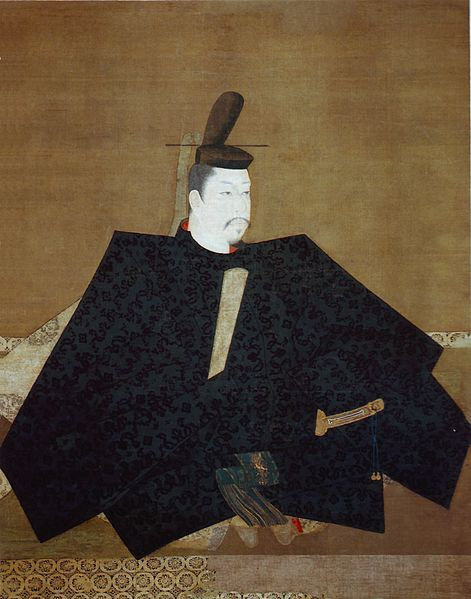
The name of the Kamakura period comes from the city called Kamakura, where the leader of the Genji clan, Minamoto-no-Yoritomo (源頼朝), established a new government, the Kamakura bakufu (鎌倉幕府).

Kamakura Bakufu (鎌倉幕府)                                                                                               

At the end of the Heian period, the Genji and the Heishi (also known as the Heike) were the two main powerful samurai clans.  After their first battle, the Heishi killed the Genji’s top leader and banished his young son, Minamoto-no-Yoritomo (源頼朝), to Izu Island.  For the people of Kyoto at that time, Izu Island was a remote place with limited  transportation in those days.

The Heishi rose to the top of society.  They were so powerful that it was once said, “If you are not a part of the Heishi, you are not human.”  Such arrogant people, however, naturally created many enemies.

Meanwhile, Yoritomo grew into a fine young man on the island.  He met Hojo Masako (北条政子), the daughter of a minor local official, Hojo Tokimasa of Izu Island, and married her.  Eventually, Yoritomo gathered an army with help from his wife’s family and his Genji relatives.  They fought against the Heishi, drove them out of Kyoto, and won the war.  This marked the end of the Heian period in 1185.  As a result, Yoritomo became the shogun in 1192, and political and military power shifted from Kyoto to Kamakura

The imperial court and aristocrats remained in Kyoto.   While the Kamakura bakufu (government) held military, police, and political power, the imperial court had administrative authority.  Although they appeared to be two major rivals, they governed different aspects of the country’s affairs and maintained a balance with one another.

                             7 Taira_no_Kiyomori,TenshiSekkanMiei[1]

From Wikimedia Commons, the free media repository: Taira-no-Kiyomori, painted in the          14th century by Fujiwara Tamenobu, owned by the Imperial Household Agency.

7 Minamoto_no_Yoritomo
From Wikimedia Commons, the free media repository.  Minamoto-no-Yoritomo by Fujiwara Takanobu, owned by Jingo-ji.

5 |Heian Period Swords  (平安時代太刀)

0-timeline - size 24 Heian

                       
                                      The circle indicates the time we discuss in this section

The Heian period is when the sword shape changed to the current curved form.  Before that, swords were straight.  It is widely accepted that the study of Japanese swords begins in the Heian period.   Swords made before the Heian period are considered archaeological artifacts.  The main reason is that sword-making techniques improved significantly after the start of the Heian period.

The elegant and graceful lifestyle of Heian culture is reflected in the style of swords.  A group of swordsmiths in the Kyoto region developed a specific sword style called Yamashiro-den (Yamashiro School).  The shape of their swords exhibits a graceful line.  The most famous sword of this period is Sanjo-Munechika (三条宗近 page 20), a national treasure today.  The Yamashiro-den represents the swords of the Heian period.                                                                                                                                 


                                                                                                      6a Heian period sword style

General Heian period sword style

The shape —————The length of a sword is about 30 inches ± a few inches.  It has an elegant, graceful shape, with a narrow blade and a small kissaki (小切先).  The curvature is deep.  This style is called Kyo-zori (京反り) or Torii-zori (鳥居ぞり).  In the Kyo-zori style, the deepest part of the curvature is near the middle of the blade.  The lower part of the sword flares out, creating an A-line shape similar to the lower part of the Eiffel Tower.  This flared shape is called funbari (踏ん張り).                                                                      

6b A line bottom

Hamon(刃文)———- Hamon is the line formed during the process of tempering.  The hamon on Heian period swords is narrow and usually suguha (直刃).  Suguha means a straight line.  The hamon is also Nie-based.  Nie(沸) are tiny particles in the hamon.   As shown below, if you look closely, you can see fine sand-like particles within the hamon line.

6 Straigh tempered line(Suguha)

10 Nie & Nioi

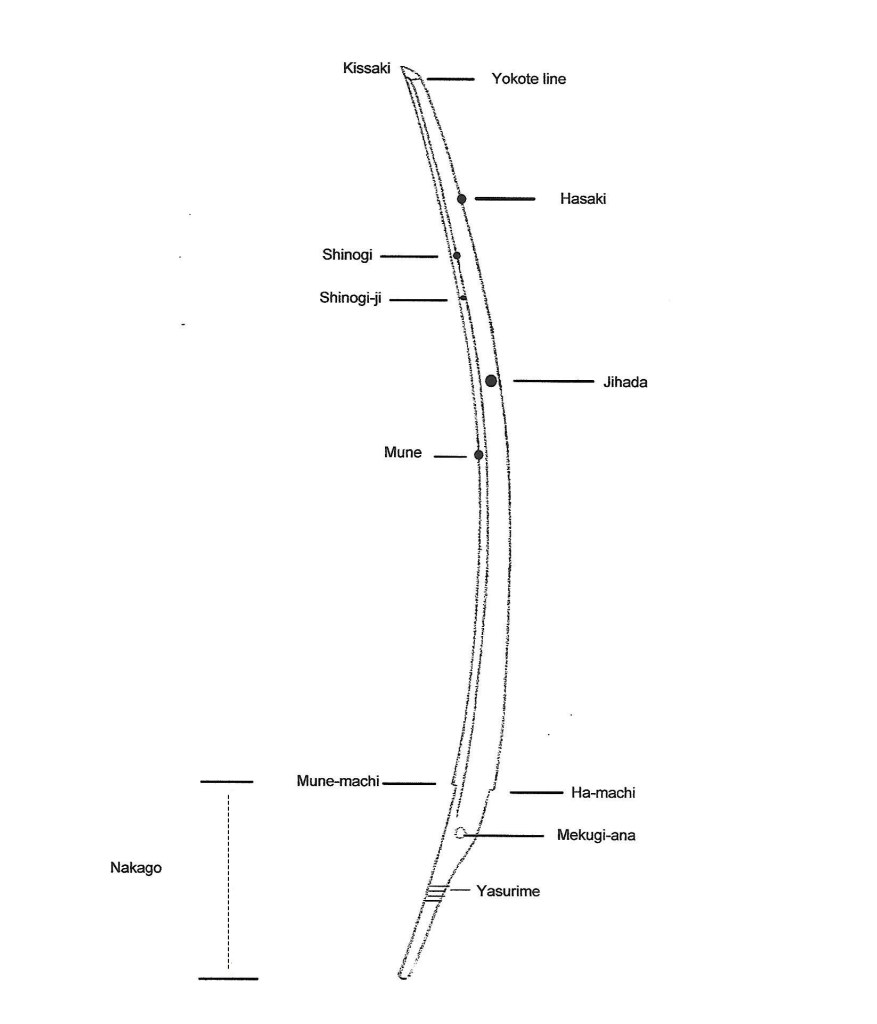
Ji-hada (地肌) ——–Fine wood-grained pattern.  The location of ji-hada (or ji-tetsu) is between the hamon and shinogi (see Chapter 3 |Names of Parts).

Nakago (中心)——– The nakago is the hilt area.  Sword makers inscribed their names there. During the Heian period, the nakago was often shaped like a kijimomo (雉腿), meaning a pheasant’s thigh.

6 Kijimomo-nakago

Hi and engrave ———- Hi (樋) means an engraved straight line.  Hi and other engraved designs were rare during the Heian period.  These became more common later on.

Kissaki (切先) ———– The shape of kissaki on a Heian sword is ko-gissaki, meaning small kissaki. The hamon line at the kissaki is called boshi.  During this period, the type of boshi design is called komaru, meaning small, round, and wrapping around the tip.

Names of the Heian period swordsmiths

  • Yamashiro School——–  Sanjo Munechika(三条宗近) Sanjo Yoshiie(三条吉家)                                                 Gojo Kanenaga(五条兼長) Gojo Kuninaga (五条国永)
  • Yamato School ————-Senju-in (千手院)
  • Bizen School ————— Bizen Tomonari(備前友成) Bizen Masatsune(備前正恒)                                                  Bizen Kanehira (備前包平)
  • Hoki (伯耆) —————–  Yasutsuna (安綱) Sanemori (真守)
  • Buzen (豊前) ————–   Cho-en (長円) Sinsoku (神息)
  • Satsuma (薩摩) ———— Naminohira (波平)


4 | Heian Period History (平安時代歴史) 794 – 1192

The Heian Period (平安時代) began when Emperor Kanmu (桓武天皇) moved the capital to Heian-Kyo (平安京) in 794, which is now known as Kyoto (京都).

0-timeline - size 24 Heian

                             The circle indicates the time we discuss in this section.

During the Heian period, emperors ruled Japan.  However, early in this era, the Fujiwara family, a wealthy aristocratic family, held actual political power. The Fujiwara family managed to marry their daughters to emperors, thereby gaining power through these marriages. The family was called “Sekkan-ke” (摂関家), meaning the guardian’s family or the emperor’s representative.

In those days, aristocrats led an elegant, refined lifestyle while cultivating a graceful culture.  Many essays and novels were written by female authors during that period.  The most famous one is “Tales of Genji (源氏物語)” written by Murasaki Shikibu (紫式部).    The Imperial Court often held ceremonies followed by elaborate, lavish banquets.  This imperial social life played an important role in advancing aristocrats’ political careers.  Women also actively participated in these ceremonies.   Many high-ranking officials owned several large estates.  Sometimes, their daughters inherited these properties and lived there.

Courtship methods were quite different back then.  To start a romantic relationship, a man would write a poem called “waka” for the lady he was interested in and have his servant deliver it to her, hoping she would write him back with a similar poem.  Once she accepted him, he was allowed to visit her for short periods from a distance.  As their relationship grew deeper, he would visit her more frequently and stay longer.  After they married, and if she was his first legal wife, she would live with him in his house.  If she were not his first legal wife, she would remain in her own home, and he would visit her for a few days or longer.  The wife’s family raised their children.  In those days, and until the next Kamakura period, a woman’s lineage was considered important.  By the middle of the Heian period, emperors regained political power because their mothers were not from the Fujiwara family.

     Scenes from the “Tales of Genji”.   Bought in Kyoto.

Origin of Samurai

Although the Heian Imperial court and aristocrats lived with grace and elegance, they lacked the political power to govern the country.  There were numerous thieves, frequent fires, and constant fights everywhere.  Consequently, the Imperial court, aristocrats, and temples began hiring armed guards or security forces to protect themselves and maintain public order.  These hired guards were the origins of bushi (武士) or samurai (侍).  Samurai extended their influence and gained more power by forming groups and suppressing uprisings.  Eventually, two powerful samurai clans emerged: one was the Heishi (平氏), often called the Heike (平家), and the other was the Genji (源氏).  Gradually, they gained power in the Imperial court.   After many power struggles among them, the Heishi started to control the Imperial court by marrying their daughters to the emperors.  In the later Heian period, political power shifted to the Heishi.  They became tyrannical and arrogant.  This behavior created many enemies.  The Genji clan and the Fujiwara family started a war against the Heishi.  The Genji pushed the Heishi to the final battlefield known as Dan-no-ura (壇ノ浦) in 1185 and defeated them.  This battle was the famous Genpei-Gassen (源平合戦).  The fall of the Heishi marked the end of the Heian period.

5-map-dan-no-ura-.jpg

During the Heian period, curved swords appeared for the first time.  Before that, swords had straight blades.  Historical studies of Japanese swords start from this point.  The elegant, refined lifestyle and culture created by the influential Fujiwara family were reflected in the swords’ style.  A group of swordsmiths in the Kyoto area created a distinctive sword style known as Yamashiro-den (den = school).  The shape of their blades exhibits a graceful line.  The most famous sword in the Yamashiro-den is the Mikazuki Munechika, by Sanjo Munechika (三条宗近) below, which is a national treasure today.  The Yamashiro-den style represents the swords of the Heian period.

Sanjo Munechika (三条宗近) from Showa Dai Mei-to Zufu (昭和大名刀図譜)  by NBTHK Owned by the Tokyo National Museum.


2 | Joko-to (上古刀)

Joko-to refers to swords made before the Heian period.  Joko-to is not part of sword study. The study of swords begins from the Heian period.  Joko-to falls under the category of archaeology.

Jomon (縄文) period     9000 B.C.

0-timeline - size 24

The Jomon period dates back to 9000 B.C.  This is between the Paleolithic and Neolithic periods. The characteristic of this time was the rope design (jomon 縄文) seen on their earthenware. 

A stone sword from this period was discovered.  It is a single piece, approximately 27 to 31 inches (70 to 80 cm) long. This is not a Neolithic scraper.  This item was made for ceremonial purposes.

Yayoi (弥生) period        300B.C to 300A.D (approximately)

0-timeline - size 24 Yayoi

Around 300 B.C., the Yayoi culture replaced the Jomon culture.  Characteristics of the Yayoi culture are shown on their earthenware.  They were rounder, smoother, and softer in design, and their techniques had greatly improved since the Jomon period.  They are called the Yayoi culture because objects from this era were unearthed in the Yayoi-cho area (the name of the place) near Tokyo University in Tokyo.  They also discovered bronze artifacts, including a bronze sword (doken 銅剣), a bronze pike (do-hoko 銅矛), bronze mirrors (do-kyo 銅鏡), and bronze musical instruments (do-taku 銅鐸).  These items were imported from China and Korea, but the Japanese began making their own bronze items in the late Yayoi period.  Although iron artifacts are rarely found, evidence indicates that iron objects already existed at that time.

Himiko(卑弥呼   

It is said that, according to the Chinese history book “Gishi Wajinden” (魏志倭人伝), around 300 A.D., there was a country called Yamataikoku (邪馬台国) that controlled about thirty small domains in Japan.  The country’s leader was a female figure named Himiko (卑弥呼), a shaman maiden.  She sent a messenger to the Chinese dynasty in 239 A.D., and she was given the title of head of Japan (親魏倭王), along with a bronze mirror and a long sword (five feet long).  Today, we still do not know the exact location of Yamataikoku.  This Chinese history book, “Gishi Wajinden” (魏志倭人伝), explains how to reach Yamataikoku, but if we follow the book’s directions exactly, we end up in the middle of the ocean, south of Kyushu (九州).  We still have a big debate over the exact location of Yamataikoku.

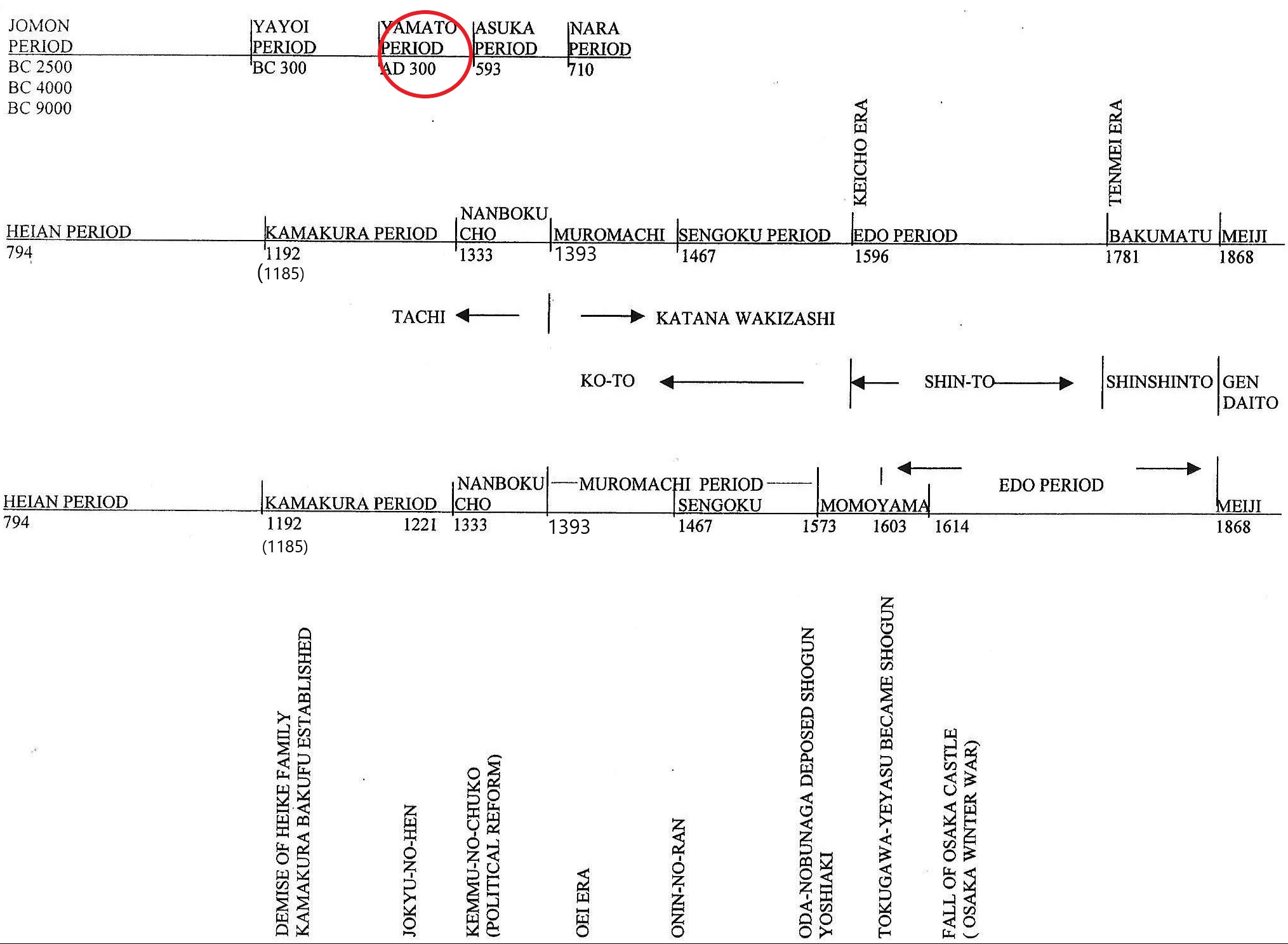
Yamato (大和) period        300 A.D. — 593 A.D

0-timeline - size 24 Yamato

At the end of the Yayoi period, Japan was divided into small regions.  These regions were ruled by local clans called Go-zoku(豪族).  Around 400 A.D., the most powerful Go-zoku united the country and named it Yamato-chotei (大和朝廷).  This was the first Japanese imperial court, the origin of the current Japanese imperial family. They were powerful enough to construct the enormous tombs called kofun (古墳) for themselves.  One of the famous kofun, Ogonzuka kofun (黄金塚古墳) in Osaka, contained swords among other items.  The sword’s hilt was made in Japan, while the blades were made in China.  On the surface of the hilt, they depicted a house design.  Other items found in the kofun include armor, mirrors, iron tools, and jewelry.  Outside the kofun, it was common practice to place haniwa (clay figurines).  These haniwa included smiling people, animals, houses, soldiers with swords, and sometimes simple tube-shaped haniwa (埴輪).  We believe they placed haniwa as retaining walls or as a dividing line for the sacred area.  Based on the writings on the backs of mirrors and swords, kanji (Japanese characters) were used around the fifth to sixth century.

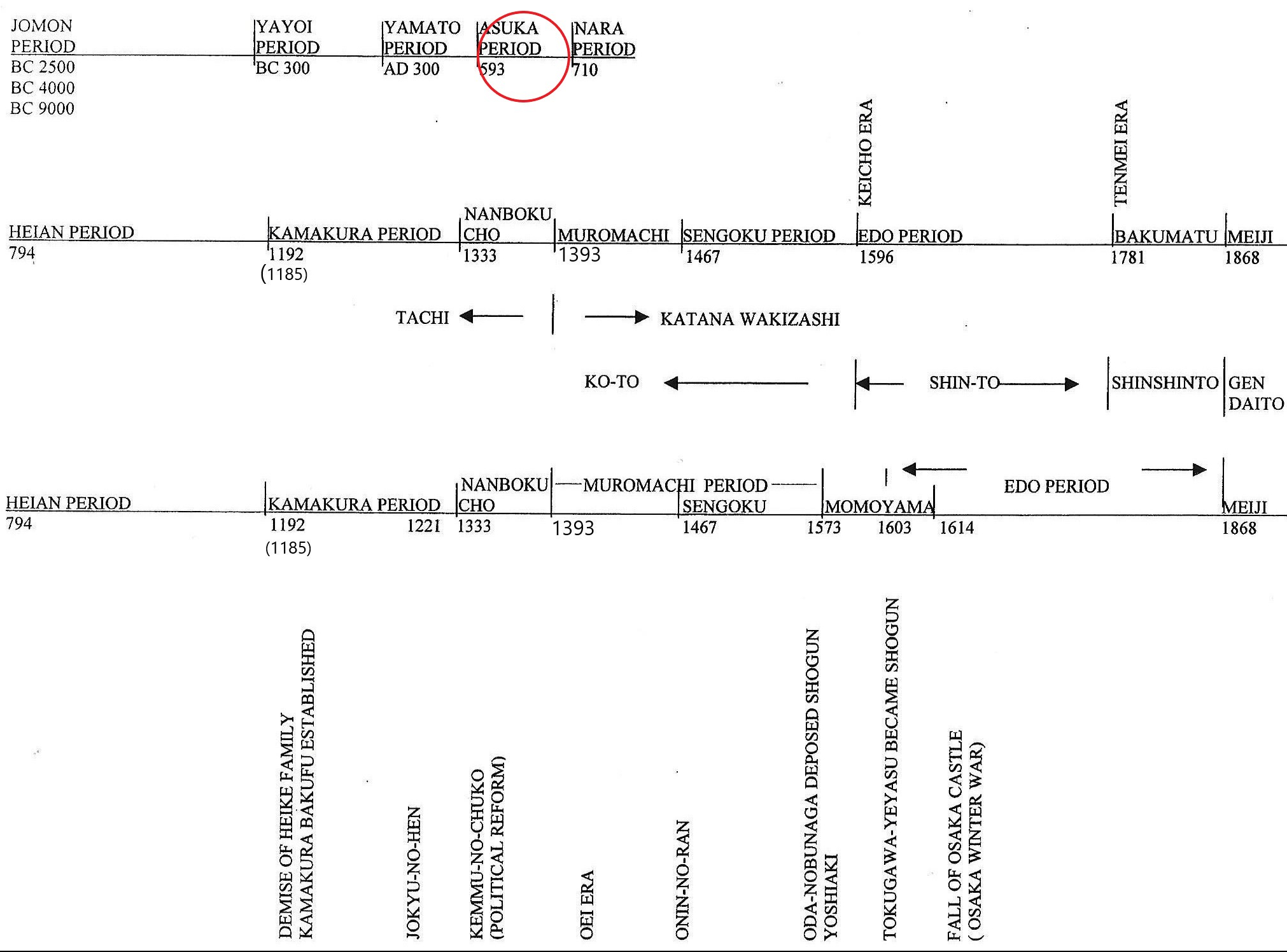
Asuka (飛鳥) period         593 —710

0-timeline - size 24 Asuka

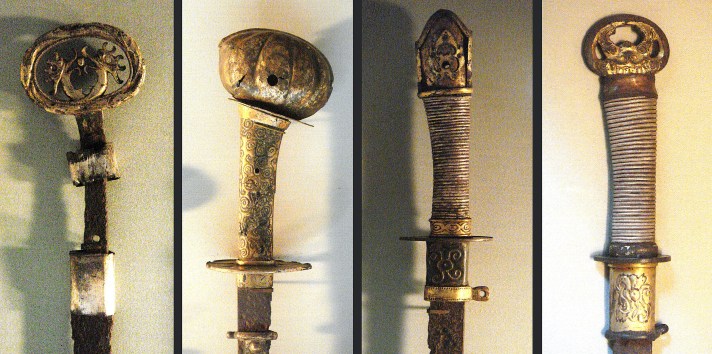
At the end of the Yamato period, after a long power struggle, Shotoku Taishi (聖徳太子) became regent in 593 (beginning of the Asuka period).  Shotoku Taishi established the political system and created Japan’s first constitution (憲法17条).  He promoted and encouraged Buddhism and built the Horyuji Temple (法隆寺) in Nara.  The image of Shotoku Taishi appeared on 10,000-yen bills for many years.  During the Asuka period, we see kanto tachi (環頭太刀), characterized by a ring-shaped hilt.   Kan (環) means ring, and to (頭) means head.  Also, on the ring-shaped hilt, there are inscriptions, such as the emperor’s name, the location, and numerals.  The numbers indicate the years when the specific emperor was enthroned.  All of these were straight swords.

Hilt of a Japanese straight sword.   Circa 600 AD.  From Wikipedia Commons, the free media repository

Nara (奈良) period        710 —794

0-timeline - size 24 Nara

In 710, the capital city was moved to Nara, known as Heijo-kyo (平城京).  The shape of the Joko-to was straight, usually measuring 25 inches (60 –70 cm) in length.  It was suspended from a waist belt.  Some swords originated from China, while others were made in Japan.  Many swords were found in Kofun and Shoso-in (正倉院) during the Nara period.  Shoso-in is a storage building where Emperor Shomu’s (聖武天皇) belongings were stored.  Among other items, 55 swords were found there.  These swords are called warabite-tachi.  Warabi (Bracken) is the name of an edible wild plant native to Japan.  These swords are called warabite-tachi because the shape of the hilt resembles warabi, whose stem curls up at the top.

warabite tachi        The photo is from Creative Commons, a free media source for online pictures

1 | Timeline

Let’s look at the diagram below.  At the beginning of each chapter, a timeline like the one below will be shown.  It will serve as a useful reference for determining which period is being discussed.

0-timeline - size24 original 1

From the Jomon period to the Nara period, (the short top line) is the period we call the Joko-to period in the history of Japanese swords.  The term “Japanese sword” as we use it today refers to swords made after the Heian period (平安 794-1185).  Usually, Joko-to falls under the category of archaeological study.  In the next chapter, we will discuss Joko-to.  The bottom timeline, with short descriptions below, is the one we see in Japan’s general history books.  The middle timeline is more specific to the study of swords.  My discussion will follow the middle timeline.  A timeline diagram will appear at the beginning of each chapter for easy reference.  The swords discussed in this book are grouped based on their shape, style, and the trends of their era.

The difference between Tachi (太刀),  Katana (),  Wakizashi (脇差), Tanto (短刀)

Swords made before the Muromachi period (before 1392) are called tachi (太刀).  Swords made after the Muromachi (室町) period are referred to as katana (刀) and wakizashi (脇差).  Katana and wakizashi were worn together.  A tanto is a short dagger.  Tantos have been made throughout history.  The difference between a tachi and a katana is how they are worn.  A tachi was suspended from the waist belt, with the blade facing down.  The katana and wakizashi (called daisho, 大小, meaning “large and small”) were worn together between the belt and the body, with the blade side up.  Usually, a tachi is longer than a katana.   A wakizashi is shorter than a katana.  The tanto is the shortest.  When facing the swordsmith’s inscribed name, if the blade is on the right, that is a tachi.  When facing the swordsmith’s inscribed name, if the blade is on the left, that indicates a katana or a wakizashi. 

                  Tachi   >  Katana >  Wakizashi   >  Tanto

22 tachi & Katana

Ko-to (古刀)   Shin-to (新刀)   Shinshin-to (新々刀)   Gendai-to (現代刀)

Ko-to are swords made between the Heian period (794-1192) and the beginning of the Keicho Era (1596-1614).  Shin-to are swords made between the Keicho Era (1596-1614) and the Tenmei Era (1781-1789).  Shin shin-to are swords created during the Bakumatsu period (幕末期 1781-1868).  Gendai-to covers the period from the Meiji Restoration (明治1868) to the present day.  Although the names of eras or periods changed overnight due to political or dynastic shifts throughout history, the changes in sword style were always gradual.  In general history, the Bakumatsu period is simply the last part of the Edo period. However, for sword classification, it is from around the Tenmei era (天明 1781) to the beginning of the Meiji period (1868).


Preface and Biography

cropped-red-picture.jpg

Preface

This book is a series of introductory lectures on Japanese swords and their history for those interested in studying Japanese art swords.

The Japanese sword was originally created as a weapon, but Japanese swordsmiths infused blades with qualities of grace and beauty as well as functional superiority.  The intricate patterns on the surface and textures formed by their highly developed forging and tempering techniques were used only in Japan.  In the past, the Japanese regarded swords as spiritual symbols of the samurai, temples, and shrines.  Today, Japanese people view swords as cultural art objects made of steel.

The variety in the appearances of swords is closely related to historical events.  Textures, contours, and tempering designs are characteristic of a particular school (Den 伝) of swordsmiths.  This series of lectures discusses the history of each period and then talks about the swordsmith schools active in a particular province at that time.  Therefore, each section starts with the history of that period.   It is necessary to discuss the history to understand the flow of events that shaped the design and style of swords.

Since the subject matter spans many centuries, I will focus more on “ko-to” (古刀), which appeared during the Heian period (平安時代 794 – 1185) until the end of the Sengoku period (戦国時代 16th cent.).  These lectures will be discussed with my illustrations and photos of swords from my father’s collection* and the Sano Museum Catalogue**.  Also, I referenced the book, “Nihon-to no Okite to Tokucho (日本刀の掟と特徴: The Rules and Characteristics of Japanese Sword)” by Mr. Honami Koson.  This is the book my sword instructor, Mori Sensei, used as a textbook for his class.  Other referenced books are “Token no Mikata (刀剣のみかた: The Way to Look at Swords)” by Mr. Yuichi Hiroi, whom I have known since my internship days at the Japanese Sword Museum, as well as “Nihonto Taikan (日本刀大鑑),” “Nihonto Koza (日本刀講座),” and several others.  Detailed information about these reference books can be found in the bibliography.

 Biography

I was born and raised in Minato-ku, Tokyo, Japan.  Later, we moved to Kamakura during my late teens.  Currently, I live in Los Angeles.  I graduated from Meiji University with a bachelor’s degree in literature and a curatorship license.  The required internship for the curator license was completed at the Nihon Bijutsu Token Hozon Kyokai (日本美術刀剣保存協会: The Japanese Sword Museum, often referred to as NBTHK) in Tokyo.  I also graduated from California State University, Northridge, earning a bachelor’s degree in economics.

My father owned a manufacturing company that dealt with metal. As a hobby, he collected Japanese swords and other types of Japanese art objects. He was one of the administrators of the Nihon Bijutsu Token Hozon Kyokai. He has long since passed away. 

One of my father’s friends, Mori sensei, who was also the main administrator of the organization, held a Japanese sword study group at his house near mine.       

I joined the study group.   Mori sensei’s class was rare and valuable because he was able to bring in top-quality swords for study materials because of his position at the museum.  The swords we studied were high-quality museum swords, including juyo bunkazai (important cultural properties) and juyo-bijutsuhin (important art objects).  I don’t know how he managed it, but he even brought a national treasure sword.  Note that things were somewhat different over 50 years ago.  Those were the kinds of swords people could only see behind glass display cases. 

I also studied swords with my father, who kept many swords in our house.  Some photos of his swords appear throughout this book. 

*My father took photos of his swords; these were his swords at the time the photos were taken.  After his death, they are no longer in our family’s possession.

**Some photos are from the Sano Museum catalogue.  The Sano Museum has granted permission for their use.